
BuddhistCatholicContemplativeEvangelicalGeneral ChristianHinduJewishLatter-day SaintMuslimNew VisionsProgressive Christian
Beliefs
- Buddhist
- Catholic
- Contemplative
- Evangelical
- General Christian
- Hindu
- Jewish
- Latter-day Saint
- More Voices
- Muslim
- New Visions
- Pagan
- Progressive Christian
Topics
- Religion News
- Food and Religion
- Sports and Religion
- Religious Art
- Religious Music and Entertainment
- Religious Events
- History and Religion
- Style and Religion
- Politics and Religion
- Women in Religion
- Recreation Outdoors and Religion
- Business Finance and Religion
- Careers Workplace and Religion
- Education and Religion
- Family Parenting and Religion
- Health Fitness and Religion
- Home and Religion
- Relationships and Religion
- Technology and Religion
- Travel and Religion
Columnists
- Buddhist Columnists
- Business Finance and Religion Columnists
- Careers Workplace and Religion Columnists
- Catholic Columnists
- Contemplative Columnists
- Education and Religion Columnists
- Evangelists Columnists
- Family Parenting and Religion Columnists
- General Christian Columnists
- Health Fitness and Religion Columnists
- Hindu Columnists
- History and Religion Columnists
- Home and Religion Columnists
- Jewish Columnists
- More Voices Columnists
- Latter Day Columnists
- Muslim Columnists
- New Visions Columnists
- Nonreligious Columnists
- Pagan Columnists
- Politics and Religion Columnists
- Progressive Columnists
- Recreation Outdoors and Religion Columnists
- Relationships and Religion Columnists
- Religion News Columnists
- Religious Art Columnists
- Religious Events Columnists
- Religious Music and Entertainment Columnists
- Sports and Religion Columnists
- Style and Religion Columnists
- Technology and Religion Columnists
- Travel and Religion Columnists
- Women in Religion Columnists
Resource Library
- 2026 Calendar
- Library of World Religions
- The 100 Most Holy Places on Earth
- Patheos Answers
- Podcasts
- Videos
- Faith Leaders Database
- Anglican Episcopalian
- Bahai
- Baptist
- Buddhism
- Christianity
- Confucianism
- Eastern Orthodoxy
- Hinduism
- Holiness and Pentecostal
- ISKCON
- Islam
- Judaism
- Lutheran
- Methodist
- The Church of Jesus Christ of Latter-day Saints
- New Age
- Paganism
- Presbytarian and Reformed
- Protestantism
- Religion Behind the Scenes
- Roman Catholic
- Scientology
- Shia Islam
- Sikhism
- Sufism
- Sunni Islam
- Taoism
- Zen
- See all religions
Research Tools
 Ad-Free & Subscriber Log-In Subscription Support
Ad-Free & Subscriber Log-In Subscription Support
Follow Patheos 

- Trending:
- Forgiveness
- |
- Marriage
- |
- Consciousness
- |
- Death Penalty
- |
- Election
- |
- Halloween

- Home
- Pagan
- Education and Religion
- Ross Douthat Wants You To Believe
Ross Douthat Wants You To Believe
Last updated on: February 23, 2025 at 3:00 am by John Beckett
Ross Douthat Wants You To Believe 2025-02-21T08:43:17-06:00 John Beckett
Patheos Explore the world's faith through different perspectives on religion and spirituality! Patheos has the views of the prevalent religions and spiritualities of the world.
New York Times columnist Ross Douthat has a new book titled Believe: Why Everyone Should Be Religious. The obvious error of saying that “everyone” should be anything aside, it’s good, though not perfect. But it wasn’t written for me, and probably not for you either. And it has one unfortunate problem.
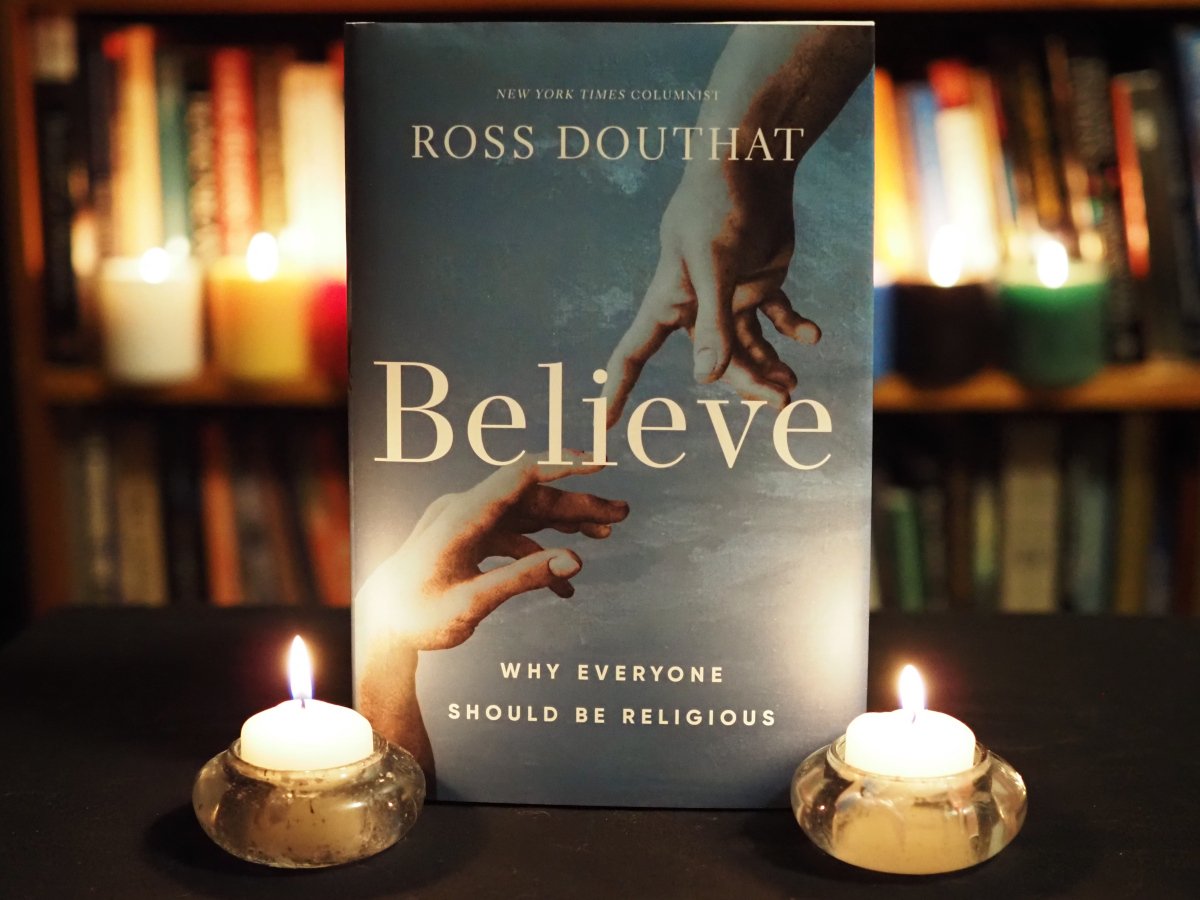
Once again my religious nerdiness has me reading a new book by a mainstream author released through an Evangelical publisher. Ross Douthat is a politically conservative New York Times columnist who is also a practicing Catholic. Would this be yet another reactionary piece of proselytization that subtly (or not-so-subtly) says that any religion that isn’t the author’s is dangerous and/or evil?
For the most part, no.
Believe skips the practical benefits of religion like friendship and community and instead makes an intuitive and experiential case for why being religious (in the commonly-understood meaning of the term) is a more reasonable approach to life than being non-religious. I find most of Douthat’s arguments persuasive.
I should – I’ve made many of them myself, either here on the blog or in The Path of Paganism.
And that led me to wonder: since it’s not attempting “proofs” of Christian doctrine and it’s respectful of all religions (though it argues some are better – or at least, more likely – than others), who is this book for?
First, let’s look at the case Ross Douthat makes for why we should all believe.
The origin of the universe is likely unknowable
The first chapter “The Fashioned Universe” is the weakest link in his case. Douthat looks at the orderliness of the universe and concludes – like many before him including Aristotle, who was a Pagan – that there must be a Prime Mover. Perhaps there is, but there are other possibilities that are at least as likely. I wrote about this in 2023 in A Pagan Look at the Origins of the Universe. Perhaps God (in the sense Douthat understands God) and the universe are one and have always existed. Perhaps there is a Creator God, but they are so far outside the Universe that we can never hope to know them. Or perhaps the origin of the universe is not just beyond our knowledge, but beyond our ability to know.
More troubling, Douthat claims that the universe appears to be designed “for us” – that humans are special. Evolution shows that this isn’t the case, while animism tells us that all living beings have mind. It’s not that we’re no better than the animals, it’s that the other animals are conscious beings just like we are. And what of the intelligent life forms that almost certain populate at least a few other planets in this universe that is so large we struggle to imagine it?
Fortunately, Believe gets better after that.
We are more than the product of brain activity
“The Mind and the Cosmos” argues that the essence of who and what we are is more than the product of brain activity. I’m in total agreement.
Douthat says that “when intellectuals stopped taking mystical experiences seriously, actual human beings kept on having the experiences.” I’m to the point where it’s easier to accept that magic is real than to keep trying to rationalize it away, plus I’ve had numerous first-hand experiences of Gods and other spirits. And also, the Myth of Disenchantment is not a new thing.
He says that “becoming a religious seeker raises your odds of some kind of mystical experience or communion.” Again, that matches my own experience (both first and second hand), and it matches Dr. Dean Radin’s research. I found myself nodding in agreement with most of this section.
Commitment and tradition are good and necessary
“The Case for Commitment” argues that diligently following any positive religious path is likely to bring tangible results, and also likely to bring you closer to Ultimate Truth even if you can never be sure you understand what that is.
He makes “The Case for the Big Religions.” As a follower of a rather small religion, I’m uncomfortable with that, but I completely agree that the average person is more likely to find a helpful path and get closer to Ultimate Truth by following in the steps of those who’ve gone before us than by trying to start from a blank slate and figure it all out themselves.
When he points out that individual religious traditions (i.e. – Christian denominations and their functional equivalents in other religions) have different emphases on “the ethical, the experiential, and the liturgical” and that those different emphases will speak to different people, he’s absolutely correct. As I’ve mentioned before, I sometimes wonder what would have happened if I had grown up in a more liturgical church instead of the “preachin’ prayin’ singin’” of the independent fundamentalist Baptists.
I wanted to get angry with him for saying that “the popular forms of Paganism [are] fundamentally naïve about the kind of terrain they’re encouraging people to navigate.” But while I and many of my co-religionists who’ve been doing this work for years know exactly who and what we’re dealing with, I know a lot of Pagans and witches who don’t. So I can’t complain too much.
Three stumbling blocks
Douthat addresses three serious objections to orthodox religions and their claims. His treatment of the Problem of Evil isn’t bad. But the Problem of Evil simply isn’t an issue in polytheism, with its many Gods of limited power and scope. It’s a major concern in monotheism, and no one – including Douthat – has ever answered it satisfactorily.
His answer to why religious institutions do so many wicked things is adequate, but it overlooks the simplest explanation: because religious institutions are human institutions and even the best humans have the capacity for great evil.
His answer to “why are traditional religions so hung up on sex?” ignores the biological and social needs of the times when the traditional religions were founded – needs that are very different in our time of overflowing population and modern medicine. But he’s correct that sex is dangerous: it presents serious risks of unwanted pregnancy, disease, and heartbreak. The answer is education and consent, not abstinence, control, and forcing people into sex and gender roles that don’t fit them.
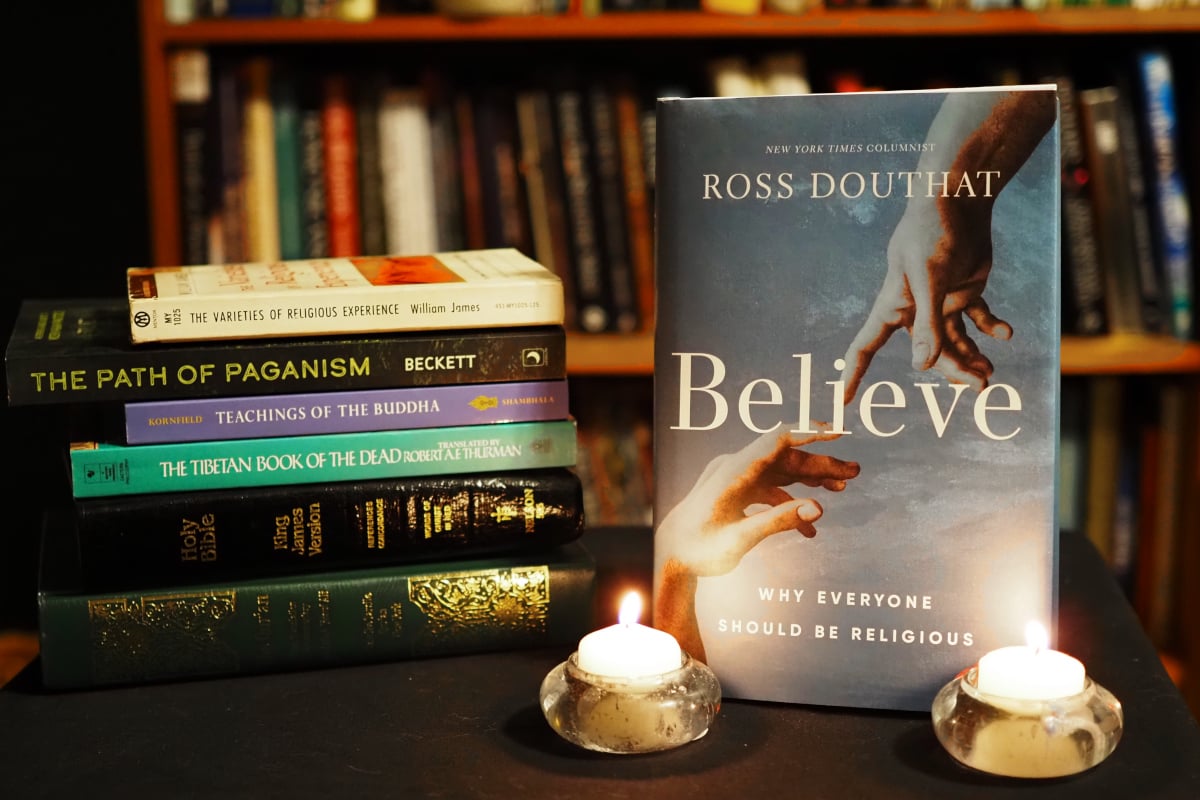
Who is Believe written for?
I struggled with this question from the first page: who is Douthat trying to convince?
It’s not atheists. His arguments aren’t likely to persuade the hardcore anti-theists, and in any case New Atheism is in decline. It’s not Christians who are leaving the Church because of hateful and exclusionary politics – the book really doesn’t address that problem. And while he argues that New Agers and other DIY religionists should pick something and dive into it deeply, most of them don’t have a problem with the basic supernatural premises of Believe.
On the day the book was launched, Douthat posted a Twitter thread that explained his approach:
I think now more than ever the Christian writer needs, if not a theory that justifies *all* the “different religious experiences” in the world, at least a theory that puts religion as a general phenomenon in some kind of coherent relationship to Christian faith.
And also
I think you’re just clearing away some impediments specific to our culture – both the sense that religious belief is irrational and the sense that a successful religious quest is impossible – so that people can make progress toward the Truth.
Douthat is trying to keep people who grew up without much formal religion from sliding from shallow belief and agnosticism into atheism. And he’s trying to “prepare the ground” for them to be receptive to more explicit Christian proselytization in the future.
And for all the respect he shows toward other religions and for as open as he is to people finding truth where ever it presents itself to them, in the final pages Douthat engages in the kind of explicit Christian proselytization he avoided through most of the book.
Choosing a path
The final chapter is titled “A Case Study: Why I Am a Christian.” Douthat tells his story of Episcopalian to Pentecostal to Roman Catholic. That’s not a common journey, but it’s not much of a stretch, either. Religiously, he stayed pretty close to home, as most people do.
At some point, those of us who take religion seriously have to set aside our comfort – or discomfort – with what we were taught, engage with the truth claims of the world’s various religions, examine the evidence, search our hearts and souls, and make a decision. I’ve done that. So have many of you.
Ross Douthat has done that too. He finds the evidence for the historicity of the Gospels to be convincing. I do not. He sees the success of Christianity in its early centuries as evidence of divine favor. I see it as fortunate timing, political support, and missionary zeal. So be it – we don’t have to agree to respect each other’s choices.
A subtle altar call is still an altar call
But while he is willing to trust that his God will not turn away those who did the best they could but ended up on another path, he is unwilling to do the same when it comes to his own soul. When he says “what Jesus brings especially, that cuts against my temperament, is a special sort of urgency” he makes it clear he fears what may happen if he strays too far from the Holy Mother Church.
And that really puts a damper on the whole book. It takes what is otherwise an imperfect but highly useful argument for the rationality and helpfulness of theistic, supernatural religion in the context of “we can’t know the truth so make an honest effort and be kind to each other” and turns it into a fear-based sales pitch for conservative Christianity.
I would expect a Christian author to make a case for the Christian religion – I’ve done the equivalent in my own Pagan writing. But the first seven chapters of this book led me to expect that Douthat would not argue for the absolute supremacy of Christianity. Certainly other writers have argued more explicitly, but his intent is clear enough.
And so I cannot recommend Believe to Pagans and other non-Christians who are struggling with the question of whether or not they should believe. Instead, I encourage these people to find other resources that will point them in a helpful direction while not implying the author knows what is ultimately unknowable.
Or at least, believes it so strongly he might as well claim he knows it.
Believing is not the most important thing
I’m very sympathetic to the core premise of Believe. I’m eternally curious – whatever the question, I want to know the answer. And if I can’t know, I want to investigate and examine and speculate and come up with the best provisional answer I can.
But Christianity – far more than any of the world’s other religions – puts an inordinate emphasis on belief, especially on believing the “right” things. And so after reviewing a Christian book, I would be an irresponsible Pagan if I did not remind everyone that while what you believe is important, what you do is far more important.
Marcus Aurelius almost certainly did not say it, but it’s still true:
Live a good life. If there are Gods and they are just, then they will not care how devout you have been, but will welcome you based on the virtues you have lived by. If there are Gods, but unjust, then you should not want to worship them. If there are no Gods, then you will be gone, but will have lived a noble life that will live on in the memories of your loved ones.
For Further Reading
Facts and Reason in Paganism – Avoiding Materialist Assumptions (November 2017)
Why I Believe in the Gods (October 2019)
Animism: Relating to Persons Who Aren’t Human (February 2020)
We Are Immortal (August 2020)
A Pagan Look at the Origins of the Universe (January 2023)
Hold Loosely But Practice Deeply (September 2023)
Education and Religion
Previous Post
February 16, 2025
Lugh Isn’t Coming To Slay Balor
Next Post

February 26, 2025 Be The Eight of Cups, Not The Four of Pentacles
Recent Comments
"Concern about the attitude of Islam toward Pagans is not limited to the Trump Administration. ..."
"Thank you for your much needed review of the Lucas Miles polemic. A key point ..."
I Read Pagan Threat So You ..."
"A number of these are also available streaming through the Kanopy digital service, carried by ..."
The Vampire Films of Jean Rollin
"Happy October!"
The Vampire Films of Jean Rollin
Browse Our Archives
Select a Category Books Community CUUPS Druidry Foundations and Context Gods and Goddesses Magic Myth Nature Ritual Spiritual Practice Theology Travel Uncategorized Videos
Select a Month October 2026 September 2026 August 2026 July 2026 June 2026 May 2026 April 2026 March 2026 February 2026 January 2026 December 2025 November 2025 October 2025 September 2025 August 2025 July 2025 June 2025 May 2025 April 2025 March 2025 February 2025 January 2025 December 2024 November 2024 October 2024 September 2024 August 2024 July 2024 June 2024 May 2024 April 2024 March 2024 February 2024 January 2024 December 2023 November 2023 October 2023 September 2023 August 2023 July 2023 June 2023 May 2023 April 2023 March 2023 February 2023 January 2023 December 2022 November 2022 October 2022 September 2022 August 2022 July 2022 June 2022 May 2022 April 2022 March 2022 February 2022 January 2022 December 2021 November 2021 October 2021 September 2021 August 2021 July 2021 June 2021 May 2021 April 2021 March 2021 February 2021 January 2021 December 2020 November 2020 October 2020 September 2020 August 2020 July 2020 June 2020 May 2020 April 2020 March 2020 February 2020 January 2020 December 2019 November 2019 October 2019 September 2019 August 2019 July 2019 June 2019 May 2019 April 2019 March 2019 February 2019 January 2019 December 2018 November 2018 October 2018 September 2018 August 2018 July 2018 June 2018 May 2018 April 2018 March 2018 February 2018 January 2018 December 2017 November 2017 October 2017 September 2017 August 2017 July 2017 June 2017 May 2017 April 2017 March 2017 February 2017 January 2017 December 2016 November 2016 October 2016 September 2016 August 2016 July 2016 June 2016 May 2016 April 2016 March 2016 February 2016 January 2016 December 2015 November 2015 October 2015 September 2015 August 2015 July 2015 June 2015 May 2015 April 2015 March 2015 February 2015 January 2015 December 2014 November 2014 October 2014 September 2014 August 2014 July 2014 June 2014 May 2014 April 2014 March 2014 February 2014 January 2014 December 2013 November 2013 October 2013 September 2013 August 2013 July 2013 June 2013 May 2013 April 2013 March 2013 February 2013 January 2013 December 2012 November 2012 October 2012 September 2012 August 2012 July 2012 June 2012 May 2012 April 2012 March 2012 February 2012 January 2012 December 2011 November 2011 October 2011 September 2011 August 2011 July 2011 June 2011 May 2011 April 2011 March 2011 February 2011 January 2011 December 2010 November 2010 October 2010 September 2010 August 2010 July 2010 June 2010 May 2010 April 2010 March 2010 February 2010 January 2010 December 2009 November 2009 October 2009 September 2009 August 2009 July 2009 June 2009 May 2009 April 2009 March 2009 February 2009 January 2009 December 2008 November 2008 October 2008 September 2008 August 2008 July 2008 June 2008
Follow Us!
TAKE THE
Religious Wisdom Quiz
What Jewish festival celebrates deliverance from Egypt?
Select your answer to see how you score.
Passover Purim Tabernacles Pentecost
Related posts from John Beckett




What We Lose When “Ask AI” Becomes A...
TRENDING AT PATHEOS Pagan

Pope Leo Celebrates Mass for Nurses & Docs...
I don't have any idea how he did it, but Pope Leo...

The Sermon on the Mount, Part I: Matthew...
The Sermon on the Mount, Part I (Matthew 4:12-5:12) St. Matthew moves...

What's up from Crossway: Reviewing some of their latest A few weeks...

Janie Learns the Way of the Cross: A...
Teaching children about Jesus' Passion can be challenging. Many parents and educators...

Looking For Good Catholic Writing - October 2026
He alone extends the heavens, and he walks upon the waves of...

In "Irreplaceable," our book on vocation and technology, Trevor Sutton and I...
view all Pagan blogs
What Are Your Thoughts?leave a comment
Ad-Free & Subscriber Log-In Subscription Support
- About Us
- 2026 Calendar
- Videos
- Podcasts
- Library of World Religions
- Faith In Media Tracker
- Advertise With Us
- Write for Us
- Privacy Policy
- Terms of Service
- Do Not Sell My Data
- Contact Us
- Radiant Digital
- Manage Newsletter Subscriptions
- Unsubscribe From Notifications
- Sitemap
Copyright 2008-2026, Patheos. All rights reserved.
Subscription Support Ad-Free & Subscriber Log-In
Follow Patheos