
BuddhistCatholicContemplativeEvangelicalGeneral ChristianHinduJewishLatter-day SaintMuslimNew VisionsProgressive Christian
Beliefs
- Buddhist
- Catholic
- Contemplative
- Evangelical
- General Christian
- Hindu
- Jewish
- Latter-day Saint
- More Voices
- Muslim
- New Visions
- Pagan
- Progressive Christian
Topics
- Religion News
- Food and Religion
- Sports and Religion
- Religious Art
- Religious Music and Entertainment
- Religious Events
- History and Religion
- Style and Religion
- Politics and Religion
- Women in Religion
- Recreation Outdoors and Religion
- Business Finance and Religion
- Careers Workplace and Religion
- Education and Religion
- Family Parenting and Religion
- Health Fitness and Religion
- Home and Religion
- Relationships and Religion
- Technology and Religion
- Travel and Religion
Columnists
- Buddhist Columnists
- Business Finance and Religion Columnists
- Careers Workplace and Religion Columnists
- Catholic Columnists
- Contemplative Columnists
- Education and Religion Columnists
- Evangelists Columnists
- Family Parenting and Religion Columnists
- General Christian Columnists
- Health Fitness and Religion Columnists
- Hindu Columnists
- History and Religion Columnists
- Home and Religion Columnists
- Jewish Columnists
- More Voices Columnists
- Latter Day Columnists
- Muslim Columnists
- New Visions Columnists
- Nonreligious Columnists
- Pagan Columnists
- Politics and Religion Columnists
- Progressive Columnists
- Recreation Outdoors and Religion Columnists
- Relationships and Religion Columnists
- Religion News Columnists
- Religious Art Columnists
- Religious Events Columnists
- Religious Music and Entertainment Columnists
- Sports and Religion Columnists
- Style and Religion Columnists
- Technology and Religion Columnists
- Travel and Religion Columnists
- Women in Religion Columnists
Resource Library
- 2026 Calendar
- Library of World Religions
- The 100 Most Holy Places on Earth
- Patheos Answers
- Podcasts
- Videos
- Faith Leaders Database
- Anglican Episcopalian
- Bahai
- Baptist
- Buddhism
- Christianity
- Confucianism
- Eastern Orthodoxy
- Hinduism
- Holiness and Pentecostal
- ISKCON
- Islam
- Judaism
- Lutheran
- Methodist
- The Church of Jesus Christ of Latter-day Saints
- New Age
- Paganism
- Presbytarian and Reformed
- Protestantism
- Religion Behind the Scenes
- Roman Catholic
- Scientology
- Shia Islam
- Sikhism
- Sufism
- Sunni Islam
- Taoism
- Zen
- See all religions
Research Tools
 Ad-Free & Subscriber Log-In Subscription Support
Ad-Free & Subscriber Log-In Subscription Support
Follow Patheos 

- Trending:
- Forgiveness
- |
- Marriage
- |
- Consciousness
- |
- Death Penalty
- |
- Election
- |
- Halloween

- Home
- Pagan
- A UU Pagan Looks at Death and Beyond
A UU Pagan Looks at Death and Beyond
Last updated on: October 27, 2024 at 10:52 am by John Beckett
A UU Pagan Looks at Death and Beyond 2024-10-27T10:52:33-06:00 John Beckett
Patheos Explore the world's faith through different perspectives on religion and spirituality! Patheos has the views of the prevalent religions and spiritualities of the world.
A UU Pagan Looks at Death and Beyond
The Denton UU Fellowship
October 27, 2024
To be human is to be aware that we are alive, and to also be aware that someday we will die.
I can’t find the source of that quote – it’s not mine. But it’s absolutely true. There is evidence that some other species understand the concept of death. But as far as we know, we are the only species who lives with the awareness that someday we will die.
We are born innocent – and unaware. As early as a few months we become aware that we exist. Later we begin to develop memories and a sense of identity. We learn that we’re going to grow and change. And then at some point, we realize that someday all that will end. We become aware that sooner or later, our body, which we inhabit, or which we are, will stop working and die.
And then what?
We know what will happen to our body. If it’s left to Nature it will decay and decompose, and eventually return to the Earth, from whence it came. Our survivors may burn it, or preserve it with processes ranging from mummification to modern embalming.
But we are more than our bodies. What happens to the essence of who and what we are? Does it too cease to exist? Does it move on to another world, a world of spirit? Does it find a newly born or soon to be born body to inhabit? Or perhaps something else that we’ve never even considered?
We don’t know.
How do we deal with this knowing and not knowing? Mostly, we don’t.
We ignore death, and when it comes – as it always does – we hide it away. It’s not been that long ago that people cared for their own dead: washing the body, laying it out, digging the grave, and burying it. And mourning together. Now we’ve outsourced the care of our dead to professionals. If we’re lucky we get three days bereavement leave and then it’s back to work. Much of this is capitalism’s insistence on “productivity” but some of is our own desire to forget about death.
We know that someday it will be us, but we try not to think about it. Until we can’t not think about it.
We are alive, and someday each and every one of us will die.
The time to think about death and what – if anything – comes after is not when we’re about to die, or when we’re at the funeral of a loved one. The time to think about death is on a beautiful Sunday morning when we feel like we’re going to live forever, even though we know we won’t.

Perhaps there is nothing
I am a Druid, a Pagan, a polytheist, and much more, but I stand here this morning as Unitarian Universalist. Many UUs believe there is only this one world and this one life. If you’re one of them, know that I freely acknowledge that you might be right.
Some years ago I had some medical tests that required me to be unconscious. The anesthesia was both quick and effective. One moment I’m laying there on the table with the doctor standing over me and the next moment I’m waking up in the recovery room. No fading in and out, no dreaming, no nothing. It was as though I ceased to exist for 15 minutes or however long it was. And when I woke up the first thought that went through my head was “if the atheists are right, this is what death is like, and I’m OK with that.”
Nearing his own death in 1910, Mark Twain said “I do not fear death. I had been dead for billions and billions of years before I was born, and had not suffered the slightest inconvenience from it.”
Death is not the opposite of life. Death is a part of life, the end of the process that begins at birth. Contemporary Druid and philosopher Brendan Myers compares life to a bird that flies into a great hall at birth, and then flies out of the other end of the hall at death. Did the bird exist before it flew into the hall? Does the bird exist after it flies out of the hall? All we can say for sure is that for a while, the bird is in the hall.
And if that’s all there is, then it is enough – in part because this one life is beautiful and terrible and wonderful and amazing all at the same time, and in part because if this is all there is then it has to be enough. We have to make it enough.
Like so much in life, death is neither good nor bad. It simply is.
There is no hell
We don’t know what happens after death. That’s never stopped people from speculating about what they hope comes next for themselves and their loved ones, and about what they hope comes next for the people they don’t like.
Life is many things, but it is not fair, and it is natural to hope there will be justice in the next life. Many religions teach some form of rewards for the good and punishment for the bad, either in an afterlife or in a future life in this world.
Unfortunately for us, the predominant religion in our culture proposes not just punishments, but eternal torment. And not just for those who do especially bad things, but for anyone and everyone who doesn’t follow the right religion in the right way.
Many people are afraid of death because they’re afraid they might go to hell.
We are gathered here this morning in a Unitarian Universalist church, the spiritual heirs of dissenting Christians who said “no.” Unitarians taught the unity of God and the humanity of Jesus. Universalists taught that all will be reconciled to God. Both arose in opposition to the kind of Christianity that threatens people with hellfire, and especially to the Calvinist Christianity that says some are predestined for hell, and that God is good for saving some and damning others.
I’m a polytheist who accepts the reality of all the Gods, but I see the God of Calvinism as a mad deity who the other Gods mostly ignore, and I do the same.
The idea that people born in countries where Christianity predominates have a great chance of finding their way to heaven while those born in countries where other religions predominate are virtually assured to go to hell was my first hint that what I was being taught in the fundamentalist church could not be right. A God who would set up such is system is neither all-good nor all-wise, and he is certainly not all-loving.
Many Christians agree, and today many Mainline Protestants and some Catholics are universalists in all but name. So are many non-fundamentalist Muslims. Some religions, including some Pagan religions, teach that the afterlife may involve some unpleasant lessons… as does this life. But the idea of eternal damnation is only taught by the most conservative sects of a few religions, and I do not fear it.
And neither did our Unitarian and Universalist predecessors. I stand here this morning on the shoulders of John Murray, who told preachers to “give them not hell but hope and courage.”
Death is coming for all of us. Let us face it not with fear, but with hope and courage.
Why I think we live on after death
Why should we have hope? Why should we think we might live on after death?
Materialists – people who believe that matter and the interactions of matter are all that exists, or that can exist – insist that what we call consciousness is a product of brain activity, and so when the brain dies consciousness dies.
Animists – people who believe that everything is not a thing but a person – point out that trees respond to their environment, they communicate with other trees, and they do their own things for their own reasons – they demonstrate autonomy. Trees have mind. A tree mind is not a human mind, but is a mind, and thus we can say that trees have consciousness. And if trees have consciousness then consciousness cannot come from the brain, because trees do not have brains.
Materialists claim that consciousness comes from matter. Animists argue that matter comes from consciousness. And if matter comes from consciousness then it is reasonable to assume that consciousness lives on after the brain and the rest of the body are dead.
There are countless stories of past life experiences, and some of them are too precise and verifiable to simply dismiss. They don’t prove anything. But they point toward something more than just the material world.
Virtually every culture has stories of an afterlife or a Otherworld. Are they all expressions of wishful thinking? Or do they point – however vaguely – toward something more?
Virtually every culture has stories of communication with the dead, of ghosts and spirits. So do more people in this country here and now than you might think. Many, perhaps most of us have experiences that indicate there’s something more. Most people keep them to themselves, for fear of being seen as immature or uneducated or mentally disturbed. But put them in a safe space and they’ll tell you all about something the mainstream world says cannot happen, but it did.
Perhaps you have such a story. If so, I encourage you to tell it. In sharing these stories we remind ourselves that we are not alone in our experiences, or in the beliefs we form around them.
If you hear these stories and investigate these ideas and come to the conclusion that there is only this one world and this one life, I respect your thinking. You might be right.
But I’ve come to the conclusion the essence of who and what we are is more than the product of brain activity, and I believe we live on after death.
Unhelpful obsessions with the afterlife
When we accept the inevitability of death and we contemplate the possibilities of what might come afterwards, our fear of death begins to fade. But like all good things, it can be taken too far.
Even if we live on in an afterlife, or if we will be reincarnated many times, this life here and now is a thing of great value. Too many people spend all their time trying to qualify for the good place in the afterlife and they neglect to live in this life.
Others waste this life, accepting mediocrity on the assumption that they’ll do better next time.
Perhaps the worst are those who believe apocalyptic prophecies, who think the world is going to end in the near future and so there’s no need to work for a better world. In the mid-19th century the preacher William Miller convinced thousands of people that Jesus would return to Earth on October 22, 1844. Many of them stopped working on their farms or in their professions. Some sold their belongings. And then, as happens every time with apocalyptic prophecies, nothing happened. October 22, 1844 is known as the Great Disappointment.
In our time we have some people in positions of power who refuse to care for the environment and who are encouraging war in the Middle East because they believe a “new heaven” and a “new Earth” are coming any day now.
Whether we will return to this world or not is a matter of speculation. What is certain is that those who come after us will continue to inhabit the Earth for countless generations to come. We owe it to them to leave this world a better place than we found it, even if we aren’t coming back.
And even if we will reincarnate many times, there is much to learn and do and experience in this life. Let’s make the most of it.
That which is remembered, lives
Even if the naturalists are correct and there is only this one life in this one world, we still live on.
We live on in our deeds. We are gathered in this room we call Miller Hall, named for Tom and Isabel Miller, the architects who helped found this fellowship and who designed this building. Because of the Millers and those of their generation, we have a home. As I understand it, the Millers were humanists who did not expect an afterlife of any sort. But even if they were right and their consciousness has vanished, they live on in us and in our work to maintain and advance Unitarian Universalism in Denton, and to build a better world here and now.
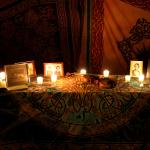
Samhain is the holiest day on the modern Pagan Wheel of the Year. Denton CUUPS will observe it this coming Saturday evening, and everyone is invited. One of the themes of Samhain is honoring our ancestors: our parents, grandparents, great-grandparents, and all those who came before us, going back as far as we can tell, and then some. We set up their pictures, eat their favorite foods, and most importantly, we tell their stories. Legend says that the Veil Between the Worlds is especially thin at this time of year. Perhaps their souls, the essence of who and what they are, are with us here. Perhaps they are here only in our memories. But this much is certain: that which is remembered, lives.
One of Denton CUUPS’ most beloved ancestors is Dolores Nabors, who died in 2021 at the age of 88. Dolores was part of this fellowship for many years – she was congregation President in 2008. She was an active member of CUUPS – she was a good teacher and a wonderful meditation leader. Some of those meditations led people beyond the Veil and into the Otherworld.
When I got word that Dolores had died, I did what I always do at times like these – I prayed. I prayed to my Gods and to the Gods I knew Dolores honored and worked with. I prayed that her journey into the next life would be safe and easy. But I do not think those prayers were necessary. Dolores knew where she was going, because she had been there before, in meditation. And there were people there ready to greet her, because she always remembered them while she was here.
What comes after death is a mystery, and I believe it will remain a mystery even as our knowledge of the innermost workings of the universe continues to expand and grow. But it is a mystery we can explore: in rational thought, in contemplation and mediation, in discussing and comparing our experiences, in ritual and in worship. In exploring the mysteries of death and what comes afterwards, we lose – or at least, greatly reduce – our fear of death.
This we know: all that lives will someday die. Let us face death not with fear and not with denial, but with hope and courage.
Benediction
To be human is to be aware that we are alive, and to also be aware that someday we will die. How do we deal with this great and terrible knowledge?
We can ignore it… for a while. We can live in fear of non-existence, or in fear of ending up in a bad afterlife. Or we can contemplate the nature of life and death and what comes after, explore it, think about what it might involve and what it almost certainly does not involve. We can approach death with hope and courage, while we live this life as fully as we can.
Go in peace, when you leave this place today and when your time comes to leave this world.
Previous Post
October 20, 2024
Six Lessons Of Samhain For The Modern World
Next Post

October 30, 2024 What To Expect In This Election, And Beyond
Recent Comments
"Concern about the attitude of Islam toward Pagans is not limited to the Trump Administration. ..."
"Thank you for your much needed review of the Lucas Miles polemic. A key point ..."
I Read Pagan Threat So You ..."
"A number of these are also available streaming through the Kanopy digital service, carried by ..."
The Vampire Films of Jean Rollin
"Happy October!"
The Vampire Films of Jean Rollin
Browse Our Archives
Select a Category Books Community CUUPS Druidry Foundations and Context Gods and Goddesses Magic Myth Nature Ritual Spiritual Practice Theology Travel Uncategorized Videos
Select a Month October 2026 September 2026 August 2026 July 2026 June 2026 May 2026 April 2026 March 2026 February 2026 January 2026 December 2025 November 2025 October 2025 September 2025 August 2025 July 2025 June 2025 May 2025 April 2025 March 2025 February 2025 January 2025 December 2024 November 2024 October 2024 September 2024 August 2024 July 2024 June 2024 May 2024 April 2024 March 2024 February 2024 January 2024 December 2023 November 2023 October 2023 September 2023 August 2023 July 2023 June 2023 May 2023 April 2023 March 2023 February 2023 January 2023 December 2022 November 2022 October 2022 September 2022 August 2022 July 2022 June 2022 May 2022 April 2022 March 2022 February 2022 January 2022 December 2021 November 2021 October 2021 September 2021 August 2021 July 2021 June 2021 May 2021 April 2021 March 2021 February 2021 January 2021 December 2020 November 2020 October 2020 September 2020 August 2020 July 2020 June 2020 May 2020 April 2020 March 2020 February 2020 January 2020 December 2019 November 2019 October 2019 September 2019 August 2019 July 2019 June 2019 May 2019 April 2019 March 2019 February 2019 January 2019 December 2018 November 2018 October 2018 September 2018 August 2018 July 2018 June 2018 May 2018 April 2018 March 2018 February 2018 January 2018 December 2017 November 2017 October 2017 September 2017 August 2017 July 2017 June 2017 May 2017 April 2017 March 2017 February 2017 January 2017 December 2016 November 2016 October 2016 September 2016 August 2016 July 2016 June 2016 May 2016 April 2016 March 2016 February 2016 January 2016 December 2015 November 2015 October 2015 September 2015 August 2015 July 2015 June 2015 May 2015 April 2015 March 2015 February 2015 January 2015 December 2014 November 2014 October 2014 September 2014 August 2014 July 2014 June 2014 May 2014 April 2014 March 2014 February 2014 January 2014 December 2013 November 2013 October 2013 September 2013 August 2013 July 2013 June 2013 May 2013 April 2013 March 2013 February 2013 January 2013 December 2012 November 2012 October 2012 September 2012 August 2012 July 2012 June 2012 May 2012 April 2012 March 2012 February 2012 January 2012 December 2011 November 2011 October 2011 September 2011 August 2011 July 2011 June 2011 May 2011 April 2011 March 2011 February 2011 January 2011 December 2010 November 2010 October 2010 September 2010 August 2010 July 2010 June 2010 May 2010 April 2010 March 2010 February 2010 January 2010 December 2009 November 2009 October 2009 September 2009 August 2009 July 2009 June 2009 May 2009 April 2009 March 2009 February 2009 January 2009 December 2008 November 2008 October 2008 September 2008 August 2008 July 2008 June 2008
Follow Us!
TAKE THE
Religious Wisdom Quiz
Which principle is behind "Turn the other cheek"?
Select your answer to see how you score.
Ignore injustice Do not retaliate Hit back harder Start a fight
Related posts from John Beckett




What We Lose When “Ask AI” Becomes A...
TRENDING AT PATHEOS Pagan

Swimfan: Forgotten Aughts Pleasures
This is a recovery effort. In 2002, My Big Fat Greek Wedding...

Top Three Anti-Catholic Lies About Catholicism
This is my initial transcript for the video, "THE 3 WORST...

Pope Leo Celebrates Mass for Nurses & Docs...
I don't have any idea how he did it, but Pope Leo...

The Sermon on the Mount, Part I: Matthew...
The Sermon on the Mount, Part I (Matthew 4:12-5:12) St. Matthew moves...

What's up from Crossway: Reviewing some of their latest A few weeks...

Janie Learns the Way of the Cross: A...
Teaching children about Jesus' Passion can be challenging. Many parents and educators...
view all Pagan blogs
What Are Your Thoughts?leave a comment
Ad-Free & Subscriber Log-In Subscription Support
- About Us
- 2026 Calendar
- Videos
- Podcasts
- Library of World Religions
- Faith In Media Tracker
- Advertise With Us
- Write for Us
- Privacy Policy
- Terms of Service
- Do Not Sell My Data
- Contact Us
- Radiant Digital
- Manage Newsletter Subscriptions
- Unsubscribe From Notifications
- Sitemap
Copyright 2008-2026, Patheos. All rights reserved.
Subscription Support Ad-Free & Subscriber Log-In
Follow Patheos