
BuddhistCatholicContemplativeEvangelicalGeneral ChristianHinduJewishLatter-day SaintMuslimNew VisionsProgressive Christian
Beliefs
- Buddhist
- Catholic
- Contemplative
- Evangelical
- General Christian
- Hindu
- Jewish
- Latter-day Saint
- More Voices
- Muslim
- New Visions
- Pagan
- Progressive Christian
Topics
- Religion News
- Food and Religion
- Sports and Religion
- Religious Art
- Religious Music and Entertainment
- Religious Events
- History and Religion
- Style and Religion
- Politics and Religion
- Women in Religion
- Recreation Outdoors and Religion
- Business Finance and Religion
- Careers Workplace and Religion
- Education and Religion
- Family Parenting and Religion
- Health Fitness and Religion
- Home and Religion
- Relationships and Religion
- Technology and Religion
- Travel and Religion
Columnists
- Buddhist Columnists
- Business Finance and Religion Columnists
- Careers Workplace and Religion Columnists
- Catholic Columnists
- Contemplative Columnists
- Education and Religion Columnists
- Evangelists Columnists
- Family Parenting and Religion Columnists
- General Christian Columnists
- Health Fitness and Religion Columnists
- Hindu Columnists
- History and Religion Columnists
- Home and Religion Columnists
- Jewish Columnists
- More Voices Columnists
- Latter Day Columnists
- Muslim Columnists
- New Visions Columnists
- Nonreligious Columnists
- Pagan Columnists
- Politics and Religion Columnists
- Progressive Columnists
- Recreation Outdoors and Religion Columnists
- Relationships and Religion Columnists
- Religion News Columnists
- Religious Art Columnists
- Religious Events Columnists
- Religious Music and Entertainment Columnists
- Sports and Religion Columnists
- Style and Religion Columnists
- Technology and Religion Columnists
- Travel and Religion Columnists
- Women in Religion Columnists
Resource Library
- 2026 Calendar
- Library of World Religions
- The 100 Most Holy Places on Earth
- Patheos Answers
- Podcasts
- Videos
- Faith Leaders Database
- Anglican Episcopalian
- Bahai
- Baptist
- Buddhism
- Christianity
- Confucianism
- Eastern Orthodoxy
- Hinduism
- Holiness and Pentecostal
- ISKCON
- Islam
- Judaism
- Lutheran
- Methodist
- The Church of Jesus Christ of Latter-day Saints
- New Age
- Paganism
- Presbytarian and Reformed
- Protestantism
- Religion Behind the Scenes
- Roman Catholic
- Scientology
- Shia Islam
- Sikhism
- Sufism
- Sunni Islam
- Taoism
- Zen
- See all religions
Research Tools
 Ad-Free & Subscriber Log-In Subscription Support
Ad-Free & Subscriber Log-In Subscription Support
Follow Patheos 

- Trending:
- Forgiveness
- |
- Marriage
- |
- Consciousness
- |
- Death Penalty
- |
- Election
- |
- Halloween

- Home
- Pagan
- A Pagan Reviews An Evangelical Book About Pagans
A Pagan Reviews An Evangelical Book About Pagans
Last updated on: June 26, 2024 at 3:00 am by John Beckett
A Pagan Reviews An Evangelical Book About Pagans 2024-06-24T15:09:06-06:00 John Beckett
Patheos Explore the world's faith through different perspectives on religion and spirituality! Patheos has the views of the prevalent religions and spiritualities of the world.
One day in high school I walked into my Algebra II class and found the chalkboard covered with a series of equations. It was a mathematical proof that 2 = 1. The instructions for the class said “find the fallacy.”
I figured it would be easy. I started at the beginning, worked quickly through all the equations, and finished with 2 = 1. Obviously I made a mistake. So I worked through them again, this time more carefully. Again I got 2 = 1. A third try stepping through the “proof” as deliberately as I could yielded the same result.
I looked around the classroom – nobody else had it either. After about ten minutes the teacher circled one part of one of the equations and said “division by zero.” Then we all saw it.
Anything divided by zero is infinity – in ordinary mathematics division by zero is said to be undefined. That means anything derived from it is meaningless and the “proof” should have stopped when it reached that point.
We were the smartest kids in our class. We learned “you can’t divide by zero” in elementary school. We all missed this because we were so caught up in the details of the equations that we overlooked an erroneous foundational assumption.
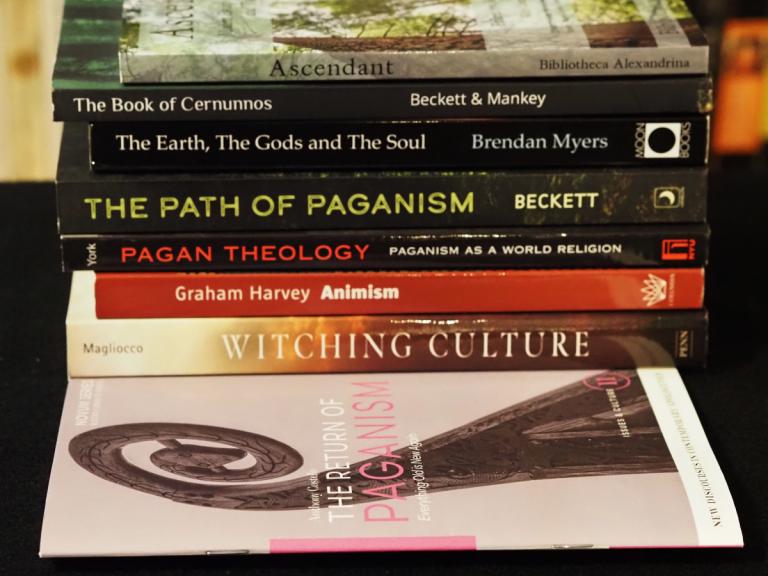
The Return of Paganism
Anthony Costello is one of the more thoughtful bloggers on the Patheos Evangelical Channel. While I rarely agree with him, I appreciate his rational approach to religion. In particular, I appreciate that he engages Paganism honestly. Unlike so many, he doesn’t use “Pagan” when he means “secular” and he doesn’t use it to mean “anything that’s not my flavor of Christianity.” So when I saw he had written a book called The Return of Paganism I knew I wanted to read it.
This is a work of Christian apologetics. It attempts to use logic and reason to prove the superiority of the Christian religion. At 34 pages it’s more of a pamphlet than a book, but that’s not a criticism – writers should use as many words as they need to make their point and no more. It is an FYI in case you decide to buy the book yourself.
Costello does a better job of honestly describing modern Paganism than almost any conservative Christian I’ve seen. He draws heavily from Pagan academics, including Michael York, Sabina Magliocco, and Graham Harvey. He understands that Paganism is broad and impossible to precisely define – he settles on a working definition of Paganism as a Nature religion that emphasizes the autonomy of the individual. I argue for a broader definition with more emphasis on the Gods, but Costello’s working definition is better than most and certainly adequate for his purposes.
He ends his section on ontology by saying “the bottom line of neopagan ontology is simply this: nature equals god, or all the gods. Full stop.”
I don’t agree completely, but so far so good.
Epistemology: honest but incomplete
The section on Epistemology (how we know what we know) is honest but incomplete. He begins by quoting Sabina Magliocco on how the Enlightenment devalued “traditional ways of knowing” including ecstatic experiences. He reprints an account of one Pagan’s ecstatic experience, but then quotes C.S. Lewis, who said “Paganism is all belly, no head.” He admits that ecstatic experiences have always been “a means to sacred knowledge” but then complains that “today’s pagans are not ascetics … they are primarily sensualists” – as though one is inherently better than the other.
Disappointingly, there is no exposition as to how and why the Christian approach to epistemology is better. I left Evangelical Christianity long before I became a Pagan because it made claims to rationality and factualism it could not support.
Two key errors on ethics and morality
The section on Morality is where Costello gets sloppy. He quotes Michael York on the necessity of freedom, then falls into the tired argument of “if there are no objective standards of good and evil, then anything is OK” (I’m summarizing – this is not an exact quote). He says (and this is an exact quote) “Nature is amoral and so neopaganism is amoral.”
This statement makes two key errors.
The first is that it ignores works on ethics by Pagans from ancient times until today, including something as basic and commonplace as the Wiccan Rede – “an it harm none, do as you will.” Even Aleister Crowley tempered “do as thou will shall be the whole of the law” with “love is the law, love under will.” Few if any contemporary Pagans argue for the kind of absolute libertinism Costello and others suggest.
Secondly, to say that “Nature is amoral” ignores the fact that humans are part of Nature, and humans are ethical creatures. Our ethics are subjective, often unclear, and always imperfect. But you will find prohibitions on murder and theft and other harm-causing actions in virtually every human society, including those who have never heard of Abrahamic monotheism.
We have ethics because we have compassion. We see others suffer and we instinctively realize that we shouldn’t do things that cause suffering. And we have ethics because we are rational creatures (again, imperfectly so). We see that not causing harm makes society better for everyone including ourselves, and so we encode these concepts in our laws, our myths, and our religions.
Modern Paganism arose in part as a reaction to unnatural and repressive Christian morals, particularly around sexuality. We’ve also learned how “sex is good and natural” can be abused to coerce people into having sex they don’t want, and so we’re working to build a consent culture.
Modern Pagan ethics are a lot deeper and more complex than “if it feels good do it.”
Paganism and Christianity: two very different paths
Costello begins the section Paganism & Christianity by saying “Paganism and Christianity cannot really co-exist in any meaningful way, in spite of their shared humanity.”
Taken at face value, this is a dangerous statement. We must all co-exist: Pagans, Christians, Muslims, atheists, and everyone else. I’m going to give Costello the benefit of the doubt and assume what he means is that Pagans and Christians can be polite neighbors but our religions cannot be reconciled – you can be one or the other but not both, and those who try succeed at neither.
This is where a book based strictly on reason would end – with the admission that Paganism and Christianity are different religions with different foundational assumptions, different understandings of the problems of humanity, and different prescriptions for dealing with those problems. Instead, Costello falls back on the old complaint about Pagans worshipping the Creation instead of the Creator – even though earlier in the book he made it clear he understands that Pagans see no difference between Creation and Creator.
And then he makes an unforced error. He mentions the Christian doctrine of the Resurrection of Jesus and says “for the pagan, and this may be the saddest part of all pagan experience, there is only this world.”
Huh?
I understand that some of our Pagan academics are naturalists who believe in only this one life in this one world, though I don’t know if any of the ones named here agree with that or not. But the stories of our ancestors are filled with descriptions of the Otherworld, Valhalla, the Elysian Fields, the Duat, and seemingly-countless versions of the afterlife. Many Pagans – both ancient and modern – expect to be reincarnated in this world. I’ve written on this on several occasions, especially in this piece from 2017.
It’s true that Pagans are primarily concerned with living fully in this world, not with trying to qualify for “the good place” in the afterlife. But many if not most modern Pagans believe that death does not end life, but rather transforms it.
An exercise in sheep herding
In the final section “Living in a Pagan World” Costello says that “western culture is already Pagan.”
I wish he was right.
I wish we didn’t have states mandating the Ten Commandments be posted in every public classroom. I wish Beltane was a national holiday, and that we all celebrated the Winter Solstice instead of Christmas. I wish an American President was Pagan… or Jewish, or Buddhist, or atheist, or anything to break up this run of 46 out of 46 Christians. Even one of the most prominent atheists calls himself a “cultural Christian.”
Here Costello shifts from dealing with Paganism honestly to fearmongering. He takes that further when he says “the Christian campaign must be one of offense, not defense.”
The Return of Paganism fails to make a rational case for the superiority of the Christian religion. But it wasn’t written to convert Pagans to Christianity. It was written in an attempt to close the barn door, to try to stem the tide of people leaving Christianity in general and Evangelical Christianity in particular. It was written to tell people who have unexamined foundational assumptions they learned in Evangelical churches that Paganism is different and therefore wrong.
But most of us aren’t in high school anymore, and we’ve learned to spot fallacies.
Previous Post

June 23, 2024
Why I Believe But Don’t Care If You Do Or Not
Next Post

June 30, 2024 Tower Time Is Still Very Much With Us
Recent Comments
"Concern about the attitude of Islam toward Pagans is not limited to the Trump Administration. ..."
"Thank you for your much needed review of the Lucas Miles polemic. A key point ..."
I Read Pagan Threat So You ..."
"A number of these are also available streaming through the Kanopy digital service, carried by ..."
The Vampire Films of Jean Rollin
"Happy October!"
The Vampire Films of Jean Rollin
Browse Our Archives
Select a Category Books Community CUUPS Druidry Foundations and Context Gods and Goddesses Magic Myth Nature Ritual Spiritual Practice Theology Travel Uncategorized Videos
Select a Month October 2026 September 2026 August 2026 July 2026 June 2026 May 2026 April 2026 March 2026 February 2026 January 2026 December 2025 November 2025 October 2025 September 2025 August 2025 July 2025 June 2025 May 2025 April 2025 March 2025 February 2025 January 2025 December 2024 November 2024 October 2024 September 2024 August 2024 July 2024 June 2024 May 2024 April 2024 March 2024 February 2024 January 2024 December 2023 November 2023 October 2023 September 2023 August 2023 July 2023 June 2023 May 2023 April 2023 March 2023 February 2023 January 2023 December 2022 November 2022 October 2022 September 2022 August 2022 July 2022 June 2022 May 2022 April 2022 March 2022 February 2022 January 2022 December 2021 November 2021 October 2021 September 2021 August 2021 July 2021 June 2021 May 2021 April 2021 March 2021 February 2021 January 2021 December 2020 November 2020 October 2020 September 2020 August 2020 July 2020 June 2020 May 2020 April 2020 March 2020 February 2020 January 2020 December 2019 November 2019 October 2019 September 2019 August 2019 July 2019 June 2019 May 2019 April 2019 March 2019 February 2019 January 2019 December 2018 November 2018 October 2018 September 2018 August 2018 July 2018 June 2018 May 2018 April 2018 March 2018 February 2018 January 2018 December 2017 November 2017 October 2017 September 2017 August 2017 July 2017 June 2017 May 2017 April 2017 March 2017 February 2017 January 2017 December 2016 November 2016 October 2016 September 2016 August 2016 July 2016 June 2016 May 2016 April 2016 March 2016 February 2016 January 2016 December 2015 November 2015 October 2015 September 2015 August 2015 July 2015 June 2015 May 2015 April 2015 March 2015 February 2015 January 2015 December 2014 November 2014 October 2014 September 2014 August 2014 July 2014 June 2014 May 2014 April 2014 March 2014 February 2014 January 2014 December 2013 November 2013 October 2013 September 2013 August 2013 July 2013 June 2013 May 2013 April 2013 March 2013 February 2013 January 2013 December 2012 November 2012 October 2012 September 2012 August 2012 July 2012 June 2012 May 2012 April 2012 March 2012 February 2012 January 2012 December 2011 November 2011 October 2011 September 2011 August 2011 July 2011 June 2011 May 2011 April 2011 March 2011 February 2011 January 2011 December 2010 November 2010 October 2010 September 2010 August 2010 July 2010 June 2010 May 2010 April 2010 March 2010 February 2010 January 2010 December 2009 November 2009 October 2009 September 2009 August 2009 July 2009 June 2009 May 2009 April 2009 March 2009 February 2009 January 2009 December 2008 November 2008 October 2008 September 2008 August 2008 July 2008 June 2008
Follow Us!
TAKE THE
Religious Wisdom Quiz
What book comes directly after Lamentations?
Select your answer to see how you score.
Hosea Jeremiah Daniel Ezekiel
Related posts from John Beckett




What We Lose When “Ask AI” Becomes A...
TRENDING AT PATHEOS Pagan

Pope Leo Celebrates Mass for Nurses & Docs...
I don't have any idea how he did it, but Pope Leo...

The Sermon on the Mount, Part I: Matthew...
The Sermon on the Mount, Part I (Matthew 4:12-5:12) St. Matthew moves...

What's up from Crossway: Reviewing some of their latest A few weeks...

Janie Learns the Way of the Cross: A...
Teaching children about Jesus' Passion can be challenging. Many parents and educators...

Looking For Good Catholic Writing - October 2026
He alone extends the heavens, and he walks upon the waves of...

In "Irreplaceable," our book on vocation and technology, Trevor Sutton and I...
view all Pagan blogs
What Are Your Thoughts?leave a comment
Ad-Free & Subscriber Log-In Subscription Support
- About Us
- 2026 Calendar
- Videos
- Podcasts
- Library of World Religions
- Faith In Media Tracker
- Advertise With Us
- Write for Us
- Privacy Policy
- Terms of Service
- Do Not Sell My Data
- Contact Us
- Radiant Digital
- Manage Newsletter Subscriptions
- Unsubscribe From Notifications
- Sitemap
Copyright 2008-2026, Patheos. All rights reserved.
Subscription Support Ad-Free & Subscriber Log-In
Follow Patheos