
BuddhistCatholicContemplativeEvangelicalGeneral ChristianHinduJewishLatter-day SaintMuslimNew VisionsProgressive Christian
Beliefs
- Buddhist
- Catholic
- Contemplative
- Evangelical
- General Christian
- Hindu
- Jewish
- Latter-day Saint
- More Voices
- Muslim
- New Visions
- Pagan
- Progressive Christian
Topics
- Religion News
- Food and Religion
- Sports and Religion
- Religious Art
- Religious Music and Entertainment
- Religious Events
- History and Religion
- Style and Religion
- Politics and Religion
- Women in Religion
- Recreation Outdoors and Religion
- Business Finance and Religion
- Careers Workplace and Religion
- Education and Religion
- Family Parenting and Religion
- Health Fitness and Religion
- Home and Religion
- Relationships and Religion
- Technology and Religion
- Travel and Religion
Columnists
- Buddhist Columnists
- Business Finance and Religion Columnists
- Careers Workplace and Religion Columnists
- Catholic Columnists
- Contemplative Columnists
- Education and Religion Columnists
- Evangelists Columnists
- Family Parenting and Religion Columnists
- General Christian Columnists
- Health Fitness and Religion Columnists
- Hindu Columnists
- History and Religion Columnists
- Home and Religion Columnists
- Jewish Columnists
- More Voices Columnists
- Latter Day Columnists
- Muslim Columnists
- New Visions Columnists
- Nonreligious Columnists
- Pagan Columnists
- Politics and Religion Columnists
- Progressive Columnists
- Recreation Outdoors and Religion Columnists
- Relationships and Religion Columnists
- Religion News Columnists
- Religious Art Columnists
- Religious Events Columnists
- Religious Music and Entertainment Columnists
- Sports and Religion Columnists
- Style and Religion Columnists
- Technology and Religion Columnists
- Travel and Religion Columnists
- Women in Religion Columnists
Resource Library
- 2026 Calendar
- Library of World Religions
- The 100 Most Holy Places on Earth
- Patheos Answers
- Podcasts
- Videos
- Faith Leaders Database
- Anglican Episcopalian
- Bahai
- Baptist
- Buddhism
- Christianity
- Confucianism
- Eastern Orthodoxy
- Hinduism
- Holiness and Pentecostal
- ISKCON
- Islam
- Judaism
- Lutheran
- Methodist
- The Church of Jesus Christ of Latter-day Saints
- New Age
- Paganism
- Presbytarian and Reformed
- Protestantism
- Religion Behind the Scenes
- Roman Catholic
- Scientology
- Shia Islam
- Sikhism
- Sufism
- Sunni Islam
- Taoism
- Zen
- See all religions
Research Tools
 Ad-Free & Subscriber Log-In Subscription Support
Ad-Free & Subscriber Log-In Subscription Support
Follow Patheos 

- Trending:
- Forgiveness
- |
- Marriage
- |
- Consciousness
- |
- Death Penalty
- |
- Election
- |
- Halloween

- Home
- Pagan
- Religious Music and Entertainment
- How to Make a Monster
How to Make a Monster
Last updated on: March 12, 2024 at 7:05 am by John Beckett
How to Make a Monster 2024-03-12T07:05:18-06:00 John Beckett
Patheos Explore the world's faith through different perspectives on religion and spirituality! Patheos has the views of the prevalent religions and spiritualities of the world.
I just finished re-reading Mary Shelley’s classic 1818 novel Frankenstein. It’s a pioneering work of horror and science fiction, and it’s as relevant today as it was when she first wrote it.
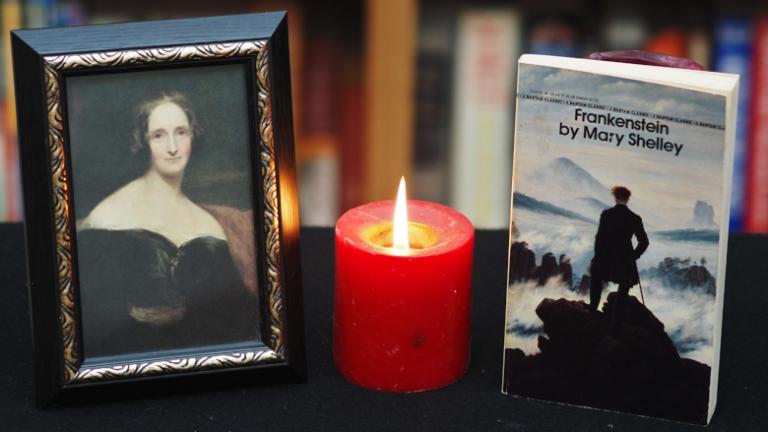
Photo by John Beckett. Portrait of Mary Shelley by Richard Rothwell (1840).
Frankenstein and me
Regular readers know that my first loves in the realm of horror (some would say my obsession) are vampires. But Frankenstein has always been right there too.
The first movie I ever saw on Shock Theatre was Dracula (1931). The next week they showed Frankenstein (1931). A couple weeks later they showed Dracula’s Daughter (1936), followed the next week by Bride of Frankenstein (1935). There was Son of Dracula (1943) and Son of Frankenstein (1939). Hammer Films did the same thing. They started with The Curse of Frankenstein (1957) and followed it with Horror of Dracula (1958) – both starring Christopher Lee in the title role.
I like horror books and movies not because I want to be scared, but because I want to be fascinated: with castles and forests, cauldrons and books, magic and monsters.
As a nerdy little kid who struggled to fit in, I especially identified with the monsters. I wanted to be Dracula, but I felt like I was Frankenstein.
For all my often-voracious reading, this is only the second time I’ve read Frankenstein. I’m struggling to remember when I read it first. My best guess is sometime in the early 1990s. I know I read Dracula for the second time in 1992, in preparation for seeing Bram Stoker’s Dracula that November. I suspect I read Frankenstein about the same time.
I’m reading more fiction these days. It’s mostly contemporary horror and urban fantasy, but I’m trying to sprinkle in some classics. I re-read Dracula in late 2022 and Carmilla in late 2023 – it was time to tackle Frankenstein again.
And so I did.
Reading a 206 year old novel
The main thing I remembered about Frankenstein from 1992 (or whenever) was that it was difficult to read. The prose is formal and unfamiliar. It didn’t help that I was reading an old mass market paperback printed in 10 point font. I’m normally a fast reader – I had to cut my reading speed about in half.
As I understand was common for novels of the day, Frankenstein is written as a series of stories told from one character to another. It begins with a letter from a Captain Walton on board a sailing ship exploring the Arctic to his sister back in England. Early on he rescues Victor Frankenstein from the ice – then we hear Victor telling his story. When we eventually hear from the Creature’s point of view, we have him talking to Victor, who tells the sort to Walton, who tells it to his sister. It works, but as with the prose, the method is unfamiliar.
When I re-read Dracula (first published in 1897) most recently, I was struck by how Christian it is. I credited that to Britain being a thoroughly Christian culture at the time.
Frankenstein impressed me with how Christian it isn’t. Religion is hardly mentioned and when it is it’s often for negative reasons, such as the priest who harangues Justine into confessing to a murder she did not commit. For all its talk of life and death, there is no discussion of heaven or hell. And for all that Frankenstein is often described as a cautionary tale for man interfering with the affairs of God, the Christian God is almost never brought up.
Internet sources are in disagreement as to Mary Shelley’s religious thoughts and beliefs. She was intelligent and curious and she lived 53 years – it is likely they shifted over the course of her life. But Frankenstein makes it clear that at age 19, she had little desire for religion in general and for established religion in particular.
It’s alive!
Books and movies are two very different ways of telling a story. The challenge for scriptwriters is to adapt the book for the screen, being neither slavish to the original nor losing sight of the book’s main characters and themes.
Peggy Webling adapted Frankenstein into a stage play in 1927. John Balderson adapted Webling’s play further, screenwriters Francis Edward Faragoh and Garrett Fort turned it into a script, and director James Whale turned that into the brilliant 1931 movie.
The movie spends much of its time in Frankenstein’s laboratory. There is the body, the defective brain, the storm, the electricity, all culminating in Colin Clive’s Dr. Frankenstein shouting “it’s alive!”
The book is much more understated. Victor engages in his “unwholesome trade,” the Creature awakens, Victor is horrified at what he has done and runs away, and when he comes back the Creature is gone. The bulk of the story is not in the making, but in the consequences of the making.
Geneva: 1816
Many of you know that Frankenstein was conceived in a storytelling contest between Mary, her husband Percy, Lord Byron, his traveling companion Dr. John Polidori, and Mary’s stepsister Claire Clairmont. They were living temporarily in Geneva – 1816 was the “year without a summer” caused by the volcanic eruption of Mount Tambora in Indonesia the previous year. The weather was cold and rainy and the party spent most of their time indoors.
This contest produced both Mary’s groundbreaking novel and Polidori’s The Vampyre, the first modern vampire story in English. Byron wrote a fragment of a vampire novel – it’s available in some anthologies (all five pages of it). Percy wrote “something about a ghost” that has been lost, and if Claire wrote anything there is no mention of it.
Byron and the Shelleys rented separate houses, but it was Byron’s house Villa Diodati where the storytelling took place, at least according to their accounts. Villa Diodati is still there. Unfortunately, it has been carved up into “luxury apartments” and is not open to the public.
I would pay an irresponsible amount of money to spend a long weekend in Villa Diodati, especially if I could persuade a few of my close Pagan and magical writer friends to join me. Alas, that’s not possible.
It’s just as well. I would be chasing someone else’s inspiration instead of following my own.
How to make a monster
Contrary to what some have said (likely in the more loose movie adaptations), Mary Shelley never named Frankenstein’s creation. He’s simply called “the Creature” or occasionally – by an angry Victor – “demon.” The idea that he was named Adam comes from this line:
I ought to be thy Adam, but I am rather the fallen angel, whom thou drivest from joy for no misdeed. Everywhere I see bliss, from which I alone am irrevocably excluded. I was benevolent and good; misery made me a fiend. Make me happy, and I shall again be virtuous.
The Creature comes to life and is immediately abandoned by his creator. Everywhere he is shunned and attacked because of his appearance – an appearance his creator made. When others are helpful to him – even unknowingly – he repays kindness with kindness. And when Victor reneges on his promise to create a mate for the Creature, the Creature takes his revenge in kind.
In the eternal question of nature vs. nurture, Mary Shelley comes down strongly on the side of nurture.
None of the Creature’s murders are justified. He understands this, saying “you hate me, but your abhorrence cannot equal that with which I regard myself.” Revenge upon the innocent is never justified.
More relevant to our world here and now, revenge leads only to more revenge, which leads only to destruction and death.
This was portrayed brilliantly in Penny Dreadful (2014 – 2016). As in the novel, the Creature is abandoned by his creator, shunned by society, and becomes a murderer. But as he is befriended – especially by Vanessa – he becomes a friend. He takes the name John Clare after the English poet (1793 – 1864) and by the end of the series, he is perhaps the most human of all the characters.
Is this canonical? No. Is it plausible? Definitely.
Who is the monster?
A meme I see occasionally says:
Knowledge is knowing Frankenstein isn’t the monster.
Wisdom is knowing Frankenstein is the monster.
This is a dangerous oversimplification.
The Creature is not the villain of Frankenstein. And yet when he kills William, Henry, Elizabeth, and indirectly, Justine, he is a monster.
Victor is the villain of Frankenstein. But he started with the best of intentions. His fatal sin was not arrogance or blasphemy but cowardice: his refusal to accept and nurture his creation, and then his refusal to keep his word and create a mate for him (though, as both Bride of Frankenstein and Penny Dreadful showed, it might not have gone well if he had).
There are two monsters in this story, and two ways of becoming a monster.
Treat people monstrously and they will become monsters.
Treat people monstrously and you will become a monster yourself.
Frankenstein is out of copyright and is available for free on Project Gutenberg.
To answer the questions I know are coming, no, I have not seen Poor Things (2023) or Lisa Frankenstein (2024). I likely will see them eventually, though at this point the rental prices on Amazon Prime are more than I want to pay.
Religious Music and Entertainment
Previous Post

March 6, 2024
I’m Already Tired of AI Art
Next Post

March 17, 2024 Survive and Advance
Recent Comments
"Concern about the attitude of Islam toward Pagans is not limited to the Trump Administration. ..."
"Thank you for your much needed review of the Lucas Miles polemic. A key point ..."
I Read Pagan Threat So You ..."
"A number of these are also available streaming through the Kanopy digital service, carried by ..."
The Vampire Films of Jean Rollin
"Happy October!"
The Vampire Films of Jean Rollin
Browse Our Archives
Select a Category Books Community CUUPS Druidry Foundations and Context Gods and Goddesses Magic Myth Nature Ritual Spiritual Practice Theology Travel Uncategorized Videos
Select a Month October 2026 September 2026 August 2026 July 2026 June 2026 May 2026 April 2026 March 2026 February 2026 January 2026 December 2025 November 2025 October 2025 September 2025 August 2025 July 2025 June 2025 May 2025 April 2025 March 2025 February 2025 January 2025 December 2024 November 2024 October 2024 September 2024 August 2024 July 2024 June 2024 May 2024 April 2024 March 2024 February 2024 January 2024 December 2023 November 2023 October 2023 September 2023 August 2023 July 2023 June 2023 May 2023 April 2023 March 2023 February 2023 January 2023 December 2022 November 2022 October 2022 September 2022 August 2022 July 2022 June 2022 May 2022 April 2022 March 2022 February 2022 January 2022 December 2021 November 2021 October 2021 September 2021 August 2021 July 2021 June 2021 May 2021 April 2021 March 2021 February 2021 January 2021 December 2020 November 2020 October 2020 September 2020 August 2020 July 2020 June 2020 May 2020 April 2020 March 2020 February 2020 January 2020 December 2019 November 2019 October 2019 September 2019 August 2019 July 2019 June 2019 May 2019 April 2019 March 2019 February 2019 January 2019 December 2018 November 2018 October 2018 September 2018 August 2018 July 2018 June 2018 May 2018 April 2018 March 2018 February 2018 January 2018 December 2017 November 2017 October 2017 September 2017 August 2017 July 2017 June 2017 May 2017 April 2017 March 2017 February 2017 January 2017 December 2016 November 2016 October 2016 September 2016 August 2016 July 2016 June 2016 May 2016 April 2016 March 2016 February 2016 January 2016 December 2015 November 2015 October 2015 September 2015 August 2015 July 2015 June 2015 May 2015 April 2015 March 2015 February 2015 January 2015 December 2014 November 2014 October 2014 September 2014 August 2014 July 2014 June 2014 May 2014 April 2014 March 2014 February 2014 January 2014 December 2013 November 2013 October 2013 September 2013 August 2013 July 2013 June 2013 May 2013 April 2013 March 2013 February 2013 January 2013 December 2012 November 2012 October 2012 September 2012 August 2012 July 2012 June 2012 May 2012 April 2012 March 2012 February 2012 January 2012 December 2011 November 2011 October 2011 September 2011 August 2011 July 2011 June 2011 May 2011 April 2011 March 2011 February 2011 January 2011 December 2010 November 2010 October 2010 September 2010 August 2010 July 2010 June 2010 May 2010 April 2010 March 2010 February 2010 January 2010 December 2009 November 2009 October 2009 September 2009 August 2009 July 2009 June 2009 May 2009 April 2009 March 2009 February 2009 January 2009 December 2008 November 2008 October 2008 September 2008 August 2008 July 2008 June 2008
Follow Us!
TAKE THE
Religious Wisdom Quiz
What Christian group is known for using the term "General Conference"?
Select your answer to see how you score.
Presbyterians Lutherans Seventh-day Adventists Baptists
Related posts from John Beckett

The Bloody Road to Castle Dracula
TRENDING AT PATHEOS Pagan

The First Eucharistic Controversy: Christ’s Real Presence
For Catholics, the Eucharist is the source and summit of the Christian...

What a Stop Sign Can Teach Us About...
How to Make a Decision When You Can't Hear God Main point:...

Archdiocese Hosts Military Marriage Retreat in Germany
RASTATT, Germany — The transient military lifestyle, with its frequent deployments and...

Nearly every morning, I make the drive to Detroit with my high-school-age...

The Real AI Story Is Adoption Without Trust
Artificial intelligence has crossed a political threshold. It is no longer a...

A new article, written by Jeff Lindsay and Gale L. Pooley,...
view all Pagan blogs
What Are Your Thoughts?leave a comment
Ad-Free & Subscriber Log-In Subscription Support
- About Us
- 2026 Calendar
- Videos
- Podcasts
- Library of World Religions
- Faith In Media Tracker
- Advertise With Us
- Write for Us
- Privacy Policy
- Terms of Service
- Do Not Sell My Data
- Contact Us
- Radiant Digital
- Manage Newsletter Subscriptions
- Unsubscribe From Notifications
- Sitemap
Copyright 2008-2026, Patheos. All rights reserved.
Subscription Support Ad-Free & Subscriber Log-In
Follow Patheos