
BuddhistCatholicContemplativeEvangelicalGeneral ChristianHinduJewishLatter-day SaintMuslimNew VisionsProgressive Christian
Beliefs
- Buddhist
- Catholic
- Contemplative
- Evangelical
- General Christian
- Hindu
- Jewish
- Latter-day Saint
- More Voices
- Muslim
- New Visions
- Pagan
- Progressive Christian
Topics
- Religion News
- Food and Religion
- Sports and Religion
- Religious Art
- Religious Music and Entertainment
- Religious Events
- History and Religion
- Style and Religion
- Politics and Religion
- Women in Religion
- Recreation Outdoors and Religion
- Business Finance and Religion
- Careers Workplace and Religion
- Education and Religion
- Family Parenting and Religion
- Health Fitness and Religion
- Home and Religion
- Relationships and Religion
- Technology and Religion
- Travel and Religion
Columnists
- Buddhist Columnists
- Business Finance and Religion Columnists
- Careers Workplace and Religion Columnists
- Catholic Columnists
- Contemplative Columnists
- Education and Religion Columnists
- Evangelists Columnists
- Family Parenting and Religion Columnists
- General Christian Columnists
- Health Fitness and Religion Columnists
- Hindu Columnists
- History and Religion Columnists
- Home and Religion Columnists
- Jewish Columnists
- More Voices Columnists
- Latter Day Columnists
- Muslim Columnists
- New Visions Columnists
- Nonreligious Columnists
- Pagan Columnists
- Politics and Religion Columnists
- Progressive Columnists
- Recreation Outdoors and Religion Columnists
- Relationships and Religion Columnists
- Religion News Columnists
- Religious Art Columnists
- Religious Events Columnists
- Religious Music and Entertainment Columnists
- Sports and Religion Columnists
- Style and Religion Columnists
- Technology and Religion Columnists
- Travel and Religion Columnists
- Women in Religion Columnists
Resource Library
- 2026 Calendar
- Library of World Religions
- The 100 Most Holy Places on Earth
- Patheos Answers
- Podcasts
- Videos
- Faith Leaders Database
- Anglican Episcopalian
- Bahai
- Baptist
- Buddhism
- Christianity
- Confucianism
- Eastern Orthodoxy
- Hinduism
- Holiness and Pentecostal
- ISKCON
- Islam
- Judaism
- Lutheran
- Methodist
- The Church of Jesus Christ of Latter-day Saints
- New Age
- Paganism
- Presbytarian and Reformed
- Protestantism
- Religion Behind the Scenes
- Roman Catholic
- Scientology
- Shia Islam
- Sikhism
- Sufism
- Sunni Islam
- Taoism
- Zen
- See all religions
Research Tools
 Ad-Free & Subscriber Log-In Subscription Support
Ad-Free & Subscriber Log-In Subscription Support
Follow Patheos 

- Trending:
- Forgiveness
- |
- Marriage
- |
- Consciousness
- |
- Death Penalty
- |
- Election
- |
- Halloween

- Home
- Pagan
- Hold Loosely But Practice Deeply
Hold Loosely But Practice Deeply
Last updated on: September 17, 2023 at 12:32 pm by John Beckett
Hold Loosely But Practice Deeply 2023-09-17T12:32:57-06:00 John Beckett
Patheos Explore the world's faith through different perspectives on religion and spirituality! Patheos has the views of the prevalent religions and spiritualities of the world.
Hold Loosely But Practice Deeply
by John Beckett
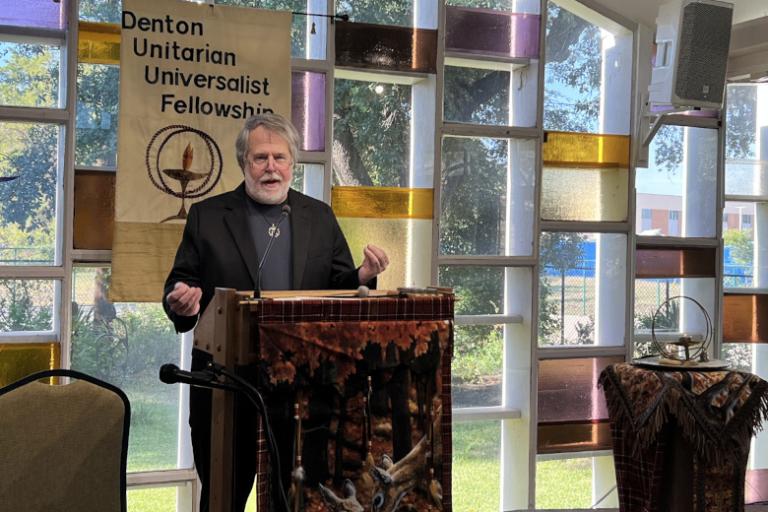
The Denton Unitarian Universalist Fellowship
September 17, 2023
When someone finds out I’m a Unitarian Universalist, it’s not long before they ask “so, what do you all believe?” My usual response is to say that UUs are united not by common beliefs but by shared values. If they push harder, I’ll say we believe what’s most important is to live fully and virtuously, and to build a better world for all, here and now. I think that’s a fairly accurate response, even if it’s not the kind of response people who’ve always been taught that religion is all about doctrines and creeds would expect.
That doesn’t mean UUs don’t have beliefs – because we do. We have no collective orthodoxy – for which I am thankful – but we still wonder about the Big Questions of Life. How did the Universe begin? Are there many Gods, one God, or no Gods? What happens after death – if anything? How do we understand our deeply spiritual experiences, especially those that call us to do something?
These questions aren’t important to everyone. If that’s you, know that I respect your position, and I hope you learn something this morning that’s interesting, even if it doesn’t directly apply to you. In any case, we’ll continue to work together to build a better world here and now.
But these questions have been with us for at least as long as we’ve been human. People have been wondering, and speculating, and arguing for and against various answers for thousands of years. Many of us still wonder about them.
And also, some of us grew up in a religion where we were told these questions were of utmost importance. We were told there were things we had to believe, or suffer dire and eternal consequences. We may have rejected those ideas a long time ago, but their tentacles can reach deep into our minds and into our souls, particularly the ideas we were taught as young children.
So for those of us who are recovering from toxic religion, or who have a deep curiosity in metaphysical and theological questions, or who feel a call to something more, we need a path forward. We need a process, we need a roadmap. I want to offer you one such approach this morning. I call it hold loosely but practice deeply.
The inherent uncertainly of religious questions
I grew up in a fundamentalist Christian church. I was told I had to believe some things, but I was also told I could believe them with certainty. Now, I was a very literal-minded kid. When they told me I could know something, I assumed I could know it in the same way I know two plus two equals four, or that Austin is the capital of Texas. But the scriptures they liked to quote were metaphorical and ambiguous – almost as though they were meant to be read that way. When I challenged their certainty, I was told “you just need to believe.”
It would take me many years to understand they were struggling with the same questions I was. But they were afraid to consider that maybe what they had always been told was true wasn’t true. Maybe they were afraid that if they abandoned fundamentalist Christianity they’d end up in hell. Maybe they couldn’t deal with the possibility of losing their religious identity. Both are serious concerns and they have my sincere sympathy.
But the fact is that all religious questions are inherently uncertain.
What happens after death? Do we live on in an afterlife? Does the afterlife have one place for everyone? Does it have one place for “the good” and another place for “the bad”? Does it have many different places and states of being? Perhaps we’re reincarnated into this life. Or maybe there is just this one life, and we only live on in the hearts and minds of those who knew us?
How do we know which is right and which is wrong? Outside of an occurrence that would properly be described as miraculous, how could we know? We can’t, at least not with any sort of objective certainty.
And still we wonder: what happens after death?
Perhaps you can say “we don’t know” and leave it at that. I occasionally see a bumper sticker in UU parking lots that says “Militant Agnostic: I don’t know and neither do you.” That’s certainly a valid approach. But it doesn’t work for me, and it doesn’t work for those of us who can’t help wondering about the Big Questions of Life.
And so our first step in dealing with these questions is to accept their inherent uncertainty.
Questions lead to inquiry
I occasionally encounter the phrase “questions demand answers.” There’s some truth to that. Unfortunately, the phrase is often used in bad faith, to insist that one particular answer must be the only answer. A better approach, I think, is “questions demand inquiry.”
Again, this assumes you find the question worthy of your time. It’s like when people knock on your door to “share” their religion with you. You owe them nothing, and you certainly don’t owe them a debate on their terms.
But if you do find a question important, or fascinating, or frustrating, you owe it to yourself to explore it in honest inquiry.
We are fortunate to live in an era where most of the world’s knowledge is literally at our fingertips. If you want something deeper, books that were all but impossible to find not all that long ago can be delivered to your doorstep – translated into English – in a matter of days.
What answers have other people proposed? Whose arguments do you find persuasive? Whose arguments do you find lacking? How does thinking vary within a religious or cultural tradition? What have people outside your tradition proposed?
I found Buddhist sources to be very helpful in the early days of my spiritual journey. Even though I quickly figured out that Buddhism isn’t for me, seeing how other cultures approached the Big Questions of Life helped reinforce the fact that there are many valid approaches to them. Which is not to say that “deep down it’s all the same” – it isn’t. The world’s religions aren’t many paths up one mountain, they’re many paths up many different mountains.
Which mountain do you want to climb?
And sometimes, we read and think and meditate, and at the end of it all we realize that the real benefit isn’t in finding “the answer” – it’s in the process of inquiry, the spiritual and intellectual growth that inquiry stimulates.
The role of religious experiences
Reading the thinking of others throughout the course of history give us a place to start, and it gives us context for our own thinking. But even more important are our first-hand religious and spiritual experiences.
Many of these experiences are subtle. Looking up at the night sky, realizing how old and how vast the universe is, how small and brief we are, and realizing that here we are, a part of it all, contemplating it all. Sunrises and sunsets – not just that beautiful orange glow on the horizon, but being outside long enough to start in full darkness and experiencing the gradual transition to full light.
Some are not subtle at all. Births, deaths, illnesses. Joyous victories and crushing defeats. All perfectly natural, and yet packed with meaning far beyond the ordinary.
And some experiences can only be described as mysterious. Prophetic dreams that come true. Intuition about something we had no way of knowing. A first-hand encounter with a God or other mighty spirit.
Can I tell you a secret? Most people have these experiences. Many of us don’t recognize them because they’re subtle, and we’re expecting Zeus to appear in-body and throwing lightning bolts. But even when we do recognize them we don’t talk about them for fear of being ridiculed. Or we rationalize them away, because we’re convinced there’s no “logical explanation” for them and therefore they can’t be real. But get ordinary people in a safe setting and they’ll start talking. “You know, one time I saw this thing and I was sure it wasn’t from this world.” Or they’ll say something like “sometimes I hear my grandmother’s voice, and she’s been dead for years.”
Not all of our wondering comes from metaphysical questions. Some of it comes from our own first-hand experiences.
The role of discernment
Our religious and spiritual experiences are always real. We saw what we saw, heard what we heard, felt what we felt. Never let anyone tell you it couldn’t have happened, especially when you were there and they weren’t. But while our experiences are always real, some interpretations of those experiences are more accurate and more helpful than others.
This is the process of discernment.
The dictionary defines discernment as “the ability to judge well.” It’s the process of drawing fine distinctions between two or more things that are similar but not identical. It’s separating facts from errors and from opinions, distilling the facts into truth, and then figuring out what to do what all of it.
All that reading we were talking about? That provides context, a reference for understanding our experiences and for locating ourselves in them.
At one level, discernment is a matching operation. We look at our experience, then we look at something we know – a story, a theory, another experience –and say “is this like that?” Then we pick up another comparison and say “is it like this?” We do this over and over and over again, comparing what we saw and heard and felt to anything in our breadth of knowledge and seeing if it matches. If our knowledge isn’t particularly broad, we may not be able to make a good match.
This is what happens when young children see unfamiliar animals and end up giving them funny names, like the kid who called a camel a “sand horse.” It’s cute, and it kinda makes sense, but a camel isn’t a horse.
If you just need a ride across town, that may not matter. If you’re trying to win a race at the horse track, or if you’re trying to make it across a desert, it matters a lot.
Whether we’re trying to answer one of the Big Questions of Life or interpret our own spiritual experiences, the process of discernment helps us find an answer.
But whatever we find is only a tentative answer.
Practice deeply
What do you think is the best answer, the best explanation? Is it reasonable? Is it plausible? We want to make sure it’s our best guess and not just what we want to be true. But if we wait for certainty we’ll never do anything. So my suggestion is to take that tentative answer and run with it.
If there are Gods, how can we best relate to them and understand them? Polytheist tradition says with prayers, offerings, and meditation. Even if nothing else happens, we know that Emerson spoke the truth when he said “that which we are worshipping, we are becoming.” Becoming more God-like – embodying the virtues of the Gods – is a very good thing.
Are our cats and dogs persons? Of course they are, and we treat them like persons. What happens if we take that a step farther and treat the trees like persons, the land like persons, the winds like persons? It’s not very hard, and our planet would be a better place if we did.
Many of us already practice some sort of ancestor veneration. We have our grandparents’ and great grandparents’ pictures on our wall. We have their mementos on our shelves. We remember them – including those we never met in this life. It’s not much farther to speak to them on a regular basis – and to listen for their responses. Are the responses we get the voices of our ancestors speaking to us from the afterlife? Are they only our memories? This much we know: that which is remembered, lives.
We take our tentative answers and we put them into practice. That gets us started. In the beginning it takes some effort – you’re doing something new and different. It takes time and repetition for it to become a habit. Give it the time it needs – that’s somewhere between three weeks and three months.
This is the “practice deeply” part.
Review and remain open
Beginning a spiritual practice is beginning a journey, a journey that we’re not exactly sure where it will lead. As with any new practice, we have to give it some time and not abandon it the first time things get difficult. But before too long, where we’re going should start to become apparent.
Do you like where you’re going? Does it help you deal with the Big Questions of Life? Does it make your life more meaningful, even if it doesn’t make it any easier? If so, good – keep doing it. If not, then take a closer look. Are you giving it an honest try? Do you need to be more consistent with your practice? Or is this just not for you? There are many different spiritual traditions, and most of them can be practiced within a UU context. If this one isn’t for you, perhaps another one is.
Where ever we go, we will have new experiences – what do those experience tell us? We continue reading, and listening, and thinking. What do we learn along the way? As we learn, we periodically revisit our Big Questions. Do our tentative answers still make good sense? Do we need to adjust them? Or have we have learned something that forces us to go back to the beginning and start over?
If new evidence or new experiences or new ways of thinking contradict our beliefs, we owe it to ourselves to re-evaluate those beliefs, to go through another process of discernment, and come up with a new answer – which will also be tentative. Our commitment to truth must be greater than our commitment to any tradition, no matter how long, or to any belief, no matter how cherished. We can never be sure we’re exactly right, but we can move closer in that direction.
Those of us who didn’t grow up UU have already done that. There was something in the religion of our childhood that wasn’t quite right – or maybe was very wrong. We abandoned one path and picked up another path, a path that eventually led us here. And just as we did that and found a new religious community, we can do that and find new religious and spiritual beliefs, ideas, and practices.
This is the “hold loosely” part. No belief, no line of thinking is above questioning.
This can be difficult. When presented with evidence that their beliefs are wrong – about religion, spirituality, politics, science, pretty much anything – most people will reject the evidence and double down on what they’ve always believed. If you want to change people’s minds you have to it indirectly, with stories and art and relationships. That’s another subject for another time. What’s important this morning is that we’re aware of this human tendency, and so we can do better in our own lives.
Which would you rather do? Change your beliefs and be closer to right, or tell yourself a comfortable lie and insist you was right all along? There’s no shame in admitting you were wrong, especially if you were wrong because you were taught wrong growing up. Continuing to be wrong because you don’t want to change? That’s another matter entirely.
Conclusion
Perhaps someday we will discover or develop a way to answer religious, spiritual, and metaphysical questions with certainty, though I do not think so. I believe – there’s that word again – these questions are inherently uncertain. And in any case, they are uncertain for us here and now. How do we deal with them?
One approach is to simply decline to deal with them. If you find these questions uninteresting or unhelpful, this is the approach for you. But some of us can’t stop wondering.
Some people’s approach is to claim that their tradition has all the answers, or at least all the important ones. Without fail, they overstate the evidence for their own belief and understate – or outright deny – any evidence to the contrary.
Or, we can build a strong foundation through reading and study. We can examine our spiritual experiences, and find what’s meaningful and helpful within them. We can develop answers that will never be final, but are enough to get us started. Then we practice deeply and see where that practice takes us. All the while, we remain open to new evidence, new experiences, and new ways of thinking. If we discover that what we think is wrong, or something else is better, we change what we think, and we adjust our practices accordingly.
Hold loosely, but practice deeply.
Benediction
I grew up in a religion that was certain it had all the answers to all the questions. Figuring out they were wrong was easy. Figuring out what to do instead has been the work of a lifetime, work that will continue as long as I’m in this world, and perhaps, beyond.
I want to answer the Big Questions of Life with certainty, and I can’t. But the answers I’ve found are reasonable, and the practices they inspire help me live a life that is meaningful and satisfying. I hope you can do the same, even if your answers are different from my answers.
Hold loosely, but practice deeply.
Previous Post

September 13, 2023
AI in Spiritual Education: Caveat Emptor
Next Post

September 20, 2023 5 Non-Traditional Tarot Decks
Recent Comments
"Concern about the attitude of Islam toward Pagans is not limited to the Trump Administration. ..."
"Thank you for your much needed review of the Lucas Miles polemic. A key point ..."
I Read Pagan Threat So You ..."
"A number of these are also available streaming through the Kanopy digital service, carried by ..."
The Vampire Films of Jean Rollin
"Happy October!"
The Vampire Films of Jean Rollin
Browse Our Archives
Select a Category Books Community CUUPS Druidry Foundations and Context Gods and Goddesses Magic Myth Nature Ritual Spiritual Practice Theology Travel Uncategorized Videos
Select a Month October 2026 September 2026 August 2026 July 2026 June 2026 May 2026 April 2026 March 2026 February 2026 January 2026 December 2025 November 2025 October 2025 September 2025 August 2025 July 2025 June 2025 May 2025 April 2025 March 2025 February 2025 January 2025 December 2024 November 2024 October 2024 September 2024 August 2024 July 2024 June 2024 May 2024 April 2024 March 2024 February 2024 January 2024 December 2023 November 2023 October 2023 September 2023 August 2023 July 2023 June 2023 May 2023 April 2023 March 2023 February 2023 January 2023 December 2022 November 2022 October 2022 September 2022 August 2022 July 2022 June 2022 May 2022 April 2022 March 2022 February 2022 January 2022 December 2021 November 2021 October 2021 September 2021 August 2021 July 2021 June 2021 May 2021 April 2021 March 2021 February 2021 January 2021 December 2020 November 2020 October 2020 September 2020 August 2020 July 2020 June 2020 May 2020 April 2020 March 2020 February 2020 January 2020 December 2019 November 2019 October 2019 September 2019 August 2019 July 2019 June 2019 May 2019 April 2019 March 2019 February 2019 January 2019 December 2018 November 2018 October 2018 September 2018 August 2018 July 2018 June 2018 May 2018 April 2018 March 2018 February 2018 January 2018 December 2017 November 2017 October 2017 September 2017 August 2017 July 2017 June 2017 May 2017 April 2017 March 2017 February 2017 January 2017 December 2016 November 2016 October 2016 September 2016 August 2016 July 2016 June 2016 May 2016 April 2016 March 2016 February 2016 January 2016 December 2015 November 2015 October 2015 September 2015 August 2015 July 2015 June 2015 May 2015 April 2015 March 2015 February 2015 January 2015 December 2014 November 2014 October 2014 September 2014 August 2014 July 2014 June 2014 May 2014 April 2014 March 2014 February 2014 January 2014 December 2013 November 2013 October 2013 September 2013 August 2013 July 2013 June 2013 May 2013 April 2013 March 2013 February 2013 January 2013 December 2012 November 2012 October 2012 September 2012 August 2012 July 2012 June 2012 May 2012 April 2012 March 2012 February 2012 January 2012 December 2011 November 2011 October 2011 September 2011 August 2011 July 2011 June 2011 May 2011 April 2011 March 2011 February 2011 January 2011 December 2010 November 2010 October 2010 September 2010 August 2010 July 2010 June 2010 May 2010 April 2010 March 2010 February 2010 January 2010 December 2009 November 2009 October 2009 September 2009 August 2009 July 2009 June 2009 May 2009 April 2009 March 2009 February 2009 January 2009 December 2008 November 2008 October 2008 September 2008 August 2008 July 2008 June 2008
Follow Us!
TAKE THE
Religious Wisdom Quiz
Which book contains a prophecy about locust swarms devastating the land?
Select your answer to see how you score.
Joel Obadiah Micah Hosea
Related posts from John Beckett




What We Lose When “Ask AI” Becomes A...
TRENDING AT PATHEOS Pagan

Archdiocese Hosts Military Marriage Retreat in Germany
RASTATT, Germany — The transient military lifestyle, with its frequent deployments and...

Nearly every morning, I make the drive to Detroit with my high-school-age...

The Real AI Story Is Adoption Without Trust
Artificial intelligence has crossed a political threshold. It is no longer a...

A new article, written by Jeff Lindsay and Gale L. Pooley,...

Swimfan: Forgotten Aughts Pleasures
This is a recovery effort. In 2002, My Big Fat Greek Wedding...

Top Three Anti-Catholic Lies About Catholicism
This is my initial transcript for the video, "THE 3 WORST...
view all Pagan blogs
What Are Your Thoughts?leave a comment
Ad-Free & Subscriber Log-In Subscription Support
- About Us
- 2026 Calendar
- Videos
- Podcasts
- Library of World Religions
- Faith In Media Tracker
- Advertise With Us
- Write for Us
- Privacy Policy
- Terms of Service
- Do Not Sell My Data
- Contact Us
- Radiant Digital
- Manage Newsletter Subscriptions
- Unsubscribe From Notifications
- Sitemap
Copyright 2008-2026, Patheos. All rights reserved.
Subscription Support Ad-Free & Subscriber Log-In
Follow Patheos