
BuddhistCatholicContemplativeEvangelicalGeneral ChristianHinduJewishLatter-day SaintMuslimNew VisionsProgressive Christian
Beliefs
- Buddhist
- Catholic
- Contemplative
- Evangelical
- General Christian
- Hindu
- Jewish
- Latter-day Saint
- More Voices
- Muslim
- New Visions
- Pagan
- Progressive Christian
Topics
- Religion News
- Food and Religion
- Sports and Religion
- Religious Art
- Religious Music and Entertainment
- Religious Events
- History and Religion
- Style and Religion
- Politics and Religion
- Women in Religion
- Recreation Outdoors and Religion
- Business Finance and Religion
- Careers Workplace and Religion
- Education and Religion
- Family Parenting and Religion
- Health Fitness and Religion
- Home and Religion
- Relationships and Religion
- Technology and Religion
- Travel and Religion
Columnists
- Buddhist Columnists
- Business Finance and Religion Columnists
- Careers Workplace and Religion Columnists
- Catholic Columnists
- Contemplative Columnists
- Education and Religion Columnists
- Evangelists Columnists
- Family Parenting and Religion Columnists
- General Christian Columnists
- Health Fitness and Religion Columnists
- Hindu Columnists
- History and Religion Columnists
- Home and Religion Columnists
- Jewish Columnists
- More Voices Columnists
- Latter Day Columnists
- Muslim Columnists
- New Visions Columnists
- Nonreligious Columnists
- Pagan Columnists
- Politics and Religion Columnists
- Progressive Columnists
- Recreation Outdoors and Religion Columnists
- Relationships and Religion Columnists
- Religion News Columnists
- Religious Art Columnists
- Religious Events Columnists
- Religious Music and Entertainment Columnists
- Sports and Religion Columnists
- Style and Religion Columnists
- Technology and Religion Columnists
- Travel and Religion Columnists
- Women in Religion Columnists
Resource Library
- 2026 Calendar
- Library of World Religions
- The 100 Most Holy Places on Earth
- Patheos Answers
- Podcasts
- Videos
- Faith Leaders Database
- Anglican Episcopalian
- Bahai
- Baptist
- Buddhism
- Christianity
- Confucianism
- Eastern Orthodoxy
- Hinduism
- Holiness and Pentecostal
- ISKCON
- Islam
- Judaism
- Lutheran
- Methodist
- The Church of Jesus Christ of Latter-day Saints
- New Age
- Paganism
- Presbytarian and Reformed
- Protestantism
- Religion Behind the Scenes
- Roman Catholic
- Scientology
- Shia Islam
- Sikhism
- Sufism
- Sunni Islam
- Taoism
- Zen
- See all religions
Research Tools
 Ad-Free & Subscriber Log-In Subscription Support
Ad-Free & Subscriber Log-In Subscription Support
Follow Patheos 

- Trending:
- Forgiveness
- |
- Marriage
- |
- Consciousness
- |
- Death Penalty
- |
- Election
- |
- Halloween

- Home
- Pagan
- Debaptism: You Probably Don’t Need It, But It Can Be Done
Debaptism: You Probably Don’t Need It, But It Can Be Done
Last updated on: December 18, 2022 at 3:00 am by John Beckett
Debaptism: You Probably Don’t Need It, But It Can Be Done 2022-12-16T14:07:28-06:00 John Beckett
Patheos Explore the world's faith through different perspectives on religion and spirituality! Patheos has the views of the prevalent religions and spiritualities of the world.
Last week there was an article going around from the National Catholic Register (a conservative Catholic site owned by EWTN) titled More People Are Demanding to Be ‘Debaptized’ — Here’s What’s Wrong With That. The Pagan and occult internet started arguing about it, with some insisting debaptism isn’t possible, some insisting it isn’t necessary, and others telling their own stories of debaptism and how it helped them.
Here’s the key quote from the Catholic article by Jimmy Akin:
“When you get baptized, an indelible spiritual mark is put on your soul, and nothing can remove this.”
Akin isn’t entirely wrong. He’s just wrong in the ways that matter, and that’s what I’d like to discuss in this post.
What I’m not going to do is go into a theological analysis of the Christian rite of baptism, especially the difference between infant baptism (as practiced by Catholics and many other churches) and “believer’s baptism” (as practiced by Baptists and most other Evangelicals). For our purposes as Pagans and polytheists, it’s enough to say that baptism is, in the words of the Catholic Catechism, a “Christian initiation.”
I have mixed feelings about infant baptism. On one hand, of course parents, grandparents, and other family want their new child recognized by their religious community. On the other hand, making religious commitments for someone else – even your own child – is a serious violation of their free will. And on the third hand, the idea that you can and should choose your own religion is a very modern, very Western idea.
I have on occasion been asked to officiate a Pagan naming ceremony for a newborn or other child. I always include these words:
We welcome you to this world, and to this community. Though we hope you will someday take your place as a full member of our grove, we do not claim you for our path, for no one can dictate the steps of another.
Still, the idea that baptismal marks and commitments are invalid because the child cannot consent is, in my experience, wishful thinking. They are real. So were those placed on me when I was baptized in the Baptist church at age 8. Still, while I made a clean break with Christianity, I never felt the need to undo my baptism.

Don’t look for a religious solution to a political problem
In the United States we argue about whether or not churches should pay taxes. In much of Europe, churches are supported by taxes. Sometimes that means there’s an established church, as with the Church of England. Other times that means a small portion of your taxes goes to the church of which you’re a member.
And churches are notorious for never scrubbing their membership rolls.
So people who leave a church – especially those who become “unaffiliated” – try to get their names removed from the church rolls.
This is a political problem, not a religious problem. As an American, I’m appalled at the idea of tax money going to support churches (one of the reasons I strongly oppose school vouchers). If a country insists on doing it, they need to make it a checkoff, like the U.S. Presidential Election Campaign Fund.
Church taxes are a political problem and debaptism isn’t the solution.
You can’t unring a bell
Here’s where Jimmy Akin is right: once a baptism is done, it’s done. And people shouldn’t expect churches to pretend it wasn’t. Akin talked about one person who renounced his baptism and the church records were updated to show that. But the person wasn’t satisfied, and “he sued the Church to have his name removed from the records.”
If you get married and later decide that was a bad idea, you can get divorced – the marriage can be dissolved. But that doesn’t mean the marriage never happened. Even if you go through all the legal, spiritual, and emotions hoops to end the marriage, that relationship changed you – perhaps subtly, perhaps dramatically.
The Catholic church doesn’t help its case here with their position on marriage. They say a marriage can be annulled, which basically states it was never a valid marriage to begin with – it never happened. Meanwhile, they don’t recognize the validity of a divorce, despite the fact that they happen successfully all the time.
It’s no wonder some people want an annulment of their baptism.
But you can’t unpour water. The baptism happened and we can’t pretend it didn’t.
But we can reverse its effects.

Polytheists shouldn’t be constrained by monotheist thinking
I know some occultists who hang out in the Big Tent of Paganism are monotheists. Some practice from a Christian worldview. Some are Christians, even though the Catholics and the Baptists would say they’re very bad Christians. That’s their business, not mine.
I’m a polytheist practicing from an animist worldview – I see the world in a different way. I see their God as one God among many, and I’m not the least bit persuaded by appeals to Christian doctrine and scripture.
That doesn’t mean I think a Christian initiation is ineffective. But as a polytheist, I evaluate the claims for what baptism does – and especially for how irreversible it is – in the context of a world full of many Gods, not one God.
A promise made for you is ethically invalid
I discussed this a few years ago in Integrity is Complicated: Breaking a Promise From Your Old Religion. That’s a slightly different question than the one we’re discussing here. If you were baptized without your consent – or if, like me, you were baptized without informed consent – you have no ethical requirement to keep the promises that were made and implied at your baptism.
But again, that doesn’t mean it didn’t happen.
The important question is whether or not your baptism doing anything. Or is it just something that happened to you? Lots of stuff happens to us as children and much of it isn’t good. Most times we get over it. Sometimes getting over it requires therapy. Other times we just move on to something bigger and better.
Is this something you think about a lot? Does it bother you that you were baptized? If not, you probably don’t need a debaptism.

Marks fade over time
Any good initiation leaves a mark. As I write this I feel the mark from my first Pagan group initiation 19 years ago – it feels as right now as it did then. But I’ve reinforced that mark on a near-constant basis with reading and study, with rituals and celebrations, and especially with daily practice.
Marks that aren’t reinforced fade over time. My baptism mark is still there, but I have to look for it to find it. It holds no power over me – not anymore.
Connections can be severed
When someone asks me about recovering from the harmful effects of fundamentalism, my first response is always “stop the bleeding.” Get out. Stop attending fundamentalist churches. Stop reading their books and websites. Stop listening to TV and radio preachers.
I speak here of fundamentalism. Christianity – Protestant, Catholic, or Orthodox – can be a perfectly fine religion, at least for some people. Fundamentalist Christianity is never a good religion. But the process of cutting ties is the same.
And that process begins with the mundane act of walking away and staying away.
When those spiritual marks stop being reinforced, they start to fade.
No debaptism required.
Crowd out bad experiences with good experiences
Once the connections are severed, the best thing you can do to make that mark fade faster is to fill your life with positive religious experiences.
For me, this began with a year of dedicated spiritual practice – the first time in my life I had done that. Then I found a group and began to practice with other Pagans. I had the initiation I mentioned above, I began to lead rituals, and then to do deeper work both on my own and in small groups.
It felt good. It felt right.
When it comes to religion, you can take someone else’s word for it, or you can experience it for yourself. Paganism is a religion of experience.
Good religious experiences crowd out bad religious experiences and leave no room for them in your soul.
You may want a debaptism ceremony
You probably don’t need a debaptism ceremony. But you may want one.
A well-done ritual can sever the spiritual and psychic ties between you and a religious tradition you no longer wish to be associated with. It can give you the spiritual strength to physically walk away. It can begin the healing process, and if the connection wasn’t completely broken already it can speed it up the break.
Several people mentioned they did the Traditional Witchcraft practice of saying the Lord’s Prayer backwards. This is an act of Christian blasphemy – it burns the bridges so you can’t go back.
If it worked for them, great. I don’t like it, because it reinforces a Christian worldview. Which, let’s face it, is the environment in which Traditional Witchcraft evolved. But your goal isn’t to become an anti-Christian, it’s to become a non-Christian.
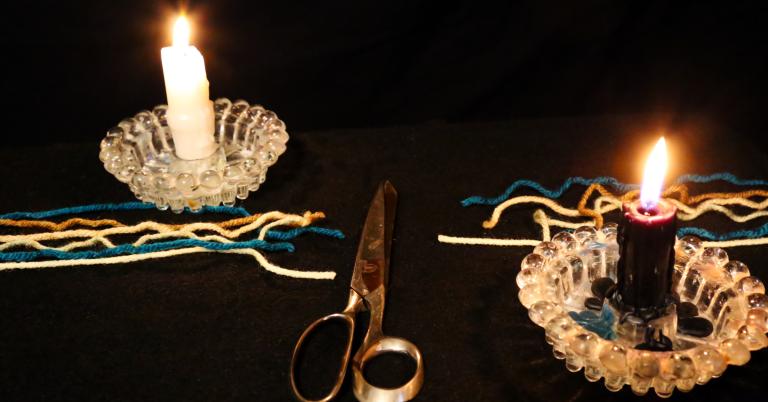
I prefer a cord-cutting ritual. Let the act of physically cutting ties in this world symbolize the act of psychically cutting ties in the spirit world. Include an element of cleansing – and if you use water, also use smoke, and perhaps sound. Do it in a magical environment that includes enough accoutrements and ritual to make it feel like the important act it is. End it with a dedication to the new religion you want to pursue.
And if that’s no religion? That’s OK. Ritual and ceremony have psychological components that can benefit atheists and skeptics as well those of us whose experiences have convinced us we live in a world with many Gods where magic is real.

Move on
There have always been a few people who left the religion of their birth to follow a new religion. Now the practice is commonplace, at least in the West. Most simply walk away from the old and embrace the new, and that’s usually all that’s required.
The experiences of our old religions leave a mark, sometimes metaphorically and sometimes spiritually. Those marks fade over time, and for most of us – myself included – that’s sufficient. Most people don’t need debaptism.
But if you have a need or a desire to speed up that process, or if your own marks are particularly stubborn, a well-crafted and well-conducted debaptism ceremony can be helpful.
Blessings to you as you follow the path to which you are called, whatever it may be.
Previous Post

December 14, 2022
The Liminal Zones of the Winter Solstice Season
Next Post
December 21, 2022 Giving Thanks to the Gods for This Year
Browse Our Archives
Select a Category Books Community CUUPS Druidry Foundations and Context Gods and Goddesses Magic Myth Nature Ritual Spiritual Practice Theology Travel Uncategorized Videos
Select a Month October 2026 September 2026 August 2026 July 2026 June 2026 May 2026 April 2026 March 2026 February 2026 January 2026 December 2025 November 2025 October 2025 September 2025 August 2025 July 2025 June 2025 May 2025 April 2025 March 2025 February 2025 January 2025 December 2024 November 2024 October 2024 September 2024 August 2024 July 2024 June 2024 May 2024 April 2024 March 2024 February 2024 January 2024 December 2023 November 2023 October 2023 September 2023 August 2023 July 2023 June 2023 May 2023 April 2023 March 2023 February 2023 January 2023 December 2022 November 2022 October 2022 September 2022 August 2022 July 2022 June 2022 May 2022 April 2022 March 2022 February 2022 January 2022 December 2021 November 2021 October 2021 September 2021 August 2021 July 2021 June 2021 May 2021 April 2021 March 2021 February 2021 January 2021 December 2020 November 2020 October 2020 September 2020 August 2020 July 2020 June 2020 May 2020 April 2020 March 2020 February 2020 January 2020 December 2019 November 2019 October 2019 September 2019 August 2019 July 2019 June 2019 May 2019 April 2019 March 2019 February 2019 January 2019 December 2018 November 2018 October 2018 September 2018 August 2018 July 2018 June 2018 May 2018 April 2018 March 2018 February 2018 January 2018 December 2017 November 2017 October 2017 September 2017 August 2017 July 2017 June 2017 May 2017 April 2017 March 2017 February 2017 January 2017 December 2016 November 2016 October 2016 September 2016 August 2016 July 2016 June 2016 May 2016 April 2016 March 2016 February 2016 January 2016 December 2015 November 2015 October 2015 September 2015 August 2015 July 2015 June 2015 May 2015 April 2015 March 2015 February 2015 January 2015 December 2014 November 2014 October 2014 September 2014 August 2014 July 2014 June 2014 May 2014 April 2014 March 2014 February 2014 January 2014 December 2013 November 2013 October 2013 September 2013 August 2013 July 2013 June 2013 May 2013 April 2013 March 2013 February 2013 January 2013 December 2012 November 2012 October 2012 September 2012 August 2012 July 2012 June 2012 May 2012 April 2012 March 2012 February 2012 January 2012 December 2011 November 2011 October 2011 September 2011 August 2011 July 2011 June 2011 May 2011 April 2011 March 2011 February 2011 January 2011 December 2010 November 2010 October 2010 September 2010 August 2010 July 2010 June 2010 May 2010 April 2010 March 2010 February 2010 January 2010 December 2009 November 2009 October 2009 September 2009 August 2009 July 2009 June 2009 May 2009 April 2009 March 2009 February 2009 January 2009 December 2008 November 2008 October 2008 September 2008 August 2008 July 2008 June 2008
Follow Us!
TAKE THE
Religious Wisdom Quiz
Which Christian movement began with John Wesley in the 18th century?
Select your answer to see how you score.
Lutheranism Methodism Calvinism Presbyterianism
Related posts from John Beckett




What We Lose When “Ask AI” Becomes A...
TRENDING AT PATHEOS Pagan

Letters on Living the Faith by C.S. Lewis
Most of us met C.S. Lewis as a public intellectual. Mere Christianity....

When Halloween Unmasks Married Hearts
Written by Dr. David K. Ewen from Eternal Truth Bible College Behind...

Aristotle. He’s been called the father of logic, the father of the...

Methodist Central Hall and Westminster Abbey
Situated on the same square is Methodist Central Hall and Westminster Abbey. ...

57th Dove Awards Honor Dolly Parton, Crown New...
On gospel music’s biggest night, the 57th annual GMA Dove Awards honored...

The First Eucharistic Controversy: Christ’s Real Presence
For Catholics, the Eucharist is the source and summit of the Christian...
view all Pagan blogs
Ad-Free & Subscriber Log-In Subscription Support
- About Us
- 2026 Calendar
- Videos
- Podcasts
- Library of World Religions
- Faith In Media Tracker
- Advertise With Us
- Write for Us
- Privacy Policy
- Terms of Service
- Do Not Sell My Data
- Contact Us
- Radiant Digital
- Manage Newsletter Subscriptions
- Unsubscribe From Notifications
- Sitemap
Copyright 2008-2026, Patheos. All rights reserved.
Subscription Support Ad-Free & Subscriber Log-In
Follow Patheos