
BuddhistCatholicContemplativeEvangelicalGeneral ChristianHinduJewishLatter-day SaintMuslimNew VisionsProgressive Christian
Beliefs
- Buddhist
- Catholic
- Contemplative
- Evangelical
- General Christian
- Hindu
- Jewish
- Latter-day Saint
- More Voices
- Muslim
- New Visions
- Pagan
- Progressive Christian
Topics
- Religion News
- Food and Religion
- Sports and Religion
- Religious Art
- Religious Music and Entertainment
- Religious Events
- History and Religion
- Style and Religion
- Politics and Religion
- Women in Religion
- Recreation Outdoors and Religion
- Business Finance and Religion
- Careers Workplace and Religion
- Education and Religion
- Family Parenting and Religion
- Health Fitness and Religion
- Home and Religion
- Relationships and Religion
- Technology and Religion
- Travel and Religion
Columnists
- Buddhist Columnists
- Business Finance and Religion Columnists
- Careers Workplace and Religion Columnists
- Catholic Columnists
- Contemplative Columnists
- Education and Religion Columnists
- Evangelists Columnists
- Family Parenting and Religion Columnists
- General Christian Columnists
- Health Fitness and Religion Columnists
- Hindu Columnists
- History and Religion Columnists
- Home and Religion Columnists
- Jewish Columnists
- More Voices Columnists
- Latter Day Columnists
- Muslim Columnists
- New Visions Columnists
- Nonreligious Columnists
- Pagan Columnists
- Politics and Religion Columnists
- Progressive Columnists
- Recreation Outdoors and Religion Columnists
- Relationships and Religion Columnists
- Religion News Columnists
- Religious Art Columnists
- Religious Events Columnists
- Religious Music and Entertainment Columnists
- Sports and Religion Columnists
- Style and Religion Columnists
- Technology and Religion Columnists
- Travel and Religion Columnists
- Women in Religion Columnists
Resource Library
- 2026 Calendar
- Library of World Religions
- The 100 Most Holy Places on Earth
- Patheos Answers
- Podcasts
- Videos
- Faith Leaders Database
- Anglican Episcopalian
- Bahai
- Baptist
- Buddhism
- Christianity
- Confucianism
- Eastern Orthodoxy
- Hinduism
- Holiness and Pentecostal
- ISKCON
- Islam
- Judaism
- Lutheran
- Methodist
- The Church of Jesus Christ of Latter-day Saints
- New Age
- Paganism
- Presbytarian and Reformed
- Protestantism
- Religion Behind the Scenes
- Roman Catholic
- Scientology
- Shia Islam
- Sikhism
- Sufism
- Sunni Islam
- Taoism
- Zen
- See all religions
Research Tools
 Ad-Free & Subscriber Log-In Subscription Support
Ad-Free & Subscriber Log-In Subscription Support
Follow Patheos 

- Trending:
- Forgiveness
- |
- Marriage
- |
- Consciousness
- |
- Death Penalty
- |
- Election
- |
- Halloween

- Home
- Pagan
- Worshipping Deities From Different Cultures
Worshipping Deities From Different Cultures
Last updated on: September 18, 2022 at 3:00 am by John Beckett
Worshipping Deities From Different Cultures 2022-09-14T19:33:26-06:00 John Beckett
Patheos Explore the world's faith through different perspectives on religion and spirituality! Patheos has the views of the prevalent religions and spiritualities of the world.
I recently received two questions that ask about worshipping and/or working with deities from different cultures. Tyson Chase asked:
What are some of the complications and benefits you have experienced working with deities from different cultures?
And an anonymous questioner asked:
How do you go about worshipping deities from other cultures together? The Morrigan leads me to other deities from other cultures periodically. It feels like such a strange gaggle of Gods, and I’m really stuck on how to synthesize the worship of all these entities.
I get questions like these rather frequently. They’re good and relevant questions. Rather than discussing them in isolation, I think we need to approach the matter of deities from different cultures from the ground up: from theology to culture to practice.
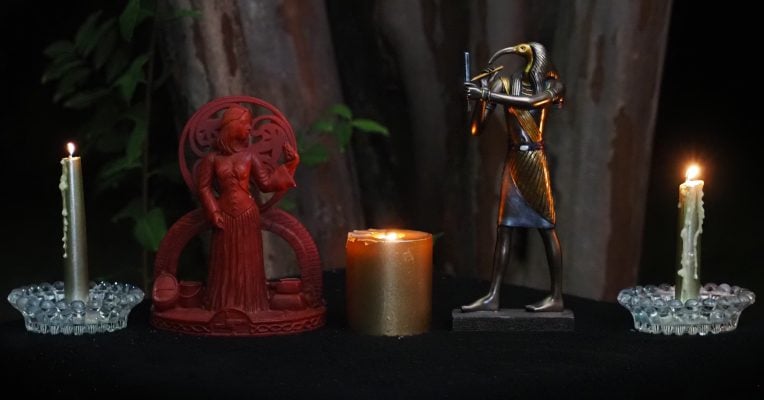
Brighid from Ireland and Thoth (Djehuty) from Egypt
Gods don’t belong to people – people belong to Gods
I sometimes speak of “my Gods” – the Morrigan, Danu, Cernunnos. Others I honor and serve without a formal relationship. But I say “my Gods” in the way I speak of “my family” or “my country.” None of those persons or things belong to me. Rather, I belong to them.
I talked about polytheist theology in the last post. Gods are individual persons. They are the mightiest of spirits. They are sovereign persons with Their own agency and will. As They frequently show us first-hand, They do what They want, with whom They want, for Their own reasons.
The Gods call who They call. The racist and folkish Pagans who tell People of Color “our Gods would never call you” are placing human limitations on divine beings, and that never ends well.
At the same time, most Gods were originally connected to specific groups of people. The Gods had people. Those people encountered their Gods and they told stories about them. As always when humans talk about Gods, those stories said as much about the people who told them as they did about the Gods they encountered. To fully understand those stories, we must understand the people who told them.
And that brings us to the matter of culture.
Worship practices are often part of culture
Where does religion end and culture begin? That can be hard to say, particularly for those of us who understand that religion isn’t just about what you believe (an idea unique to Protestant Christianity) but about what you do and who you are.
Religion – from the Latin religare, meaning to bind together – is the sacred things a group of people have in common. It’s what brings us together and keeps us together.
A religion is in part a set of protocols and technologies for maintaining relationships between a group of people and their Gods. When we look at how people traditionally interact with their Gods (again, “their” meaning they belong to those Gods, not that those Gods belong to them) we need to determine what parts of those protocols are technology (generic techniques and methods) and what parts are culture (identity markers of a group of people).
Let me be blunt: I’m done arguing about cultural appropriation. It’s real, it’s bad, and we shouldn’t do it. But too much of the current discourse around cultural appropriation is done by white people using it as a blunt instrument in ways never requested by indigenous and/or oppressed people, for the purpose of making themselves feel superior, and with the result of creating cultural silos that would make any white supremacist proud.
I am far more concerned with cultural authenticity: don’t pretend to be something you aren’t.
Is a religious practice a technical protocol for approaching a deity, or is it just the way a particular group of people in a particular place and time approached that deity? If it’s the first, following that protocol is probably necessary. If it’s the second, doing it your own way is probably better.
Mainly, do what you do respectfully and authentically.
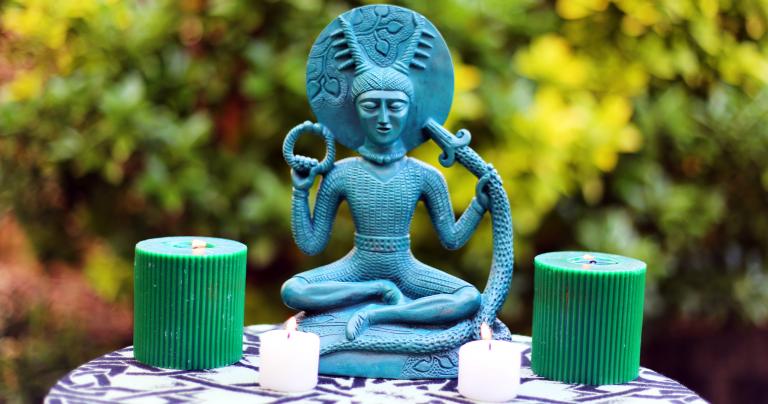
Cernunnos from Gaul… and perhaps, other places as well
The Gods want what They want
When people ask about worshipping and working with multiple deities – whether from the same culture or from different cultures – I emphasize the need to be fully devoted to all of Them. Cernunnos will always be first in my life – He gets what He wants. And also, Danu gets what She wants. And also, the Morrigan gets what She wants.
Our Gods are not jealous Gods. For the most part, They don’t care if we worship, work with, or work for other deities – so long as They get what They want.
That means we rarely are able to synthesize our worship. To use an electrical metaphor, it’s something we do in series, not in parallel: one and then the other, not all at the same time.
They’re not all on the same team
A plain reading of the stories our ancestors told about their Gods makes it clear that some Gods don’t get along with others. Some Gods are associated with cultures that are very different (i.e. – East Asian deities and Northern European deities). Trying to worship Them together is incongruous, at the least.
You may need to set up separate shrines and altars. You will probably need to worship Them on different days – you will certainly need to observe each One’s high days separately. Give each one what They want.
But some of Them are working together
The questioner’s comment about the Morrigan leading them to deities from different cultures is not uncommon. I haven’t heard stories of the Morrigan and Odin “horse-trading” devotees in a while, but I think that’s more because the spaces for those kinds of conversations aren’t nearly as common as they were in the mid-2010s.
Still, the first-hand experiences of many contemporary polytheists confirm that this sort of cooperation and coordination happens with some regularity. If the Morrigan or some other deity points us in the direction of other deities, we can safely assume there’s a good reason for it.
This phenomenon reminds us that we are practicing a living religion. The lore of our ancestors is a treasure, but modern Pagan polytheism is grounded in our own contemporary experiences of our Gods. They can speak to us just as They spoke to our ancestors – and they do.
And sometimes what They tell us involves working with Someone totally unexpected.
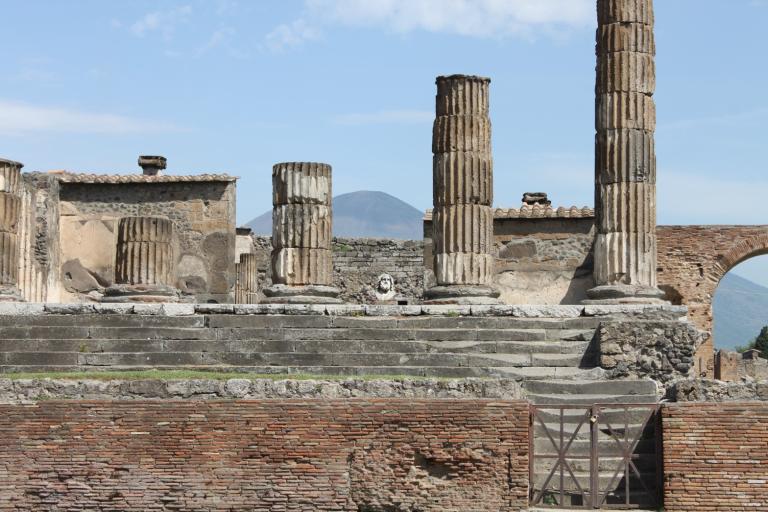
Temple of Jupiter – Pompeii
Proceed with respect, with dedication, and with love
As with so much else when it comes to our relations with our Gods, the specifics often get complicated but the basics are simple.
Whether you’re called to a particular deity or if you pursue Them, begin with respect. Listen closely, assume nothing, and remember that you’re dealing with persons who are far more than we are. Show Them the dignity and honor They deserve.
For most of us, most of the time, They don’t ask a lot. Some prayers, some meditation, some offerings. The occasional hands-on assignment that helps promote Their virtues and values in this world. What They ask, we should give. Unless we can’t, in which case it’s up to us to explain why and to offer what we can in its place. Mainly, we need the dedication to do what we say we’ll do.
Many of us like to emphasize the power and might of our Gods, and the seriousness of our service to Them. That’s a good and necessary thing. But both the stories of our ancestors and our own experience demonstrate that our Gods love us. Working from a place of love is a very good thing.
When we do what we do with respect, dedication, and love, we are likely to be on the right path.

Next Post

September 21, 2022 Worship, Practice, and Spirits from Pop Culture
Browse Our Archives
Select a Category Books Community CUUPS Druidry Foundations and Context Gods and Goddesses Magic Myth Nature Ritual Spiritual Practice Theology Travel Uncategorized Videos
Select a Month October 2026 September 2026 August 2026 July 2026 June 2026 May 2026 April 2026 March 2026 February 2026 January 2026 December 2025 November 2025 October 2025 September 2025 August 2025 July 2025 June 2025 May 2025 April 2025 March 2025 February 2025 January 2025 December 2024 November 2024 October 2024 September 2024 August 2024 July 2024 June 2024 May 2024 April 2024 March 2024 February 2024 January 2024 December 2023 November 2023 October 2023 September 2023 August 2023 July 2023 June 2023 May 2023 April 2023 March 2023 February 2023 January 2023 December 2022 November 2022 October 2022 September 2022 August 2022 July 2022 June 2022 May 2022 April 2022 March 2022 February 2022 January 2022 December 2021 November 2021 October 2021 September 2021 August 2021 July 2021 June 2021 May 2021 April 2021 March 2021 February 2021 January 2021 December 2020 November 2020 October 2020 September 2020 August 2020 July 2020 June 2020 May 2020 April 2020 March 2020 February 2020 January 2020 December 2019 November 2019 October 2019 September 2019 August 2019 July 2019 June 2019 May 2019 April 2019 March 2019 February 2019 January 2019 December 2018 November 2018 October 2018 September 2018 August 2018 July 2018 June 2018 May 2018 April 2018 March 2018 February 2018 January 2018 December 2017 November 2017 October 2017 September 2017 August 2017 July 2017 June 2017 May 2017 April 2017 March 2017 February 2017 January 2017 December 2016 November 2016 October 2016 September 2016 August 2016 July 2016 June 2016 May 2016 April 2016 March 2016 February 2016 January 2016 December 2015 November 2015 October 2015 September 2015 August 2015 July 2015 June 2015 May 2015 April 2015 March 2015 February 2015 January 2015 December 2014 November 2014 October 2014 September 2014 August 2014 July 2014 June 2014 May 2014 April 2014 March 2014 February 2014 January 2014 December 2013 November 2013 October 2013 September 2013 August 2013 July 2013 June 2013 May 2013 April 2013 March 2013 February 2013 January 2013 December 2012 November 2012 October 2012 September 2012 August 2012 July 2012 June 2012 May 2012 April 2012 March 2012 February 2012 January 2012 December 2011 November 2011 October 2011 September 2011 August 2011 July 2011 June 2011 May 2011 April 2011 March 2011 February 2011 January 2011 December 2010 November 2010 October 2010 September 2010 August 2010 July 2010 June 2010 May 2010 April 2010 March 2010 February 2010 January 2010 December 2009 November 2009 October 2009 September 2009 August 2009 July 2009 June 2009 May 2009 April 2009 March 2009 February 2009 January 2009 December 2008 November 2008 October 2008 September 2008 August 2008 July 2008 June 2008
Follow Us!
TAKE THE
Religious Wisdom Quiz
I am patient and kind. I do not envy or boast. I never fail and endure all things. What am I?
Select your answer to see how you score.
Faith Love Grace Hope
Related posts from John Beckett




What We Lose When “Ask AI” Becomes A...
TRENDING AT PATHEOS Pagan

The Sermon on the Mount, Part I: Matthew...
The Sermon on the Mount, Part I (Matthew 4:12-5:12) St. Matthew moves...

What's up from Crossway: Reviewing some of their latest A few weeks...

Janie Learns the Way of the Cross: A...
Teaching children about Jesus' Passion can be challenging. Many parents and educators...

Looking For Good Catholic Writing - October 2026
He alone extends the heavens, and he walks upon the waves of...

In "Irreplaceable," our book on vocation and technology, Trevor Sutton and I...

I was strolling through the top floor of the brand new Parthenon...
view all Pagan blogs
Ad-Free & Subscriber Log-In Subscription Support
- About Us
- 2026 Calendar
- Videos
- Podcasts
- Library of World Religions
- Faith In Media Tracker
- Advertise With Us
- Write for Us
- Privacy Policy
- Terms of Service
- Do Not Sell My Data
- Contact Us
- Radiant Digital
- Manage Newsletter Subscriptions
- Unsubscribe From Notifications
- Sitemap
Copyright 2008-2026, Patheos. All rights reserved.
Subscription Support Ad-Free & Subscriber Log-In
Follow Patheos