
BuddhistCatholicContemplativeEvangelicalGeneral ChristianHinduJewishLatter-day SaintMuslimNew VisionsProgressive Christian
Beliefs
- Buddhist
- Catholic
- Contemplative
- Evangelical
- General Christian
- Hindu
- Jewish
- Latter-day Saint
- More Voices
- Muslim
- New Visions
- Pagan
- Progressive Christian
Topics
- Religion News
- Food and Religion
- Sports and Religion
- Religious Art
- Religious Music and Entertainment
- Religious Events
- History and Religion
- Style and Religion
- Politics and Religion
- Women in Religion
- Recreation Outdoors and Religion
- Business Finance and Religion
- Careers Workplace and Religion
- Education and Religion
- Family Parenting and Religion
- Health Fitness and Religion
- Home and Religion
- Relationships and Religion
- Technology and Religion
- Travel and Religion
Columnists
- Buddhist Columnists
- Business Finance and Religion Columnists
- Careers Workplace and Religion Columnists
- Catholic Columnists
- Contemplative Columnists
- Education and Religion Columnists
- Evangelists Columnists
- Family Parenting and Religion Columnists
- General Christian Columnists
- Health Fitness and Religion Columnists
- Hindu Columnists
- History and Religion Columnists
- Home and Religion Columnists
- Jewish Columnists
- More Voices Columnists
- Latter Day Columnists
- Muslim Columnists
- New Visions Columnists
- Nonreligious Columnists
- Pagan Columnists
- Politics and Religion Columnists
- Progressive Columnists
- Recreation Outdoors and Religion Columnists
- Relationships and Religion Columnists
- Religion News Columnists
- Religious Art Columnists
- Religious Events Columnists
- Religious Music and Entertainment Columnists
- Sports and Religion Columnists
- Style and Religion Columnists
- Technology and Religion Columnists
- Travel and Religion Columnists
- Women in Religion Columnists
Resource Library
- 2026 Calendar
- Library of World Religions
- The 100 Most Holy Places on Earth
- Patheos Answers
- Podcasts
- Videos
- Faith Leaders Database
- Anglican Episcopalian
- Bahai
- Baptist
- Buddhism
- Christianity
- Confucianism
- Eastern Orthodoxy
- Hinduism
- Holiness and Pentecostal
- ISKCON
- Islam
- Judaism
- Lutheran
- Methodist
- The Church of Jesus Christ of Latter-day Saints
- New Age
- Paganism
- Presbytarian and Reformed
- Protestantism
- Religion Behind the Scenes
- Roman Catholic
- Scientology
- Shia Islam
- Sikhism
- Sufism
- Sunni Islam
- Taoism
- Zen
- See all religions
Research Tools
 Ad-Free & Subscriber Log-In Subscription Support
Ad-Free & Subscriber Log-In Subscription Support
Follow Patheos 

- Trending:
- Forgiveness
- |
- Marriage
- |
- Consciousness
- |
- Death Penalty
- |
- Election
- |
- Halloween

- Home
- Pagan
- Are Self-Given Titles Valid?
Are Self-Given Titles Valid?
Last updated on: June 22, 2022 at 7:33 am by John Beckett
Are Self-Given Titles Valid? 2022-06-22T07:33:10-06:00 John Beckett
Patheos Explore the world's faith through different perspectives on religion and spirituality! Patheos has the views of the prevalent religions and spiritualities of the world.
I saw a good question and conversation on a friend’s Facebook page last weekend. It’s locked to friends-only so I can’t link to it, but I can present the question and then give my thoughts on the matter. Because I have a few.
Ursa Sylvest asked this question:
I’ve been seeing some posts in different groups that are debating the appropriateness of claiming a spiritual title for oneself. I wonder what my local community’s opinion is on title-claiming? I do have a few opinions myself, especially when it comes to culturally specific titles that are not applicable to most people raised in the United States, such as ’shaman’.
Do you have a title that you refer to yourself by? Was it given to you by your community, or did you claim it?
I’m leery of titles. Some people are obsessed with getting them, either by external investiture or by claiming them for themselves. Some people are more concerned with putting another line on their nametag than with actually performing the functions associated with the title.
I’m more concerned with what I do than with what you call me. I claim only two titles: Druid and priest. The other words I use to describe myself are part of my religious and spiritual identity – they’re descriptors rather than titles.
Still, titles can be meaningful and helpful, if they’re used properly.

Your identity – and not a title – is who you are
So much of the desire for titles is really a desire for an identity – to understand who and what you are.
“Who am I?” is one of those eternal philosophical and metaphysical questions that each of us must wrestle with. If we don’t wrestle with it, we’re likely to accept the identity impressed on us by the mainstream society – and that’s rarely a good thing.
In 2018 I wrote about Paganism as an Orientation. If you look at where and how and when I grew up, you’d think I’d be some kind of Christian. Or if I rejected that, an atheist. But I’m a Pagan, and being Pagan is part of who I am. So is being a polytheist, an animist, a magician, and all the other elements of my religious and spiritual practice.
But these are descriptors, not titles. Their value comes from embodying them in your life, not from having them as a label.
Focus on doing the work
As you begin to explore the depths of your religious and spiritual identities, you will begin to encounter titles: priest, diviner, sorcerer, hedge witch, high priestess, shaman, and many, many more. These aren’t identities – they’re roles. They’re job descriptions. And the need – for our communities and for ourselves as individuals – is for the work to be done.
Different traditions have slightly different job descriptions for “priest” but in general, a priest 1) serves their God or Gods, 2) mediates for their God or Gods, and 3) serves their co-religionists. Do you want to be a priest? Then focus on doing these things.
Byron Ballard says if you want to know who the high priestess is, look for who’s sweeping the floor and locking up the building at the end of the night. The older I get the harder this is, but I’m almost always part of the group that’s the last to leave after a ritual. It’s part of my obligation, whether I have a title or not.
There’s more to it than that. Priesthood is a formal relationship that involves callings, oaths, and commitments. But if you want to call yourself a priest – or any other religious title – focus on doing what priests do.

Titles have to be earned
Honesty is one of the most important virtues. Don’t pretend to be something you aren’t.
Are you doing the work? Does what you do match the job description? Are your skills adequate in all areas of responsibility?
Some titles can only be earned in a specific way, and can only be bestowed by certain organizations and authorities. I could gather all the necessary elements and recite the Latin Mass every morning and I still wouldn’t be a Catholic priest.
This is especially true when you’re talking about titles that are closely associated with specific traditions and cultures. The word “shaman” has moved beyond its origins with the Tunguskan people of Siberia. It now generally means “spirit worker in an indigenous tradition” – even though most indigenous traditions have their own words for their spirit workers.
But if you aren’t doing spirit work in an indigenous context then you aren’t a shaman – you haven’t earned that title.
If you’re doing it then you are it
There’s something to be said for “fake it till you make it.” I refused to call myself a priest for my first few years of practice – I didn’t feel like I had earned the title. But I functioned as a priest on a regular basis – I didn’t let the lack of a title keep me from doing the work that needed to be done. Then when I was spiritually ready to take vows of priesthood to Cernunnos, I already had the technical skills to do the job.
Our mainstream culture puts too much emphasis on certification. Among other things, we use college degrees as cultural screening tools when they have little relevance to a job description. That’s another rant for another time. What’s relevant here is that too many Pagans and other non-traditionally spiritual people feel like they have to have a title before they can do the work.
This is backwards. Do the work. The title will come in its own time.
And when it does – whether from yourself, from an outside authority, or from a group – then you can feel confident about claiming it.
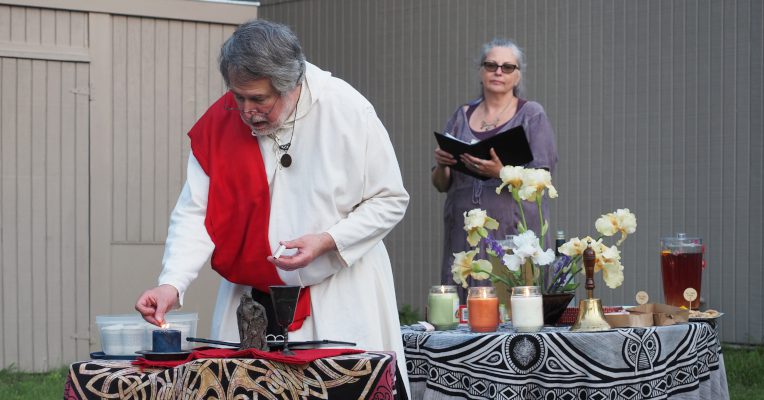
doing what a priest does – Beltane 2022
Understand the title you’re claiming
What does it mean to be a priest or a shaman or a Druid or a person who has any other religious title?
What’s the job description?
What do people who carry these titles do?
In what context do they do it?
Too many people claim a title without understanding what’s involved. They just want to be that, so the call themselves that, with little thought to whether it fits them or not. Do some research and study – and some self-reflection – first.
The worst I’ve seen of this is when someone picks a word from a language that sounds exotic to them – sometimes Latin, sometimes Irish (which is a living language) – and says “this is what I am.” Even if they pick a relevant word, it has no real connection to what they do or to the people who speak that language. It just sounds cool.
If you feel the need to make up a title to describe what you do, you probably need to do a lot more research into your tradition, and a lot more reading in comparative religions. And then pick a word in your own language.
Self-given titles carry no authority
In the wider world, titles often come with authority. The Chosen Chief of OBOD has near-absolute authority on matters concerning the Order’s structure and curriculum. The Archdruid of ADF has much more limited authority, but still has considerable power within what is a democratic organization. Both leaders’ authority comes from their Orders and only exists within those Orders.
Self-given titles carry no authority beyond the person who claims them. You would think that would be obvious, but I’ve encountered plenty of people who acted as though because they call themselves a priest or a priestess then everyone else should defer to them. It doesn’t work that way.

So, are self-given titles valid?
For me, it comes down to one simple thing: do the deeds match the words?
Do you do the things that other people who carry that title do, and do you do them with a suitable degree of competence and commitment? Do you do them in a comparable context?
If the answer is yes, then the title is valid.
If the answer is no, then it’s probably not.
If a self-given title gives someone the confidence they need to take on new or additional responsibilities, that’s a good thing. If it acknowledges that someone is already doing the work, it’s a good thing.
If it gives someone an excuse for narcissistic and controlling behavior, then it’s a bad thing.
Focus on the work. The titles will take care of themselves.
Previous Post

June 19, 2022
Which God are White Christian Nationalists Praying To?
Next Post

June 24, 2022 We Have Only the Rights the Majority Deigns to Give Us
Browse Our Archives
Select a Category Books Community CUUPS Druidry Foundations and Context Gods and Goddesses Magic Myth Nature Ritual Spiritual Practice Theology Travel Uncategorized Videos
Select a Month October 2026 September 2026 August 2026 July 2026 June 2026 May 2026 April 2026 March 2026 February 2026 January 2026 December 2025 November 2025 October 2025 September 2025 August 2025 July 2025 June 2025 May 2025 April 2025 March 2025 February 2025 January 2025 December 2024 November 2024 October 2024 September 2024 August 2024 July 2024 June 2024 May 2024 April 2024 March 2024 February 2024 January 2024 December 2023 November 2023 October 2023 September 2023 August 2023 July 2023 June 2023 May 2023 April 2023 March 2023 February 2023 January 2023 December 2022 November 2022 October 2022 September 2022 August 2022 July 2022 June 2022 May 2022 April 2022 March 2022 February 2022 January 2022 December 2021 November 2021 October 2021 September 2021 August 2021 July 2021 June 2021 May 2021 April 2021 March 2021 February 2021 January 2021 December 2020 November 2020 October 2020 September 2020 August 2020 July 2020 June 2020 May 2020 April 2020 March 2020 February 2020 January 2020 December 2019 November 2019 October 2019 September 2019 August 2019 July 2019 June 2019 May 2019 April 2019 March 2019 February 2019 January 2019 December 2018 November 2018 October 2018 September 2018 August 2018 July 2018 June 2018 May 2018 April 2018 March 2018 February 2018 January 2018 December 2017 November 2017 October 2017 September 2017 August 2017 July 2017 June 2017 May 2017 April 2017 March 2017 February 2017 January 2017 December 2016 November 2016 October 2016 September 2016 August 2016 July 2016 June 2016 May 2016 April 2016 March 2016 February 2016 January 2016 December 2015 November 2015 October 2015 September 2015 August 2015 July 2015 June 2015 May 2015 April 2015 March 2015 February 2015 January 2015 December 2014 November 2014 October 2014 September 2014 August 2014 July 2014 June 2014 May 2014 April 2014 March 2014 February 2014 January 2014 December 2013 November 2013 October 2013 September 2013 August 2013 July 2013 June 2013 May 2013 April 2013 March 2013 February 2013 January 2013 December 2012 November 2012 October 2012 September 2012 August 2012 July 2012 June 2012 May 2012 April 2012 March 2012 February 2012 January 2012 December 2011 November 2011 October 2011 September 2011 August 2011 July 2011 June 2011 May 2011 April 2011 March 2011 February 2011 January 2011 December 2010 November 2010 October 2010 September 2010 August 2010 July 2010 June 2010 May 2010 April 2010 March 2010 February 2010 January 2010 December 2009 November 2009 October 2009 September 2009 August 2009 July 2009 June 2009 May 2009 April 2009 March 2009 February 2009 January 2009 December 2008 November 2008 October 2008 September 2008 August 2008 July 2008 June 2008
Follow Us!
TAKE THE
Religious Wisdom Quiz
True or False: Jonathan was David's best friend and King Saul's son.
Select your answer to see how you score.
FALSE TRUE
Related posts from John Beckett


The Vampire Films of Jean Rollin


Bo French Doesn’t Understand Texas
TRENDING AT PATHEOS Pagan

The Sermon on the Mount, Part I: Matthew...
The Sermon on the Mount, Part I (Matthew 4:12-5:12) St. Matthew moves...

What's up from Crossway: Reviewing some of their latest A few weeks...

Janie Learns the Way of the Cross: A...
Teaching children about Jesus' Passion can be challenging. Many parents and educators...

Looking For Good Catholic Writing - October 2026
He alone extends the heavens, and he walks upon the waves of...

In "Irreplaceable," our book on vocation and technology, Trevor Sutton and I...

I was strolling through the top floor of the brand new Parthenon...
view all Pagan blogs
Ad-Free & Subscriber Log-In Subscription Support
- About Us
- 2026 Calendar
- Videos
- Podcasts
- Library of World Religions
- Faith In Media Tracker
- Advertise With Us
- Write for Us
- Privacy Policy
- Terms of Service
- Do Not Sell My Data
- Contact Us
- Radiant Digital
- Manage Newsletter Subscriptions
- Unsubscribe From Notifications
- Sitemap
Copyright 2008-2026, Patheos. All rights reserved.
Subscription Support Ad-Free & Subscriber Log-In
Follow Patheos