
BuddhistCatholicContemplativeEvangelicalGeneral ChristianHinduJewishLatter-day SaintMuslimNew VisionsProgressive Christian
Beliefs
- Buddhist
- Catholic
- Contemplative
- Evangelical
- General Christian
- Hindu
- Jewish
- Latter-day Saint
- More Voices
- Muslim
- New Visions
- Pagan
- Progressive Christian
Topics
- Religion News
- Food and Religion
- Sports and Religion
- Religious Art
- Religious Music and Entertainment
- Religious Events
- History and Religion
- Style and Religion
- Politics and Religion
- Women in Religion
- Recreation Outdoors and Religion
- Business Finance and Religion
- Careers Workplace and Religion
- Education and Religion
- Family Parenting and Religion
- Health Fitness and Religion
- Home and Religion
- Relationships and Religion
- Technology and Religion
- Travel and Religion
Columnists
- Buddhist Columnists
- Business Finance and Religion Columnists
- Careers Workplace and Religion Columnists
- Catholic Columnists
- Contemplative Columnists
- Education and Religion Columnists
- Evangelists Columnists
- Family Parenting and Religion Columnists
- General Christian Columnists
- Health Fitness and Religion Columnists
- Hindu Columnists
- History and Religion Columnists
- Home and Religion Columnists
- Jewish Columnists
- More Voices Columnists
- Latter Day Columnists
- Muslim Columnists
- New Visions Columnists
- Nonreligious Columnists
- Pagan Columnists
- Politics and Religion Columnists
- Progressive Columnists
- Recreation Outdoors and Religion Columnists
- Relationships and Religion Columnists
- Religion News Columnists
- Religious Art Columnists
- Religious Events Columnists
- Religious Music and Entertainment Columnists
- Sports and Religion Columnists
- Style and Religion Columnists
- Technology and Religion Columnists
- Travel and Religion Columnists
- Women in Religion Columnists
Resource Library
- 2026 Calendar
- Library of World Religions
- The 100 Most Holy Places on Earth
- Patheos Answers
- Podcasts
- Videos
- Faith Leaders Database
- Anglican Episcopalian
- Bahai
- Baptist
- Buddhism
- Christianity
- Confucianism
- Eastern Orthodoxy
- Hinduism
- Holiness and Pentecostal
- ISKCON
- Islam
- Judaism
- Lutheran
- Methodist
- The Church of Jesus Christ of Latter-day Saints
- New Age
- Paganism
- Presbytarian and Reformed
- Protestantism
- Religion Behind the Scenes
- Roman Catholic
- Scientology
- Shia Islam
- Sikhism
- Sufism
- Sunni Islam
- Taoism
- Zen
- See all religions
Research Tools
 Ad-Free & Subscriber Log-In Subscription Support
Ad-Free & Subscriber Log-In Subscription Support
Follow Patheos 

- Trending:
- Forgiveness
- |
- Marriage
- |
- Consciousness
- |
- Death Penalty
- |
- Election
- |
- Halloween

- Home
- Pagan
- Paganism: No Calls Required
Paganism: No Calls Required
Last updated on: February 17, 2022 at 3:00 am by John Beckett
Paganism: No Calls Required 2022-02-14T19:37:03-06:00 John Beckett
Patheos Explore the world's faith through different perspectives on religion and spirituality! Patheos has the views of the prevalent religions and spiritualities of the world.
For what seemed like many years, the battle cry in the wider Pagan community was “you can’t tell me what to do!”
I rarely bother to tell anyone what to do because I know I have zero power to force them to do it. I often try to make a case for why doing this or that would be in someone’s best interests, but in the end whether they do it or not is up to them, as it should be.
Now it seems like the battle cry has shifted to “you can’t do that!”
This trend has taken a legitimate concern over cultural appropriation and blown it way out of proportion. Now anything and everything is called a “closed practice.” Or they say there’s a problem with someone associated with a tradition or a practice – a problem that may or may not have a factual basis – and so the whole tradition is now off limits.
I would blame it on TikTok, but I’m not on TikTok, and I see it on Twitter and Facebook. So it’s not just a TikTok thing.
And that leads to a question that showed up in my in-box last week:
This seems to be coming around a lot in groups. People are telling others that you must “hear a call” to be involved in anything Pagan, polytheist, or Wiccan. I’m wondering what your take is on this for people who do not hear a call? Is that required?
My short answer is this: no, no, and no!

Follow the path you’re called to
I frequently tell people “follow the path you’re called to.” This doesn’t mean a literal call… or at least, it doesn’t mean that the vast majority of the time.
For most of human history, people followed the religion of their parents, grandparents, and their parents before them. Their religion wasn’t something they believed, it was something they did and something they were. That’s still the case for some people in some traditions.
But we in the West live in the most religiously diverse culture in the history of the world. Many religions and traditions are actively seeking converts. Most – though not all – will welcome you if you have an interest.
Those of us who are dissatisfied with the religion of our childhood (often with good reason) have plenty of options. Where do we start?
What looks interesting? What looks like it aligns with your values? Whose stories resonate with you? Which God or Goddess do you need in your life?
When we find something that matches what we’re looking for, we often say we’re called to it. That’s not a literal call. It’s not an invitation from Cernunnos or the Morrigan, or for that matter from the Buddha or from Richard Dawkins.
A calling is a metaphor for a close match between your religious orientation and interests and the beliefs and practices of an existing or emerging tradition. It’s not a literal call.
Calls from Gods are amazing but not required
Which is not to say that literal calls don’t exist – they do. They’re powerful, they’re amazing, and they’re terrifying.
But they’re not the norm for polytheist religion, and they’re definitely not common for Paganism in general.
All that is required to be a polytheist is to worship one or more of the many Gods. That’s it. Many people talk about being called by this God or that Goddess. Some of those calls fit the definition in the previous section: the call is a match between what’s known about the God (through lore or through contemporary experience) and the interests of the person in question.
That type of call is absolutely valid. You do not need an invitation to worship Cernunnos. All you need is a resonance with the Lord of the Animals and Lord of the Hunt, a desire to embrace wildness, and a love for the natural world. And then a commitment to pray, meditate, make offerings, and perform other acts of devotion and service.
Most times when you approach a God in reverence, They respond. But not always, and not to everyone. Some people have a hard time hearing the Gods. That doesn’t mean their worship is inappropriate or unwanted – it just means they have a hard time discerning the subtle messages that are Their preferred form of communication. But the worship these people offer is just as valid and can be just as meaningful as anyone else’s.
Do you need a literal call to become a priest of a deity? You need something – you can’t just declare yourself to be a priest. Not that people don’t do that, because some do. But could that call be more of a gradual drawing closer in service to a God and less of a specific message? I tend to think it could.
But for the purposes of this question, no call is required to be a polytheist.
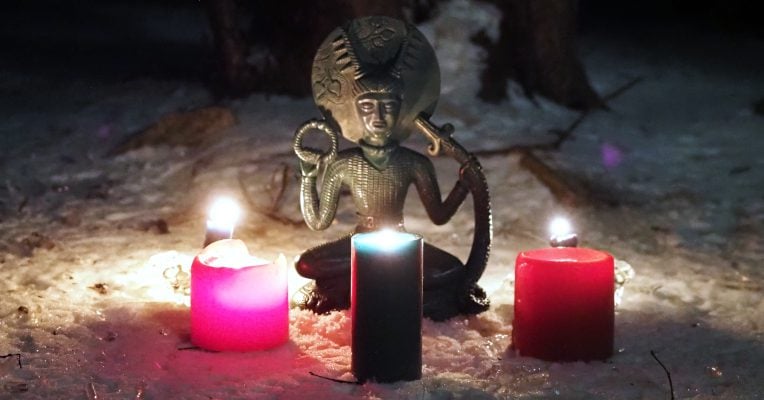
Individual groups may require an invitation
The original question mentioned Wicca. You do need an invitation to join a Wiccan coven – they’re private groups with their own requirements for membership. It’s the same for Wiccan traditions like the Gardnerians and the Alexandrians.
But the majority of Wiccans today are solitary practitioners who learned Wicca from books and from other solitary Wiccans. You don’t need a call to buy Raymond Buckland’s books – or Jason Mankey’s, or Thorn Mooney’s. You don’t need a call to practice what you learn in them.
You don’t need an invitation to become an OBOD Druid, but you do need to join the order, and then to work through the study program. Groups, organizations, and traditions have the right to draw their own boundaries and to set their own requirements for membership. No one is entitled to membership in any group, and acting like you’re entitled to it is a good way to get the door slammed in your face.
Beyond that, no one is a good fit for every group. If a group doesn’t want me, I’m better off knowing that up front rather than figuring it out after I’ve invested weeks or months with them.
People want something that’s theirs
I have no patience with people who just want to feel special and who make up silly ahistorical tests to exclude others. I wrote about gatekeeping a couple years ago in response to people like this.
On the other hand, I understand people who want something that’s theirs. They want a place where they belong, where their values are affirmed and worshipping their Gods in their way is a given.
I’d like to have that too. But not so that I can exclude those who haven’t heard the same kind of calls I’ve heard. Rather, so we can help others to be ready to hear those calls when they come, and to provide a home for those who never hear such calls but who love our Gods and share our values just the same.
We will never get those places by throwing up irrelevant gates around broad movements like Paganism, polytheism, and Wicca. We will only get them by building them.

No calls required
Paganism is a movement, not an institution. As such, it has no boundaries – only centers. On one hand, that makes Paganism difficult if not impossible to define. On the other hand, that means gatekeeping such as described here is nonsensical.
Polytheism is also a movement, though it can be defined at a generic level. In 2015 we killed a lot of pixels – and a few friendships – debating the boundaries of polytheism. But nowhere in that debate was anything about “you must be called.” And the idea of Gods calling people was extremely uncommon in ancient times.
Individual Pagan and/or polytheist traditions set their own boundaries. Some of them may require calls from Gods or spirits. But those are few. More common is the expectation that if you want to be a part of a tradition, you feel a call in that “alignment of interests” sense to the extent that you’re willing to embrace and support the tradition.
But in every group I know, the test isn’t “were you called?” but “are you willing to commit?”
As an experienced practitioner, it’s easy for me to roll my eyes at people who obviously don’t know what they’re talking about trying to keep people out of traditions they’re not a part of in the first place. But as the question in my in-box shows, some people are concerned about these claims. They wonder if they’re doing something wrong, or trying to do something that simply can’t be done.
They aren’t.
The people who promote these gatekeeping ideas – for whatever reason – are harming other people, and they’re harming our religious and spiritual movements.
As I said at the beginning of this post, I have no power to make them stop.
But I can tell them and everyone else just how wrong they are.
Previous Post

February 15, 2022
Explaining Paganism to the Curious but Religiously Ignorant
Next Post

February 20, 2022 Magic is Fun!
Browse Our Archives
Select a Category Books Community CUUPS Druidry Foundations and Context Gods and Goddesses Magic Myth Nature Ritual Spiritual Practice Theology Travel Uncategorized Videos
Select a Month October 2026 September 2026 August 2026 July 2026 June 2026 May 2026 April 2026 March 2026 February 2026 January 2026 December 2025 November 2025 October 2025 September 2025 August 2025 July 2025 June 2025 May 2025 April 2025 March 2025 February 2025 January 2025 December 2024 November 2024 October 2024 September 2024 August 2024 July 2024 June 2024 May 2024 April 2024 March 2024 February 2024 January 2024 December 2023 November 2023 October 2023 September 2023 August 2023 July 2023 June 2023 May 2023 April 2023 March 2023 February 2023 January 2023 December 2022 November 2022 October 2022 September 2022 August 2022 July 2022 June 2022 May 2022 April 2022 March 2022 February 2022 January 2022 December 2021 November 2021 October 2021 September 2021 August 2021 July 2021 June 2021 May 2021 April 2021 March 2021 February 2021 January 2021 December 2020 November 2020 October 2020 September 2020 August 2020 July 2020 June 2020 May 2020 April 2020 March 2020 February 2020 January 2020 December 2019 November 2019 October 2019 September 2019 August 2019 July 2019 June 2019 May 2019 April 2019 March 2019 February 2019 January 2019 December 2018 November 2018 October 2018 September 2018 August 2018 July 2018 June 2018 May 2018 April 2018 March 2018 February 2018 January 2018 December 2017 November 2017 October 2017 September 2017 August 2017 July 2017 June 2017 May 2017 April 2017 March 2017 February 2017 January 2017 December 2016 November 2016 October 2016 September 2016 August 2016 July 2016 June 2016 May 2016 April 2016 March 2016 February 2016 January 2016 December 2015 November 2015 October 2015 September 2015 August 2015 July 2015 June 2015 May 2015 April 2015 March 2015 February 2015 January 2015 December 2014 November 2014 October 2014 September 2014 August 2014 July 2014 June 2014 May 2014 April 2014 March 2014 February 2014 January 2014 December 2013 November 2013 October 2013 September 2013 August 2013 July 2013 June 2013 May 2013 April 2013 March 2013 February 2013 January 2013 December 2012 November 2012 October 2012 September 2012 August 2012 July 2012 June 2012 May 2012 April 2012 March 2012 February 2012 January 2012 December 2011 November 2011 October 2011 September 2011 August 2011 July 2011 June 2011 May 2011 April 2011 March 2011 February 2011 January 2011 December 2010 November 2010 October 2010 September 2010 August 2010 July 2010 June 2010 May 2010 April 2010 March 2010 February 2010 January 2010 December 2009 November 2009 October 2009 September 2009 August 2009 July 2009 June 2009 May 2009 April 2009 March 2009 February 2009 January 2009 December 2008 November 2008 October 2008 September 2008 August 2008 July 2008 June 2008
Follow Us!
TAKE THE
Religious Wisdom Quiz
What does the Greek word 'Logos' mean in the Bible?
Select your answer to see how you score.
Word Life Grace Truth
Related posts from John Beckett




What We Lose When “Ask AI” Becomes A...
TRENDING AT PATHEOS Pagan

The Sermon on the Mount, Part I: Matthew...
The Sermon on the Mount, Part I (Matthew 4:12-5:12) St. Matthew moves...

What's up from Crossway: Reviewing some of their latest A few weeks...

Janie Learns the Way of the Cross: A...
Teaching children about Jesus' Passion can be challenging. Many parents and educators...

Looking For Good Catholic Writing - October 2026
He alone extends the heavens, and he walks upon the waves of...

In "Irreplaceable," our book on vocation and technology, Trevor Sutton and I...

I was strolling through the top floor of the brand new Parthenon...
view all Pagan blogs
Ad-Free & Subscriber Log-In Subscription Support
- About Us
- 2026 Calendar
- Videos
- Podcasts
- Library of World Religions
- Faith In Media Tracker
- Advertise With Us
- Write for Us
- Privacy Policy
- Terms of Service
- Do Not Sell My Data
- Contact Us
- Radiant Digital
- Manage Newsletter Subscriptions
- Unsubscribe From Notifications
- Sitemap
Copyright 2008-2026, Patheos. All rights reserved.
Subscription Support Ad-Free & Subscriber Log-In
Follow Patheos