
BuddhistCatholicContemplativeEvangelicalGeneral ChristianHinduJewishLatter-day SaintMuslimNew VisionsProgressive Christian
Beliefs
- Buddhist
- Catholic
- Contemplative
- Evangelical
- General Christian
- Hindu
- Jewish
- Latter-day Saint
- More Voices
- Muslim
- New Visions
- Pagan
- Progressive Christian
Topics
- Religion News
- Food and Religion
- Sports and Religion
- Religious Art
- Religious Music and Entertainment
- Religious Events
- History and Religion
- Style and Religion
- Politics and Religion
- Women in Religion
- Recreation Outdoors and Religion
- Business Finance and Religion
- Careers Workplace and Religion
- Education and Religion
- Family Parenting and Religion
- Health Fitness and Religion
- Home and Religion
- Relationships and Religion
- Technology and Religion
- Travel and Religion
Columnists
- Buddhist Columnists
- Business Finance and Religion Columnists
- Careers Workplace and Religion Columnists
- Catholic Columnists
- Contemplative Columnists
- Education and Religion Columnists
- Evangelists Columnists
- Family Parenting and Religion Columnists
- General Christian Columnists
- Health Fitness and Religion Columnists
- Hindu Columnists
- History and Religion Columnists
- Home and Religion Columnists
- Jewish Columnists
- More Voices Columnists
- Latter Day Columnists
- Muslim Columnists
- New Visions Columnists
- Nonreligious Columnists
- Pagan Columnists
- Politics and Religion Columnists
- Progressive Columnists
- Recreation Outdoors and Religion Columnists
- Relationships and Religion Columnists
- Religion News Columnists
- Religious Art Columnists
- Religious Events Columnists
- Religious Music and Entertainment Columnists
- Sports and Religion Columnists
- Style and Religion Columnists
- Technology and Religion Columnists
- Travel and Religion Columnists
- Women in Religion Columnists
Resource Library
- 2026 Calendar
- Library of World Religions
- The 100 Most Holy Places on Earth
- Patheos Answers
- Podcasts
- Videos
- Faith Leaders Database
- Anglican Episcopalian
- Bahai
- Baptist
- Buddhism
- Christianity
- Confucianism
- Eastern Orthodoxy
- Hinduism
- Holiness and Pentecostal
- ISKCON
- Islam
- Judaism
- Lutheran
- Methodist
- The Church of Jesus Christ of Latter-day Saints
- New Age
- Paganism
- Presbytarian and Reformed
- Protestantism
- Religion Behind the Scenes
- Roman Catholic
- Scientology
- Shia Islam
- Sikhism
- Sufism
- Sunni Islam
- Taoism
- Zen
- See all religions
Research Tools
 Ad-Free & Subscriber Log-In Subscription Support
Ad-Free & Subscriber Log-In Subscription Support
Follow Patheos 

- Trending:
- Forgiveness
- |
- Marriage
- |
- Consciousness
- |
- Death Penalty
- |
- Election
- |
- Halloween

- Home
- Pagan
- The Dawn of Everything: A New History of Humanity
The Dawn of Everything: A New History of Humanity
Last updated on: November 30, 2021 at 3:00 am by John Beckett
The Dawn of Everything: A New History of Humanity 2021-11-29T16:00:31-06:00 John Beckett
Patheos Explore the world's faith through different perspectives on religion and spirituality! Patheos has the views of the prevalent religions and spiritualities of the world.
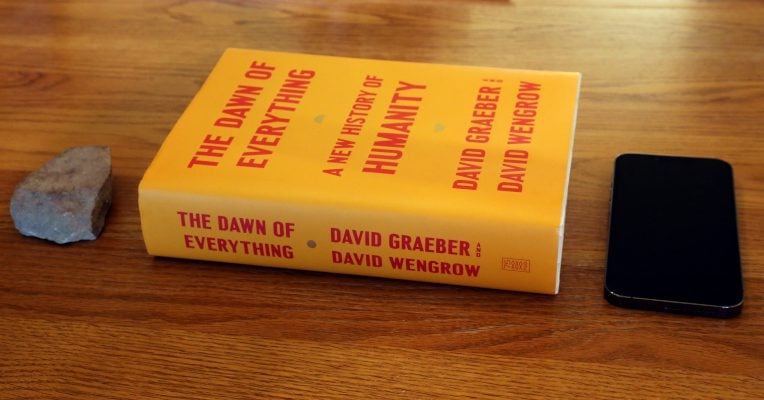
The Dawn of Everything: A New History of Humanity
by David Graeber and David Wengrow
Farrar, Straus and Giroux – November 2021
704 pages
Hardback: $35.00, Kindle: $16.99
A book with the title The Dawn of Everything is nothing if not ambitious. One with 526 pages of text, 84 pages of end notes, and 63 pages of bibliography is nothing if not exhaustive. And when it begins with the question “why does inequality exist?” you know you’re not dealing with your typical history book.
“The Dawn of Everything” is perhaps an overly broad title. Graeber and Wengrow quickly acknowledge the impossibility of answering the question of why inequality exists (because the definition of “equality” is largely dependent on cultural context) and move to examining questions of hierarchy, governmental systems, food supplies, and ultimately, freedom.
The book presents clear evidence that the way things are today – a hierarchical blend of oligarchy and representative democracy – was not inevitable and is not the only way things could have turned out.
Before you can create a new way of living, someone must first imagine it. This has happened over and over again throughout the history and prehistory of humanity. The Dawn of Everything does not imagine a new way of living. Rather, it provides ample evidence that different ways of living are possible, because humans have lived and governed ourselves in many different ways in the past. In doing so, it frees our imaginations to begin looking for new ways to solve societal problems.
That alone is worth the price of the book.
History is written by the winners – and by people who think like the winners
The most popular negative review on Amazon calls The Dawn of Everything “woke revisionism.” I suspect this person hasn’t actually read the book. Or if they have, they’re so wedded to what they’ve always assumed are “the way things are supposed to be” that they’re incapable of examining evidence to the contrary.
We’ve always been taught (or at least, I was) that humanity progressed from “primitive” hunter-gatherers who were mostly egalitarian to tribal societies organized around chiefs and elders. Then people developed agriculture, which led to settled societies. The surpluses agriculture created allowed for some to have more than others, which led to private property, which led to governments to manage those surpluses and to keep people in line, which in turn led to organized religions, priests, kings, and the beginning of “proper” civilization.
The Dawn of Everything shows that’s not the way things happened. Rather, our history (and especially our prehistory) has been written by the descendants of the Roman Empire who focused their attention on those parts of history that fit their preferred narrative.
What they’ve left out is critical.
Humans have been more or less the same for 200,000 years
Whether you’re talking about an early example of homo sapiens sapiens hunting on the plains of Africa, a pre-Columbian Native American, or a 21st century Englishman, you’re talking about the same creatures. Our bodies have changed slightly but not significantly. We’re them and they’re us.
So when we think of people in other human societies as “primitive” or “childlike” or “naïve” we’re making a mistake – one born primarily from a desire to justify colonial exploitation. We can’t see what’s there because we can’t imagine that it could be there. It’s like those who insist the pyramids must have been built by space aliens, because the ancient Egyptians couldn’t possibly have built something so advanced. And yet they did.
And so did many other societies.

Uxmal – built by the Maya
Humans have lived in many socio-political arrangements over the millennia
There was no Garden of Eden – not literally and not metaphorically either.
Yes, there were the stereotypical nomadic hunter-gatherers. But people started living in settled places not long after the end of the last ice age. If you have a place where there’s plenty of fresh water, plenty of game animals, and plenty of edible plants, why wouldn’t people settle there?
And once they started settling, they used many different ways to organize themselves. Some had kings with the power of life and death. Some used a consensus method to make decisions. And some – the evidence strongly suggests – had no government at all.
This is perhaps the most interesting part of The Dawn of Everything: all the accounts of all the societies around the world and all their different ways of living. Size doesn’t seem to matter – larger societies don’t automatically require more coercive coordination.
Hierarchy was not inevitable. But somewhere along the way, we stepped into hierarchy, and we got stuck.
What does it mean to be free?
Having decided that the question of inequality is impossible to answer, Graeber and Wengrow instead tackle the question of freedom. In particular, what did “freedom” mean to people living in prehistoric times?
They identify three “primordial freedoms” – the freedom to move, the freedom to disobey orders, and the freedom to create or transform social relationships. Many of the early chiefs and kings were leaders with little real power to compel others. While people might follow them in times of war, in times of peace they would simply ignore commands they didn’t like. Many of the “primitive” restrictions on leaders were intended to keep any one person or family from gaining too much power over others.
So, what happened? A lot, to be fair. But in an almost-throwaway comment, Graeber and Wengrow blame it on bureaucracy: “when promises become impersonal, transferable … one of the most fundamental building blocks of social life corrupted by a confluence of maths and violence.”
Or, as novelist Terry Pratchett said, “sin is when you treat people like things.”
“Western” ideas about freedom and democracy owe much to Native American philosophers
We usually think of freedom as a product of the European enlightenment – certainly that’s where contemporary conservatives tell us it comes from. But our ideas about freedom would be out of place in early modern Europe, where aristocracy and the divine right of kings were still in full swing.
When the French began to colonize what is now Canada in the late 1600s, they sent Jesuits to convert the natives to Christianity. Their success was mixed, but the records they kept provide an important look into the thinking of the people they encountered.
The Dawn of Everything quotes from the records of conversations between a French military officer named Louis-Armand Lahontan and a Wendat diplomat named Kandiaronk, who provided a stark critique of European society. Here are a few quotes.
What kind of human, what species of creature, must Europeans be, that they have to be forced to do good, and only refrain from evil because of fear of punishment?
I have spent six years reflecting on the state of European society and I still can’t think of a single way they act that’s not inhuman, and I genuinely think this can only be the case, as long as you stick to your distinctions of “mine” and “thine”. I affirm that what you call money is the devil of devils, the tyrant of the French, the source of all evils.
Over and over I have set forth the qualities that we Wendat believe ought to define humanity – wisdom, reason, equity – and demonstrated that the existence of separate material interests knocks all of these on the head. A man motivated by interest cannot be a man of reason.
Graeber and Wengrow examine the charges that these records were exaggerated to create a “noble savage.” And then they provide examples of similar discourse from Western society, showing that while the Native critique is imperfect, it is entirely reasonable and likely to be historically accurate.
Or, what happens when you organize a society around the happiness of its members and not around material gain?

The weaknesses of The Dawn of Everything
This book is not perfect. It devotes virtually nothing to the actual dawn of humanity, then bounces around the past 10,000 years or so in an anecdotal way. It devotes its longest chapter to “why the state has no origin” without directly proposing an answer. It makes a strong case that the way things are was not inevitable, but spends very little time on why they are way they are – besides blaming it on Roman Law and its concept of freedom as “the power of the individual (by implication, a male head of household) to dispose of his property as he sees fit” – and his property included his wife, his children, and his slaves.
It touches only briefly on the difference between “formal” freedoms (what is legal – what it is theoretically possible for someone to do) and “substantive” freedoms (what someone can actually do).
Finally, as with so much academic work, it does a very good job of presenting the facts and defining the problem, but a poor job of proposing a solution. I suppose that’s not the job of historians… though Graeber (who died in 2020 shortly after this book was completed) was an anthropologist and Wengrow is an archaeologist.
But these are minor complaints. The stories this book tells and the truth it reveals are insightful.
As textbooks sometimes say, the implementation of those insights is left as an exercise for the reader.
How can we be more free?
It is impossible to read The Dawn of Everything without wondering “are we free?” “Am I free?”
Our overflowing prisons and militarized borders scream that we are not.
My substantive freedoms – what I can actually do – are greater than they were ten years ago, to say nothing of what they were forty years ago. I have more money now than I did then, and in this society, money buys freedom.
Must it be that way? Should it be that way?
Are we too far down the road of money – what Kandiaronk called the devil of devils – to go back? I suspect we are, though I may be guilty of the very lack of imagination The Dawn of Everything attempts to correct.
Here’s what I learned in reading this book: throughout our existence, humans have lived in many different socio-political arrangements. None were inevitable. All were the products of their environment and of their choices – some conscious, many not.
None were permanent. If the conditions they produced were unsatisfactory for enough people, they would change them and try something else.
And we still can.
Previous Post

November 28, 2021
Intuitive Magic is More than Making Stuff Up
Next Post

December 2, 2021 The Currents of Magic are Getting Stronger
Browse Our Archives
Select a Category Books Community CUUPS Druidry Foundations and Context Gods and Goddesses Magic Myth Nature Ritual Spiritual Practice Theology Travel Uncategorized Videos
Select a Month October 2026 September 2026 August 2026 July 2026 June 2026 May 2026 April 2026 March 2026 February 2026 January 2026 December 2025 November 2025 October 2025 September 2025 August 2025 July 2025 June 2025 May 2025 April 2025 March 2025 February 2025 January 2025 December 2024 November 2024 October 2024 September 2024 August 2024 July 2024 June 2024 May 2024 April 2024 March 2024 February 2024 January 2024 December 2023 November 2023 October 2023 September 2023 August 2023 July 2023 June 2023 May 2023 April 2023 March 2023 February 2023 January 2023 December 2022 November 2022 October 2022 September 2022 August 2022 July 2022 June 2022 May 2022 April 2022 March 2022 February 2022 January 2022 December 2021 November 2021 October 2021 September 2021 August 2021 July 2021 June 2021 May 2021 April 2021 March 2021 February 2021 January 2021 December 2020 November 2020 October 2020 September 2020 August 2020 July 2020 June 2020 May 2020 April 2020 March 2020 February 2020 January 2020 December 2019 November 2019 October 2019 September 2019 August 2019 July 2019 June 2019 May 2019 April 2019 March 2019 February 2019 January 2019 December 2018 November 2018 October 2018 September 2018 August 2018 July 2018 June 2018 May 2018 April 2018 March 2018 February 2018 January 2018 December 2017 November 2017 October 2017 September 2017 August 2017 July 2017 June 2017 May 2017 April 2017 March 2017 February 2017 January 2017 December 2016 November 2016 October 2016 September 2016 August 2016 July 2016 June 2016 May 2016 April 2016 March 2016 February 2016 January 2016 December 2015 November 2015 October 2015 September 2015 August 2015 July 2015 June 2015 May 2015 April 2015 March 2015 February 2015 January 2015 December 2014 November 2014 October 2014 September 2014 August 2014 July 2014 June 2014 May 2014 April 2014 March 2014 February 2014 January 2014 December 2013 November 2013 October 2013 September 2013 August 2013 July 2013 June 2013 May 2013 April 2013 March 2013 February 2013 January 2013 December 2012 November 2012 October 2012 September 2012 August 2012 July 2012 June 2012 May 2012 April 2012 March 2012 February 2012 January 2012 December 2011 November 2011 October 2011 September 2011 August 2011 July 2011 June 2011 May 2011 April 2011 March 2011 February 2011 January 2011 December 2010 November 2010 October 2010 September 2010 August 2010 July 2010 June 2010 May 2010 April 2010 March 2010 February 2010 January 2010 December 2009 November 2009 October 2009 September 2009 August 2009 July 2009 June 2009 May 2009 April 2009 March 2009 February 2009 January 2009 December 2008 November 2008 October 2008 September 2008 August 2008 July 2008 June 2008
Follow Us!
TAKE THE
Religious Wisdom Quiz
What city is considered holy by Christians, Jews, and Muslims alike?
Select your answer to see how you score.
Antioch Jerusalem Rome Paris
Related posts from John Beckett




What We Lose When “Ask AI” Becomes A...
TRENDING AT PATHEOS Pagan

'Super Scam Me' Exposes AI Jon Bon Jovi...
Leslie Pickett believed she was in a relationship with Jon Bon Jovi....

The Brazilian Remake of Kendricks' 'Flywheel' Opens in...
“Flywheel,” the story that launched the Kendrick Brothers’ filmmaking career is getting...

The Dangers of Gradual Accommodation (Winking at Sin)
Recently, the “law of gradualness” resurfaced during the opening of a weeklong,...

The Iron Gates and the Lion of the...
Yesterday, I didn't finish my report about, well, yesterday. So I'll...

The Image: On the Horror of Capitalism and...
The Image Then went the Pharisees, and took counsel how they might...

We are approaching the date of our new American national holiday: October...
view all Pagan blogs
Ad-Free & Subscriber Log-In Subscription Support
- About Us
- 2026 Calendar
- Videos
- Podcasts
- Library of World Religions
- Faith In Media Tracker
- Advertise With Us
- Write for Us
- Privacy Policy
- Terms of Service
- Do Not Sell My Data
- Contact Us
- Radiant Digital
- Manage Newsletter Subscriptions
- Unsubscribe From Notifications
- Sitemap
Copyright 2008-2026, Patheos. All rights reserved.
Subscription Support Ad-Free & Subscriber Log-In
Follow Patheos