
BuddhistCatholicContemplativeEvangelicalGeneral ChristianHinduJewishLatter-day SaintMuslimNew VisionsProgressive Christian
Beliefs
- Buddhist
- Catholic
- Contemplative
- Evangelical
- General Christian
- Hindu
- Jewish
- Latter-day Saint
- More Voices
- Muslim
- New Visions
- Pagan
- Progressive Christian
Topics
- Religion News
- Food and Religion
- Sports and Religion
- Religious Art
- Religious Music and Entertainment
- Religious Events
- History and Religion
- Style and Religion
- Politics and Religion
- Women in Religion
- Recreation Outdoors and Religion
- Business Finance and Religion
- Careers Workplace and Religion
- Education and Religion
- Family Parenting and Religion
- Health Fitness and Religion
- Home and Religion
- Relationships and Religion
- Technology and Religion
- Travel and Religion
Columnists
- Buddhist Columnists
- Business Finance and Religion Columnists
- Careers Workplace and Religion Columnists
- Catholic Columnists
- Contemplative Columnists
- Education and Religion Columnists
- Evangelists Columnists
- Family Parenting and Religion Columnists
- General Christian Columnists
- Health Fitness and Religion Columnists
- Hindu Columnists
- History and Religion Columnists
- Home and Religion Columnists
- Jewish Columnists
- More Voices Columnists
- Latter Day Columnists
- Muslim Columnists
- New Visions Columnists
- Nonreligious Columnists
- Pagan Columnists
- Politics and Religion Columnists
- Progressive Columnists
- Recreation Outdoors and Religion Columnists
- Relationships and Religion Columnists
- Religion News Columnists
- Religious Art Columnists
- Religious Events Columnists
- Religious Music and Entertainment Columnists
- Sports and Religion Columnists
- Style and Religion Columnists
- Technology and Religion Columnists
- Travel and Religion Columnists
- Women in Religion Columnists
Resource Library
- 2026 Calendar
- Library of World Religions
- The 100 Most Holy Places on Earth
- Patheos Answers
- Podcasts
- Videos
- Faith Leaders Database
- Anglican Episcopalian
- Bahai
- Baptist
- Buddhism
- Christianity
- Confucianism
- Eastern Orthodoxy
- Hinduism
- Holiness and Pentecostal
- ISKCON
- Islam
- Judaism
- Lutheran
- Methodist
- The Church of Jesus Christ of Latter-day Saints
- New Age
- Paganism
- Presbytarian and Reformed
- Protestantism
- Religion Behind the Scenes
- Roman Catholic
- Scientology
- Shia Islam
- Sikhism
- Sufism
- Sunni Islam
- Taoism
- Zen
- See all religions
Research Tools
 Ad-Free & Subscriber Log-In Subscription Support
Ad-Free & Subscriber Log-In Subscription Support
Follow Patheos 

- Trending:
- Forgiveness
- |
- Marriage
- |
- Consciousness
- |
- Death Penalty
- |
- Election
- |
- Halloween

- Home
- Pagan
- Why I Read Tarot For Divination
Why I Read Tarot For Divination
Last updated on: June 15, 2021 at 9:46 am by John Beckett
Why I Read Tarot For Divination 2021-06-15T09:46:05-06:00 John Beckett
Patheos Explore the world's faith through different perspectives on religion and spirituality! Patheos has the views of the prevalent religions and spiritualities of the world.
Last week freelance journalist and former Wild Hunt editor Heather Greene had an interesting piece on Religion News Services that got picked up by several large newspapers. It’s titled Tarot booms as Generation Z sorts out spiritual path. The subtitle says “Generation Z has been the driving force behind the renewed popularity and mainstreaming of the age-old esoteric system.”
I’m a long way from Gen Z – I’m a very late Boomer who’s always identified with Gen X. But I have a life-long interest in Tarot… even though it took me a long time to learn to read with it. I told that story a couple years ago. Heather’s article got me to thinking: why, exactly, do I read Tarot? Why not runes or Ogham or even a different form of cartomancy?
I don’t use Tarot for meditation or spiritual development. I respect those who work through the Fool’s Journey, but that’s not what I do. I read Tarot for two purposes.
The first is literal divination – ascertaining messages from the Divine. I’ve practiced ecstatic communion with my Gods for long enough that I recognize Their voices, but particularly when something is very important (especially if it’s very important for someone else) I want to be absolutely sure that what I’m hearing is Them and not me. Divination adds an objective element into the messaging. If I’m hearing something and the cards confirm it (often in an “of course that’s what I told you, now go do it” tone) then I’m confident I’m not just telling myself what I want to hear.
The second is looking into the future. “If you keep going down this path, here’s where you’re going to end up.” The cards can’t tell me if I should do that or not – why would you give away your agency to a deck of cards anyway? But they can give me more information so I can do a better job of deciding for myself what I should or shouldn’t do.
Still, I could do that with any divination system. Why do I read Tarot and not something else?
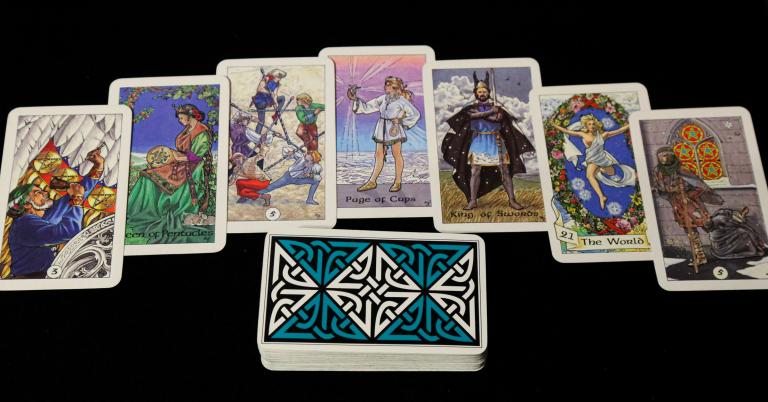
The Robin Wood Tarot
The aesthetic puts me in the right frame of mind
There’s something about a deck of Tarot cards that whispers “magic!”
Tarot begin in Italy in the late 1300s and early 1400s as tarocchi, a card game. It wasn’t long before people figured out they could use tarocchi cards for divination and fortune telling. It also wasn’t long before various churchmen decided they should be banned, particularly when some decks included The Pope and The Popess in them.
However the transition from game to divination happened, people have been reading Tarot cards for several hundred years. They show up in supernatural fiction – I’m pretty sure my first exposure to Tarot was in Dark Shadows. And at least on the better decks, the imagery is quite magical.
For all the efforts of some to reduce magic to technology (and there is value in studying magical tech) there is still a place for the aesthetics of magic – something that tells us we’re no longer in the ordinary world.
Being in the right frame of mind helps with anything, whether magical or mundane. It especially helps with divination.
A variety of decks for a variety of needs
The only consistency among Tarot decks over the centuries has been four suits of 14 cards plus 22 trumps, for a total of 78 cards. Most early decks only had illustrations on the trumps – what would become known as the Major Arcana. The suit cards simply had seven swords for the 7 of Swords and so on.
I occasionally hear people refer to the Waite-Smith deck as “the original Tarot.” It’s certainly the most widely used deck, but it’s rather new – it wasn’t published until 1909.
Most Tarot books are based on the Waite-Smith deck. But when I first started on my Pagan journey, I wanted something without its overt Christian imagery. I found the Robin Wood Tarot – it became my go-to deck for over 20 years. In recent years I’ve been using Kristoffer Hughes’ Celtic Tarot – I find it incredibly easy to read with.
I also have Aleister Crowley’s Thoth Tarot – I love the artwork but I struggle to read with it. And I have the Sola Busca Tarot. It’s one of the oldest decks in existence. It’s very different from most decks, and it tends to read rather unpleasantly. But there are times when dire situations call for dire decks.
As Heather pointed out in her article, there are many, many new Tarot decks these days – Llewellyn’s website has 38 pages of decks and related items. Whatever you’re looking for, there’s likely something for you.
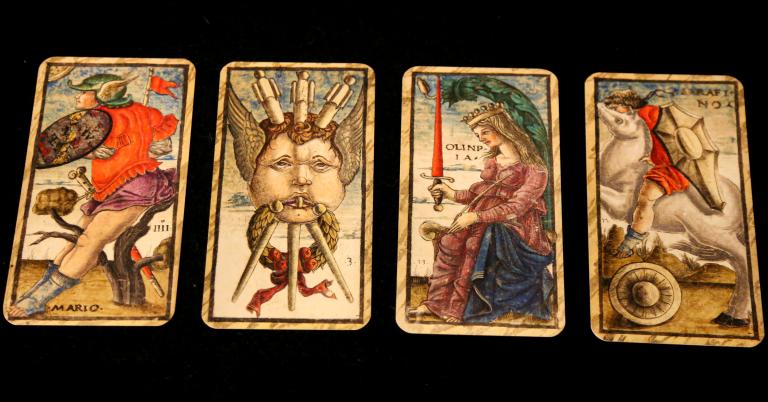
The Sola Busca Tarot
The imagery is easily understood
You could spend a lifetime trying to decipher the arcane meanings in Tarot artwork. Or, you could simply look at the cards and see what you see.
I often say we’re living in Tower Time – I taught an online class on the subject earlier this year. When we look at The Tower card, it’s easy to see the connection: lightning (a natural force) striking the Tower (a man-made edifice). The crown blown off the building and those in the Tower thrown from it to the ground. This is deep, but it isn’t particularly complicated.
What do you see? How does that relate to the question you asked at the beginning of the reading. No need to overthink things… and I say that as a certified overthinker. The pictures tell a story – just see what’s there.
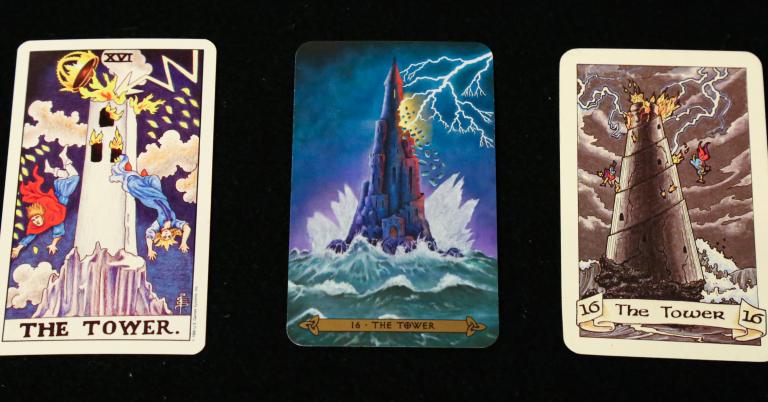
The Tower in Waite-Smith, Celtic Tarot, and Robin Wood
The imagery has depth
One of my favorite cards – or at least, one I strongly relate to – is the Eight of Cups. There’s so much here: the figure walking away, the eight cups left behind, the mountains in the distance, the waning crescent moon, and more.
This is why I prefer the more elaborate decks to the simpler ones. There are so many details to notice, and when one of them grabs your attention it’s usually important.
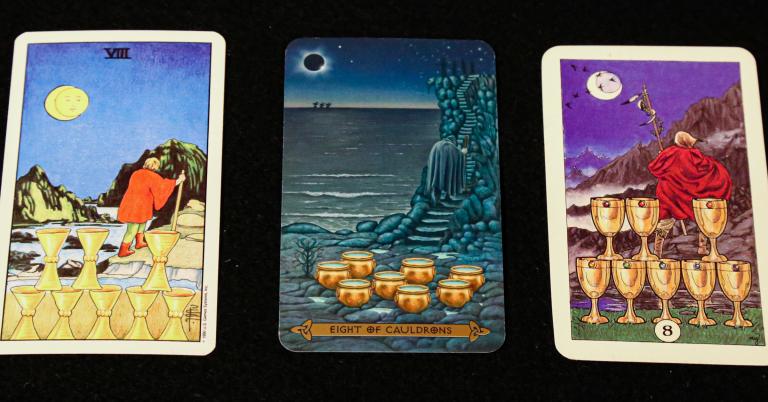
The 8 of Cups in Waite-Smith, Celtic Tarot, and Robin Wood
Because I get good results with it
All of these reasons are part of why I read Tarot when I need to do divination, but the biggest reason is that it works. I can get clear answers with Tarot that I simply can’t get with other divination system.
I learned Ogham as part of my Ovate studies – I still have my set. But every time I start thinking I should practice enough to read well with it, it occurs to me that I can already read well with Tarot. If I put that time into practicing Tarot I can be even better. I would love to have a bone set and learn to throw them well. But I would be starting from zero… with no guarantee of success.
Tarot works for me. And so it’s the divination system I use.
I’m a Tarot reader and a Tarot fan, but I’m not a Tarot evangelist. It’s the best divination system for me, but another system may work better for you. If you’re just beginning, try several and see which ones work best for you. If none of them blow you away at first (and that’s likely – any divination system requires study and practice) then pick the one that interests you most. Study it, practice it, and get some professional instruction if you can.
And then read as much as you can, as often as you can. As with any other skill, divination gets better with practice and worse with neglect.
Previous Post

April 29, 2021
Why I Block Every “Law of Attraction” Account I See
Next Post

May 4, 2021 There is Freedom in the Vastness of the Universe
Browse Our Archives
Select a Category Books Community CUUPS Druidry Foundations and Context Gods and Goddesses Magic Myth Nature Ritual Spiritual Practice Theology Travel Uncategorized Videos
Select a Month October 2026 September 2026 August 2026 July 2026 June 2026 May 2026 April 2026 March 2026 February 2026 January 2026 December 2025 November 2025 October 2025 September 2025 August 2025 July 2025 June 2025 May 2025 April 2025 March 2025 February 2025 January 2025 December 2024 November 2024 October 2024 September 2024 August 2024 July 2024 June 2024 May 2024 April 2024 March 2024 February 2024 January 2024 December 2023 November 2023 October 2023 September 2023 August 2023 July 2023 June 2023 May 2023 April 2023 March 2023 February 2023 January 2023 December 2022 November 2022 October 2022 September 2022 August 2022 July 2022 June 2022 May 2022 April 2022 March 2022 February 2022 January 2022 December 2021 November 2021 October 2021 September 2021 August 2021 July 2021 June 2021 May 2021 April 2021 March 2021 February 2021 January 2021 December 2020 November 2020 October 2020 September 2020 August 2020 July 2020 June 2020 May 2020 April 2020 March 2020 February 2020 January 2020 December 2019 November 2019 October 2019 September 2019 August 2019 July 2019 June 2019 May 2019 April 2019 March 2019 February 2019 January 2019 December 2018 November 2018 October 2018 September 2018 August 2018 July 2018 June 2018 May 2018 April 2018 March 2018 February 2018 January 2018 December 2017 November 2017 October 2017 September 2017 August 2017 July 2017 June 2017 May 2017 April 2017 March 2017 February 2017 January 2017 December 2016 November 2016 October 2016 September 2016 August 2016 July 2016 June 2016 May 2016 April 2016 March 2016 February 2016 January 2016 December 2015 November 2015 October 2015 September 2015 August 2015 July 2015 June 2015 May 2015 April 2015 March 2015 February 2015 January 2015 December 2014 November 2014 October 2014 September 2014 August 2014 July 2014 June 2014 May 2014 April 2014 March 2014 February 2014 January 2014 December 2013 November 2013 October 2013 September 2013 August 2013 July 2013 June 2013 May 2013 April 2013 March 2013 February 2013 January 2013 December 2012 November 2012 October 2012 September 2012 August 2012 July 2012 June 2012 May 2012 April 2012 March 2012 February 2012 January 2012 December 2011 November 2011 October 2011 September 2011 August 2011 July 2011 June 2011 May 2011 April 2011 March 2011 February 2011 January 2011 December 2010 November 2010 October 2010 September 2010 August 2010 July 2010 June 2010 May 2010 April 2010 March 2010 February 2010 January 2010 December 2009 November 2009 October 2009 September 2009 August 2009 July 2009 June 2009 May 2009 April 2009 March 2009 February 2009 January 2009 December 2008 November 2008 October 2008 September 2008 August 2008 July 2008 June 2008
Follow Us!
TAKE THE
Religious Wisdom Quiz
What does the Greek word 'Logos' mean in the Bible?
Select your answer to see how you score.
Word Life Grace Truth
Related posts from John Beckett




What We Lose When “Ask AI” Becomes A...
TRENDING AT PATHEOS Pagan

The Sermon on the Mount, Part I: Matthew...
The Sermon on the Mount, Part I (Matthew 4:12-5:12) St. Matthew moves...

What's up from Crossway: Reviewing some of their latest A few weeks...

Janie Learns the Way of the Cross: A...
Teaching children about Jesus' Passion can be challenging. Many parents and educators...

Looking For Good Catholic Writing - October 2026
He alone extends the heavens, and he walks upon the waves of...

In "Irreplaceable," our book on vocation and technology, Trevor Sutton and I...

I was strolling through the top floor of the brand new Parthenon...
view all Pagan blogs
Ad-Free & Subscriber Log-In Subscription Support
- About Us
- 2026 Calendar
- Videos
- Podcasts
- Library of World Religions
- Faith In Media Tracker
- Advertise With Us
- Write for Us
- Privacy Policy
- Terms of Service
- Do Not Sell My Data
- Contact Us
- Radiant Digital
- Manage Newsletter Subscriptions
- Unsubscribe From Notifications
- Sitemap
Copyright 2008-2026, Patheos. All rights reserved.
Subscription Support Ad-Free & Subscriber Log-In
Follow Patheos