
BuddhistCatholicContemplativeEvangelicalGeneral ChristianHinduJewishLatter-day SaintMuslimNew VisionsProgressive Christian
Beliefs
- Buddhist
- Catholic
- Contemplative
- Evangelical
- General Christian
- Hindu
- Jewish
- Latter-day Saint
- More Voices
- Muslim
- New Visions
- Pagan
- Progressive Christian
Topics
- Religion News
- Food and Religion
- Sports and Religion
- Religious Art
- Religious Music and Entertainment
- Religious Events
- History and Religion
- Style and Religion
- Politics and Religion
- Women in Religion
- Recreation Outdoors and Religion
- Business Finance and Religion
- Careers Workplace and Religion
- Education and Religion
- Family Parenting and Religion
- Health Fitness and Religion
- Home and Religion
- Relationships and Religion
- Technology and Religion
- Travel and Religion
Columnists
- Buddhist Columnists
- Business Finance and Religion Columnists
- Careers Workplace and Religion Columnists
- Catholic Columnists
- Contemplative Columnists
- Education and Religion Columnists
- Evangelists Columnists
- Family Parenting and Religion Columnists
- General Christian Columnists
- Health Fitness and Religion Columnists
- Hindu Columnists
- History and Religion Columnists
- Home and Religion Columnists
- Jewish Columnists
- More Voices Columnists
- Latter Day Columnists
- Muslim Columnists
- New Visions Columnists
- Nonreligious Columnists
- Pagan Columnists
- Politics and Religion Columnists
- Progressive Columnists
- Recreation Outdoors and Religion Columnists
- Relationships and Religion Columnists
- Religion News Columnists
- Religious Art Columnists
- Religious Events Columnists
- Religious Music and Entertainment Columnists
- Sports and Religion Columnists
- Style and Religion Columnists
- Technology and Religion Columnists
- Travel and Religion Columnists
- Women in Religion Columnists
Resource Library
- 2026 Calendar
- Library of World Religions
- The 100 Most Holy Places on Earth
- Patheos Answers
- Podcasts
- Videos
- Faith Leaders Database
- Anglican Episcopalian
- Bahai
- Baptist
- Buddhism
- Christianity
- Confucianism
- Eastern Orthodoxy
- Hinduism
- Holiness and Pentecostal
- ISKCON
- Islam
- Judaism
- Lutheran
- Methodist
- The Church of Jesus Christ of Latter-day Saints
- New Age
- Paganism
- Presbytarian and Reformed
- Protestantism
- Religion Behind the Scenes
- Roman Catholic
- Scientology
- Shia Islam
- Sikhism
- Sufism
- Sunni Islam
- Taoism
- Zen
- See all religions
Research Tools
 Ad-Free & Subscriber Log-In Subscription Support
Ad-Free & Subscriber Log-In Subscription Support
Follow Patheos 

- Trending:
- Forgiveness
- |
- Marriage
- |
- Consciousness
- |
- Death Penalty
- |
- Election
- |
- Halloween

- Home
- Pagan
- The Roman Colosseum is Getting a New Floor
The Roman Colosseum is Getting a New Floor
Last updated on: May 6, 2021 at 3:00 am by John Beckett
The Roman Colosseum is Getting a New Floor 2021-05-04T18:11:44-06:00 John Beckett
Patheos Explore the world's faith through different perspectives on religion and spirituality! Patheos has the views of the prevalent religions and spiritualities of the world.
This week I’ve seen several news reports discussing the plans Italy has for restoring the wooden floor to the Roman Colosseum. Here’s one from NBC News that provides most of the details.
The Colosseum had a wooden floor when it was completed in 80 CE. Usually the wood was covered in sand (the Latin word arena means “sand”) to absorb the blood of gladiatorial contests, but occasionally it was flooded for mock naval battles. The floor covered the hypogeum – the catacombs and cages where gladiators, prisoners, and animals were staged until their time in the arena.
As with the rest of the structure, the floor fell into disrepair over the centuries. The last of the flooring was removed in the early 1800s so the hypogeum could be excavated.
The new floor will be retractable. It can be closed to allow tourists to get a first-hand view of the arena, or to hold concerts or other events. And it can be opened to allow sunlight into the hypogeum. It will also keep the rain out of the lower levels – apparently that’s causing some damage.
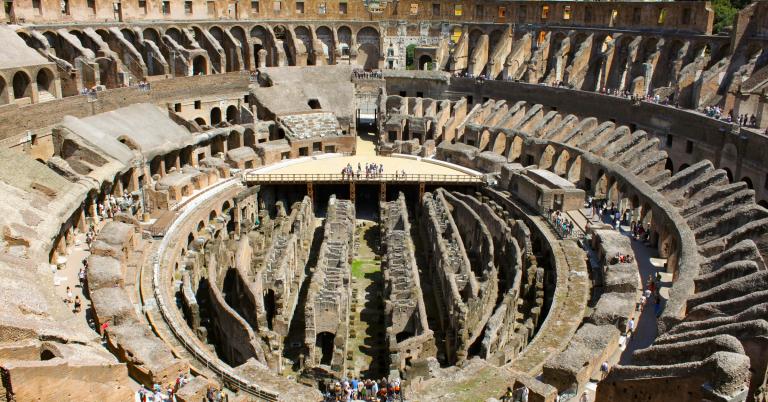
The Colosseum in 2012, as seen from the upper level. There is currently a floor over a part of the arena – the new floor will cover it completely.
An afternoon in the Colosseum
I visited the Colosseum in 2012. One of my traveling companions signed us up for a walking tour that was supposed to take 90 minutes. It ended up taking over 3 hours, and not because of lines and delays. Our tour guide was just that detailed – he worked as a logistics manager during the week and led tours on the weekends, because he had a degree in Classics and loved telling people about ancient Rome. This was our first full day in Europe, so we were exhausted by the end of the tour… but it was very much worth it.
Currently there is a floor over a small segment of the arena – I got to walk out onto it. I couldn’t help but think about how I knew I was going to walk out of there alive, something most who made that walk didn’t.

Our tour guide (whose name I have sadly forgotten) leads us out onto the arena floor.
Interpretive restoration
What struck me about this story – and why I’m blogging about it – is the idea of restoring an ancient site for contemporary use. That’s always a question when you’re dealing with ancient sites, especially those that have been “lost” for centuries. Some argue that the proper approach is to simply leave them as we find them. Particularly from times and places where writing wasn’t common, we often don’t know what they looked like or how they were used. “Restoring” them is an act of interpretation.
If you’ve been to Newgrange in Ireland, you’ve seen what such an act of interpretive restoration looks like. We don’t know if Newgrange looked like this in ancient times. When he excavated Newgrange in the 1960s, Professor Michael O’Kelly saw the white quartz stones and decided they must have been on the front. The only problem is that it took modern concrete to get them to stay in place. There’s a very good chance that Newgrange never looked like it does now in ancient times.
When Professor George Eogan excavated Knowth (another major passage tomb in the Brú na Bóinne region) he also found white quartz stones – he chose to leave them on the ground.
Who’s right? It depends on what you mean by “right”.
I like Newgrange as it is today. When you see it from the road, you instantly know this is a sacred place. This isn’t just a burial mound – this is a temple. Maybe not a temple in the same sense as the Greek and Roman temples, or in the same sense as a stone circle. But it’s clearly a sacred space.
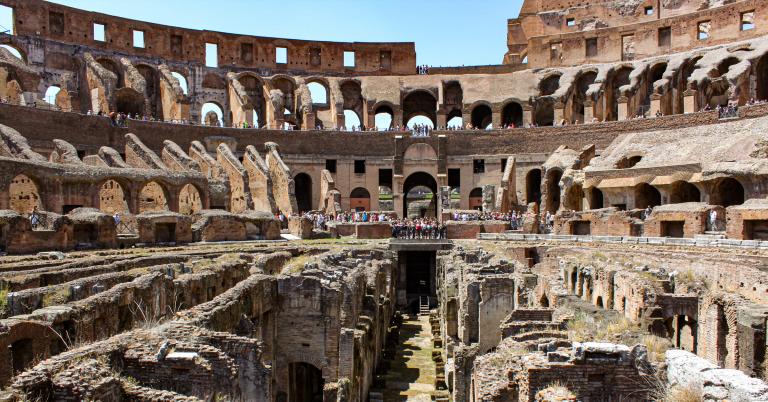
Looking out from the edge of the floor. This is as close to a “gladiator view” as you can get today.
A living place in the contemporary world
The Roman Colosseum is not a sacred site. Some Christians consider it a site of martyrdom, but there is no evidence Christians were killed there for their faith. That idea appears to be medieval in origin.
Still, it is culturally and historically important. It’s a tangible connection to the roots of European civilization and its American offshoots. As such, it’s important to preserve it.
But what do we mean when we say “preserve”?
Should we treat it like a museum piece in a glass case, never to be touched lest we degrade it further from its pristine origins?
Or should we treat it like a living being, one that needs periodic medical care (i.e. – physical maintenance) and that should be included in the life of the community?
I like the idea of holding concerts and other cultural events in the Colosseum. I’m thrilled that the Anglesey Druid Order conducts public rituals at Bryn Celli Ddu, a site that’s at least 5000 years old. I would love to see Athena worshipped at the Parthenon once again.
We can debate what is restoration vs. what is a living place vs. what is an inappropriate modification. There are limits – I would hate to see grandstands installed at Stonehenge.
But the more places like this can be a part of our lives and not “ruins” the better off we’ll all be.
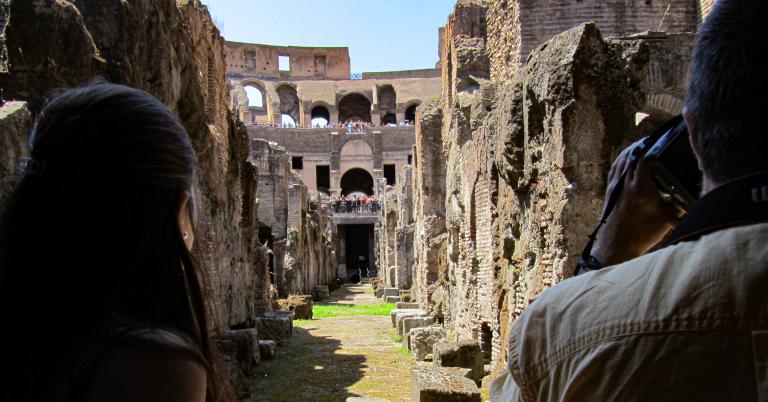
The view from the hypogeum – the lower levels. That’s me on the right, a tourist from another party on the left – both of us trying to get the same shot without blocking the other.
Living places, living rites
And that brings me to the final thing the Colosseum floor has me thinking about. If our ancient and sacred sites should be treated as living things, shouldn’t our worship and rituals be alive too?
For some Pagans this isn’t an issue – they’re doing their thing here and now, oftentimes with no regard for the past. That’s another matter for another time. Here I’m talking about those who try to recreate the past as completely as possible.
I’m all for good scholarship – it’s important to know what our ancestors did and why they did it. Given the thousand years and more separation we have from our ancestral Pagan and polytheist traditions, good scholarship is essential.
But scholarship is only the beginning. At some point we have to be active creators of our own living traditions. We have to listen to the Gods and to the land, build our own interfaces for relating to them, and figure out how to honor them in a way that’s meaningful and helpful to us here and now.
There is room for many different approaches under the Pagan umbrella (to the extent that “the Pagan umbrella” means anything these days). My approach is to be inspired by our ancestors, but then to build an ancestral, devotional, ecstatic, oracular, magical, public, Pagan polytheism for today.
My Paganism is a living thing.
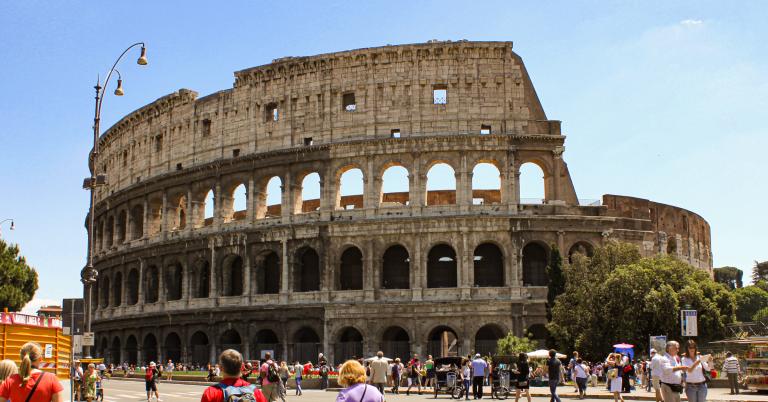
The exterior of the Colosseum – 2012
The floor should be complete by 2023
The designs are finished and the contract has been awarded to an engineering firm out of Milan. No word on when construction will begin, or to what extent it will limit tours of the Colosseum, which only restarted last week after shutting down due to the pandemic. But the schedule calls for the new floor to be completed by 2023.
I don’t know when I’ll go back to Italy. I greatly enjoyed my time there in 2012 and I really want to see more of Rome and the rest of the country. Still, other places are well ahead of it on my bucket list. It may be a while.
But I look forward to seeing the Colosseum again someday, a little more alive than it was the last time I was there.
Previous Post

May 4, 2021
There is Freedom in the Vastness of the Universe
Next Post

May 9, 2021 Why Are Pagan Groups Cash-Poor?
Browse Our Archives
Select a Category Books Community CUUPS Druidry Foundations and Context Gods and Goddesses Magic Myth Nature Ritual Spiritual Practice Theology Travel Uncategorized Videos
Select a Month October 2026 September 2026 August 2026 July 2026 June 2026 May 2026 April 2026 March 2026 February 2026 January 2026 December 2025 November 2025 October 2025 September 2025 August 2025 July 2025 June 2025 May 2025 April 2025 March 2025 February 2025 January 2025 December 2024 November 2024 October 2024 September 2024 August 2024 July 2024 June 2024 May 2024 April 2024 March 2024 February 2024 January 2024 December 2023 November 2023 October 2023 September 2023 August 2023 July 2023 June 2023 May 2023 April 2023 March 2023 February 2023 January 2023 December 2022 November 2022 October 2022 September 2022 August 2022 July 2022 June 2022 May 2022 April 2022 March 2022 February 2022 January 2022 December 2021 November 2021 October 2021 September 2021 August 2021 July 2021 June 2021 May 2021 April 2021 March 2021 February 2021 January 2021 December 2020 November 2020 October 2020 September 2020 August 2020 July 2020 June 2020 May 2020 April 2020 March 2020 February 2020 January 2020 December 2019 November 2019 October 2019 September 2019 August 2019 July 2019 June 2019 May 2019 April 2019 March 2019 February 2019 January 2019 December 2018 November 2018 October 2018 September 2018 August 2018 July 2018 June 2018 May 2018 April 2018 March 2018 February 2018 January 2018 December 2017 November 2017 October 2017 September 2017 August 2017 July 2017 June 2017 May 2017 April 2017 March 2017 February 2017 January 2017 December 2016 November 2016 October 2016 September 2016 August 2016 July 2016 June 2016 May 2016 April 2016 March 2016 February 2016 January 2016 December 2015 November 2015 October 2015 September 2015 August 2015 July 2015 June 2015 May 2015 April 2015 March 2015 February 2015 January 2015 December 2014 November 2014 October 2014 September 2014 August 2014 July 2014 June 2014 May 2014 April 2014 March 2014 February 2014 January 2014 December 2013 November 2013 October 2013 September 2013 August 2013 July 2013 June 2013 May 2013 April 2013 March 2013 February 2013 January 2013 December 2012 November 2012 October 2012 September 2012 August 2012 July 2012 June 2012 May 2012 April 2012 March 2012 February 2012 January 2012 December 2011 November 2011 October 2011 September 2011 August 2011 July 2011 June 2011 May 2011 April 2011 March 2011 February 2011 January 2011 December 2010 November 2010 October 2010 September 2010 August 2010 July 2010 June 2010 May 2010 April 2010 March 2010 February 2010 January 2010 December 2009 November 2009 October 2009 September 2009 August 2009 July 2009 June 2009 May 2009 April 2009 March 2009 February 2009 January 2009 December 2008 November 2008 October 2008 September 2008 August 2008 July 2008 June 2008
Follow Us!
TAKE THE
Religious Wisdom Quiz
How many books of the Bible are named after women?
Select your answer to see how you score.
3 2 1 4
Related posts from John Beckett




What We Lose When “Ask AI” Becomes A...
TRENDING AT PATHEOS Pagan

The First Eucharistic Controversy: Christ’s Real Presence
For Catholics, the Eucharist is the source and summit of the Christian...

How to Make a Decision When You Can't...
Main point: It’s much more valuable to stay close to God so...

Archdiocese Hosts Military Marriage Retreat in Germany
RASTATT, Germany — The transient military lifestyle, with its frequent deployments and...

Nearly every morning, I make the drive to Detroit with my high-school-age...

The Real AI Story Is Adoption Without Trust
Artificial intelligence has crossed a political threshold. It is no longer a...

A new article, written by Jeff Lindsay and Gale L. Pooley,...
view all Pagan blogs
Ad-Free & Subscriber Log-In Subscription Support
- About Us
- 2026 Calendar
- Videos
- Podcasts
- Library of World Religions
- Faith In Media Tracker
- Advertise With Us
- Write for Us
- Privacy Policy
- Terms of Service
- Do Not Sell My Data
- Contact Us
- Radiant Digital
- Manage Newsletter Subscriptions
- Unsubscribe From Notifications
- Sitemap
Copyright 2008-2026, Patheos. All rights reserved.
Subscription Support Ad-Free & Subscriber Log-In
Follow Patheos