
BuddhistCatholicContemplativeEvangelicalGeneral ChristianHinduJewishLatter-day SaintMuslimNew VisionsProgressive Christian
Beliefs
- Buddhist
- Catholic
- Contemplative
- Evangelical
- General Christian
- Hindu
- Jewish
- Latter-day Saint
- More Voices
- Muslim
- New Visions
- Pagan
- Progressive Christian
Topics
- Religion News
- Food and Religion
- Sports and Religion
- Religious Art
- Religious Music and Entertainment
- Religious Events
- History and Religion
- Style and Religion
- Politics and Religion
- Women in Religion
- Recreation Outdoors and Religion
- Business Finance and Religion
- Careers Workplace and Religion
- Education and Religion
- Family Parenting and Religion
- Health Fitness and Religion
- Home and Religion
- Relationships and Religion
- Technology and Religion
- Travel and Religion
Columnists
- Buddhist Columnists
- Business Finance and Religion Columnists
- Careers Workplace and Religion Columnists
- Catholic Columnists
- Contemplative Columnists
- Education and Religion Columnists
- Evangelists Columnists
- Family Parenting and Religion Columnists
- General Christian Columnists
- Health Fitness and Religion Columnists
- Hindu Columnists
- History and Religion Columnists
- Home and Religion Columnists
- Jewish Columnists
- More Voices Columnists
- Latter Day Columnists
- Muslim Columnists
- New Visions Columnists
- Nonreligious Columnists
- Pagan Columnists
- Politics and Religion Columnists
- Progressive Columnists
- Recreation Outdoors and Religion Columnists
- Relationships and Religion Columnists
- Religion News Columnists
- Religious Art Columnists
- Religious Events Columnists
- Religious Music and Entertainment Columnists
- Sports and Religion Columnists
- Style and Religion Columnists
- Technology and Religion Columnists
- Travel and Religion Columnists
- Women in Religion Columnists
Resource Library
- 2026 Calendar
- Library of World Religions
- The 100 Most Holy Places on Earth
- Patheos Answers
- Podcasts
- Videos
- Faith Leaders Database
- Anglican Episcopalian
- Bahai
- Baptist
- Buddhism
- Christianity
- Confucianism
- Eastern Orthodoxy
- Hinduism
- Holiness and Pentecostal
- ISKCON
- Islam
- Judaism
- Lutheran
- Methodist
- The Church of Jesus Christ of Latter-day Saints
- New Age
- Paganism
- Presbytarian and Reformed
- Protestantism
- Religion Behind the Scenes
- Roman Catholic
- Scientology
- Shia Islam
- Sikhism
- Sufism
- Sunni Islam
- Taoism
- Zen
- See all religions
Research Tools
 Ad-Free & Subscriber Log-In Subscription Support
Ad-Free & Subscriber Log-In Subscription Support
Follow Patheos 

- Trending:
- Forgiveness
- |
- Marriage
- |
- Consciousness
- |
- Death Penalty
- |
- Election
- |
- Halloween

- Home
- Pagan
- The Decline of the Baptists and What the Rest of Us Can Learn From It
The Decline of the Baptists and What the Rest of Us Can Learn From It
Last updated on: May 29, 2021 at 12:20 pm by John Beckett
The Decline of the Baptists and What the Rest of Us Can Learn From It 2021-05-29T12:20:26-06:00 John Beckett
Patheos Explore the world's faith through different perspectives on religion and spirituality! Patheos has the views of the prevalent religions and spiritualities of the world.
For all that I’m passionately committed to my Pagan polytheist path, I remain a religious pluralist. Deep down all paths aren’t the same, and that’s OK – the world is better off with a glorious garden of many religions.
That doesn’t mean I want all religions to succeed.
Given my rather unpleasant childhood in the denomination and its offshoots, I freely admit to more than a bit of schadenfreude any time I see bad news for the Southern Baptist Convention.
Last week I saw this article from Religion News Service, reporting that the denomination has lost more than 2 million members since 2006. Here’s a quote:
Southern Baptists, long known for denominational infighting, have seen several high-profile departures of leaders in the past year, including Bible teacher Beth Moore, ethicist Russell Moore, and a number of Black pastors. The SBC has also faced controversy over revelations of abuse, disputes over support for Donald Trump and a debate over critical race theory.
Another Religion News Service article quotes political science professor Ryan Burge, who predicts that “by 2025, Baptists will be at about half their former size, and more politically homogenous than ever.”
A third article – this from the Christian Post, an evangelical publication not affiliated with the SBC but generally in agreement with them – reports survey results that say “43% of millennials ‘don’t know, don’t care, don’t believe’ God exists.” The future is not bright for the Southern Baptist Convention.
Much of this is simply the continued decline of Christianity, something that started 500 years ago and that has been accelerating for the past 60 years. But there are specific reasons behind the SBC’s decline that are worth looking at – in part for schadenfreude and in part so the rest of us can avoid them.
To be clear: there are numerous Baptist denominations in the United States – Wikipedia lists 62 of them. Some are theologically moderate and socially progressive – I wish them well. But the Southern Baptist Convention is by far the largest – they’re the ones I’m discussing in this post.

You can’t preach hate and call it love
We need to start here. The #1 reason young people are leaving the SBC and other conservative churches is the continued attack on LGBTQ people.
Older generations often debated issues of sexuality and orientation in a vacuum – a bunch of straight white men pontificating on something they knew nothing about. Younger generations grew up with openly gay friends. So when preachers talked about the evils of homosexuality, it didn’t match their lived experiences. Their gay friends weren’t evil, they were their friends – they didn’t like hearing them slandered.
And let’s not forget about LGBTQ people themselves. Previous generations stayed in the church due to social and religious pressure. Some of them tried to conform, while others just hid in the closet. Now there are plenty of churches who accept them freely and openly. Why stay with people who hate who and what you are?
Because that’s what it is – hate. No amount of devotion to ancient texts can justify trying to change someone’s orientation – the essence of who they are.
You can’t ignore the truth
The SBC insists that the Bible is the literal and inerrant Word of God – that puts them at odds with most Christian denominations. This leads to absurd beliefs such as Young Earth Creationism – the idea that the Earth is only 6000 years old and that humans were placed on the Earth in our current form.
Perhaps 200 years ago this was an understandable position. But over the last 200 years advancements in geology, astrophysics, and biology have provided ample evidence that the Universe is 13.8 billion years old, the Earth is 4.5 billion years old, and the human species evolved from previous species, taking our current form around 200,000 years ago.
And also over the past 200 years, Biblical criticism has brought a literary and historical analysis that has shown that the Bible is exactly what it appears to be: a collection of ancient writings from multiple sources over multiple centuries, most of which were not written by the claimed authors. Most of the “history” has been mythologized. Like sacred texts in other religions, the Bible works well when read for contemplative purposes. When read as history or science – or as a voting guide – it is completely inadequate… something most Christians understand.
Like all Christian fundamentalists, the Southern Baptists understand that if they accept the truth about evolution and the age of the Earth, they lose their claim to a literal interpretation of the Bible. And if they lose that, their whole “metanarrative” of original sin falls apart like a house of cards.
A quote often misattributed to Carl Sagan but that originated with fantasy author P.C. Hodgell says “if it can be destroyed by the truth, it deserves to be destroyed by the truth.” Younger people are asking “why do they tell me I have to believe things that aren’t true?” The Southern Baptist Convention is being destroyed by the truth.

“Costly religion” doesn’t always work
In the last decades of the 20th century, the SBC and other conservative denominations were growing, even as more liberal and moderate Mainline Protestants were shrinking. That led them to argue that people who wanted religion wanted “real” religion with supernatural beliefs, traditional morals, and high expectations for maintaining orthodox beliefs and practices. But that changed in the 21st century and now the conservative denominations are shrinking at a fast rate.
Costly religion – a religion that requires much of its followers – builds a sense of identity and purpose. But how many people are willing to make that kind of investment? Clearly, not as many as there were 30 years ago.
More importantly, what is the identity you’re building? Devotion to your God is one thing – devotion to continuous proselytizing and to hating gay people is something very different.
The era of the Church as dictator of belief is over
In 1633 the Catholic Church forced Galileo to renounce his scientific finding that the Earth revolves around the Sun, because it conflicted with official church doctrine. 359 years later they finally admitted their error.
No church has that kind of power anymore. Baptists in Texas keep trying to stop the teaching of evolution in public schools – they’ve only managed to muck things up with statements about “only a theory.” And putting Richard Dawkins on trial is laughably impossible (I’m a polytheist – Richard Dawkins is not my friend. But he’s a very good biologist).
The Southern Baptist Convention can’t convince young people that being gay is a sin, or that the Bible is inerrant. They can’t make their case on its merits and they don’t have the authority to force people to accept it.
More importantly, they’re unable to convince people that their beliefs about Jesus, Heaven, and Hell are correct, and they don’t have the power to force people to pretend they do.

Even a good salesman can’t sell a bad product
The fundamentalists can read the numbers – they know they have a problem. But their answer has been to double down on fundamentalism and to focus on building more churches. As Religion News Service reports, “that has led to more churches but not more baptisms and Southern Baptists.”
I started driving in the late 1970s, possibly the worst era for automobiles in history – particularly for American cars. They were poorly designed, inefficient, and unreliable. GM, Ford, and Chrysler tried to sell them with flashy advertising, or with appeals to “made in the USA” patriotism.
Meanwhile, Toyota, Honda, and other Japanese manufacturers introduced small, efficient, and reliable models and people bought so many they couldn’t keep them in stock.
Cars and religion are very different things. But people buy – or buy into – them both because they fill a need in their lives. If what you’re selling doesn’t fill people’s needs – whether for transportation or for spiritual fulfillment – they’re going to look somewhere else.
And they have lots of options.
At some point you have to accept that the problem isn’t the sales pitch, it’s that people have looked at your product and they see no reason to buy it.
The Baptists could change. They could focus on following the teachings of Jesus and building the Kingdom of God here and now. But they’re too invested in Biblical literalism and the authoritarian politics it supports.
Religion is becoming an individual matter
I’ll be honest: I don’t like this any more than the Baptists do. I have no desire to convince – much less force – everyone to follow my religion. But I would like for those who follow the same Gods in more or less the same ways and who share more or less the same values to join together and build a lasting tradition. The Pagan community shows little interest in that, at least on a large scale.
Christians are moving in that direction too.
Belief is a personal thing. For all the councils and creeds, what goes on in someone’s heart and in their head is an individual matter. It’s always been that way – it’s just that now there’s nothing to stop people from talking about ideas that establishment leaders consider heresy.
Or from putting those ideas into practice.
Europe is running ahead of America. Their churches are more museums than houses of worship. Most churches in this country weren’t built to last centuries. Still, they aren’t going to disappear any time soon. This is a centuries-long process that will continue for hundreds more years.
In 2015 I said Pagans needed to focus on building the institutions and infrastructure we need today, not on what the mainstream religions have. Turns out that’s not much at the moment. I gave up on building institutions a couple years ago. My focus is on refining my practice, and on teaching those who are interested in what I do. If some day that requires a building, then we’ll talk about buildings.
But the future of religion is with the individual.
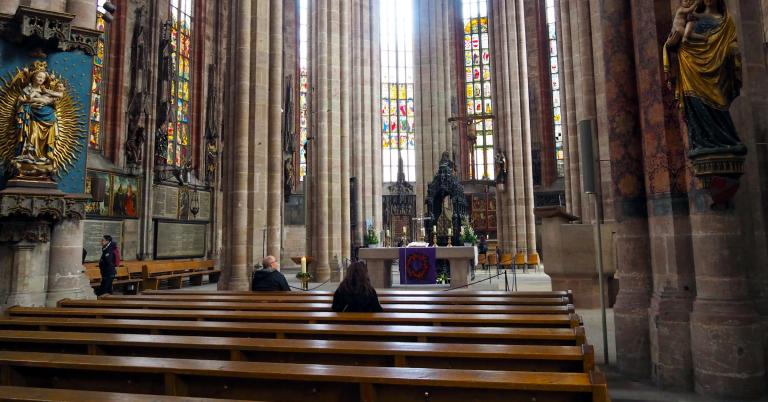
St. Sebald’s Church – Nuremberg – 2019
There will always be a need for supportive religious communities
That said, religion is still best done as a group project. We will always need people to talk through our experiences and help us figure out what they mean. We will always need people to officiate our weddings and funerals, and to be there to congratulate and console us when needed.
We will always need people to welcome newcomers, to challenge and affirm us, and to celebrate the high days and holy days with. You can’t dance the Maypole by yourself.
These groups will just be smaller than we’ve always assumed they should be. Perhaps future Baptists can adopt the Wiccan coven model.
I’m thankful for my local co-religionists. They are my closest and most trusted friends. I wish our circle was larger, but if it never is then what we have is enough.
And perhaps that’s something we all need to learn.
There will always be mystics and contemplatives
One of the things I missed growing up Baptist was the presence of mystics and contemplatives… or really, the acknowledgement that they even existed. For a group that shares their name with John the Baptist they never really talked about what he did and how he lived.
But in every tradition there are people who are called to a deeper practice, who spend hours in prayer and meditation, in study and contemplation, and in ritual. Some of them are fit for little else. I think that’s the Baptists’ main problem with mystics – they don’t fit into the Protestant work ethic.
We need communities to support these people. The Pagan community by and large doesn’t have a way to do that. So our mystics make do as best they can, for better or worse.
This is where our big ideas begin. This is where we first hear from our Gods and other spiritual allies.
These are the people who remind us that a good religion is an experiential religion, not a sit-and-listen religion. We may not all have the skills of the mystics – and most of us don’t want them, or at least, we don’t want the obligations that come with them – but we all have our first-hand experiences. Our mystics have the experience to help us interpret them as accurately as possible.
We don’t need churches nearly as much as we need a way to support our mystics and contemplatives, and to facilitate them helping the rest of us.

Focus on what’s in front of you
Ultimately, any time I spend gloating over the decline of a fundamentalist denomination is time I’m not spending doing the work my Gods have placed in front of me. So while I want to acknowledge what’s going on and figure out what I can learn from it, mainly I need to get back to my own work.
For me, that starts with honoring my Gods and ancestors. It’s supporting my co-religionists. It’s practicing my Pagan polytheist religion, and then writing about what I do for the benefit of those who are interested in it.
But there is something we can learn here.
We don’t have the infrastructure and wealth of the Southern Baptist Convention. We also don’t have their baggage. That means we can travel faster and adjust more quickly to a changing environment.
Let’s do what we can with what we have.
Previous Post

May 25, 2021
Are We Living in a New Victorian Era?
Next Post

May 30, 2021 Raven Goddess: Going Deeper with the Morrigan
Browse Our Archives
Select a Category Books Community CUUPS Druidry Foundations and Context Gods and Goddesses Magic Myth Nature Ritual Spiritual Practice Theology Travel Uncategorized Videos
Select a Month October 2026 September 2026 August 2026 July 2026 June 2026 May 2026 April 2026 March 2026 February 2026 January 2026 December 2025 November 2025 October 2025 September 2025 August 2025 July 2025 June 2025 May 2025 April 2025 March 2025 February 2025 January 2025 December 2024 November 2024 October 2024 September 2024 August 2024 July 2024 June 2024 May 2024 April 2024 March 2024 February 2024 January 2024 December 2023 November 2023 October 2023 September 2023 August 2023 July 2023 June 2023 May 2023 April 2023 March 2023 February 2023 January 2023 December 2022 November 2022 October 2022 September 2022 August 2022 July 2022 June 2022 May 2022 April 2022 March 2022 February 2022 January 2022 December 2021 November 2021 October 2021 September 2021 August 2021 July 2021 June 2021 May 2021 April 2021 March 2021 February 2021 January 2021 December 2020 November 2020 October 2020 September 2020 August 2020 July 2020 June 2020 May 2020 April 2020 March 2020 February 2020 January 2020 December 2019 November 2019 October 2019 September 2019 August 2019 July 2019 June 2019 May 2019 April 2019 March 2019 February 2019 January 2019 December 2018 November 2018 October 2018 September 2018 August 2018 July 2018 June 2018 May 2018 April 2018 March 2018 February 2018 January 2018 December 2017 November 2017 October 2017 September 2017 August 2017 July 2017 June 2017 May 2017 April 2017 March 2017 February 2017 January 2017 December 2016 November 2016 October 2016 September 2016 August 2016 July 2016 June 2016 May 2016 April 2016 March 2016 February 2016 January 2016 December 2015 November 2015 October 2015 September 2015 August 2015 July 2015 June 2015 May 2015 April 2015 March 2015 February 2015 January 2015 December 2014 November 2014 October 2014 September 2014 August 2014 July 2014 June 2014 May 2014 April 2014 March 2014 February 2014 January 2014 December 2013 November 2013 October 2013 September 2013 August 2013 July 2013 June 2013 May 2013 April 2013 March 2013 February 2013 January 2013 December 2012 November 2012 October 2012 September 2012 August 2012 July 2012 June 2012 May 2012 April 2012 March 2012 February 2012 January 2012 December 2011 November 2011 October 2011 September 2011 August 2011 July 2011 June 2011 May 2011 April 2011 March 2011 February 2011 January 2011 December 2010 November 2010 October 2010 September 2010 August 2010 July 2010 June 2010 May 2010 April 2010 March 2010 February 2010 January 2010 December 2009 November 2009 October 2009 September 2009 August 2009 July 2009 June 2009 May 2009 April 2009 March 2009 February 2009 January 2009 December 2008 November 2008 October 2008 September 2008 August 2008 July 2008 June 2008
Follow Us!
TAKE THE
Religious Wisdom Quiz
Which Christian denomination is known for emphasizing predestination?
Select your answer to see how you score.
Methodism Calvinism Lutheranism Catholicism
Related posts from John Beckett


The Vampire Films of Jean Rollin


Bo French Doesn’t Understand Texas
TRENDING AT PATHEOS Pagan

The Sermon on the Mount, Part I: Matthew...
The Sermon on the Mount, Part I (Matthew 4:12-5:12) St. Matthew moves...

What's up from Crossway: Reviewing some of their latest A few weeks...

Janie Learns the Way of the Cross: A...
Teaching children about Jesus' Passion can be challenging. Many parents and educators...

Looking For Good Catholic Writing - October 2026
He alone extends the heavens, and he walks upon the waves of...

In "Irreplaceable," our book on vocation and technology, Trevor Sutton and I...

I was strolling through the top floor of the brand new Parthenon...
view all Pagan blogs
Ad-Free & Subscriber Log-In Subscription Support
- About Us
- 2026 Calendar
- Videos
- Podcasts
- Library of World Religions
- Faith In Media Tracker
- Advertise With Us
- Write for Us
- Privacy Policy
- Terms of Service
- Do Not Sell My Data
- Contact Us
- Radiant Digital
- Manage Newsletter Subscriptions
- Unsubscribe From Notifications
- Sitemap
Copyright 2008-2026, Patheos. All rights reserved.
Subscription Support Ad-Free & Subscriber Log-In
Follow Patheos