
BuddhistCatholicContemplativeEvangelicalGeneral ChristianHinduJewishLatter-day SaintMuslimNew VisionsProgressive Christian
Beliefs
- Buddhist
- Catholic
- Contemplative
- Evangelical
- General Christian
- Hindu
- Jewish
- Latter-day Saint
- More Voices
- Muslim
- New Visions
- Pagan
- Progressive Christian
Topics
- Religion News
- Food and Religion
- Sports and Religion
- Religious Art
- Religious Music and Entertainment
- Religious Events
- History and Religion
- Style and Religion
- Politics and Religion
- Women in Religion
- Recreation Outdoors and Religion
- Business Finance and Religion
- Careers Workplace and Religion
- Education and Religion
- Family Parenting and Religion
- Health Fitness and Religion
- Home and Religion
- Relationships and Religion
- Technology and Religion
- Travel and Religion
Columnists
- Buddhist Columnists
- Business Finance and Religion Columnists
- Careers Workplace and Religion Columnists
- Catholic Columnists
- Contemplative Columnists
- Education and Religion Columnists
- Evangelists Columnists
- Family Parenting and Religion Columnists
- General Christian Columnists
- Health Fitness and Religion Columnists
- Hindu Columnists
- History and Religion Columnists
- Home and Religion Columnists
- Jewish Columnists
- More Voices Columnists
- Latter Day Columnists
- Muslim Columnists
- New Visions Columnists
- Nonreligious Columnists
- Pagan Columnists
- Politics and Religion Columnists
- Progressive Columnists
- Recreation Outdoors and Religion Columnists
- Relationships and Religion Columnists
- Religion News Columnists
- Religious Art Columnists
- Religious Events Columnists
- Religious Music and Entertainment Columnists
- Sports and Religion Columnists
- Style and Religion Columnists
- Technology and Religion Columnists
- Travel and Religion Columnists
- Women in Religion Columnists
Resource Library
- 2026 Calendar
- Library of World Religions
- The 100 Most Holy Places on Earth
- Patheos Answers
- Podcasts
- Videos
- Faith Leaders Database
- Anglican Episcopalian
- Bahai
- Baptist
- Buddhism
- Christianity
- Confucianism
- Eastern Orthodoxy
- Hinduism
- Holiness and Pentecostal
- ISKCON
- Islam
- Judaism
- Lutheran
- Methodist
- The Church of Jesus Christ of Latter-day Saints
- New Age
- Paganism
- Presbytarian and Reformed
- Protestantism
- Religion Behind the Scenes
- Roman Catholic
- Scientology
- Shia Islam
- Sikhism
- Sufism
- Sunni Islam
- Taoism
- Zen
- See all religions
Research Tools
 Ad-Free & Subscriber Log-In Subscription Support
Ad-Free & Subscriber Log-In Subscription Support
Follow Patheos 

- Trending:
- Forgiveness
- |
- Marriage
- |
- Consciousness
- |
- Death Penalty
- |
- Election
- |
- Halloween

- Home
- Pagan
- The Role of Belief in an Orthopraxic Religion
The Role of Belief in an Orthopraxic Religion
Last updated on: December 8, 2020 at 6:09 am by John Beckett
The Role of Belief in an Orthopraxic Religion 2020-12-08T06:09:44-06:00 John Beckett
Patheos Explore the world's faith through different perspectives on religion and spirituality! Patheos has the views of the prevalent religions and spiritualities of the world.
My Paganism begins with experience. It is a religion of relationships, and it is orthopraxic not orthodoxic – it’s more important to do the right things than to believe the right things.
But that doesn’t mean belief is unimportant. There’s a place for belief in Paganism, even if it isn’t at the center of our religion(s). In this post, I want to look at the matter of belief: what it is, how it arises, and how we can develop beliefs that are meaningful and helpful without falling into false and harmful certainty.

What is belief?
Merriam-Webster lists three definitions of the word “belief.” All three are intertwined and all three are good, but it’s the third that’s most relevant here: “conviction of the truth of some statement or the reality of some being or phenomenon especially when based on examination of evidence.”
Too many people think that belief means accepting something uncritically and without evidence, that it’s mindlessly repeating what you’re told instead of thinking for yourself. There are other, better words for that: “indoctrination” “mind control” “unresolved trauma” and all too often “intellectual laziness.”
Done right, belief is an interpretation of our experiences and the experiences of others. All we know with certainty is that we saw, heard, and/or felt something that defied conventional explanation. We use the process of discernment to try to figure out what happened, and more importantly, what it means for us in our lives. That interpretation becomes a belief.
Over time, beliefs that are robust are affirmed by other experiences, whether our own or those of others. They grow stronger and deeper as we become convinced that they really are meaningful and helpful, even if we can never be sure they’re true.
Foundational assumptions provide context for beliefs
We can only believe what we think is possible. And what we think is possible is controlled by our foundational assumptions: our basic, gut-level ideas about the world and the way it works.
I think that some of our foundational assumptions are an orientation we’re born with. But many come from what we were taught as very small children: from what we picked up by observation as much as anything we learned in kindergarten or Sunday School.
If you’re convinced that nothing exists except matter and the product of its interactions, you will find it difficult if not impossible to believe in the reality of spirits. If you are convinced there is only one God and that polytheism is a “primitive” superstition, it will be very difficult for you to relate to one of the Many Gods.
If you’re convinced people who aren’t like you are always trying to “take what’s yours” it will be very difficult for you to practice good hospitality.
Most people aren’t even aware that they have foundation assumptions. They think that’s just the way things are – it’s “common sense” or “what everybody knows.”
Identifying and challenging your unstated assumptions is very, very hard. It’s also very important, because our foundational assumptions control what we can believe.
The order of belief
I’ve shown this diagram multiple times over the years – a version of it is in The Path of Paganism. Practice, experience, and belief form a “virtuous circle.” One leads to the others, and over time it leads to an ever-deepening cycle of meaning. When I first drew this diagram I said you can enter at any point and travel in any direction. In general this is true.
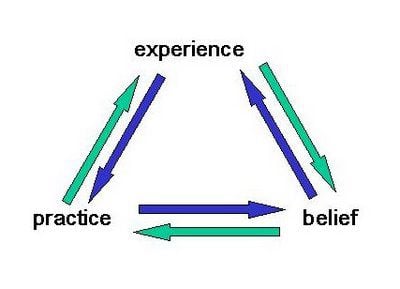
But in an orthopraxic religion we begin with practice. When we do the practices (properly and consistently) we have experiences. When we interpret our experiences, we form beliefs. And those beliefs inspire us to keep practicing, which continues and deepens the virtuous circle.
An orthopraxic religion never asks its followers to believe mindlessly. Rather, it says to do these things because they’ve proven helpful. The practices lead to experiences (which, to be clear, are often ordinary and not otherworldly), and the experiences lead to beliefs.
Belief comes third.
Common practices lead to common beliefs
You can have your own individual beliefs and practices, but religion is what we do together. It’s how we form sacred relationships with our Gods and ancestors, with the natural world, and with each other.
We practice together. We observe the same cycles of the moon, we sing the same songs, we pour similar offerings to the same deities. These common practices naturally lead to shared experiences. And especially if they’re grounded in a common culture and common foundational assumptions, we’re likely to interpret them in very similar ways. Common practice leads to common beliefs.
Over time, this runs the risk of turning into orthodoxy – of shifting from “these are our most consistently helpful interpretations” to “this is the only valid interpretation.” But if we keep our primary emphasis on action rather than on interpretation, we can remain open to unorthodox interpretations that may be helpful for an individual, or for many individuals.
And more importantly, we can avoid becoming stagnated in beliefs that may have been helpful at one point but that are now outdated and harmful.
Beliefs are necessary to explore the world of spirit
So why even bother with belief? Why not just practice, experience, and leave it at that?
I don’t know about you, but I can’t just leave it at that. If I have a spiritual experience – from the very ordinary to the deeply mystical – I can’t help but wonder what it means. In part, I wonder what it means for me. But I also wonder what it tells us about the nature of the universe.
I experience the presence of another person who I cannot see or touch. I interpret that as the experience of a God. What does it mean that there are Gods? What does it mean that this God is called the Morrigan? What does it mean that She wants me to prepare for a time of upheaval? What is changing? What is changing that I cannot see? What does that tell us about the nature of the Otherworld?
All these questions demand answers. Maybe you can decline to answer them – I can’t. And every answer leads to yet more questions.
Taken in total, these questions and their tentative answers form a model of the worlds (two? nine? many?) and how they work. They tell a story that provides context and meaning. They help us orient ourselves in the big picture.
Good beliefs don’t shut down curiosity – they encourage it.

Good beliefs require humility
Whatever we learn through this process of exploration, it’s important to remember that our conclusions are beliefs, not facts.
Science doesn’t have all the answers, but the answers it has are generally reliable, and we ignore them at our peril. We make further mistakes when we assume science tells us something it doesn’t – bad science makes for bad religion.
Multiple experiences over time lead to confidence in our interpretations, especially when they align with the experiences and interpretations of others, and with the stories from our pre-Christian ancestors. This is a good thing. When I say I know there are many Gods and some of Them want certain things from me, I am expressing a confidence that comes from years of consistent practice and experience and from interpretations that have been affirmed over and over again.
And I still recognize that our understanding of the Gods is like cats’ understanding of humans.
Whatever confidence we may have in our beliefs, whether individually or collectively, ultimately they are our best guesses.
They might be wrong.
While we explore our beliefs as deeply as we can, we must hold them loosely. If we discover or are presented with evidence that our beliefs are wrong, or that a different belief is more meaningful, more helpful, or more accurate, then we must have the integrity to change our beliefs.
Practice remains primary
When your religion is centered on beliefs, what do you do when those beliefs are shown to be untrue?
Christian fundamentalists deny the reality of evolution, the age of the Earth, the equality of women, and the dignity of LGBTQ persons because their religion is centered on the belief that the Bible is the literal and inerrant “Word of God.”
When you build your religion on belief you build a house of cards. Without a historical Adam and Eve, the whole doctrine of original sin falls apart. And so fundamentalists reject reality rather than change their beliefs.
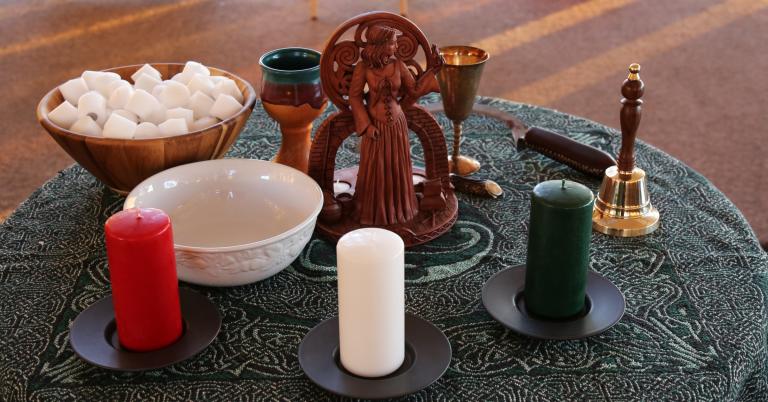
Meanwhile, in one of our CUUPS Imbolc rituals everyone made offerings to Brighid. Some offered to the Goddess, some to an aspect of the Divine Feminine, some to the saint, and some to the ideals of poetry and smithcraft. What we believed about Brighid was less important than the fact that we all made offerings to Brighid.
binary comment
Practice leads to experience. Experience leads to belief. Belief motivates us to practice more deeply. There is a place for belief in a religion centered on practice and on right action.
It’s just not at the center.

Next Post

December 10, 2020 Why Politicians Never Retire and What That Means for Us
Browse Our Archives
Select a Category Books Community CUUPS Druidry Foundations and Context Gods and Goddesses Magic Myth Nature Ritual Spiritual Practice Theology Travel Uncategorized Videos
Select a Month October 2026 September 2026 August 2026 July 2026 June 2026 May 2026 April 2026 March 2026 February 2026 January 2026 December 2025 November 2025 October 2025 September 2025 August 2025 July 2025 June 2025 May 2025 April 2025 March 2025 February 2025 January 2025 December 2024 November 2024 October 2024 September 2024 August 2024 July 2024 June 2024 May 2024 April 2024 March 2024 February 2024 January 2024 December 2023 November 2023 October 2023 September 2023 August 2023 July 2023 June 2023 May 2023 April 2023 March 2023 February 2023 January 2023 December 2022 November 2022 October 2022 September 2022 August 2022 July 2022 June 2022 May 2022 April 2022 March 2022 February 2022 January 2022 December 2021 November 2021 October 2021 September 2021 August 2021 July 2021 June 2021 May 2021 April 2021 March 2021 February 2021 January 2021 December 2020 November 2020 October 2020 September 2020 August 2020 July 2020 June 2020 May 2020 April 2020 March 2020 February 2020 January 2020 December 2019 November 2019 October 2019 September 2019 August 2019 July 2019 June 2019 May 2019 April 2019 March 2019 February 2019 January 2019 December 2018 November 2018 October 2018 September 2018 August 2018 July 2018 June 2018 May 2018 April 2018 March 2018 February 2018 January 2018 December 2017 November 2017 October 2017 September 2017 August 2017 July 2017 June 2017 May 2017 April 2017 March 2017 February 2017 January 2017 December 2016 November 2016 October 2016 September 2016 August 2016 July 2016 June 2016 May 2016 April 2016 March 2016 February 2016 January 2016 December 2015 November 2015 October 2015 September 2015 August 2015 July 2015 June 2015 May 2015 April 2015 March 2015 February 2015 January 2015 December 2014 November 2014 October 2014 September 2014 August 2014 July 2014 June 2014 May 2014 April 2014 March 2014 February 2014 January 2014 December 2013 November 2013 October 2013 September 2013 August 2013 July 2013 June 2013 May 2013 April 2013 March 2013 February 2013 January 2013 December 2012 November 2012 October 2012 September 2012 August 2012 July 2012 June 2012 May 2012 April 2012 March 2012 February 2012 January 2012 December 2011 November 2011 October 2011 September 2011 August 2011 July 2011 June 2011 May 2011 April 2011 March 2011 February 2011 January 2011 December 2010 November 2010 October 2010 September 2010 August 2010 July 2010 June 2010 May 2010 April 2010 March 2010 February 2010 January 2010 December 2009 November 2009 October 2009 September 2009 August 2009 July 2009 June 2009 May 2009 April 2009 March 2009 February 2009 January 2009 December 2008 November 2008 October 2008 September 2008 August 2008 July 2008 June 2008
Follow Us!
TAKE THE
Religious Wisdom Quiz
According to Hebrews, who serves as a copy and shadow of what is in heaven?
Select your answer to see how you score.
The priests in the earthly sanctuary The angels The apostles The prophets
Related posts from John Beckett




What We Lose When “Ask AI” Becomes A...
TRENDING AT PATHEOS Pagan

A new article, written by Jeff Lindsay and Gale L. Pooley,...

Swimfan: Forgotten Aughts Pleasures
This is a recovery effort. In 2002, My Big Fat Greek Wedding...

Top Three Anti-Catholic Lies About Catholicism
This is my initial transcript for the video, "THE 3 WORST...

Pope Leo Celebrates Mass for Nurses & Docs...
I don't have any idea how he did it, but Pope Leo...

The Sermon on the Mount, Part I: Matthew...
The Sermon on the Mount, Part I (Matthew 4:12-5:12) St. Matthew moves...

What's up from Crossway: Reviewing some of their latest A few weeks...
view all Pagan blogs
Ad-Free & Subscriber Log-In Subscription Support
- About Us
- 2026 Calendar
- Videos
- Podcasts
- Library of World Religions
- Faith In Media Tracker
- Advertise With Us
- Write for Us
- Privacy Policy
- Terms of Service
- Do Not Sell My Data
- Contact Us
- Radiant Digital
- Manage Newsletter Subscriptions
- Unsubscribe From Notifications
- Sitemap
Copyright 2008-2026, Patheos. All rights reserved.
Subscription Support Ad-Free & Subscriber Log-In
Follow Patheos