
BuddhistCatholicContemplativeEvangelicalGeneral ChristianHinduJewishLatter-day SaintMuslimNew VisionsProgressive Christian
Beliefs
- Buddhist
- Catholic
- Contemplative
- Evangelical
- General Christian
- Hindu
- Jewish
- Latter-day Saint
- More Voices
- Muslim
- New Visions
- Pagan
- Progressive Christian
Topics
- Religion News
- Food and Religion
- Sports and Religion
- Religious Art
- Religious Music and Entertainment
- Religious Events
- History and Religion
- Style and Religion
- Politics and Religion
- Women in Religion
- Recreation Outdoors and Religion
- Business Finance and Religion
- Careers Workplace and Religion
- Education and Religion
- Family Parenting and Religion
- Health Fitness and Religion
- Home and Religion
- Relationships and Religion
- Technology and Religion
- Travel and Religion
Columnists
- Buddhist Columnists
- Business Finance and Religion Columnists
- Careers Workplace and Religion Columnists
- Catholic Columnists
- Contemplative Columnists
- Education and Religion Columnists
- Evangelists Columnists
- Family Parenting and Religion Columnists
- General Christian Columnists
- Health Fitness and Religion Columnists
- Hindu Columnists
- History and Religion Columnists
- Home and Religion Columnists
- Jewish Columnists
- More Voices Columnists
- Latter Day Columnists
- Muslim Columnists
- New Visions Columnists
- Nonreligious Columnists
- Pagan Columnists
- Politics and Religion Columnists
- Progressive Columnists
- Recreation Outdoors and Religion Columnists
- Relationships and Religion Columnists
- Religion News Columnists
- Religious Art Columnists
- Religious Events Columnists
- Religious Music and Entertainment Columnists
- Sports and Religion Columnists
- Style and Religion Columnists
- Technology and Religion Columnists
- Travel and Religion Columnists
- Women in Religion Columnists
Resource Library
- 2026 Calendar
- Library of World Religions
- The 100 Most Holy Places on Earth
- Patheos Answers
- Podcasts
- Videos
- Faith Leaders Database
- Anglican Episcopalian
- Bahai
- Baptist
- Buddhism
- Christianity
- Confucianism
- Eastern Orthodoxy
- Hinduism
- Holiness and Pentecostal
- ISKCON
- Islam
- Judaism
- Lutheran
- Methodist
- The Church of Jesus Christ of Latter-day Saints
- New Age
- Paganism
- Presbytarian and Reformed
- Protestantism
- Religion Behind the Scenes
- Roman Catholic
- Scientology
- Shia Islam
- Sikhism
- Sufism
- Sunni Islam
- Taoism
- Zen
- See all religions
Research Tools
 Ad-Free & Subscriber Log-In Subscription Support
Ad-Free & Subscriber Log-In Subscription Support
Follow Patheos 

- Trending:
- Forgiveness
- |
- Marriage
- |
- Consciousness
- |
- Death Penalty
- |
- Election
- |
- Halloween

- Home
- Pagan
- The Evolution of My Pagan Ritual Liturgy
The Evolution of My Pagan Ritual Liturgy
Last updated on: December 17, 2020 at 3:00 am by John Beckett
The Evolution of My Pagan Ritual Liturgy 2020-12-13T10:23:51-06:00 John Beckett
Patheos Explore the world's faith through different perspectives on religion and spirituality! Patheos has the views of the prevalent religions and spiritualities of the world.
Tomorrow’s Winter Solstice Ritual will be the seventh online ritual I’ve done this year. All of them follow a similar ritual order and framework – a liturgy. We often think of liturgy as something Christians do, but the word comes to us from the ancient Greek lēitos meaning “public” and -ergos meaning “working.” Liturgy was Pagan long before it was Christian.
I’ve been using this particular liturgy for several years, but it didn’t start here. It’s been a journey. My Pagan ritual liturgy has evolved, and likely, it will continue to evolve.
To be clear, when I say “my liturgy” I mean “the liturgy I use.” I didn’t invent any of this. I’m not sure anybody invented any of it, at least not in our era. People have been doing these things for hundreds and hundreds of years.
I don’t even own this exact combination of ritual elements. Much of this liturgy evolved in my work with Denton CUUPS, and with other groups and individuals. Rarely have we sat down and tried to determine the best possible liturgy. Rather, we’ve added and removed elements because of specific needs at specific times. We kept what worked and discarded what didn’t.
This is how I got here, through 10 years of solitary practice and 17 years of group practice.
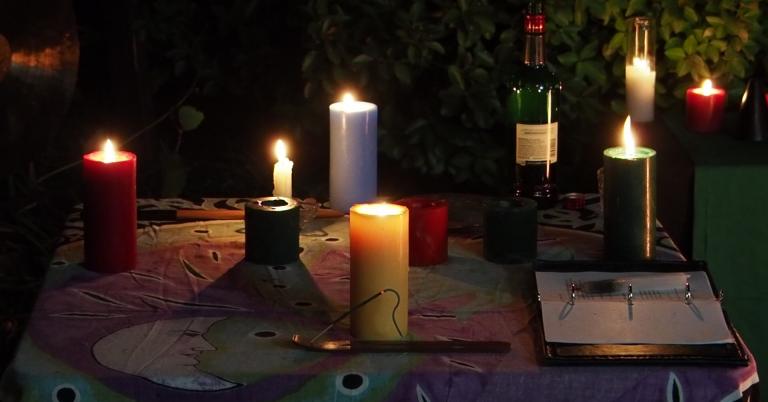
Under the Ancient Oaks Online Samhain Ritual – 2020
In the beginning was Scott Cunningham
Like most Pagans of this generation, my initial instruction was from books, in particular Scott Cunningham’s Wicca: A Guide For The Solitary Practitioner.
I’m not sure it would be fair to call my early workings “ritual,” much less “liturgy.” I was primarily focused on low-level magical workings. It would be a long time before I tried anything resembling high magic, much less devotion. Most of what could be considered liturgy was cleansing, casting a circle, and calling the quarters (a term I no longer use).
I wasn’t the only one. When I finally started going to public rituals, I mostly saw cleansing, casting a circle, and calling the quarters. I went to several rituals where there was ten to fifteen minutes of elaborate opening, ten minutes of elaborate closing, and maybe five minutes of an actual magical or religious working in between. That’s one of the reasons I’ve always emphasized “make the main event the main event” when I teach ritual.
My first public ritual – thank you ADF
The first time I led a public ritual was Summer Solstice 2003. That occasion has its own blog post, including how I was so nervous I almost backed out.
I wanted to do a Druid ritual, I didn’t know where to start, and most of the Druid rituals I found on the internet were from ADF – Ár nDraíocht Féin. I still have the script – it follows their Core Order of Ritual almost exactly.
Unlike Wicca and OBOD, ADF doesn’t cast circles and call quarters. The “world building” part of their liturgy focuses on the Fire, the Well, and the Tree. Over the years I’ve kept casting circles and invoking the spirits of the elements and directions – I explained why in a 2017 blog post (short answer: I find it helpful – my liturgy is very utilitarian).
But from ADF I learned to do a pre-ritual briefing, to let everyone know what you’re going to do and how to participate. I find that helpful even in a closed group that’s been working together for years.
I got the idea of a grounding meditation from ADF, and I still use a version of their Tree Meditation in my daily practice. It was a major part of my liturgy for many years, though lately I find myself using it less and less.
ADF introduced me to the idea of the Three Kindreds – the Gods, the Ancestors, and the Nature Spirits – and also to the idea that if we invite them into our rituals, we should make offerings to them. That gradually made its way into my liturgy.
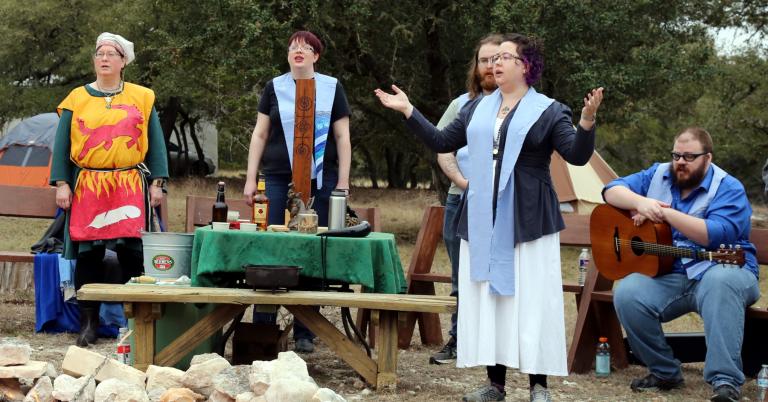
ADF priest Rev. Lauren Mart and the members of Nine Waves Grove lead ritual at the 2018 Texas Imbolc Retreat
OBOD and “borrow and blend”
I joined the Order of Bards, Ovates and Druids in Fall 2004 and began their training program. OBOD is part of the Western Mystery Tradition: they cast circles and call the spirits of the elements and directions much the same as Wiccans. That made it easy to move back and forth between my solitary OBOD rituals and my public CUUPS rituals, which were still heavily Wiccan.
Writing a ritual is hard, and when trying to do it for the first time most people do what I did: they find something they like on the internet and use that. The problem is that they throw together a bit of Wicca, a bit of ADF, a bit of traditional witchcraft, and a bit of something they saw on TV – and it doesn’t work. If you’re going to borrow, you have to blend – you have to give the whole ritual one theme and one voice. The same is true for rituals written by several people – someone has to edit it to make it sound like one person wrote the whole thing.
From about 2004 to about 2011, my liturgy had been borrowed and blended into a fairly consistent order. Pre-ritual briefing. Opening bell. Ground and center meditation. Formal opening. Cast circle and call quarters. Invoke ancestors and deities. Then the main working. After that the simple feast, reversing the grounding meditation, thanking the Gods, dismissing the quarters, uncasting the circle, a benediction and the closing bell.
Most of that liturgical framework remains. But there have been changes over the years.
The emergence of a polytheist
In 2010, if you had asked me if I was a hard polytheist or a soft polytheist, I would have said “yes.” By 2014, I would have said “I’m a polytheist – soft polytheism is pantheism.”
There were always deities involved in my rituals. Sometimes they were individual deities (I first met the Morrigan at Lughnasadh 2004), but many times they were simply “The Goddess” and “The God.” Reciting The Charge of the Goddess was a frequent ritual element.
My liturgy was quite flexible – it worked either way. But invocations and offerings became more important, as did choosing the right Deity of the Occasion. Figuring out that we need to honor Lugh at Lughnasadh or Brighid at Imbolc is easy, but who do we honor at Beltane? Sometimes it’s Whoever says “I want your next ritual” – we can’t nail the Gods to a calendar.
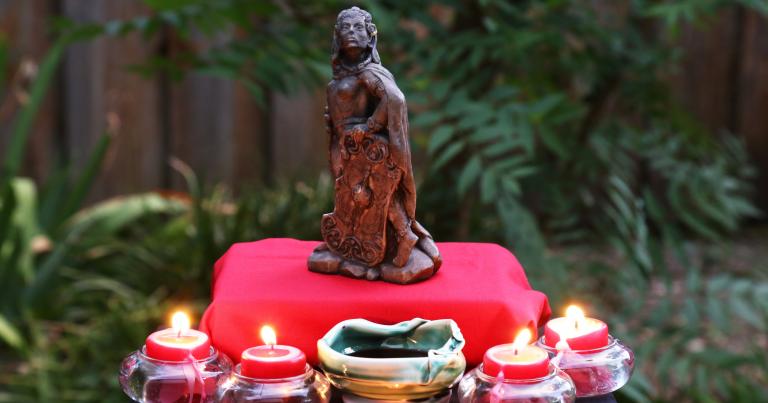
Honor the Morrigan at the Summer Solstice? If She says so, yes! Under the Ancient Oaks Online Summer Solstice Ritual – 2020
The Fair Folk demand their due
The Fair Folk are not to be trifled with, and whenever someone tells me they want to “work with the fairies” I send them to Morgan Daimler and hope they can be persuaded otherwise. But Denton CUUPS and its members have had a rather unique relationship with the Good Neighbors since before there was a Denton CUUPS. We have, upon occasion, acknowledged them in ritual and tried to maintain neighborly relations.
One such time was Beltane 2016. We invited the Fair Folk, we told some of their stories, and we were – in our opinion – quite hospitable toward them. They thought otherwise and helped themselves to an entire pitcher of wine.
Before the ritual we poured wine out of bottles into a glass pitcher and set it on a table near the main altar, to use in our simple feast. It sat there for at least a half hour. And then at one point in the ritual, with nothing going on around the table, the pitcher simply split, like what happens when you pour cold water into a hot glass. Except there was no sudden change of temperature anywhere.
For this and other reasons, I am now obligated to acknowledge the Fair Folk in my rituals – I can’t dump them in with the land spirits like I tried to do for several years. If you’re participating in one of my online rituals and you’re not comfortable offering to themselves, then don’t. I completely understand, and to a large extent, agree. But I no longer have that choice, and so my liturgy now includes recognizing and offering to the Fair Folk.
The central fire
Early on my Pagan journey I learned that some people invoke Center as the fifth direction. I did that a couple of times, but never gave it much thought. Later, I learned about the Greek Omphalos and the Norse Yggdrasil – mystical centers of the world.
ADF teaches that the fire is a gateway to the Otherworld – but so are the Well and the Tree. But there’s something special about fire, going back to the idea that the campfire was humanity’s first sacred circle.
In this short video, I talk with ADF Archdruid Jean Pagano about the importance of fire in ADF ritual, and in Indo-European religion in general.
My invocation of the central fire varies from ritual to ritual, but it always begins with the statement “this fire is the intersection of all times, all directions, and all worlds.” It ends with “we make this offering, that our journeys may be safe and fruitful.” The fire is the mystical center of the ritual.
Going forward: make changes mindfully
I run into some Pagans who dislike the whole idea of liturgy. For them, Pagan ritual should always be “spontaneous.” They are, of course, free to conduct their rituals however they like.
But while there’s a place for spontaneity, it’s mainly in solitary and very small group workings. In a medium to large group ritual, it usually leads to disjointed and ineffectual workings.
The Greeks – who gave us the word “liturgy” – had an order to their sacrifices and other public rituals. The Egyptians had a liturgy for everything – we have them because they painted them on the walls of their temples and tombs. In some cases they were literally carved in stone.
As I hope this post has demonstrated, our contemporary Pagan liturgies need not be permanently fixed. When there’s a good reason to make a change – either as a one-time thing or going forward indefinitely – then make the change. If it works, keep it. If it doesn’t, don’t.
But I encourage you to make changes mindfully. Break rules on purpose, not haphazardly. You don’t have to justify your changes to me or to anyone else. You just have to convince yourself that you’re changing a liturgy that works because something else might work better, not just because “this is cool and I want to do it.”
Good liturgy should be a living thing. This is how my liturgy has evolved over the years.
Previous Post
December 15, 2020
9 Observations on the Gods – Polytheism as I Practice It
Next Post

December 20, 2020 A Winter Solstice Reflection in 2020
Browse Our Archives
Select a Category Books Community CUUPS Druidry Foundations and Context Gods and Goddesses Magic Myth Nature Ritual Spiritual Practice Theology Travel Uncategorized Videos
Select a Month October 2026 September 2026 August 2026 July 2026 June 2026 May 2026 April 2026 March 2026 February 2026 January 2026 December 2025 November 2025 October 2025 September 2025 August 2025 July 2025 June 2025 May 2025 April 2025 March 2025 February 2025 January 2025 December 2024 November 2024 October 2024 September 2024 August 2024 July 2024 June 2024 May 2024 April 2024 March 2024 February 2024 January 2024 December 2023 November 2023 October 2023 September 2023 August 2023 July 2023 June 2023 May 2023 April 2023 March 2023 February 2023 January 2023 December 2022 November 2022 October 2022 September 2022 August 2022 July 2022 June 2022 May 2022 April 2022 March 2022 February 2022 January 2022 December 2021 November 2021 October 2021 September 2021 August 2021 July 2021 June 2021 May 2021 April 2021 March 2021 February 2021 January 2021 December 2020 November 2020 October 2020 September 2020 August 2020 July 2020 June 2020 May 2020 April 2020 March 2020 February 2020 January 2020 December 2019 November 2019 October 2019 September 2019 August 2019 July 2019 June 2019 May 2019 April 2019 March 2019 February 2019 January 2019 December 2018 November 2018 October 2018 September 2018 August 2018 July 2018 June 2018 May 2018 April 2018 March 2018 February 2018 January 2018 December 2017 November 2017 October 2017 September 2017 August 2017 July 2017 June 2017 May 2017 April 2017 March 2017 February 2017 January 2017 December 2016 November 2016 October 2016 September 2016 August 2016 July 2016 June 2016 May 2016 April 2016 March 2016 February 2016 January 2016 December 2015 November 2015 October 2015 September 2015 August 2015 July 2015 June 2015 May 2015 April 2015 March 2015 February 2015 January 2015 December 2014 November 2014 October 2014 September 2014 August 2014 July 2014 June 2014 May 2014 April 2014 March 2014 February 2014 January 2014 December 2013 November 2013 October 2013 September 2013 August 2013 July 2013 June 2013 May 2013 April 2013 March 2013 February 2013 January 2013 December 2012 November 2012 October 2012 September 2012 August 2012 July 2012 June 2012 May 2012 April 2012 March 2012 February 2012 January 2012 December 2011 November 2011 October 2011 September 2011 August 2011 July 2011 June 2011 May 2011 April 2011 March 2011 February 2011 January 2011 December 2010 November 2010 October 2010 September 2010 August 2010 July 2010 June 2010 May 2010 April 2010 March 2010 February 2010 January 2010 December 2009 November 2009 October 2009 September 2009 August 2009 July 2009 June 2009 May 2009 April 2009 March 2009 February 2009 January 2009 December 2008 November 2008 October 2008 September 2008 August 2008 July 2008 June 2008
Follow Us!
TAKE THE
Religious Wisdom Quiz
How many people did Jesus feed with five loaves of bread and two fish?
Select your answer to see how you score.
5,000 1,000 2,500 500
Related posts from John Beckett




What We Lose When “Ask AI” Becomes A...
TRENDING AT PATHEOS Pagan

The Sermon on the Mount, Part I: Matthew...
The Sermon on the Mount, Part I (Matthew 4:12-5:12) St. Matthew moves...

What's up from Crossway: Reviewing some of their latest A few weeks...

Janie Learns the Way of the Cross: A...
Teaching children about Jesus' Passion can be challenging. Many parents and educators...

Looking For Good Catholic Writing - October 2026
He alone extends the heavens, and he walks upon the waves of...

In "Irreplaceable," our book on vocation and technology, Trevor Sutton and I...

I was strolling through the top floor of the brand new Parthenon...
view all Pagan blogs
Ad-Free & Subscriber Log-In Subscription Support
- About Us
- 2026 Calendar
- Videos
- Podcasts
- Library of World Religions
- Faith In Media Tracker
- Advertise With Us
- Write for Us
- Privacy Policy
- Terms of Service
- Do Not Sell My Data
- Contact Us
- Radiant Digital
- Manage Newsletter Subscriptions
- Unsubscribe From Notifications
- Sitemap
Copyright 2008-2026, Patheos. All rights reserved.
Subscription Support Ad-Free & Subscriber Log-In
Follow Patheos