
BuddhistCatholicContemplativeEvangelicalGeneral ChristianHinduJewishLatter-day SaintMuslimNew VisionsProgressive Christian
Beliefs
- Buddhist
- Catholic
- Contemplative
- Evangelical
- General Christian
- Hindu
- Jewish
- Latter-day Saint
- More Voices
- Muslim
- New Visions
- Pagan
- Progressive Christian
Topics
- Religion News
- Food and Religion
- Sports and Religion
- Religious Art
- Religious Music and Entertainment
- Religious Events
- History and Religion
- Style and Religion
- Politics and Religion
- Women in Religion
- Recreation Outdoors and Religion
- Business Finance and Religion
- Careers Workplace and Religion
- Education and Religion
- Family Parenting and Religion
- Health Fitness and Religion
- Home and Religion
- Relationships and Religion
- Technology and Religion
- Travel and Religion
Columnists
- Buddhist Columnists
- Business Finance and Religion Columnists
- Careers Workplace and Religion Columnists
- Catholic Columnists
- Contemplative Columnists
- Education and Religion Columnists
- Evangelists Columnists
- Family Parenting and Religion Columnists
- General Christian Columnists
- Health Fitness and Religion Columnists
- Hindu Columnists
- History and Religion Columnists
- Home and Religion Columnists
- Jewish Columnists
- More Voices Columnists
- Latter Day Columnists
- Muslim Columnists
- New Visions Columnists
- Nonreligious Columnists
- Pagan Columnists
- Politics and Religion Columnists
- Progressive Columnists
- Recreation Outdoors and Religion Columnists
- Relationships and Religion Columnists
- Religion News Columnists
- Religious Art Columnists
- Religious Events Columnists
- Religious Music and Entertainment Columnists
- Sports and Religion Columnists
- Style and Religion Columnists
- Technology and Religion Columnists
- Travel and Religion Columnists
- Women in Religion Columnists
Resource Library
- 2026 Calendar
- Library of World Religions
- The 100 Most Holy Places on Earth
- Patheos Answers
- Podcasts
- Videos
- Faith Leaders Database
- Anglican Episcopalian
- Bahai
- Baptist
- Buddhism
- Christianity
- Confucianism
- Eastern Orthodoxy
- Hinduism
- Holiness and Pentecostal
- ISKCON
- Islam
- Judaism
- Lutheran
- Methodist
- The Church of Jesus Christ of Latter-day Saints
- New Age
- Paganism
- Presbytarian and Reformed
- Protestantism
- Religion Behind the Scenes
- Roman Catholic
- Scientology
- Shia Islam
- Sikhism
- Sufism
- Sunni Islam
- Taoism
- Zen
- See all religions
Research Tools
 Ad-Free & Subscriber Log-In Subscription Support
Ad-Free & Subscriber Log-In Subscription Support
Follow Patheos 

- Trending:
- Forgiveness
- |
- Marriage
- |
- Consciousness
- |
- Death Penalty
- |
- Election
- |
- Halloween

- Home
- Pagan
- Memories of Hagia Sophia in Better Times
Memories of Hagia Sophia in Better Times
Last updated on: July 28, 2020 at 3:00 am by John Beckett
Memories of Hagia Sophia in Better Times 2020-07-27T19:42:10-06:00 John Beckett
Patheos Explore the world's faith through different perspectives on religion and spirituality! Patheos has the views of the prevalent religions and spiritualities of the world.
Earlier this month, Turkish President Recep Tayyip Erdogan ordered that Hagia Sophia, a UNESCO World Heritage Site in Istanbul, be converted from a museum into a mosque. The Wild Hunt covered this story, including the Pagan roots of some of Hagia Sophia’s architecture.
I visited Istanbul in 2012. We toured the Hippodrome (which includes a column with twined serpents taken from the Temple of Apollo at Delphi), the Blue Mosque, Topkapi Palace (home of the sultans of the Ottoman Empire), and perhaps my favorite, the Basilica Cistern – favorite in part because it was a lot cooler underground on a very hot day, and also because it was one of the locations in the James Bond movie From Russia With Love.
But perhaps the most beautiful of all these sites was Hagia Sophia. It was built as a cathedral in 537 and was the largest cathedral in the world for almost a thousand years. When the Ottomans defeated the Byzantines in 1453, Hagia Sophia was converted to a mosque. It was turned into a museum in 1935 after Turkey became a secular republic.
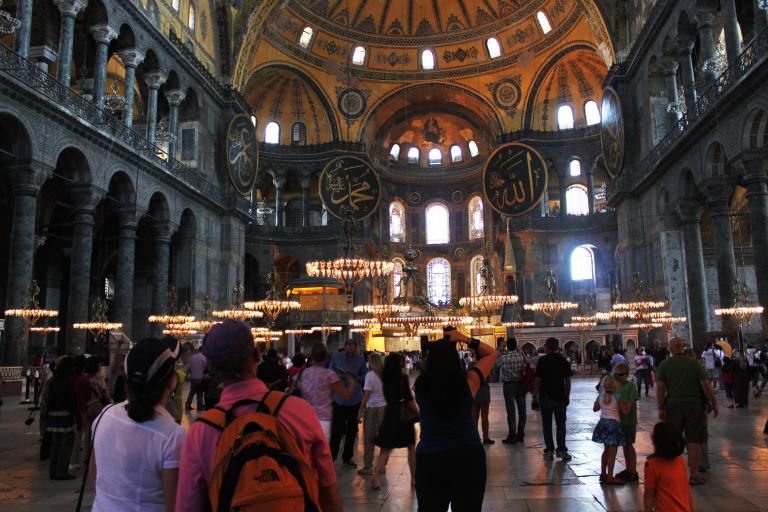
I had a wonderful – if brief – time in Turkey. When I got back, I wrote a blog post titled Islam in Turkey. I also freely admitted I should have titled that post “The Observations And Impressions Of An American On His First Visit To A Country Where Islam Is The Predominant Religion.”
Our tour guides – licensed by the government – went to great lengths to emphasize that while the vast majority of Turks are Sunni Muslims, Turkey is officially a secular state. They wanted to distance themselves from officially Islamic states like Iraq, Iran, and Saudi Arabia.
That was 2012.
Since then, President Erdogan has moved the country toward a more Islamist position, and himself toward a dictatorial position – much like Putin in Russia, and like some other elected leaders are trying to do in other countries. This BBC story from 2019 has plenty of details, and links to still more. This New York Times piece sheds considerable light on Erdogan’s motivation and thinking around reconverting Hagia Sophia to a mosque.
Last Friday, July 24, prayers were held in Hagia Sophia for the first time in 86 years. Erdogan himself read from the Quran during the service. This story and video essay from Al Jazeera describe the changes.
The marble floor has been covered in carpet, and movable curtains covered the Christian artwork during the prayers. Admission is now free, but tours will be halted for all five prayers, which will be held daily.
Orthodox Christians are particularly upset – Hagia Sophia was the center of the Greek Orthodox Church for most of its time as a church. Catholics, Protestants, and others have also expressed dismay. Pope Francis said “I think of Hagia Sophia, and I am very saddened.”
Rather than analyzing the politics of this transition, I’d rather share some pictures and focus on my memories of Hagia Sophia in better times.
The first thing I noticed upon walking into Hagia Sophia is that it didn’t look like a church. Or at least, it didn’t look like what I expected a church to be. It hasn’t been a church in over 500 years – of course there’s no altar, no pulpit, and no pews. It almost certainly never had pews – they’re a rather late invention, and mosques don’t have them.
The architecture is Byzantine – the building is almost square. It doesn’t resemble the Gothic cathedrals of Europe, which are rectangular and cruciform.
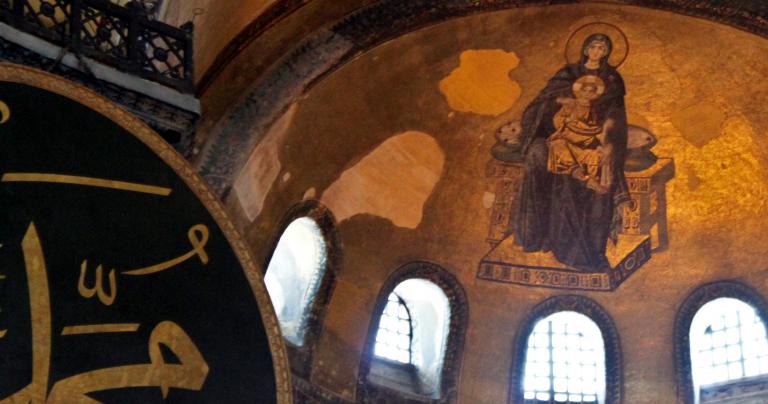
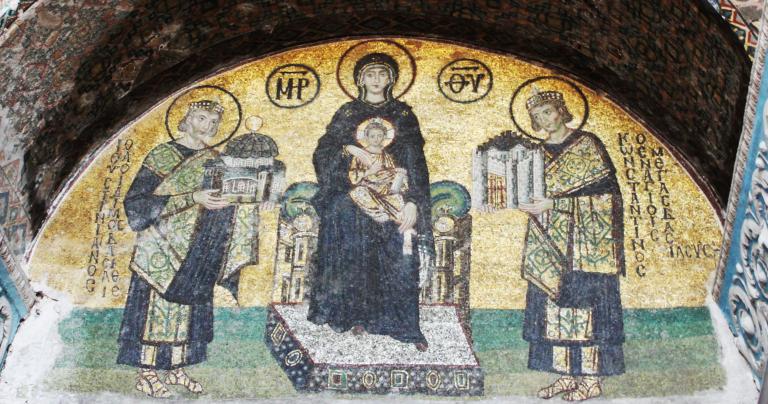
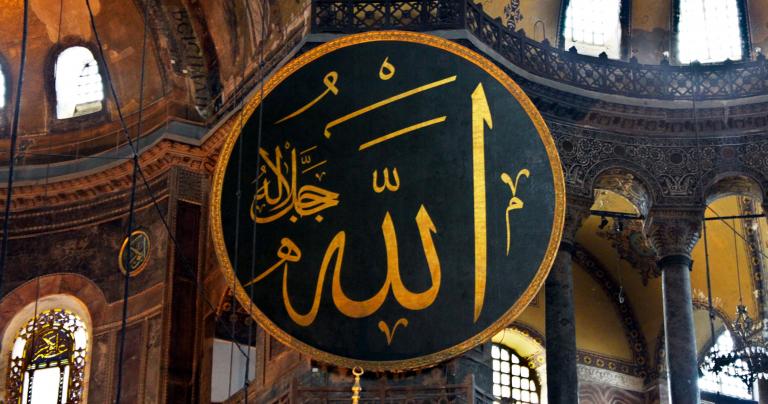
There were no statues or shrines – this was a museum. The Christian artwork high on the walls stands in contrast with the eight large hanging “calligraphic roundels” bearing the names of Allah, Muhammad, and six other key figures in the foundation of Islam. Islam prohibits physical representations of people (they take the “no graven images” thing even more seriously than Evangelical Christians) so calligraphy is often used for decoration. One website said roundels like these are unique to Ottoman mosques, but a brief internet search turned up no examples other than Hagia Sophia.
The Wild Hunt piece discussed the marble columns brought from the Temple of Artemis in Ephesus. Hagia Sophia is also home to two very large lustration urns (used to hold oil or water for ritual cleansings) each carved from a single block of marble. They were made around 200 BCE, meaning they are Pagan in origin. They were lost and then rediscovered in Pergamum (about 240 miles southwest of Istanbul) in the mid-1500s. Sultan Murad III had them brought to Hagia Sophia.
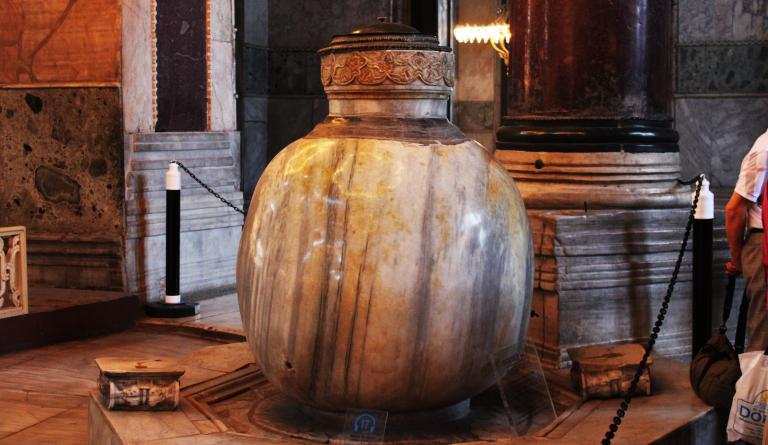
Unlike the Gothic cathedrals I’ve visited, I got no sense of spiritual power and depth at Hagia Sophia. Maybe it was just me being a tourist (though I had no such problems at the Pagan sites I visited on the same trip) or maybe it was the crowds. We were there on a Sunday, which isn’t a holy day in the Islamic world but is still the weekend. It’s a popular tourist spot.
But this was a museum, not a church or a temple. And before that it was a mosque. For whatever reason, I didn’t connect with the place.
That didn’t keep me from appreciating its history and beauty.
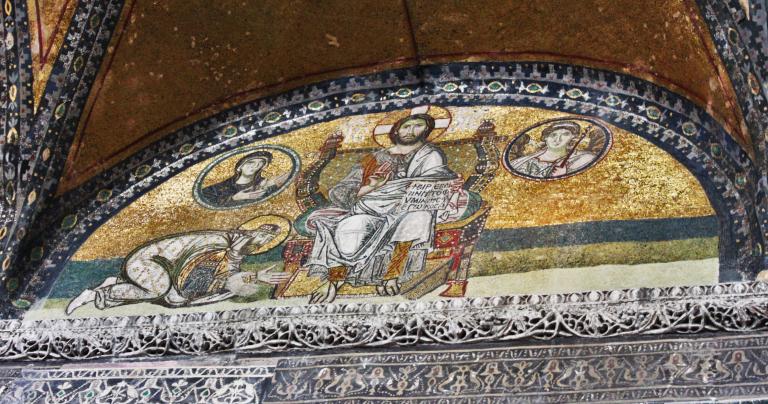
Erdogan has promised that Hagia Sophia will remain open to tourists outside of prayer times, much like the nearby Blue Mosque. Plans are to cover the Christian artwork during prayers and then uncover it afterwards. When Hagia Sophia was previously a mosque, the Christian artwork was permanently covered with plaster, which at least didn’t destroy it – it was restored in 1935. Perhaps future visitors who are Pagan, Christian, or followers of other religions (or of no religion) will be able to see and appreciate Hagia Sophia much as I did in 2012.
Still, when any religion claims ownership of a World Heritage Site that is significant to many people from different religions, it makes the world a little smaller and a little poorer.
And I remain thankful I was able to see Hagia Sophia when it was a museum.
Previous Post
July 26, 2020
I Like It Here – Why Do I Have To Leave?
Next Post
July 30, 2020 Denton CUUPS Online Lughnasadh Ritual: August 1
Browse Our Archives
Select a Category Books Community CUUPS Druidry Foundations and Context Gods and Goddesses Magic Myth Nature Ritual Spiritual Practice Theology Travel Uncategorized Videos
Select a Month October 2026 September 2026 August 2026 July 2026 June 2026 May 2026 April 2026 March 2026 February 2026 January 2026 December 2025 November 2025 October 2025 September 2025 August 2025 July 2025 June 2025 May 2025 April 2025 March 2025 February 2025 January 2025 December 2024 November 2024 October 2024 September 2024 August 2024 July 2024 June 2024 May 2024 April 2024 March 2024 February 2024 January 2024 December 2023 November 2023 October 2023 September 2023 August 2023 July 2023 June 2023 May 2023 April 2023 March 2023 February 2023 January 2023 December 2022 November 2022 October 2022 September 2022 August 2022 July 2022 June 2022 May 2022 April 2022 March 2022 February 2022 January 2022 December 2021 November 2021 October 2021 September 2021 August 2021 July 2021 June 2021 May 2021 April 2021 March 2021 February 2021 January 2021 December 2020 November 2020 October 2020 September 2020 August 2020 July 2020 June 2020 May 2020 April 2020 March 2020 February 2020 January 2020 December 2019 November 2019 October 2019 September 2019 August 2019 July 2019 June 2019 May 2019 April 2019 March 2019 February 2019 January 2019 December 2018 November 2018 October 2018 September 2018 August 2018 July 2018 June 2018 May 2018 April 2018 March 2018 February 2018 January 2018 December 2017 November 2017 October 2017 September 2017 August 2017 July 2017 June 2017 May 2017 April 2017 March 2017 February 2017 January 2017 December 2016 November 2016 October 2016 September 2016 August 2016 July 2016 June 2016 May 2016 April 2016 March 2016 February 2016 January 2016 December 2015 November 2015 October 2015 September 2015 August 2015 July 2015 June 2015 May 2015 April 2015 March 2015 February 2015 January 2015 December 2014 November 2014 October 2014 September 2014 August 2014 July 2014 June 2014 May 2014 April 2014 March 2014 February 2014 January 2014 December 2013 November 2013 October 2013 September 2013 August 2013 July 2013 June 2013 May 2013 April 2013 March 2013 February 2013 January 2013 December 2012 November 2012 October 2012 September 2012 August 2012 July 2012 June 2012 May 2012 April 2012 March 2012 February 2012 January 2012 December 2011 November 2011 October 2011 September 2011 August 2011 July 2011 June 2011 May 2011 April 2011 March 2011 February 2011 January 2011 December 2010 November 2010 October 2010 September 2010 August 2010 July 2010 June 2010 May 2010 April 2010 March 2010 February 2010 January 2010 December 2009 November 2009 October 2009 September 2009 August 2009 July 2009 June 2009 May 2009 April 2009 March 2009 February 2009 January 2009 December 2008 November 2008 October 2008 September 2008 August 2008 July 2008 June 2008
Follow Us!
TAKE THE
Religious Wisdom Quiz
What book comes directly after Lamentations?
Select your answer to see how you score.
Hosea Jeremiah Daniel Ezekiel
Related posts from John Beckett




What We Lose When “Ask AI” Becomes A...
TRENDING AT PATHEOS Pagan

Pope Leo Celebrates Mass for Nurses & Docs...
I don't have any idea how he did it, but Pope Leo...

The Sermon on the Mount, Part I: Matthew...
The Sermon on the Mount, Part I (Matthew 4:12-5:12) St. Matthew moves...

What's up from Crossway: Reviewing some of their latest A few weeks...

Janie Learns the Way of the Cross: A...
Teaching children about Jesus' Passion can be challenging. Many parents and educators...

Looking For Good Catholic Writing - October 2026
He alone extends the heavens, and he walks upon the waves of...

In "Irreplaceable," our book on vocation and technology, Trevor Sutton and I...
view all Pagan blogs
Ad-Free & Subscriber Log-In Subscription Support
- About Us
- 2026 Calendar
- Videos
- Podcasts
- Library of World Religions
- Faith In Media Tracker
- Advertise With Us
- Write for Us
- Privacy Policy
- Terms of Service
- Do Not Sell My Data
- Contact Us
- Radiant Digital
- Manage Newsletter Subscriptions
- Unsubscribe From Notifications
- Sitemap
Copyright 2008-2026, Patheos. All rights reserved.
Subscription Support Ad-Free & Subscriber Log-In
Follow Patheos