
BuddhistCatholicContemplativeEvangelicalGeneral ChristianHinduJewishLatter-day SaintMuslimNew VisionsProgressive Christian
Beliefs
- Buddhist
- Catholic
- Contemplative
- Evangelical
- General Christian
- Hindu
- Jewish
- Latter-day Saint
- More Voices
- Muslim
- New Visions
- Pagan
- Progressive Christian
Topics
- Religion News
- Food and Religion
- Sports and Religion
- Religious Art
- Religious Music and Entertainment
- Religious Events
- History and Religion
- Style and Religion
- Politics and Religion
- Women in Religion
- Recreation Outdoors and Religion
- Business Finance and Religion
- Careers Workplace and Religion
- Education and Religion
- Family Parenting and Religion
- Health Fitness and Religion
- Home and Religion
- Relationships and Religion
- Technology and Religion
- Travel and Religion
Columnists
- Buddhist Columnists
- Business Finance and Religion Columnists
- Careers Workplace and Religion Columnists
- Catholic Columnists
- Contemplative Columnists
- Education and Religion Columnists
- Evangelists Columnists
- Family Parenting and Religion Columnists
- General Christian Columnists
- Health Fitness and Religion Columnists
- Hindu Columnists
- History and Religion Columnists
- Home and Religion Columnists
- Jewish Columnists
- More Voices Columnists
- Latter Day Columnists
- Muslim Columnists
- New Visions Columnists
- Nonreligious Columnists
- Pagan Columnists
- Politics and Religion Columnists
- Progressive Columnists
- Recreation Outdoors and Religion Columnists
- Relationships and Religion Columnists
- Religion News Columnists
- Religious Art Columnists
- Religious Events Columnists
- Religious Music and Entertainment Columnists
- Sports and Religion Columnists
- Style and Religion Columnists
- Technology and Religion Columnists
- Travel and Religion Columnists
- Women in Religion Columnists
Resource Library
- 2026 Calendar
- Library of World Religions
- The 100 Most Holy Places on Earth
- Patheos Answers
- Podcasts
- Videos
- Faith Leaders Database
- Anglican Episcopalian
- Bahai
- Baptist
- Buddhism
- Christianity
- Confucianism
- Eastern Orthodoxy
- Hinduism
- Holiness and Pentecostal
- ISKCON
- Islam
- Judaism
- Lutheran
- Methodist
- The Church of Jesus Christ of Latter-day Saints
- New Age
- Paganism
- Presbytarian and Reformed
- Protestantism
- Religion Behind the Scenes
- Roman Catholic
- Scientology
- Shia Islam
- Sikhism
- Sufism
- Sunni Islam
- Taoism
- Zen
- See all religions
Research Tools
 Ad-Free & Subscriber Log-In Subscription Support
Ad-Free & Subscriber Log-In Subscription Support
Follow Patheos 

- Trending:
- Forgiveness
- |
- Marriage
- |
- Consciousness
- |
- Death Penalty
- |
- Election
- |
- Halloween

- Home
- Pagan
- I Like It Here – Why Do I Have To Leave?
I Like It Here – Why Do I Have To Leave?
Last updated on: July 26, 2020 at 9:57 am by John Beckett
I Like It Here – Why Do I Have To Leave? 2020-07-26T09:57:16-06:00 John Beckett
Patheos Explore the world's faith through different perspectives on religion and spirituality! Patheos has the views of the prevalent religions and spiritualities of the world.
The Denton Unitarian Universalist Fellowship
July 26, 2020
I don’t know how I could get through all this without my regular spiritual practice.
Prayer, communion with Nature, offerings to my Gods and ancestors: these things keep me connected to the Source of my strength. They keep me focused on who I am and who I want to be, no matter the circumstances.
Spiritual practice isn’t a panacea. It doesn’t provide protection from Covid-19, and it doesn’t make the isolation and limitations of social distancing any more pleasant. But the practices and the spiritual foundation they’ve helped me build make it possible for me to carry on when it would be all too easy to give in to despair.
Some of you have spiritual practices. Some of you do meditation, Lectio Divina, or any of numerous other spiritual and religious practices. We don’t all do the same things, and that’s fine. We’re Unitarian Universalists – we’re united not by common beliefs or even by common practices, but by shared values… especially a commitment to justice… especially justice for those for whom it has long been denied.
This service is not a primer in Unitarian Universalism, nor is it an introduction to spiritual practice. If you’re new to either one or both of these topics, I hope it will show you what’s possible with consistent practice… if you choose.
Rather, this service is geared toward those who do have a spiritual practice. You’ve been doing something for a while… maybe for a long while. Like me, your practice brings you stability and comfort. It’s something familiar in a world where everything is new and different, and not in a good way. You would never consider giving it up, and I’m the last person who would suggest you do.
But as good as that practice is, every now and then you get the urge, the desire, the call… for something even deeper. And this morning I want to talk about that call to greater spiritual depth.

I like stability
To say I grew up in a stable home would be a massive understatement. My parents were married for almost 50 years. I lived in the same house until I left for college. I never changed schools except for promotions.
I wanted to get away from home, but that was ordinary teenage desire for independence. I’ve never had wanderlust – I wanted to get away from home and build a new home the way I wanted it to be… and then stay there. When Cathy and I built our first house shortly after we got married, I thought that was exactly what I was going to do.
And then my job went away, starting a process that led to three cross-country moves in six years, eventually bringing me here in 2001.
I like stability. If a situation is good, my preference is to stay there and use it as a foundation for further growth, not to walk away because something else might be better – because that something else might be worse. But if I hadn’t made all those cross-country moves – including two I really didn’t want to make – my life would be so much less than it is, in every sense of the word.
The process of religious depth
What happens in our religious and spiritual lives is similar to what happens in our lives as a whole.
Most of us did not grow up UU. The same is true of my other religious identity as a Pagan. We discover something new – something that speaks to us. We start participating, we read books, we take classes… we serve on committees. There’s a process of experience, practice, and contemplation that leads to integration. We stop telling people “I go to the UU church” and start saying “I am a UU.”
That sense of religious identity leads to stability. We’re no longer “seekers” because we found what we were looking for all along… even if we didn’t know what we wanted when we started looking. That stability is a good thing, even a necessary thing.
But there’s a fine line between stability and stagnation. If you’ve been doing the same things in the same way for a long time, perhaps it’s time to take on something new.
The Eight of Cups
This is the Eight of Cups in the Waite-Smith Tarot deck, first published in 1910.
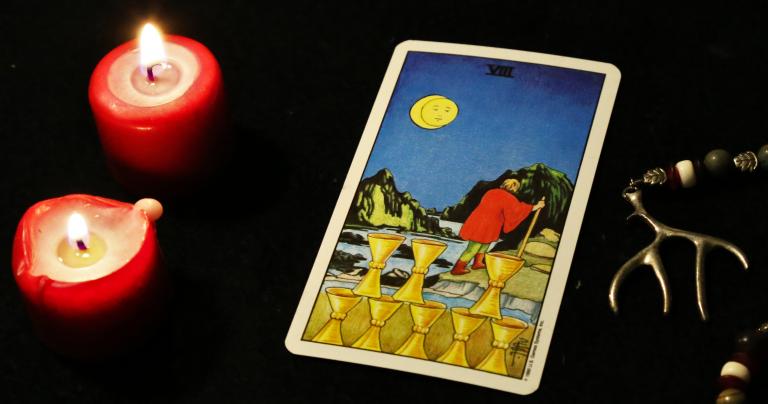
For most of that 110 years it’s been called the Rider-Waite deck, named for Arthur Waite, who conceptualized the deck, and the Rider company, who published it. That name ignored the work of artist Pamela Coleman Smith, a British woman of color who drew and painted the 78 cards. Waite and Smith were both members of the Golden Dawn – by far the most influential esoteric order of the late 19th and early 20th centuries – but only Waite got credit for this amazing work of spirituality. That’s finally starting to change.
Some UUs are skeptical about the Tarot, but you need not believe anything mystical to see the meaning and wisdom in this artwork. The person in the card has turned their back on eight cups, symbols of emotional fulfillment. They’re starting off on a new journey over difficult terrain into unknown territory.
Why would someone leave a good situation – a stable situation – to wander off into the unknown? Or as the title of this service asks, “I like it here – why do I have to leave?”
Why you need to leave
One reason you might leave a comfortable practice is that you need to grow, and growth requires a stimulus. You need to take on something else.
Perhaps you’re knowledgeable and experienced enough that it’s time for you to start teaching. On one hand, our wider society has the idea that religious and spiritual teachers need to be holy people, specially trained in a specific tradition. The UUA has a rigorous credentialing program for ordained ministers, and another program for religious educators. There’s value in that.
On the other hand, there’s the opposite idea that everybody’s path is different and spirituality is something everybody has to do on their own, so nobody needs a teacher. Certainly we all have to do our own spiritual work.
But there are always times when we can learn something from someone who’s been there and done that. And I can promise you that when you have the responsibility to teach someone else, you’ll make sure you know the material as well as you can. Maybe it’s time for you to take on the mantle of teaching, perhaps in our Religious Education program, or perhaps on your own.
Maybe you need to move into a leadership role. Again, some in our wider society have the idea that spirituality should be a completely egalitarian thing, that we should have no leaders. Those of us who’ve spent any amount of time in an actual spiritual community know that without leaders, things tend to not get done. I’m thankful for our Board and other lay leaders here at Denton UU.
At its core, spiritual leadership is about service: doing the sometimes hard and rarely glamourous work needed to facilitate religious community. It’s serving on boards and committees. It’s writing newsletters and answering e-mails. These days it’s setting up Zoom calls and helping those with no computer experience or old technology to stay connected. It’s doing all the things that somebody has to do and most people assume someone else will take care of.
Maybe it’s time for you to take on a leadership role.

Moving into greater spiritual depth
Or perhaps your call to greater spiritual depth is a call for more spiritual work.
Maybe this means more of what you’re already doing. The greatest benefit in meditation and other spiritual practices is going from doing nothing to doing something, no matter how small. But we also benefit when we go from 5 minutes a day to 10 minutes, or from 10 minutes to 20. At some point the law of diminishing returns starts to take effect, but until you reach that point, perhaps you need to do more by literally doing more.
Or perhaps you need to add a new practice to your routine. Meditation, prayer, offerings, communion with Nature, devotional reading, singing, ancestor work, journaling… the list is long. Maybe you need to use this time of social distancing to develop your own monastic practices.
If you’re trying to decide what to add, my suggestion is to add the one that most interests you, that seems like fun. If you pick something you like, you’re more likely to stay with it, and consistent practice over time is where the benefits come from. That builds skills for when you need to take on a spiritual practice that’s not so easy.
Teaching, leadership, longer practices, different practices – that call for more that you’re feeling may be answered with any of these responses.
For some of us, though, the call to spiritual depth is a call to re-examine our spiritual experiences, and what they mean for how we interact with the world.
Mystical experiences
I’ve been leading public Pagan rituals for 17 years. I’ve been blogging for 12 years. My first book came out three years ago. I write about what I do, which includes some first-hand religious and spiritual experiences that some people find… unlikely. Or even, impossible.
And yet, some of these very same skeptical people, in a private moment, will tell me things like “I knew this thing was going to happen and I had no way of knowing that.” “I saw something and I’m sure it wasn’t from this world.” “I had a conversation with my dead grandmother.”
Many of us have at least one mystical experience that we can’t explain. But our mainstream society tells us that people who see and hear things that others don’t are mentally ill. Or they’re under the influence of drugs or alcohol. Or they’re lying “to get attention.” And so we rationalize our experiences away. Or worse, we tell ourselves they never happened.
A line from English literature says “once all the land was full of fairies, but now no one can see them anymore.” That was Geoffrey Chaucer, writing in the 14th century. In the early 20th century Walter Evans-Wentz collected stories of encounters with fairies in the Celtic countries. Most of his subjects were older people, since in his words “younger people pride themselves on their own exemption from ‘superstition’.”
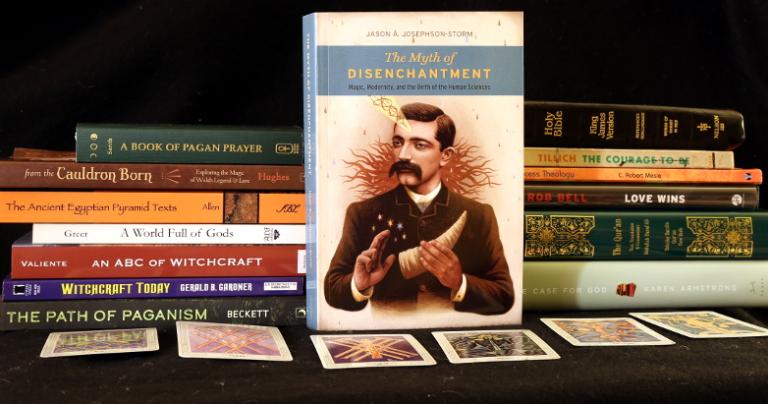
In his book The Myth of Disenchantment, Jason Josephson-Storm, Professor of Religion at Williams College in Massachusetts, provides ample historical evidence that it’s always been this way. We all think our ancestors had all of these mystical experiences but now no one has them anymore. Meanwhile, our own mystical experiences become the “golden age” for the next generation.
Maybe it’s time to do something different.
Starting out on an unfamiliar path
Maybe it’s time to explore your spiritual experiences in more depth. If you don’t have any spiritual experiences – or if you’ve rationalized them all away – maybe it’s time to put yourself in positions where they’re more likely to happen… though these things come in their own time and not when we command them.
Not to throw reason out the window. Good discernment is always required, even when dealing with things we’re told are unreasonable. Sometimes that strange light in the middle of the night is just a neighbor playing with a flashlight. But other times it’s not.
If your initial reaction is that we shouldn’t be worrying about Otherworldly events when there’s so much to do in this world, this probably isn’t for you. And that’s OK. If you’re likely to become obsessed with Otherworldly matters, this also probably isn’t for you. My Baptist father used to complain about people who were “so heavenly minded they’re no earthly good.” I’m sure there’s a Pagan equivalent of that saying somewhere.
But it’s entirely possible to remain grounded in the ordinary world, to stay engaged with the work of this place and this time, and to also respond to our mystical experiences and explore their implications for the way we see the world and our place in it.
Some of us left those eight cups behind a long time ago. We’re not sure exactly where we’re going, but we can’t imagine being on any other path.
The call to greater depth
Regular spiritual practice has many benefits, and with a little work you can find a practice that matches your interests, abilities, and core beliefs about the world and the way it works. These practices will help you stay focused on who you are and who you want to be, no matter the circumstances. And if you’re not only happy where you are, but you feel like you belong where you are, perhaps you can stay there.
But if you find yourself getting bored with your practice, or you see a need you know you can fill even though it may require learning new skills, or if you just feel a call to something more, then perhaps it’s time to take the first step on a new path.

Additional Pagan comments
Here the UU service ends. Messages have to be tailored to their audience, and my goal in this presentation was to speak deeply to a handful of people in the UU church without confusing or frightening those who aren’t ready to contemplate mystical experiences.
In a Pagan setting I have far fewer reservations. This service is an excerpt from what will be a much longer presentation at some future Pagan conference. I can’t cover all the material I’ll add to that presentation, but there are a couple more things I need to say.
If you feel the call to something deeper, your first task is one of discernment. Who’s calling you? What are they calling you to do?
Meditate, contemplate, and do divination. If you can’t divine for yourself, find someone to read Tarot or runes or Ogham for you… and remember that good diviners deserve to be paid just like you’d pay a plumber or an auto mechanic.
Never expect to see a full plan. The Gods have many virtues – transparency is not one of them… as those of you who have dealings with the Morrigan know very well. Expect to be told to do this. After you do this, expect to be told to do that, and after that the next thing, and the next thing, and so on.
Do you trust the source of your call? Do you want to be a part of their work? Then say yes.
And if you don’t, don’t say yes. Do not promise what you cannot or will not do.
Your answer will have consequences. Say yes and you’ve committed yourself to a path you can’t see. Say no and you may not get another offer.
Now, some people don’t have a choice, but that’s whole ‘nother workshop.
There is risk in embodying the Eight of Cups, in setting off on a new journey over difficult terrain into unknown territory. The work is usually hard, often thankless, and sometimes dangerous. It’s not glamourous and it certainly brings no power or privilege.
But some of us can’t imagine doing anything else.
Whatever your practice, whatever your path, may the blessings of the Gods and ancestors be with you, now and in the days to come.
Previous Post

July 23, 2020
In the Doldrums… But the Wind is Beginning to Stir
Next Post

July 28, 2020 Memories of Hagia Sophia in Better Times
Browse Our Archives
Select a Category Books Community CUUPS Druidry Foundations and Context Gods and Goddesses Magic Myth Nature Ritual Spiritual Practice Theology Travel Uncategorized Videos
Select a Month October 2026 September 2026 August 2026 July 2026 June 2026 May 2026 April 2026 March 2026 February 2026 January 2026 December 2025 November 2025 October 2025 September 2025 August 2025 July 2025 June 2025 May 2025 April 2025 March 2025 February 2025 January 2025 December 2024 November 2024 October 2024 September 2024 August 2024 July 2024 June 2024 May 2024 April 2024 March 2024 February 2024 January 2024 December 2023 November 2023 October 2023 September 2023 August 2023 July 2023 June 2023 May 2023 April 2023 March 2023 February 2023 January 2023 December 2022 November 2022 October 2022 September 2022 August 2022 July 2022 June 2022 May 2022 April 2022 March 2022 February 2022 January 2022 December 2021 November 2021 October 2021 September 2021 August 2021 July 2021 June 2021 May 2021 April 2021 March 2021 February 2021 January 2021 December 2020 November 2020 October 2020 September 2020 August 2020 July 2020 June 2020 May 2020 April 2020 March 2020 February 2020 January 2020 December 2019 November 2019 October 2019 September 2019 August 2019 July 2019 June 2019 May 2019 April 2019 March 2019 February 2019 January 2019 December 2018 November 2018 October 2018 September 2018 August 2018 July 2018 June 2018 May 2018 April 2018 March 2018 February 2018 January 2018 December 2017 November 2017 October 2017 September 2017 August 2017 July 2017 June 2017 May 2017 April 2017 March 2017 February 2017 January 2017 December 2016 November 2016 October 2016 September 2016 August 2016 July 2016 June 2016 May 2016 April 2016 March 2016 February 2016 January 2016 December 2015 November 2015 October 2015 September 2015 August 2015 July 2015 June 2015 May 2015 April 2015 March 2015 February 2015 January 2015 December 2014 November 2014 October 2014 September 2014 August 2014 July 2014 June 2014 May 2014 April 2014 March 2014 February 2014 January 2014 December 2013 November 2013 October 2013 September 2013 August 2013 July 2013 June 2013 May 2013 April 2013 March 2013 February 2013 January 2013 December 2012 November 2012 October 2012 September 2012 August 2012 July 2012 June 2012 May 2012 April 2012 March 2012 February 2012 January 2012 December 2011 November 2011 October 2011 September 2011 August 2011 July 2011 June 2011 May 2011 April 2011 March 2011 February 2011 January 2011 December 2010 November 2010 October 2010 September 2010 August 2010 July 2010 June 2010 May 2010 April 2010 March 2010 February 2010 January 2010 December 2009 November 2009 October 2009 September 2009 August 2009 July 2009 June 2009 May 2009 April 2009 March 2009 February 2009 January 2009 December 2008 November 2008 October 2008 September 2008 August 2008 July 2008 June 2008
Follow Us!
TAKE THE
Religious Wisdom Quiz
What food did God provide for Israel in the wilderness every morning?
Select your answer to see how you score.
Olives Quail Manna Barley
Related posts from John Beckett




What We Lose When “Ask AI” Becomes A...
TRENDING AT PATHEOS Pagan

The Iron Gates and the Lion of the...
Yesterday, I didn't finish my report about, well, yesterday. So I'll...

Dolly Parton’s Last Song Wins Dove Award with...
Bluegrass band The Grascals, speaking on the red carpet at the 57th...

The Image: On the Horror of Capitalism and...
The Image Then went the Pharisees, and took counsel how they might...

We are approaching the date of our new American national holiday: October...

Letters on Living the Faith by C.S. Lewis
Most of us met C.S. Lewis as a public intellectual. Mere Christianity....

When Halloween Unmasks Married Hearts
Written by Dr. David K. Ewen from Eternal Truth Bible College Behind...
view all Pagan blogs
Ad-Free & Subscriber Log-In Subscription Support
- About Us
- 2026 Calendar
- Videos
- Podcasts
- Library of World Religions
- Faith In Media Tracker
- Advertise With Us
- Write for Us
- Privacy Policy
- Terms of Service
- Do Not Sell My Data
- Contact Us
- Radiant Digital
- Manage Newsletter Subscriptions
- Unsubscribe From Notifications
- Sitemap
Copyright 2008-2026, Patheos. All rights reserved.
Subscription Support Ad-Free & Subscriber Log-In
Follow Patheos