
BuddhistCatholicContemplativeEvangelicalGeneral ChristianHinduJewishLatter-day SaintMuslimNew VisionsProgressive Christian
Beliefs
- Buddhist
- Catholic
- Contemplative
- Evangelical
- General Christian
- Hindu
- Jewish
- Latter-day Saint
- More Voices
- Muslim
- New Visions
- Pagan
- Progressive Christian
Topics
- Religion News
- Food and Religion
- Sports and Religion
- Religious Art
- Religious Music and Entertainment
- Religious Events
- History and Religion
- Style and Religion
- Politics and Religion
- Women in Religion
- Recreation Outdoors and Religion
- Business Finance and Religion
- Careers Workplace and Religion
- Education and Religion
- Family Parenting and Religion
- Health Fitness and Religion
- Home and Religion
- Relationships and Religion
- Technology and Religion
- Travel and Religion
Columnists
- Buddhist Columnists
- Business Finance and Religion Columnists
- Careers Workplace and Religion Columnists
- Catholic Columnists
- Contemplative Columnists
- Education and Religion Columnists
- Evangelists Columnists
- Family Parenting and Religion Columnists
- General Christian Columnists
- Health Fitness and Religion Columnists
- Hindu Columnists
- History and Religion Columnists
- Home and Religion Columnists
- Jewish Columnists
- More Voices Columnists
- Latter Day Columnists
- Muslim Columnists
- New Visions Columnists
- Nonreligious Columnists
- Pagan Columnists
- Politics and Religion Columnists
- Progressive Columnists
- Recreation Outdoors and Religion Columnists
- Relationships and Religion Columnists
- Religion News Columnists
- Religious Art Columnists
- Religious Events Columnists
- Religious Music and Entertainment Columnists
- Sports and Religion Columnists
- Style and Religion Columnists
- Technology and Religion Columnists
- Travel and Religion Columnists
- Women in Religion Columnists
Resource Library
- 2026 Calendar
- Library of World Religions
- The 100 Most Holy Places on Earth
- Patheos Answers
- Podcasts
- Videos
- Faith Leaders Database
- Anglican Episcopalian
- Bahai
- Baptist
- Buddhism
- Christianity
- Confucianism
- Eastern Orthodoxy
- Hinduism
- Holiness and Pentecostal
- ISKCON
- Islam
- Judaism
- Lutheran
- Methodist
- The Church of Jesus Christ of Latter-day Saints
- New Age
- Paganism
- Presbytarian and Reformed
- Protestantism
- Religion Behind the Scenes
- Roman Catholic
- Scientology
- Shia Islam
- Sikhism
- Sufism
- Sunni Islam
- Taoism
- Zen
- See all religions
Research Tools
 Ad-Free & Subscriber Log-In Subscription Support
Ad-Free & Subscriber Log-In Subscription Support
Follow Patheos 

- Trending:
- Forgiveness
- |
- Marriage
- |
- Consciousness
- |
- Death Penalty
- |
- Election
- |
- Halloween

- Home
- Pagan
- Worship: Proclaiming That The Gods Are Worthy
Worship: Proclaiming That The Gods Are Worthy
Last updated on: June 18, 2020 at 3:00 am by John Beckett
Worship: Proclaiming That The Gods Are Worthy 2020-06-16T12:25:59-06:00 John Beckett
Patheos Explore the world's faith through different perspectives on religion and spirituality! Patheos has the views of the prevalent religions and spiritualities of the world.
Jason Mankey has a very good post this week titled Worship Is More Than Words & Offerings. He does a good job of explaining how worship does not mean self-debasement, and then asks an interesting question:
At what point does admiration become worship? Does one have to believe in a higher power to worship it? In other words, when does worship become worship?
This is important when we look back at the appearances of Pagan Gods in art, music, and literature during a time when Europe was considered “Christendom” and when practicing any religion other than Christianity was difficult and in many cases, a risk to life.
What we learn there is informative as we look at the slow but steady rise of Paganism and polytheism in our culture, which is still predominantly Christian. The old Gods never really went away, and our worship – in many forms – helps restore Them to a place of prominence and honor.

Worship is proclaiming what is most worthy
I apologize if you’ve heard me say this before a time or ten, but it’s one of those things I have to talk about on a regular basis. So many people have the wrong idea about worship.
“Worship” comes from the Old English word weorthscipe meaning worthiness and respect – to worship is to declare something or someone worthy of honor. At its core, worship is an expression of respect and a statement of worth. When we worship the Gods we are affirming that They are worthy of our honor and respect.
Prayers, hymns, and offerings are one way to do that. But that’s not the only way to worship.
Worship draws us closer to the Gods
When we declare that Cernunnos or the Morrigan or Athena is worthy of honor and respect, we necessarily focus on the attributes that make Them worthy: growth and nurturing, strength and tenacity, wisdom and courage. We focus on Their stories that tell us how They embody and express their virtues and values, and that remind us that They are whole persons, not merely personifications.
Contemplating the Gods draws us closer to the Gods. It helps us incorporate Their attributes into our lives and makes us more God-like. That in turn strengthens the relationships between us and the Gods, which helps us understand Them better, which helps us become more like Them.
Good, honest, authentic worship is a virtuous circle.
The Gods never really went away
Plutarch was wrong: the Great God Pan never died. The Gods of the Greeks, Romans, Celts, and other cultures may have faded into the background when their formal worship ended, but they never really went away. They remained present in art and literature, and in the land itself.
They also remained in the physical and spiritual descendants of the people who actively worshipped Them in earlier times. Jason tells about a tour guide who is a member of the Greek Orthodox Church but who also “uttered prayers to Athena now and then.” Egypt is a Muslim country, but they still put Horus on their airplanes, because Horus has always been a part of Egypt.
Because the Gods never went away, They were always there when people thought of Them, and especially when people thought about worshipping Them.

photo via Wikimedia Commons

Many Renaissance artists and Romantic poets were aspirationally Pagan
In his excellent book on Pagan philosophy The Earth, The Gods and The Soul, Brendan Myers quotes historian Jocelyn Godwin, who said:
I do not suppose that anyone in the fifteenth or sixteenth centuries was a pagan, in the sense of rejecting Christianity and adopting a pre-Christian religion… What I do suggest is that some people during this period ‘dreamed’ of being pagans. In their waking life they accepted the absurdities acknowledged as the essence and credenda of Christianity, all the while nurturing a longing for the world of antiquity and a secret affinity for the divinities of that world.
Can you worship a God whose existence you don’t actively affirm? This isn’t an ecclesiastical court: we’re neither trying someone for Christian heresy nor testing them for Pagan orthodoxy. What artists and writers believed isn’t important to us. Their art and writings declared that the old Gods are worthy of honor and respect, and that’s close enough to worship for me.
More importantly, it was close enough to worship to assist in the return of the Gods.
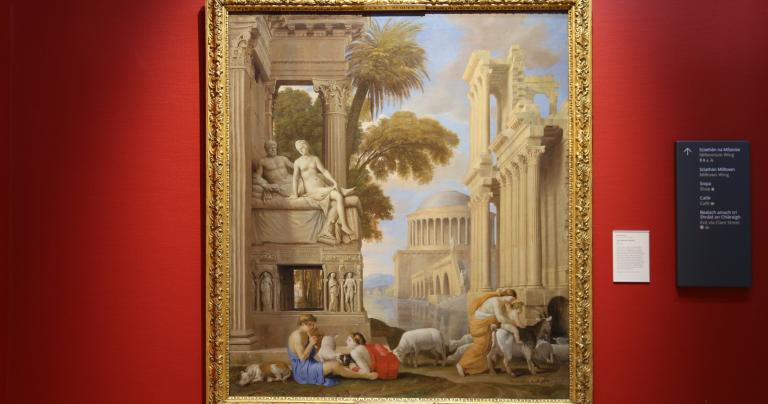
“The Childhood of Bacchus” by Jean Lemaire c.1630. My photo of a painting in the National Gallery of Ireland in Dublin.
Worship advances the Gods
The Neoplatonists argued (and they still do) that the Gods are perfect and need nothing, therefore our worship does not benefit Them. That may – or may not – be true. But what is clearly true is that humans worshipping Gods makes those Gods more visible in human society.
At first it’s just an artist re-creating a scene from Greek mythology. Then it’s someone viewing that art, and thinking about a Goddess they had heard about but never really thought about. Then it’s someone whispering a prayer to Athena because it seems like Jesus isn’t listening.
Eventually you’ve got Percy Shelley raising a turf-altar to Pan and calling it “the rites of the true religion” in 1821.
Again, this isn’t an ecclesiastical court and we need not decide whether Shelley actually worshipped Pan… though it certainly looks that way to me. But because Shelley and others like him wrote about the old Gods, eventually people begin worshipping Them in ways that are undeniably Pagan, undeniably polytheist, and undeniably religious.
And that bring us to where we are today.
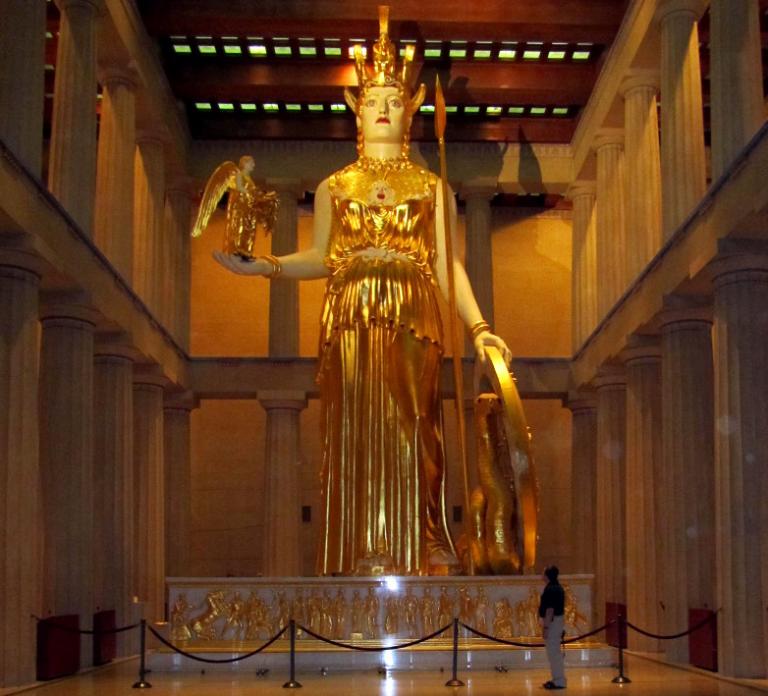
Athena, in the Parthenon in Nashville, Tennessee. That’s me for a size comparison.
Our worship helps make the Gods more visible for the next generation of Pagans
On one hand, worship is something deeply personal. I worship Cernunnos, Danu, the Morrigan, and others because I truly believe They are worthy of honor and respect, and because I want to strengthen and deepen my relationships with Them. I want to become more like Them.
That’s what I get out of worship. But when I talk about worship, write about worship, and share pictures of worship, I’m doing the same things that Jean Lemaire and Percy Shelley did: I’m making the Gods more visible in the world.
And you are too. Even if your worship is a private thing, it brings you closer to your Gods and that will cause you to bring Their values and virtues into the world, to one extent or another.
The next generation of Pagans and polytheists won’t have to worry about whether building an altar to Pan is “the true religion” or not. There are enough people who practice these religions, and our society is sufficiently plural – despite the very loud Christians and almost-as-loud atheists – that the worship of the many Gods will be seen as one legitimate alternative among many.
I used to think the future would be Pagan and polytheist. I’m less certain now, at least over the next hundred years or so. But I am certain that the worship of the many Gods never really ended, it has been growing for over 500 years, and it will continue to grow in the future.
Previous Post

June 16, 2020
Work Through Purgatory or Descend Into Hell
Next Post

June 21, 2020 What to Do When You Make a Mistake in Ritual
Browse Our Archives
Select a Category Books Community CUUPS Druidry Foundations and Context Gods and Goddesses Magic Myth Nature Ritual Spiritual Practice Theology Travel Uncategorized Videos
Select a Month October 2026 September 2026 August 2026 July 2026 June 2026 May 2026 April 2026 March 2026 February 2026 January 2026 December 2025 November 2025 October 2025 September 2025 August 2025 July 2025 June 2025 May 2025 April 2025 March 2025 February 2025 January 2025 December 2024 November 2024 October 2024 September 2024 August 2024 July 2024 June 2024 May 2024 April 2024 March 2024 February 2024 January 2024 December 2023 November 2023 October 2023 September 2023 August 2023 July 2023 June 2023 May 2023 April 2023 March 2023 February 2023 January 2023 December 2022 November 2022 October 2022 September 2022 August 2022 July 2022 June 2022 May 2022 April 2022 March 2022 February 2022 January 2022 December 2021 November 2021 October 2021 September 2021 August 2021 July 2021 June 2021 May 2021 April 2021 March 2021 February 2021 January 2021 December 2020 November 2020 October 2020 September 2020 August 2020 July 2020 June 2020 May 2020 April 2020 March 2020 February 2020 January 2020 December 2019 November 2019 October 2019 September 2019 August 2019 July 2019 June 2019 May 2019 April 2019 March 2019 February 2019 January 2019 December 2018 November 2018 October 2018 September 2018 August 2018 July 2018 June 2018 May 2018 April 2018 March 2018 February 2018 January 2018 December 2017 November 2017 October 2017 September 2017 August 2017 July 2017 June 2017 May 2017 April 2017 March 2017 February 2017 January 2017 December 2016 November 2016 October 2016 September 2016 August 2016 July 2016 June 2016 May 2016 April 2016 March 2016 February 2016 January 2016 December 2015 November 2015 October 2015 September 2015 August 2015 July 2015 June 2015 May 2015 April 2015 March 2015 February 2015 January 2015 December 2014 November 2014 October 2014 September 2014 August 2014 July 2014 June 2014 May 2014 April 2014 March 2014 February 2014 January 2014 December 2013 November 2013 October 2013 September 2013 August 2013 July 2013 June 2013 May 2013 April 2013 March 2013 February 2013 January 2013 December 2012 November 2012 October 2012 September 2012 August 2012 July 2012 June 2012 May 2012 April 2012 March 2012 February 2012 January 2012 December 2011 November 2011 October 2011 September 2011 August 2011 July 2011 June 2011 May 2011 April 2011 March 2011 February 2011 January 2011 December 2010 November 2010 October 2010 September 2010 August 2010 July 2010 June 2010 May 2010 April 2010 March 2010 February 2010 January 2010 December 2009 November 2009 October 2009 September 2009 August 2009 July 2009 June 2009 May 2009 April 2009 March 2009 February 2009 January 2009 December 2008 November 2008 October 2008 September 2008 August 2008 July 2008 June 2008
Follow Us!
TAKE THE
Religious Wisdom Quiz
What book comes directly after Lamentations?
Select your answer to see how you score.
Hosea Jeremiah Daniel Ezekiel
Related posts from John Beckett




What We Lose When “Ask AI” Becomes A...
TRENDING AT PATHEOS Pagan

Pope Leo Celebrates Mass for Nurses & Docs...
I don't have any idea how he did it, but Pope Leo...

The Sermon on the Mount, Part I: Matthew...
The Sermon on the Mount, Part I (Matthew 4:12-5:12) St. Matthew moves...

What's up from Crossway: Reviewing some of their latest A few weeks...

Janie Learns the Way of the Cross: A...
Teaching children about Jesus' Passion can be challenging. Many parents and educators...

Looking For Good Catholic Writing - October 2026
He alone extends the heavens, and he walks upon the waves of...

In "Irreplaceable," our book on vocation and technology, Trevor Sutton and I...
view all Pagan blogs
Ad-Free & Subscriber Log-In Subscription Support
- About Us
- 2026 Calendar
- Videos
- Podcasts
- Library of World Religions
- Faith In Media Tracker
- Advertise With Us
- Write for Us
- Privacy Policy
- Terms of Service
- Do Not Sell My Data
- Contact Us
- Radiant Digital
- Manage Newsletter Subscriptions
- Unsubscribe From Notifications
- Sitemap
Copyright 2008-2026, Patheos. All rights reserved.
Subscription Support Ad-Free & Subscriber Log-In
Follow Patheos