
BuddhistCatholicContemplativeEvangelicalGeneral ChristianHinduJewishLatter-day SaintMuslimNew VisionsProgressive Christian
Beliefs
- Buddhist
- Catholic
- Contemplative
- Evangelical
- General Christian
- Hindu
- Jewish
- Latter-day Saint
- More Voices
- Muslim
- New Visions
- Pagan
- Progressive Christian
Topics
- Religion News
- Food and Religion
- Sports and Religion
- Religious Art
- Religious Music and Entertainment
- Religious Events
- History and Religion
- Style and Religion
- Politics and Religion
- Women in Religion
- Recreation Outdoors and Religion
- Business Finance and Religion
- Careers Workplace and Religion
- Education and Religion
- Family Parenting and Religion
- Health Fitness and Religion
- Home and Religion
- Relationships and Religion
- Technology and Religion
- Travel and Religion
Columnists
- Buddhist Columnists
- Business Finance and Religion Columnists
- Careers Workplace and Religion Columnists
- Catholic Columnists
- Contemplative Columnists
- Education and Religion Columnists
- Evangelists Columnists
- Family Parenting and Religion Columnists
- General Christian Columnists
- Health Fitness and Religion Columnists
- Hindu Columnists
- History and Religion Columnists
- Home and Religion Columnists
- Jewish Columnists
- More Voices Columnists
- Latter Day Columnists
- Muslim Columnists
- New Visions Columnists
- Nonreligious Columnists
- Pagan Columnists
- Politics and Religion Columnists
- Progressive Columnists
- Recreation Outdoors and Religion Columnists
- Relationships and Religion Columnists
- Religion News Columnists
- Religious Art Columnists
- Religious Events Columnists
- Religious Music and Entertainment Columnists
- Sports and Religion Columnists
- Style and Religion Columnists
- Technology and Religion Columnists
- Travel and Religion Columnists
- Women in Religion Columnists
Resource Library
- 2026 Calendar
- Library of World Religions
- The 100 Most Holy Places on Earth
- Patheos Answers
- Podcasts
- Videos
- Faith Leaders Database
- Anglican Episcopalian
- Bahai
- Baptist
- Buddhism
- Christianity
- Confucianism
- Eastern Orthodoxy
- Hinduism
- Holiness and Pentecostal
- ISKCON
- Islam
- Judaism
- Lutheran
- Methodist
- The Church of Jesus Christ of Latter-day Saints
- New Age
- Paganism
- Presbytarian and Reformed
- Protestantism
- Religion Behind the Scenes
- Roman Catholic
- Scientology
- Shia Islam
- Sikhism
- Sufism
- Sunni Islam
- Taoism
- Zen
- See all religions
Research Tools
 Ad-Free & Subscriber Log-In Subscription Support
Ad-Free & Subscriber Log-In Subscription Support
Follow Patheos 

- Trending:
- Forgiveness
- |
- Marriage
- |
- Consciousness
- |
- Death Penalty
- |
- Election
- |
- Halloween

- Home
- Pagan
- We Cannot Nail the Gods to a Calendar
We Cannot Nail the Gods to a Calendar
Last updated on: May 14, 2020 at 3:00 am by John Beckett
We Cannot Nail the Gods to a Calendar 2020-05-09T15:23:01-06:00 John Beckett
Patheos Explore the world's faith through different perspectives on religion and spirituality! Patheos has the views of the prevalent religions and spiritualities of the world.
What do you do when a deity to whom you are oathed “requests” to be the focus of your next major public ritual, but They have no connections to that high day in lore or through function?
In my case, you say “yes Ma’am – I’ll make it work one way or another.”
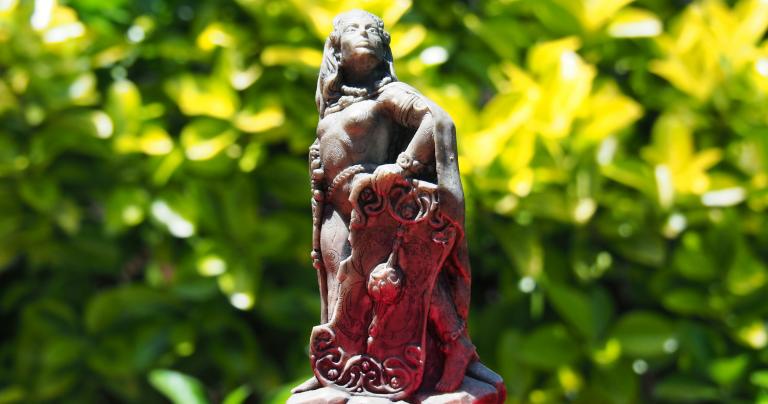
In addition to writing a Summer Solstice ritual with the Morrigan at the center, this exchange has me thinking about the Wheel of the Year and its strengths and weaknesses.
As we begin, it’s important to understand that I’m writing as a modern Pagan polytheist to others in the general Pagan community. If you’re part of a reconstructionist or living tradition that has its own liturgical calendar, I’m not talking to you. If you’re quite happy with the Wheel of the Year and its agricultural metaphors, I’m not talking to you. Both of those groups already have an answer to this question and they don’t need my help. If that’s you, I welcome your expertise and your suggestions (seriously – I’d love to hear them) but if you start to comment with either “not all Pagans” or “this is the only way to do it” – don’t.
Liturgical calendars old and new
The purpose of a liturgical calendar is to maintain traditions and to make things simple: you always know which holy days to observe, which great events to commemorate, and which Gods, ancestors, and other spirits to honor on which days.
I found one source that lists 81 festivals for the ancient Greeks and 165 for the ancient Egyptians. I’ve seen other sources that say both cultures had observances and commemorations on virtually every day of the year. The exact number isn’t relevant here. What’s important for this blog post is that there were a lot more than eight.
The solstices and equinoxes are as old as the Earth herself. The four fire festivals of Imbolc, Beltane, Lughnasadh, and Samhain originated with the Celts, meaning they’re at least 2500 years old. But the modern Pagan eightfold Wheel of the Year is a 20th century invention. Legend says that Wicca founder Gerald Gardner wanted to celebrate the four solar holidays, while OBOD founder Ross Nichols wanted to celebrate the four fire festivals. When they discussed the matter at their naturist (i.e. – nudist) retreat, they decided to do both. That story is probably more apocryphal than historical, but it emphasizes the modern blended nature of the Wheel of the Year.
However it originated, it’s worked well for Wiccans, Druids, and Pagans of many sorts. It’s become so ubiquitous that new Pagans are often surprised to learn that some traditions have their own very different set of holidays and holy days.
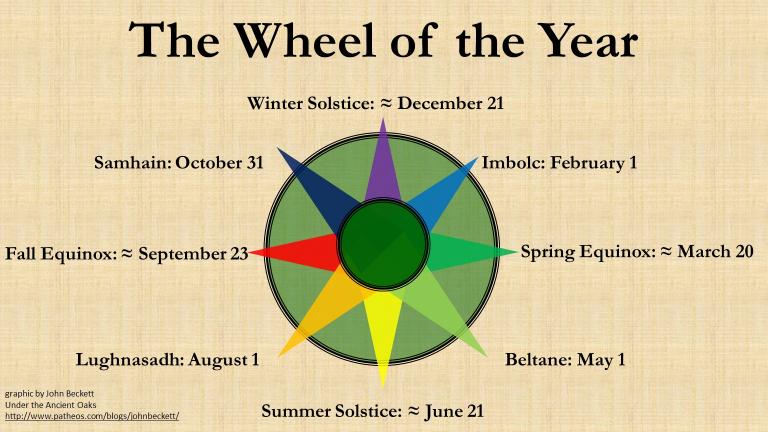
The Wheel of the Year and me
The Wheel of the Year was one of the first things I learned when I started exploring Paganism. I was taught that Imbolc, Ostara, and Beltane were the fertility festivals, Summer Solstice was the turning of the year from increase to decrease, Lughnasadh, Mabon, and Samhain were the harvest festivals, and Winter Solstice was the rebirth of the sun and the turning back to increase. It made sense.
For a while, anyway. It wasn’t long before I started hearing people ask “what does an agricultural cycle from Northwest Europe have to do with people in suburban North America?” People in the Southern Hemisphere flip the Wheel 180 degrees. That’s clearly correct for the solstices and equinoxes, but I always wondered if the fire festivals shouldn’t be kept on their original dates. Like many, I tried to adapt the Wheel for where I live, but that never really went anywhere.
And then there’s the whole question of how we relate to the Wheel of the Year in an era of climate change.
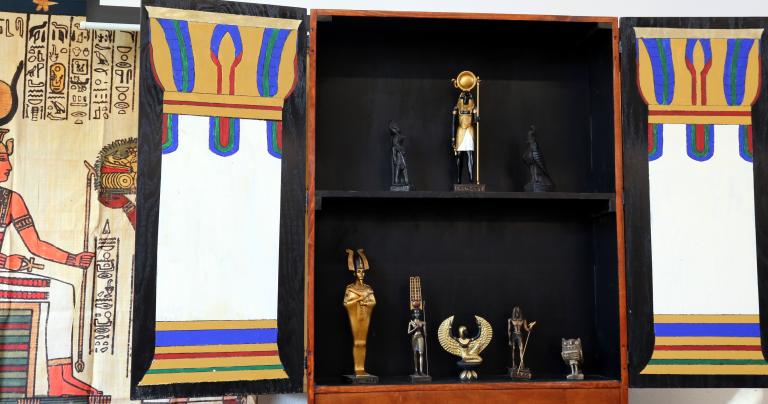
As my practice shifted from generic Nature worship to polytheism, things got complicated – especially in an eclectic Pagan group where there aren’t enough high days to go around. For 15 years Denton CUUPS honored the Gods of Egypt on the Summer Solstice. For five years we celebrated the Fall Equinox in a Norse tradition. Last year we switched them.
Is it Lughnasadh if you don’t honor Lugh? I don’t think so, even if you hold the ritual on August 1.
The wider Pagan community has been discussing this for years. But my difficulties with the Wheel of the Year are growing. I’m not sure how to proceed, but as I contemplate the task in front of me and what it means in a wider sense, there are a few things I’m sure are true.
It’s good to observe the seasons and cycles of Nature
For all that my practice is focused on Cernunnos, Danu, the Morrigan, and several others, I remain a Nature-centered Pagan. My practice is grounded not just in the land, but in the sun and the moon and the stars, in the wind and rain, and in the ever-changing seasons. It is good – and for me, necessary – to mark the longest day, the shortest day, and the days of equal day and night. In Texas, celebrating Samhain as Summer’s End is very appropriate – it’s about the earliest you can be sure the oppressive heat is gone for good (record high for October 31 at DFW: 89°F / 32°C).
Observing and celebrating the Wheel of the Year reminds us that we’re a part of Nature. We need to keep that one way or another.
Connections to the mainstream calendar are important
I’ve been leading and participating in public rituals for 17 years. Over that time I’ve seen that people who are curious about Paganism are going to turn out for Samhain. We get more Pagan-adjacent and non-Pagan people at the Winter Solstice than at any other time.
Last year I did Ranking the Eight Pagan Sabbats – the Story in the Numbers. The story is that connections matter. People come to Samhain because they know Halloween. They come to Winter Solstice because they know Christmas. They know Groundhog Day (Imbolc) and May Day (Beltane) to a lesser extent – they don’t know Lughnasadh or the Fall Equinox much at all.
Even if we wanted to do away with the Wheel of the Year, we’re pretty much stuck with it.
(Every time I write something like this I get comments saying “this is why I want Paganism to be small / private / occult / etc.” If that’s your calling, so be it. My calling is to do Paganism in public, and to be here for people who are trying to find it even if they’re not sure exactly what they’re looking for.)
Our Gods and ancestors deserve their own holy days
While there’s something that feels right about meeting for ritual every six to seven weeks, eight high days simply isn’t enough for a religious tradition that honors multiple deities and other spiritual persons.
I addressed this issue in 2018 in a post titled Building Your Own Liturgical Calendar, where I said:
Resist the urge to cram everyone onto the Wheel of the Year. The Gods deserve Their own days when They’re the center of attention, not just “who we’re going to call this time.”
We celebrate Mother’s Day and Father’s Day. We celebrate our own birthdays and the birthdays of our family members and friends. If a deity is important enough to be a part of your life, They’re important enough to have Their own day when we make Them the center of attention.
This is easy to do in solitary practice – I do it in my own practice. It’s harder to do in the wider Pagan world, where people have come to expect exactly eight high days and maybe the occasional full moon.
But even with a fully formed liturgical calendar, what do you do when a deity says “I need you to do a ritual for Me and I need you to do it now”?

We cannot nail the Gods to a calendar
The many Gods are not relics to be locked away in pretty boxes and brought out for show on special occasions. They are living persons with Their own sovereignty and agency who do Their own things for Their own reasons – at Their own time.
What am I supposed to do, tell the Morrigan “sorry, Summer Solstice isn’t your time. I’ll put you on the schedule for Samhain”?
Sometimes people ask me “how do you serve two Gods at once? Who do you put first?” That’s easy to answer: They both come first. Polytheism – as I practice it, anyway – doesn’t have a lot of room for “either/or.” It’s a lot of “both/and.” This is a both/and situation.
This isn’t the first time something like this has happened. It won’t be the last. I don’t think we can get rid of the Wheel of the Year – I don’t want to get rid of it. And also we need a structure that allows for public devotional and ecstatic rituals whenever there’s a need for them.
Or when we’re told to do them.
I could do two rituals: a traditional Solstice observance and then a devotion to the Morrigan. But then the many people who turned out for the Solstice celebration wouldn’t hear Herself, and I guarantee the attendance at the devotional ritual would be much smaller.
She knows that at least as well as I do.
So my current assignment is to write a ritual that observes the Summer Solstice and that also presents the ideas, concepts, and messages that the Morrigan wants me to present.
I have five weeks to figure it out.
Previous Post

May 12, 2020
Conversations Under the Oaks: Questions and Answers
Next Post

May 17, 2020 How My Paganism Is Changing During the Pandemic
Browse Our Archives
Select a Category Books Community CUUPS Druidry Foundations and Context Gods and Goddesses Magic Myth Nature Ritual Spiritual Practice Theology Travel Uncategorized Videos
Select a Month October 2026 September 2026 August 2026 July 2026 June 2026 May 2026 April 2026 March 2026 February 2026 January 2026 December 2025 November 2025 October 2025 September 2025 August 2025 July 2025 June 2025 May 2025 April 2025 March 2025 February 2025 January 2025 December 2024 November 2024 October 2024 September 2024 August 2024 July 2024 June 2024 May 2024 April 2024 March 2024 February 2024 January 2024 December 2023 November 2023 October 2023 September 2023 August 2023 July 2023 June 2023 May 2023 April 2023 March 2023 February 2023 January 2023 December 2022 November 2022 October 2022 September 2022 August 2022 July 2022 June 2022 May 2022 April 2022 March 2022 February 2022 January 2022 December 2021 November 2021 October 2021 September 2021 August 2021 July 2021 June 2021 May 2021 April 2021 March 2021 February 2021 January 2021 December 2020 November 2020 October 2020 September 2020 August 2020 July 2020 June 2020 May 2020 April 2020 March 2020 February 2020 January 2020 December 2019 November 2019 October 2019 September 2019 August 2019 July 2019 June 2019 May 2019 April 2019 March 2019 February 2019 January 2019 December 2018 November 2018 October 2018 September 2018 August 2018 July 2018 June 2018 May 2018 April 2018 March 2018 February 2018 January 2018 December 2017 November 2017 October 2017 September 2017 August 2017 July 2017 June 2017 May 2017 April 2017 March 2017 February 2017 January 2017 December 2016 November 2016 October 2016 September 2016 August 2016 July 2016 June 2016 May 2016 April 2016 March 2016 February 2016 January 2016 December 2015 November 2015 October 2015 September 2015 August 2015 July 2015 June 2015 May 2015 April 2015 March 2015 February 2015 January 2015 December 2014 November 2014 October 2014 September 2014 August 2014 July 2014 June 2014 May 2014 April 2014 March 2014 February 2014 January 2014 December 2013 November 2013 October 2013 September 2013 August 2013 July 2013 June 2013 May 2013 April 2013 March 2013 February 2013 January 2013 December 2012 November 2012 October 2012 September 2012 August 2012 July 2012 June 2012 May 2012 April 2012 March 2012 February 2012 January 2012 December 2011 November 2011 October 2011 September 2011 August 2011 July 2011 June 2011 May 2011 April 2011 March 2011 February 2011 January 2011 December 2010 November 2010 October 2010 September 2010 August 2010 July 2010 June 2010 May 2010 April 2010 March 2010 February 2010 January 2010 December 2009 November 2009 October 2009 September 2009 August 2009 July 2009 June 2009 May 2009 April 2009 March 2009 February 2009 January 2009 December 2008 November 2008 October 2008 September 2008 August 2008 July 2008 June 2008
Follow Us!
TAKE THE
Religious Wisdom Quiz
Which book has the only prayer recorded from Jesus outside of the Gospels?
Select your answer to see how you score.
Acts 1 Corinthians Revelation Hebrews
Related posts from John Beckett




What We Lose When “Ask AI” Becomes A...
TRENDING AT PATHEOS Pagan

The Real AI Story Is Adoption Without Trust
Artificial intelligence has crossed a political threshold. It is no longer a...

A new article, written by Jeff Lindsay and Gale L. Pooley,...

Swimfan: Forgotten Aughts Pleasures
This is a recovery effort. In 2002, My Big Fat Greek Wedding...

Top Three Anti-Catholic Lies About Catholicism
This is my initial transcript for the video, "THE 3 WORST...

Pope Leo Celebrates Mass for Nurses & Docs...
I don't have any idea how he did it, but Pope Leo...

The Sermon on the Mount, Part I: Matthew...
The Sermon on the Mount, Part I (Matthew 4:12-5:12) St. Matthew moves...
view all Pagan blogs
Ad-Free & Subscriber Log-In Subscription Support
- About Us
- 2026 Calendar
- Videos
- Podcasts
- Library of World Religions
- Faith In Media Tracker
- Advertise With Us
- Write for Us
- Privacy Policy
- Terms of Service
- Do Not Sell My Data
- Contact Us
- Radiant Digital
- Manage Newsletter Subscriptions
- Unsubscribe From Notifications
- Sitemap
Copyright 2008-2026, Patheos. All rights reserved.
Subscription Support Ad-Free & Subscriber Log-In
Follow Patheos