
BuddhistCatholicContemplativeEvangelicalGeneral ChristianHinduJewishLatter-day SaintMuslimNew VisionsProgressive Christian
Beliefs
- Buddhist
- Catholic
- Contemplative
- Evangelical
- General Christian
- Hindu
- Jewish
- Latter-day Saint
- More Voices
- Muslim
- New Visions
- Pagan
- Progressive Christian
Topics
- Religion News
- Food and Religion
- Sports and Religion
- Religious Art
- Religious Music and Entertainment
- Religious Events
- History and Religion
- Style and Religion
- Politics and Religion
- Women in Religion
- Recreation Outdoors and Religion
- Business Finance and Religion
- Careers Workplace and Religion
- Education and Religion
- Family Parenting and Religion
- Health Fitness and Religion
- Home and Religion
- Relationships and Religion
- Technology and Religion
- Travel and Religion
Columnists
- Buddhist Columnists
- Business Finance and Religion Columnists
- Careers Workplace and Religion Columnists
- Catholic Columnists
- Contemplative Columnists
- Education and Religion Columnists
- Evangelists Columnists
- Family Parenting and Religion Columnists
- General Christian Columnists
- Health Fitness and Religion Columnists
- Hindu Columnists
- History and Religion Columnists
- Home and Religion Columnists
- Jewish Columnists
- More Voices Columnists
- Latter Day Columnists
- Muslim Columnists
- New Visions Columnists
- Nonreligious Columnists
- Pagan Columnists
- Politics and Religion Columnists
- Progressive Columnists
- Recreation Outdoors and Religion Columnists
- Relationships and Religion Columnists
- Religion News Columnists
- Religious Art Columnists
- Religious Events Columnists
- Religious Music and Entertainment Columnists
- Sports and Religion Columnists
- Style and Religion Columnists
- Technology and Religion Columnists
- Travel and Religion Columnists
- Women in Religion Columnists
Resource Library
- 2026 Calendar
- Library of World Religions
- The 100 Most Holy Places on Earth
- Patheos Answers
- Podcasts
- Videos
- Faith Leaders Database
- Anglican Episcopalian
- Bahai
- Baptist
- Buddhism
- Christianity
- Confucianism
- Eastern Orthodoxy
- Hinduism
- Holiness and Pentecostal
- ISKCON
- Islam
- Judaism
- Lutheran
- Methodist
- The Church of Jesus Christ of Latter-day Saints
- New Age
- Paganism
- Presbytarian and Reformed
- Protestantism
- Religion Behind the Scenes
- Roman Catholic
- Scientology
- Shia Islam
- Sikhism
- Sufism
- Sunni Islam
- Taoism
- Zen
- See all religions
Research Tools
 Ad-Free & Subscriber Log-In Subscription Support
Ad-Free & Subscriber Log-In Subscription Support
Follow Patheos 

- Trending:
- Forgiveness
- |
- Marriage
- |
- Consciousness
- |
- Death Penalty
- |
- Election
- |
- Halloween

- Home
- Pagan
- Is This a God or Not? How to Tell Who You’re Talking To
Is This a God or Not? How to Tell Who You’re Talking To
Last updated on: February 14, 2020 at 8:05 am by John Beckett
Is This a God or Not? How to Tell Who You’re Talking To 2020-02-14T08:05:29-06:00 John Beckett
Patheos Explore the world's faith through different perspectives on religion and spirituality! Patheos has the views of the prevalent religions and spiritualities of the world.
Today’s question concerns discernment.
You’ve talked in the past that deities – as you define them – are divine because they are virtuous or the personification of virtues, not simply because they are powerful. However, you’ve also talked about how we don’t always understand the actions of deities, and it’s possible that something that looks petty or un-virtuous to us is actually just something where we are too human-focused and/or don’t see the big picture.
So as a polytheist Pagan who interacts with a variety of spiritual beings, how do you tell that one being is divine and virtuous, while another is not?
First, some context. As the questioner said, I believe the Gods are always virtuous. If it appears that They are acting in an unvirtuous manner (and from the stories of our ancestors, sometimes it does) then either those stories are inaccurate, or we do not completely understand them. I discussed this last year in Sometimes The Gods Take What They Want and Sometimes What They Want Is You and 6 Thoughts on Gods Claiming People.
I completely reject the idea that “They’re Gods so They can do whatever They want” or “who are you to tell a God what’s right and wrong?” That way lies Calvinism and its many ills. The Gods have a very different perspective from us. That different perspective leads Them to different values, and so They make different choices than we would… sometimes choices that puzzle us.
I think it’s better to live with that puzzlement than to deny the inherent virtue of the Gods.
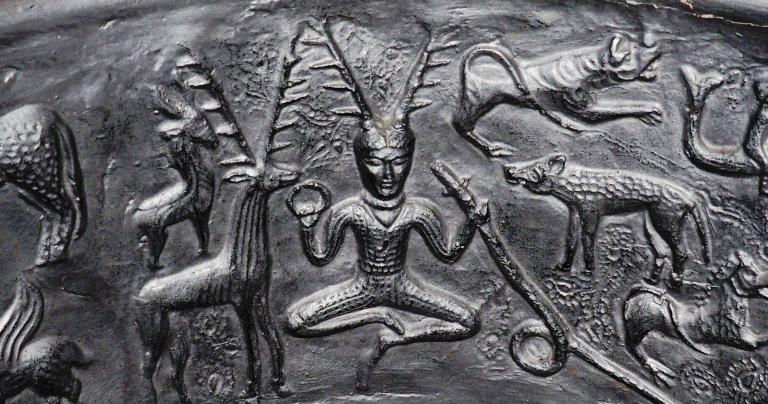
Cernunnos, from a replica of the Gundestrup Cauldron. We can’t be 100% sure that’s Who is depicted here, but after years of practice and first-hand experience, I’m pretty sure.
But given the uncertain identities of the spiritual persons we encounter, the question in bold above is very relevant: how do you know that who (or Who) you’re talking to is divine and virtuous?
Gods and spirits don’t wear nametags
It would be so much easier if they did. Or if Gods were always 50 feet tall, or glowed like the sun, or spoke with an audible voice that filled you with unmistakable awe.
But they don’t.
Our first-hand experiences of Gods and spirits are usually subtle – they speak in whispers, not in shouts. And they rarely tell you who they are.
Perhaps that’s because there’s power in a name, and they don’t want to give you that power. Perhaps they think you should already know who they are. Or perhaps they want you to do the work of figuring it out for yourself.
Regardless of why, if you want to know who you’re dealing with, discernment is required.
The Gods are always virtuous – other spiritual persons aren’t
Gods do not lie1. The Fair Folk either cannot or will not lie, but they’re masters at twisting the truth2. Other spirits will flat-out lie to you. They will make you think they’re someone they’re not so you’ll feed them with offerings, do their work for them, or just provide them with some low-level amusement.
Obviously, then, if you discover a lie you’re not dealing with a God. But most spirits have been doing this a lot longer than you have – don’t count on spotting the deceptions.
Still, ordinary skepticism is a useful thing. If something sounds too good to be true, it probably is. If someone tells you exactly what you want to hear, they’re probably not being honest with you.
If they tell you what deep down you know is true only you wish it wasn’t, if they urge you to move on from what’s comfortable to what’s necessary, if they call you to participate in something bigger than yourself, it’s probably legitimate.
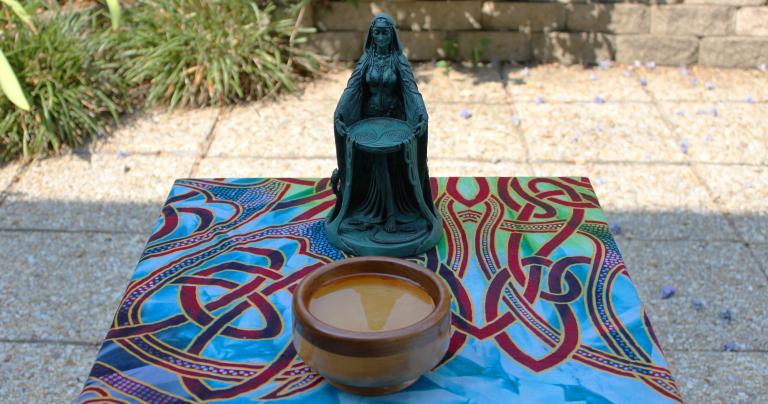
Danu. Very little is known about Her from history. Those of us who’ve experienced Her know a little… but only a little.
Research who you think it is
Take what you know and start trying to match it against known descriptions: those found in the stories of our ancestors, in the history of ancient worship (where such history exists), and in the accounts of contemporary priests and other devotees.
For Gods this is easier than you might think. They tend to make an impression on people. We remember Them, we worship Them, we write about Them. There’s reference material somewhere on virtually every deity ever known to humanity. And there’s probably someone already worshipping and/or working with Them who can help with your identification.
For non-divine spirits it’s much more difficult. We rarely have names in the historical record, lists of demons from grimoires notwithstanding. However, if you can’t positively identify a spirit as a God, it’s safer to assume they aren’t.
Talk to other polytheists – don’t try to do it all on your own. I can’t emphasize this enough. Our experiences of Gods and spirits are necessarily filtered through our own thoughts and feelings, which can keep us from seeing things that would be obvious to someone else. This is a very inexact science – the more experienced people involved, the better the chances of getting it right.

The Danube River, one of several rivers named for Danu. Is this also Her? I say yes.
A God will not ask you to do unvirtuous things
The caveat here is that as we discussed in the introduction, we aren’t always certain what’s virtuous and what isn’t where the Gods are concerned. And virtues can be in conflict, as anyone who’s ever tried to be both honest and kind at the same time understands.
Still, you wouldn’t ask a friend to steal for you. You wouldn’t ask a Muslim friend to eat bacon. Ultimately that may not be very important, but it’s very important to them. If someone asks you to do something that strikes you as unvirtuous or just plain wrong, you’re probably not dealing with a God.
Just remember that “virtuous” doesn’t mean “nice.” I serve a Battle Goddess who knows that war is a terrible thing, but sometimes it’s a necessary thing.
Over time, you know
I wish I could be less vague. I wish I had a “God test” that would allow us all to know exactly who and what the spiritual beings we encounter really are. But this is all I’ve got.
I’ve been fooled before. A more experienced friend stepped in before any harm was done… which just reinforces the need to talk these things through with other people, ideally people who’ve done it before.
The main thing is to keep at it. Each experience is another data point. Each book, blog post, or conversation is another point for comparison.
If another human moves into the house next door to you, initially you know nothing about them. Even after all the introductions and pleasantries, you still don’t know if you like them, or if you can trust them. But the more you’re around them the more you get to know who and what they are. After a while you learn who will be there when things get tough, and who’s just looking to see what they can get from you.
Of course, while you’re doing that with them, they’re doing the same with you.
It’s not all that different with Gods and spirits. Over time we learn who we can trust, who’s worth following, and who we would just as soon avoid. They learn the same about us.
Most good relationships begin with hospitality and are maintained through reciprocity.
Blessings to you as you form and maintain good relationships with the spiritual persons you encounter, divine and otherwise.
1 See Gordon Cooper’s comment below, and my response.
2 This is a well-known warning from fairy lore. In my experience, fairy royalty will be as honest with you as you are with them, though caution is still recommended. They may be your neighbors, but they are not your friends. Lower-ranking fae, well, they’re mostly where those warnings came from. Unless you have the skills of both a lawyer and a bard, you’re probably going to come out on the short end of the deal.
Previous Post

February 11, 2020
Approaching the Gods with Offerings and Service
Next Post

February 16, 2020 Magical Tech, Pagan Publicity, and Some Questions For Fun
Browse Our Archives
Select a Category Books Community CUUPS Druidry Foundations and Context Gods and Goddesses Magic Myth Nature Ritual Spiritual Practice Theology Travel Uncategorized Videos
Select a Month October 2026 September 2026 August 2026 July 2026 June 2026 May 2026 April 2026 March 2026 February 2026 January 2026 December 2025 November 2025 October 2025 September 2025 August 2025 July 2025 June 2025 May 2025 April 2025 March 2025 February 2025 January 2025 December 2024 November 2024 October 2024 September 2024 August 2024 July 2024 June 2024 May 2024 April 2024 March 2024 February 2024 January 2024 December 2023 November 2023 October 2023 September 2023 August 2023 July 2023 June 2023 May 2023 April 2023 March 2023 February 2023 January 2023 December 2022 November 2022 October 2022 September 2022 August 2022 July 2022 June 2022 May 2022 April 2022 March 2022 February 2022 January 2022 December 2021 November 2021 October 2021 September 2021 August 2021 July 2021 June 2021 May 2021 April 2021 March 2021 February 2021 January 2021 December 2020 November 2020 October 2020 September 2020 August 2020 July 2020 June 2020 May 2020 April 2020 March 2020 February 2020 January 2020 December 2019 November 2019 October 2019 September 2019 August 2019 July 2019 June 2019 May 2019 April 2019 March 2019 February 2019 January 2019 December 2018 November 2018 October 2018 September 2018 August 2018 July 2018 June 2018 May 2018 April 2018 March 2018 February 2018 January 2018 December 2017 November 2017 October 2017 September 2017 August 2017 July 2017 June 2017 May 2017 April 2017 March 2017 February 2017 January 2017 December 2016 November 2016 October 2016 September 2016 August 2016 July 2016 June 2016 May 2016 April 2016 March 2016 February 2016 January 2016 December 2015 November 2015 October 2015 September 2015 August 2015 July 2015 June 2015 May 2015 April 2015 March 2015 February 2015 January 2015 December 2014 November 2014 October 2014 September 2014 August 2014 July 2014 June 2014 May 2014 April 2014 March 2014 February 2014 January 2014 December 2013 November 2013 October 2013 September 2013 August 2013 July 2013 June 2013 May 2013 April 2013 March 2013 February 2013 January 2013 December 2012 November 2012 October 2012 September 2012 August 2012 July 2012 June 2012 May 2012 April 2012 March 2012 February 2012 January 2012 December 2011 November 2011 October 2011 September 2011 August 2011 July 2011 June 2011 May 2011 April 2011 March 2011 February 2011 January 2011 December 2010 November 2010 October 2010 September 2010 August 2010 July 2010 June 2010 May 2010 April 2010 March 2010 February 2010 January 2010 December 2009 November 2009 October 2009 September 2009 August 2009 July 2009 June 2009 May 2009 April 2009 March 2009 February 2009 January 2009 December 2008 November 2008 October 2008 September 2008 August 2008 July 2008 June 2008
Follow Us!
TAKE THE
Religious Wisdom Quiz
What is the distinctive cup used in receiving communion in many traditions?
Select your answer to see how you score.
Chalice Plate Jug Bowl
Related posts from John Beckett




What We Lose When “Ask AI” Becomes A...
TRENDING AT PATHEOS Pagan

When Halloween Unmasks Married Hearts
Written by Dr. David K. Ewen from Eternal Truth Bible College Behind...

Aristotle. He’s been called the father of logic, the father of the...

Methodist Central Hall and Westminster Abbey
Situated on the same square is Methodist Central Hall and Westminster Abbey. ...

57th Dove Awards Honor Dolly Parton, Crown New...
On gospel music’s biggest night, the 57th annual GMA Dove Awards honored...

The First Eucharistic Controversy: Christ’s Real Presence
For Catholics, the Eucharist is the source and summit of the Christian...

What a Stop Sign Can Teach Us About...
How to Make a Decision When You Can't Hear God Main point:...
view all Pagan blogs
Ad-Free & Subscriber Log-In Subscription Support
- About Us
- 2026 Calendar
- Videos
- Podcasts
- Library of World Religions
- Faith In Media Tracker
- Advertise With Us
- Write for Us
- Privacy Policy
- Terms of Service
- Do Not Sell My Data
- Contact Us
- Radiant Digital
- Manage Newsletter Subscriptions
- Unsubscribe From Notifications
- Sitemap
Copyright 2008-2026, Patheos. All rights reserved.
Subscription Support Ad-Free & Subscriber Log-In
Follow Patheos