
BuddhistCatholicContemplativeEvangelicalGeneral ChristianHinduJewishLatter-day SaintMuslimNew VisionsProgressive Christian
Beliefs
- Buddhist
- Catholic
- Contemplative
- Evangelical
- General Christian
- Hindu
- Jewish
- Latter-day Saint
- More Voices
- Muslim
- New Visions
- Pagan
- Progressive Christian
Topics
- Religion News
- Food and Religion
- Sports and Religion
- Religious Art
- Religious Music and Entertainment
- Religious Events
- History and Religion
- Style and Religion
- Politics and Religion
- Women in Religion
- Recreation Outdoors and Religion
- Business Finance and Religion
- Careers Workplace and Religion
- Education and Religion
- Family Parenting and Religion
- Health Fitness and Religion
- Home and Religion
- Relationships and Religion
- Technology and Religion
- Travel and Religion
Columnists
- Buddhist Columnists
- Business Finance and Religion Columnists
- Careers Workplace and Religion Columnists
- Catholic Columnists
- Contemplative Columnists
- Education and Religion Columnists
- Evangelists Columnists
- Family Parenting and Religion Columnists
- General Christian Columnists
- Health Fitness and Religion Columnists
- Hindu Columnists
- History and Religion Columnists
- Home and Religion Columnists
- Jewish Columnists
- More Voices Columnists
- Latter Day Columnists
- Muslim Columnists
- New Visions Columnists
- Nonreligious Columnists
- Pagan Columnists
- Politics and Religion Columnists
- Progressive Columnists
- Recreation Outdoors and Religion Columnists
- Relationships and Religion Columnists
- Religion News Columnists
- Religious Art Columnists
- Religious Events Columnists
- Religious Music and Entertainment Columnists
- Sports and Religion Columnists
- Style and Religion Columnists
- Technology and Religion Columnists
- Travel and Religion Columnists
- Women in Religion Columnists
Resource Library
- 2026 Calendar
- Library of World Religions
- The 100 Most Holy Places on Earth
- Patheos Answers
- Podcasts
- Videos
- Faith Leaders Database
- Anglican Episcopalian
- Bahai
- Baptist
- Buddhism
- Christianity
- Confucianism
- Eastern Orthodoxy
- Hinduism
- Holiness and Pentecostal
- ISKCON
- Islam
- Judaism
- Lutheran
- Methodist
- The Church of Jesus Christ of Latter-day Saints
- New Age
- Paganism
- Presbytarian and Reformed
- Protestantism
- Religion Behind the Scenes
- Roman Catholic
- Scientology
- Shia Islam
- Sikhism
- Sufism
- Sunni Islam
- Taoism
- Zen
- See all religions
Research Tools
 Ad-Free & Subscriber Log-In Subscription Support
Ad-Free & Subscriber Log-In Subscription Support
Follow Patheos 

- Trending:
- Forgiveness
- |
- Marriage
- |
- Consciousness
- |
- Death Penalty
- |
- Election
- |
- Halloween

- Home
- Pagan
- Approaching the Gods with Offerings and Service
Approaching the Gods with Offerings and Service
Last updated on: February 11, 2020 at 3:00 am by John Beckett
Approaching the Gods with Offerings and Service 2020-02-05T20:23:38-06:00 John Beckett
Patheos Explore the world's faith through different perspectives on religion and spirituality! Patheos has the views of the prevalent religions and spiritualities of the world.
Our next Conversations Under the Oaks questions concern approaching the Gods… or in some cases, not approaching Them.
A friend of mine is curious about the Morrigan but is devoted to Brigid. She wonders how she can learn more about the Morrigan without opening herself up to being selected as a disciple.
Good luck with that. If any of the Gods really want you – but especially the Morrigan – They’re going to claim you. And They may not wait till you learn more about Them.
That said, such involuntary selection is relatively uncommon. And simply learning more about a deity rarely results in offers / requests / demands for service… though it is often the first step in that direction.
My first recommendation is to strengthen your ties to Brigid. Make sure you’re completely fulfilling any commitments to Her. Then let Her know what you want to do, and that you would like Her help to insure that She remains your only formal commitment. Then listen for an answer. If you’re not sure of Her response, do divination, or get good polytheist diviner (not an ordinary Tarot reader at a psychic fair) to ask for you.
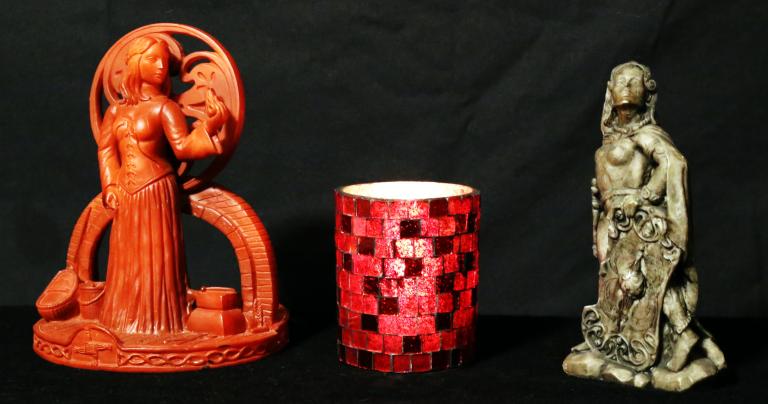
in my experience – which is mostly UPG – They’re usually on the same team
Then approach the Morrigan. Tell Her what you want to do, and what you don’t want to do. Remind Her of your commitments to Brigid. Again, listen for a response. My experience – both first hand and second hand – is that the Morrigan usually respects your limits.
Usually.
As for learning about Her, there are numerous posts on this blog. Put “Morrigan” in the search block on the right side of the screen (near the bottom of the page if you’re on mobile) and you’ll get everything I’ve written for and about Her.
There are three books I recommend.
Start with The Morrigan: Meeting the Great Queens by Morgan Daimler. It’s a short, concise introduction.
The Morrigan: Celtic Goddess of Magick and Might by Courtney Weber is an experiential guide to Herself.
The Book of the Great Queen by Morpheus Ravenna is a much longer, more academically complete book.
Not every Morrigan book is a good book. But once you read all this you’ll be able to tell the helpful books from the less helpful ones.

I would like to make some offerings to a Goddess, but I don’t know how to make a proper libation. Should I just pour the liquid on the floor/garden and leave it there? And what about food? What should I do with it after I remove it from the altar? Could I just throw it away, or should I burn it or bury it?
So much depends on Who you’re offering to. Different traditions had (and have) very different requirements and rubrics around offerings. What would be appropriate and welcome in one setting would be highly offensive in another.
This is what I do.
Most of my liquid offerings are poured on the ground, or if indoors, into an offering bowl that will later be poured on the ground. Pour as elegantly as you can, and include words of offering: a libation without a prayer is just a spilled drink. Food offerings are crumbled onto the ground and left where local animals can find them – assuming they’re safe for consumption by birds, rabbits, squirrels, and the like.
In a ritual, offerings are often poured or crumbled into the fire. Be careful here – beer and wine have alcohol, but not that much. They can put a fire out. Whiskey is flammable. It can produce a dramatic effect – it can also flare up in your face if you’re not careful.
Sometimes I place the offerings in front of a shrine and leave them there for a time – usually about a half hour. Then I remove them and pour / crumble them outside. Some people leave offerings on shrines for longer times. Alcohol and water will slowly evaporate – so long as they’re still clean (would you drink it?) it’s OK to leave things for a day or two. Never leave anything that’s dirty or spoiled.
Occasionally I practice “reversion of offerings.” Here you place the offerings in front of the shrine, then after a suitable time you eat them yourself. The assumption is that the Gods have taken nourishment from them and have replaced what They took with Their divine essence – you are receiving the blessings of the Gods. This is what Egyptian temple priests did every day for close to four thousand years.
However, in some traditions it is a grave insult to eat what you’ve given to the Gods. Do your research before you do this.
Which one I do depends largely on what the deity I’m honoring tells me They want.
I never throw any offering in the trash or pour it down the drain – this strikes me as highly disrespectful. If an offering cannot be poured on the ground, I burn it or bury it.
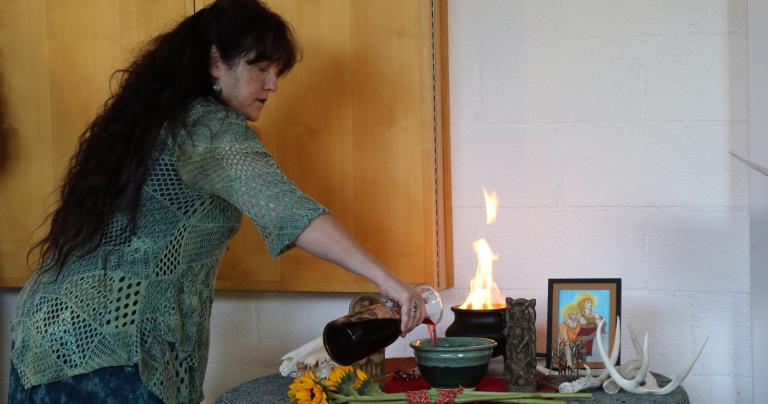
pouring an offering
Can one follow a priest/ess path without being a devotee to any particular God or Goddess?
Yes, but…
In her very good book A Practical Guide to Pagan Priesthood, Lora O’Brien divides priesthood into pastoral duties (caring for a community and its members) and sacerdotal duties (“all the supernatural bits of a religious belief system”). It is entirely possible to perform pastoral care for a religious community without being devoted to any deity. It’s also possible to serve a God as Their priest and not perform any pastoral duties. That’s what the vast majority of ancient temple priests did.
For me, my identity as a priest is tied to my oaths of service to Cernunnos and to Danu (but not to the Morrigan – my oath to Her is not an oath of priesthood). I occasionally serve as a priest of other deities in ritual, but that is a function and not a relationship, and it’s only for the duration of that ritual.
My pastoral work is important and sacred, and it is what many people think of when they think of “Pagan priest” – someone to call to for spiritual counseling, or to officiate their wedding or funeral. But as I see it, that work doesn’t make me a priest – it makes me a spiritual leader.
Still, different Pagan traditions have different definitions of priesthood. If your definition is one of service to your community but not to a specific deity, I see no reason you can’t call yourself a priest.

Next Post
February 13, 2020 Is This a God or Not? How to Tell Who You’re Talking To
Browse Our Archives
Select a Category Books Community CUUPS Druidry Foundations and Context Gods and Goddesses Magic Myth Nature Ritual Spiritual Practice Theology Travel Uncategorized Videos
Select a Month October 2026 September 2026 August 2026 July 2026 June 2026 May 2026 April 2026 March 2026 February 2026 January 2026 December 2025 November 2025 October 2025 September 2025 August 2025 July 2025 June 2025 May 2025 April 2025 March 2025 February 2025 January 2025 December 2024 November 2024 October 2024 September 2024 August 2024 July 2024 June 2024 May 2024 April 2024 March 2024 February 2024 January 2024 December 2023 November 2023 October 2023 September 2023 August 2023 July 2023 June 2023 May 2023 April 2023 March 2023 February 2023 January 2023 December 2022 November 2022 October 2022 September 2022 August 2022 July 2022 June 2022 May 2022 April 2022 March 2022 February 2022 January 2022 December 2021 November 2021 October 2021 September 2021 August 2021 July 2021 June 2021 May 2021 April 2021 March 2021 February 2021 January 2021 December 2020 November 2020 October 2020 September 2020 August 2020 July 2020 June 2020 May 2020 April 2020 March 2020 February 2020 January 2020 December 2019 November 2019 October 2019 September 2019 August 2019 July 2019 June 2019 May 2019 April 2019 March 2019 February 2019 January 2019 December 2018 November 2018 October 2018 September 2018 August 2018 July 2018 June 2018 May 2018 April 2018 March 2018 February 2018 January 2018 December 2017 November 2017 October 2017 September 2017 August 2017 July 2017 June 2017 May 2017 April 2017 March 2017 February 2017 January 2017 December 2016 November 2016 October 2016 September 2016 August 2016 July 2016 June 2016 May 2016 April 2016 March 2016 February 2016 January 2016 December 2015 November 2015 October 2015 September 2015 August 2015 July 2015 June 2015 May 2015 April 2015 March 2015 February 2015 January 2015 December 2014 November 2014 October 2014 September 2014 August 2014 July 2014 June 2014 May 2014 April 2014 March 2014 February 2014 January 2014 December 2013 November 2013 October 2013 September 2013 August 2013 July 2013 June 2013 May 2013 April 2013 March 2013 February 2013 January 2013 December 2012 November 2012 October 2012 September 2012 August 2012 July 2012 June 2012 May 2012 April 2012 March 2012 February 2012 January 2012 December 2011 November 2011 October 2011 September 2011 August 2011 July 2011 June 2011 May 2011 April 2011 March 2011 February 2011 January 2011 December 2010 November 2010 October 2010 September 2010 August 2010 July 2010 June 2010 May 2010 April 2010 March 2010 February 2010 January 2010 December 2009 November 2009 October 2009 September 2009 August 2009 July 2009 June 2009 May 2009 April 2009 March 2009 February 2009 January 2009 December 2008 November 2008 October 2008 September 2008 August 2008 July 2008 June 2008
Follow Us!
TAKE THE
Religious Wisdom Quiz
How many disciples did Jesus have?
Select your answer to see how you score.
Twelve Thirty Seven One hundred
Related posts from John Beckett




What We Lose When “Ask AI” Becomes A...
TRENDING AT PATHEOS Pagan

The First Eucharistic Controversy: Christ’s Real Presence
For Catholics, the Eucharist is the source and summit of the Christian...

What a Stop Sign Can Teach Us About...
How to Make a Decision When You Can't Hear God Main point:...

Archdiocese Hosts Military Marriage Retreat in Germany
RASTATT, Germany — The transient military lifestyle, with its frequent deployments and...

Nearly every morning, I make the drive to Detroit with my high-school-age...

The Real AI Story Is Adoption Without Trust
Artificial intelligence has crossed a political threshold. It is no longer a...

A new article, written by Jeff Lindsay and Gale L. Pooley,...
view all Pagan blogs
Ad-Free & Subscriber Log-In Subscription Support
- About Us
- 2026 Calendar
- Videos
- Podcasts
- Library of World Religions
- Faith In Media Tracker
- Advertise With Us
- Write for Us
- Privacy Policy
- Terms of Service
- Do Not Sell My Data
- Contact Us
- Radiant Digital
- Manage Newsletter Subscriptions
- Unsubscribe From Notifications
- Sitemap
Copyright 2008-2026, Patheos. All rights reserved.
Subscription Support Ad-Free & Subscriber Log-In
Follow Patheos