
BuddhistCatholicContemplativeEvangelicalGeneral ChristianHinduJewishLatter-day SaintMuslimNew VisionsProgressive Christian
Beliefs
- Buddhist
- Catholic
- Contemplative
- Evangelical
- General Christian
- Hindu
- Jewish
- Latter-day Saint
- More Voices
- Muslim
- New Visions
- Pagan
- Progressive Christian
Topics
- Religion News
- Food and Religion
- Sports and Religion
- Religious Art
- Religious Music and Entertainment
- Religious Events
- History and Religion
- Style and Religion
- Politics and Religion
- Women in Religion
- Recreation Outdoors and Religion
- Business Finance and Religion
- Careers Workplace and Religion
- Education and Religion
- Family Parenting and Religion
- Health Fitness and Religion
- Home and Religion
- Relationships and Religion
- Technology and Religion
- Travel and Religion
Columnists
- Buddhist Columnists
- Business Finance and Religion Columnists
- Careers Workplace and Religion Columnists
- Catholic Columnists
- Contemplative Columnists
- Education and Religion Columnists
- Evangelists Columnists
- Family Parenting and Religion Columnists
- General Christian Columnists
- Health Fitness and Religion Columnists
- Hindu Columnists
- History and Religion Columnists
- Home and Religion Columnists
- Jewish Columnists
- More Voices Columnists
- Latter Day Columnists
- Muslim Columnists
- New Visions Columnists
- Nonreligious Columnists
- Pagan Columnists
- Politics and Religion Columnists
- Progressive Columnists
- Recreation Outdoors and Religion Columnists
- Relationships and Religion Columnists
- Religion News Columnists
- Religious Art Columnists
- Religious Events Columnists
- Religious Music and Entertainment Columnists
- Sports and Religion Columnists
- Style and Religion Columnists
- Technology and Religion Columnists
- Travel and Religion Columnists
- Women in Religion Columnists
Resource Library
- 2026 Calendar
- Library of World Religions
- The 100 Most Holy Places on Earth
- Patheos Answers
- Podcasts
- Videos
- Faith Leaders Database
- Anglican Episcopalian
- Bahai
- Baptist
- Buddhism
- Christianity
- Confucianism
- Eastern Orthodoxy
- Hinduism
- Holiness and Pentecostal
- ISKCON
- Islam
- Judaism
- Lutheran
- Methodist
- The Church of Jesus Christ of Latter-day Saints
- New Age
- Paganism
- Presbytarian and Reformed
- Protestantism
- Religion Behind the Scenes
- Roman Catholic
- Scientology
- Shia Islam
- Sikhism
- Sufism
- Sunni Islam
- Taoism
- Zen
- See all religions
Research Tools
 Ad-Free & Subscriber Log-In Subscription Support
Ad-Free & Subscriber Log-In Subscription Support
Follow Patheos 

- Trending:
- Forgiveness
- |
- Marriage
- |
- Consciousness
- |
- Death Penalty
- |
- Election
- |
- Halloween

- Home
- Pagan
- Three Circles of Paganism: the Plumber, the Priest, and the Mystic
Three Circles of Paganism: the Plumber, the Priest, and the Mystic
Last updated on: October 6, 2019 at 3:00 am by John Beckett
Three Circles of Paganism: the Plumber, the Priest, and the Mystic 2019-10-04T18:09:30-06:00 John Beckett
Patheos Explore the world's faith through different perspectives on religion and spirituality! Patheos has the views of the prevalent religions and spiritualities of the world.
If you want to start a fight at a Pagan gathering, suggest that Paganism needs rules, structures, and fixed traditions. Then sit back and watch as people start arguing about “gatekeeping” “creating dogma” and my favorite “making yourself the Pagan pope.”
Of course, you can start a fight the other way too. Simply suggest that there should never be any secrets or oath-bound material, and that every group and tradition should be open to everyone (“why won’t anybody teach me Feri?!”).
We Pagans tend to be a reactive bunch, throwing the baby out with the dirty bathwater. We were hurt by fundamentalist religion, so we want a religion (or a not-religion) with no rules at all. We were abused by authority figures, so we want a religion with no priests or other formal leaders. Or we burned our fingers with magic, so we want to put Spellcasting 101 behind initiatory oaths so we can make sure nobody does magic who isn’t ready for magic.
We often miss the point that while Paganism is a movement with centers and directions, our individual Pagan groups and traditions are institutions. They have boundaries that define who and what they are. Those boundaries can take many forms.
You don’t get much more inclusive than a CUUPS group, and Denton CUUPS welcomes all who come in love and friendship. You can be a polytheist, a pantheist, a non-theist, or even a monotheist and be welcome in our group. But white nationalists are not welcome. Homophobes and transphobes are not welcome. These are our boundaries – they define who and what we are. Without them we could not be faithful to our mission as Unitarian Universalists and as Pagans.
Not all boundaries are about keeping bad people out. Some boundaries are about maintaining a tradition or a religious focus. I’m happy to dance the Maypole with all people of good will, but I cannot do ecstatic polytheist ritual with atheists and monotheists. You wouldn’t expect a vegan group to discuss recipes for barbequed ribs and you wouldn’t expect a writers’ group to hold a workshop on painting techniques. Our religious boundaries deserve at least as much respect.
I think a big part of the arguments come from a misunderstanding of which boundaries apply to which people, and – as happens so many times – from applying Christian assumptions to Pagan and polytheist religions.
There is no One True Paganism
Conservative Christianity – whether Protestant or Catholic – teaches that it is the one true faith, and all who reject it are damned. So while they may say “all are welcome here” what they really mean is “all are expected to become just like us.” If you don’t fit those expectations, you have a problem. Either you change who and what you are (or try to) or you leave something that’s been part of your family and cultural heritage for generations… and (according to them, anyway) risk eternal damnation.
Paganism make no such claims. At least when it’s properly understood, Paganism doesn’t even claim to be one thing – so much so that some traditions that are generally considered part of the Pagan movement refuse to call themselves Pagans.
[For more on the origin and usage of the term “Pagan” – including why I call myself one – see this post from last year What Makes Paganism Pagan? Be sure to read the commentary at the end by Dr. Edward Butler.]
So if you feel excluded – or are excluded – from one Pagan tradition, it doesn’t mean you have to change and it doesn’t mean you’re going to Tartarus when you die. It means you’re a vegetarian at a pig roast, and you need to keep looking. You don’t want to eat the pig, and while the carnivores may be happy to nibble on your vegetables they’re not going to give up their ribs. The boundaries are there to preserve meaningful differences.

Paganism for plumbers
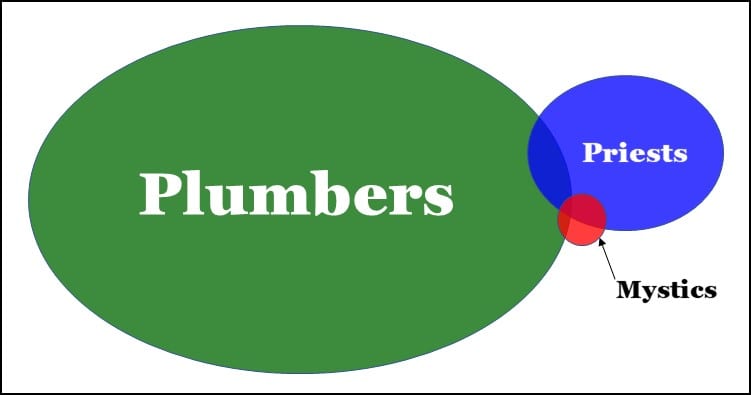
I often say that I want my religion to be as accessible to the plumber and the accountant (i.e. – ordinary people) as it is to the priest and the mystic. The problem is that plumbers and accountants by and large want different things from their religions than priests and mystics.
There’s a place in the Pagan movement for people who are completely devoted to their Gods and completely committed to their craft. But we cannot expect everyone to have that level of commitment. If we do, those who just want to show up for the high days will find their way to Buddhism or liberal Christianity or (more likely) to the Spiritual But Not Religious.
We need a Paganism that serves these people. Certainly it should encourage them to contribute to the upkeep of the community (with time or money or both) and we should provide a ready path to greater involvement for those who discover they really want something more. But it needs be to as easy to walk into a Samhain celebration as it is to walk into a Sunday morning service at the local Presbyterian church.
And if you don’t want plumbers and accountants at your super special Samhain circle, you’re not obligated to invite them. But they need some place to go, and someone in the wider Pagan community has to provide it.
The boundaries for this circle must be low and flexible. We want to exclude people who do bad things (white supremacists, sexual abusers, etc.), but the requirements for orthodoxy (“right belief”) must be minimal.
Paganism for priests
I usually advocate for a fairly specific definition of priesthood: it is a formal relationship that involves service to the Gods, mediation for the Gods, and service to the community. Here, though, I want to expand it to include all the things that people who call themselves priests or who serve as clergy do in the contemporary Pagan movement.
This circle of Paganism is for the people who get things done: those who rent the buildings, write the rituals, and clean up when it’s over. Those who pray and make offerings on a regular basis, creating and maintaining divine relationships they can then present to the wider community. Those who officiate the weddings and funerals, who take over the house cleansings when they turn out to be bigger than expected, and who answer the calls when people are in spiritual crisis and don’t know where to turn.
Priests aren’t “better” than plumbers, but they fill a different role. Typically (though not always) they are more committed to their practices and their communities. Because of this commitment they usually have more influence in the affairs of their organizations, and rightly so.
Each tradition and organization must set its own boundaries, but these boundaries must be fairly high. ADF members can and should debate how ADF should be structured and run, but an ADF grove cannot be run the same way as a Gardnerian coven, or for that matter, as an OBOD grove. Tradition, process, procedures, and even hierarchy all matter.
The institution and its mission are more important than any of its individual members and their own personal needs. Thus it has boundaries of both orthodoxy and orthopraxy.
Paganism for mystics
The third circle of Paganism consists of those who frequently experience the Gods and spirits first-hand, who work the strongest magics, and who have the “fire in the head” – Pagans who are off the map.
On one hand, the boundaries for this circle are extremely high. You want in? Prepare to have your life turned upside down. Prepare to be pierced with a flaming spear. Expect huge assignments with tight deadlines and no tolerance for failure. That’s the price of admission, and once you’re in, you’re in for good. Walk away and be marked as an oath breaker, in the Otherworld if not in this world.
On the other hand, each tradition and to a certain extent each person has their own boundaries. What is required of me is not what’s required of the witch, the priest, and the nun who do the same work in the same group, nor are their requirements mine.
These are boundaries of commitment. If you aren’t willing to make and keep the commitment, you cannot be in this circle.
One, two, or all three
It is entirely possible to be in all three of these circles. You can be a mystic who does the work of a priest and who makes their living as a plumber. Or in my case, as an engineer. You can be in different circles in different traditions. For all of my devotional work, my community service, and my public writing and teaching, within ADF I’m an ordinary member.
What Paganism in its broadest sense offers is the ability for you to participate in the circle or circles that call to you. Each circle has boundaries, because each circle is different from every other circle. Is this where you belong, or are you a vegan and this is a pig roast? The zucchini and hummus group is down the street.
And if the exact group you want, with the exact beliefs and practices you need, and the exact boundaries that seem right to you doesn’t exist? Congratulations – you’re now the founder of a new tradition. Better get busy.
Previous Post

October 3, 2019
A House Cleansing Ritual: Spiritually Protecting Your Space
Next Post
October 8, 2019 The Spiral Labyrinth: Beauty and Mystery at Samhain
Browse Our Archives
Select a Category Books Community CUUPS Druidry Foundations and Context Gods and Goddesses Magic Myth Nature Ritual Spiritual Practice Theology Travel Uncategorized Videos
Select a Month October 2026 September 2026 August 2026 July 2026 June 2026 May 2026 April 2026 March 2026 February 2026 January 2026 December 2025 November 2025 October 2025 September 2025 August 2025 July 2025 June 2025 May 2025 April 2025 March 2025 February 2025 January 2025 December 2024 November 2024 October 2024 September 2024 August 2024 July 2024 June 2024 May 2024 April 2024 March 2024 February 2024 January 2024 December 2023 November 2023 October 2023 September 2023 August 2023 July 2023 June 2023 May 2023 April 2023 March 2023 February 2023 January 2023 December 2022 November 2022 October 2022 September 2022 August 2022 July 2022 June 2022 May 2022 April 2022 March 2022 February 2022 January 2022 December 2021 November 2021 October 2021 September 2021 August 2021 July 2021 June 2021 May 2021 April 2021 March 2021 February 2021 January 2021 December 2020 November 2020 October 2020 September 2020 August 2020 July 2020 June 2020 May 2020 April 2020 March 2020 February 2020 January 2020 December 2019 November 2019 October 2019 September 2019 August 2019 July 2019 June 2019 May 2019 April 2019 March 2019 February 2019 January 2019 December 2018 November 2018 October 2018 September 2018 August 2018 July 2018 June 2018 May 2018 April 2018 March 2018 February 2018 January 2018 December 2017 November 2017 October 2017 September 2017 August 2017 July 2017 June 2017 May 2017 April 2017 March 2017 February 2017 January 2017 December 2016 November 2016 October 2016 September 2016 August 2016 July 2016 June 2016 May 2016 April 2016 March 2016 February 2016 January 2016 December 2015 November 2015 October 2015 September 2015 August 2015 July 2015 June 2015 May 2015 April 2015 March 2015 February 2015 January 2015 December 2014 November 2014 October 2014 September 2014 August 2014 July 2014 June 2014 May 2014 April 2014 March 2014 February 2014 January 2014 December 2013 November 2013 October 2013 September 2013 August 2013 July 2013 June 2013 May 2013 April 2013 March 2013 February 2013 January 2013 December 2012 November 2012 October 2012 September 2012 August 2012 July 2012 June 2012 May 2012 April 2012 March 2012 February 2012 January 2012 December 2011 November 2011 October 2011 September 2011 August 2011 July 2011 June 2011 May 2011 April 2011 March 2011 February 2011 January 2011 December 2010 November 2010 October 2010 September 2010 August 2010 July 2010 June 2010 May 2010 April 2010 March 2010 February 2010 January 2010 December 2009 November 2009 October 2009 September 2009 August 2009 July 2009 June 2009 May 2009 April 2009 March 2009 February 2009 January 2009 December 2008 November 2008 October 2008 September 2008 August 2008 July 2008 June 2008
Follow Us!
TAKE THE
Religious Wisdom Quiz
What does "Gideon" mean in Hebrew?
Select your answer to see how you score.
God is my Strength Warrior Hewer Redeemer
Related posts from John Beckett


The Vampire Films of Jean Rollin


Bo French Doesn’t Understand Texas
TRENDING AT PATHEOS Pagan

How to Make a Decision When You Can't...
Main point: It’s much more valuable to stay close to God so...

Archdiocese Hosts Military Marriage Retreat in Germany
RASTATT, Germany — The transient military lifestyle, with its frequent deployments and...

Nearly every morning, I make the drive to Detroit with my high-school-age...

The Real AI Story Is Adoption Without Trust
Artificial intelligence has crossed a political threshold. It is no longer a...

A new article, written by Jeff Lindsay and Gale L. Pooley,...

Swimfan: Forgotten Aughts Pleasures
This is a recovery effort. In 2002, My Big Fat Greek Wedding...
view all Pagan blogs
Ad-Free & Subscriber Log-In Subscription Support
- About Us
- 2026 Calendar
- Videos
- Podcasts
- Library of World Religions
- Faith In Media Tracker
- Advertise With Us
- Write for Us
- Privacy Policy
- Terms of Service
- Do Not Sell My Data
- Contact Us
- Radiant Digital
- Manage Newsletter Subscriptions
- Unsubscribe From Notifications
- Sitemap
Copyright 2008-2026, Patheos. All rights reserved.
Subscription Support Ad-Free & Subscriber Log-In
Follow Patheos