
BuddhistCatholicContemplativeEvangelicalGeneral ChristianHinduJewishLatter-day SaintMuslimNew VisionsProgressive Christian
Beliefs
- Buddhist
- Catholic
- Contemplative
- Evangelical
- General Christian
- Hindu
- Jewish
- Latter-day Saint
- More Voices
- Muslim
- New Visions
- Pagan
- Progressive Christian
Topics
- Religion News
- Food and Religion
- Sports and Religion
- Religious Art
- Religious Music and Entertainment
- Religious Events
- History and Religion
- Style and Religion
- Politics and Religion
- Women in Religion
- Recreation Outdoors and Religion
- Business Finance and Religion
- Careers Workplace and Religion
- Education and Religion
- Family Parenting and Religion
- Health Fitness and Religion
- Home and Religion
- Relationships and Religion
- Technology and Religion
- Travel and Religion
Columnists
- Buddhist Columnists
- Business Finance and Religion Columnists
- Careers Workplace and Religion Columnists
- Catholic Columnists
- Contemplative Columnists
- Education and Religion Columnists
- Evangelists Columnists
- Family Parenting and Religion Columnists
- General Christian Columnists
- Health Fitness and Religion Columnists
- Hindu Columnists
- History and Religion Columnists
- Home and Religion Columnists
- Jewish Columnists
- More Voices Columnists
- Latter Day Columnists
- Muslim Columnists
- New Visions Columnists
- Nonreligious Columnists
- Pagan Columnists
- Politics and Religion Columnists
- Progressive Columnists
- Recreation Outdoors and Religion Columnists
- Relationships and Religion Columnists
- Religion News Columnists
- Religious Art Columnists
- Religious Events Columnists
- Religious Music and Entertainment Columnists
- Sports and Religion Columnists
- Style and Religion Columnists
- Technology and Religion Columnists
- Travel and Religion Columnists
- Women in Religion Columnists
Resource Library
- 2026 Calendar
- Library of World Religions
- The 100 Most Holy Places on Earth
- Patheos Answers
- Podcasts
- Videos
- Faith Leaders Database
- Anglican Episcopalian
- Bahai
- Baptist
- Buddhism
- Christianity
- Confucianism
- Eastern Orthodoxy
- Hinduism
- Holiness and Pentecostal
- ISKCON
- Islam
- Judaism
- Lutheran
- Methodist
- The Church of Jesus Christ of Latter-day Saints
- New Age
- Paganism
- Presbytarian and Reformed
- Protestantism
- Religion Behind the Scenes
- Roman Catholic
- Scientology
- Shia Islam
- Sikhism
- Sufism
- Sunni Islam
- Taoism
- Zen
- See all religions
Research Tools
 Ad-Free & Subscriber Log-In Subscription Support
Ad-Free & Subscriber Log-In Subscription Support
Follow Patheos 

- Trending:
- Forgiveness
- |
- Marriage
- |
- Consciousness
- |
- Death Penalty
- |
- Election
- |
- Halloween

- Home
- Pagan
- Language and the Gods
Language and the Gods
Last updated on: October 27, 2019 at 3:00 am by John Beckett
Language and the Gods 2019-10-24T19:50:15-06:00 John Beckett
Patheos Explore the world's faith through different perspectives on religion and spirituality! Patheos has the views of the prevalent religions and spiritualities of the world.
In this month’s Conversations Under the Oaks, I had two questions on language and languages that I want to address together.
How far does the study of language and archaeology work into your worship and relationships with the Gods?
and
Some cultures pray aloud; the West prays silently, assuming (perhaps) that Gods read minds. Is there any lore to back this up? What of those who learn a foreign (or extinct) language just to communicate with their chosen Gods?
I’ll start with the easy part. I don’t really agree that the West prays silently, considering the long tradition of spoken prayer in both the Catholic and Protestant traditions. Still, virtually all Christians agree that their God hears silent prayers. Further, I think there’s a difference between reading minds and hearing thoughts.
I have lots of thoughts on language in regards to our experiences of the Gods and our conceptions of Them. Those thoughts begin in the beginning.

The Danube River is millions of years old. How old is the Goddess who shares its name?
The Gods are older than language
How old are the Gods? We tend to associate the first appearance of deities with the records of the people who first worshipped Them, but at least some of the Gods are older than that. Far older.
Are the various Sun Gods 4.6 billion years old? Are the many Moon Goddesses 4.5 billion years old? What Gods were on or around the Earth in the age of the dinosaurs? We can’t answer these questions with any precision, but it would be the height of human arrogance to assume the Gods did not appear until we did.
We do not know when humans developed the capacity for language. The other existing species of hominids do not have it, so it is virtually certain that our earliest human ancestors didn’t either. Did one of our intermediate ancestors have it and pass it down to us? Or is language the evolutionary mutation that gave homo sapiens sapiens the ability to begin spreading around the globe around 70,000 years ago?
To be clear: individual languages are human inventions. But the capacity for language is a biological feature, a product of evolutionary processes.
The Gods are older than language. We have evidence (primarily burials with grave goods) of religious behavior by human species who did not have language. We cannot know what Gods spoke to these ancestors or what relationships they formed, but it is entirely reasonable to conclude that humans do not need language to encounter the Gods.
The Gods transcend language
Many mystical experiences are described as ineffable. We can’t talk about them, not because it’s forbidden, but because words cannot adequately describe them. I suspect these experiences are virtually identical to the experiences our earliest ancestors had of Gods and spirits.
We contemplate these experiences using language – as best we can – because that’s what we do. But the core of what They have to say to us is not words, even if we “hear” it in words. Rather, it’s ideas, concepts, and images.
So, it is not necessary to learn a specific language or any language at all to communicate with the Gods. You do not need to learn Greek (either ancient or modern) in order to worship Zeus, pray to Zeus, or to hear Zeus, should He choose to speak to you.
However, religion is more than experiences of the Gods and relationships with Them. Religion is also about practices, culture, and community. And one of the core elements of a community is a shared language. If you want to be part of an extant community, you need to be able to speak and read their language.

The Goddess Danu
The problems with translation
Even if your religious community is here in the United States and your shared language is American English, there is still value in learning the language of your hearth culture. Most Pagans rightly value the writings of our ancestors, and none of them were written in modern English. We rely on translations done by others who almost never share our religious outlook.
There is no such thing as a “neutral” translation. Different languages aren’t just a collection of different words. They have different grammar structures, different idioms, and different taxonomies. How many times do you say “what do you mean by that?” to someone who’s speaking your native language? Now try doing it with a different language.
Every translation has a perspective and every translation reflects a series of choices made by the translator. There are over 450 translations of the Bible in English alone – all of them reflect the choices of their translators. Meanwhile, Muslims say that if you haven’t read the Quran in Arabic, you haven’t really read the Quran.
I recently had the opportunity to preview Morgan Daimler’s upcoming book Raven Goddess: Going Deeper with the Morrigan (scheduled for publication October 2020). It’s primarily intended for beginning and early intermediate devotees of the Morrigan. But it has value for those of us who are more experienced, because it includes Daimler’s translation of key texts related to the Great Queen. I believe this is the first time some of these texts have been available in English and translated by someone who sees the Morrigan as an actual deity – and who doesn’t censor the text because of sexual elements. That perspective matters.
My personal practice
As for my practice, I’m monolingual. My only regret from all my years of schooling is that I never learned another language. Don’t send me links to Duolingo – at this age I have other priorities. I’m aware of the intricacies of language and the problems with translations and I count on that awareness to keep me from jumping to inaccurate conclusions about what words really mean.
I do my best to pronounce non-English names and key words properly, but I don’t obsess over it. And I have no patience with those who insist their preferred pronunciation is the only proper one – especially those who aren’t native speakers. Irish, Welsh, and Scots Gaelic all have ancient and modern variants as well as regional dialects – just like English. Modern Greek is not the Greek of Homer or Plato.
That said, not every pronunciation is a good pronunciation. Samhain was never, is never, and never will be pronounced SAM-hane.
But be kind to those who say it that way out of ignorance – you were a beginner too at one point.
A religion for who you are, where you are, when you are
The first question mentioned archaeology. As with language, I’m informed and inspired by what archaeology, anthropology, and history can tell us about our ancestors and their beliefs and practices. But at the end of the day I’m not a pre-Roman Celt or a Pharaonic Egyptian, nor am I a contemporary Greek. I’m a 21st century American whose only working language is English. My Paganism and polytheism are a religion for here and now.
If you want to be a part of a culture that speaks a different language, learn it. If you want to read source material for yourself, learn the language.
But you don’t need a different language – or any language – to speak with the Gods.
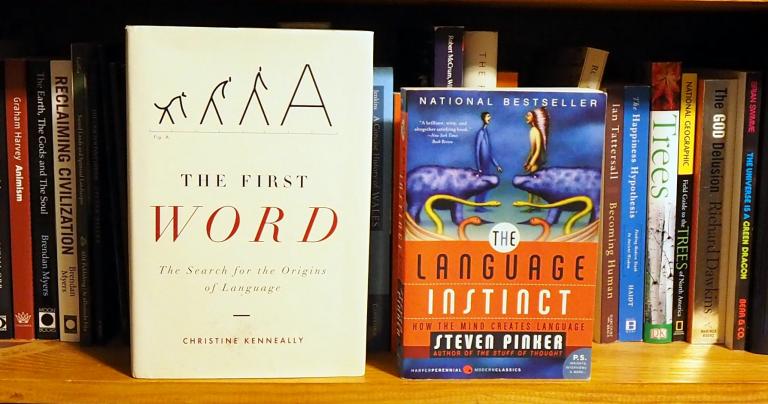
For more on the roots and nature of language, I recommend The Language Instinct by Steven Pinker and The First Word by Christine Kenneally. The Language Instinct takes a psychological approach and looks at how language develops here and now, while The First Word takes an archaeological approach and provides informed speculation on how language first originated. Either would be a good addition to your library – both would be better.

Next Post

October 29, 2019 Should I Join This Pagan Group or Not?
Browse Our Archives
Select a Category Books Community CUUPS Druidry Foundations and Context Gods and Goddesses Magic Myth Nature Ritual Spiritual Practice Theology Travel Uncategorized Videos
Select a Month October 2026 September 2026 August 2026 July 2026 June 2026 May 2026 April 2026 March 2026 February 2026 January 2026 December 2025 November 2025 October 2025 September 2025 August 2025 July 2025 June 2025 May 2025 April 2025 March 2025 February 2025 January 2025 December 2024 November 2024 October 2024 September 2024 August 2024 July 2024 June 2024 May 2024 April 2024 March 2024 February 2024 January 2024 December 2023 November 2023 October 2023 September 2023 August 2023 July 2023 June 2023 May 2023 April 2023 March 2023 February 2023 January 2023 December 2022 November 2022 October 2022 September 2022 August 2022 July 2022 June 2022 May 2022 April 2022 March 2022 February 2022 January 2022 December 2021 November 2021 October 2021 September 2021 August 2021 July 2021 June 2021 May 2021 April 2021 March 2021 February 2021 January 2021 December 2020 November 2020 October 2020 September 2020 August 2020 July 2020 June 2020 May 2020 April 2020 March 2020 February 2020 January 2020 December 2019 November 2019 October 2019 September 2019 August 2019 July 2019 June 2019 May 2019 April 2019 March 2019 February 2019 January 2019 December 2018 November 2018 October 2018 September 2018 August 2018 July 2018 June 2018 May 2018 April 2018 March 2018 February 2018 January 2018 December 2017 November 2017 October 2017 September 2017 August 2017 July 2017 June 2017 May 2017 April 2017 March 2017 February 2017 January 2017 December 2016 November 2016 October 2016 September 2016 August 2016 July 2016 June 2016 May 2016 April 2016 March 2016 February 2016 January 2016 December 2015 November 2015 October 2015 September 2015 August 2015 July 2015 June 2015 May 2015 April 2015 March 2015 February 2015 January 2015 December 2014 November 2014 October 2014 September 2014 August 2014 July 2014 June 2014 May 2014 April 2014 March 2014 February 2014 January 2014 December 2013 November 2013 October 2013 September 2013 August 2013 July 2013 June 2013 May 2013 April 2013 March 2013 February 2013 January 2013 December 2012 November 2012 October 2012 September 2012 August 2012 July 2012 June 2012 May 2012 April 2012 March 2012 February 2012 January 2012 December 2011 November 2011 October 2011 September 2011 August 2011 July 2011 June 2011 May 2011 April 2011 March 2011 February 2011 January 2011 December 2010 November 2010 October 2010 September 2010 August 2010 July 2010 June 2010 May 2010 April 2010 March 2010 February 2010 January 2010 December 2009 November 2009 October 2009 September 2009 August 2009 July 2009 June 2009 May 2009 April 2009 March 2009 February 2009 January 2009 December 2008 November 2008 October 2008 September 2008 August 2008 July 2008 June 2008
Follow Us!
TAKE THE
Religious Wisdom Quiz
What was the primary beverage in biblical times?
Select your answer to see how you score.
Milk Wine Water Beer
Related posts from John Beckett




What We Lose When “Ask AI” Becomes A...
TRENDING AT PATHEOS Pagan

Janie Learns the Way of the Cross: A...
Teaching children about Jesus' Passion can be challenging. Many parents and educators...

Looking For Good Catholic Writing - October 2026
He alone extends the heavens, and he walks upon the waves of...

In "Irreplaceable," our book on vocation and technology, Trevor Sutton and I...

I was strolling through the top floor of the brand new Parthenon...

What Does Gêvâh Mean For Kimberley Guifoyle &...
This week, a lot of the news is focused on Kimberly Guilfoyle....

INNER CIRCLE: Profound Mystery (Of Christ In All...
Ephesians 5:31-32 “For this reason, a man will leave his father and...
view all Pagan blogs
Ad-Free & Subscriber Log-In Subscription Support
- About Us
- 2026 Calendar
- Videos
- Podcasts
- Library of World Religions
- Faith In Media Tracker
- Advertise With Us
- Write for Us
- Privacy Policy
- Terms of Service
- Do Not Sell My Data
- Contact Us
- Radiant Digital
- Manage Newsletter Subscriptions
- Unsubscribe From Notifications
- Sitemap
Copyright 2008-2026, Patheos. All rights reserved.
Subscription Support Ad-Free & Subscriber Log-In
Follow Patheos