
BuddhistCatholicContemplativeEvangelicalGeneral ChristianHinduJewishLatter-day SaintMuslimNew VisionsProgressive Christian
Beliefs
- Buddhist
- Catholic
- Contemplative
- Evangelical
- General Christian
- Hindu
- Jewish
- Latter-day Saint
- More Voices
- Muslim
- New Visions
- Pagan
- Progressive Christian
Topics
- Religion News
- Food and Religion
- Sports and Religion
- Religious Art
- Religious Music and Entertainment
- Religious Events
- History and Religion
- Style and Religion
- Politics and Religion
- Women in Religion
- Recreation Outdoors and Religion
- Business Finance and Religion
- Careers Workplace and Religion
- Education and Religion
- Family Parenting and Religion
- Health Fitness and Religion
- Home and Religion
- Relationships and Religion
- Technology and Religion
- Travel and Religion
Columnists
- Buddhist Columnists
- Business Finance and Religion Columnists
- Careers Workplace and Religion Columnists
- Catholic Columnists
- Contemplative Columnists
- Education and Religion Columnists
- Evangelists Columnists
- Family Parenting and Religion Columnists
- General Christian Columnists
- Health Fitness and Religion Columnists
- Hindu Columnists
- History and Religion Columnists
- Home and Religion Columnists
- Jewish Columnists
- More Voices Columnists
- Latter Day Columnists
- Muslim Columnists
- New Visions Columnists
- Nonreligious Columnists
- Pagan Columnists
- Politics and Religion Columnists
- Progressive Columnists
- Recreation Outdoors and Religion Columnists
- Relationships and Religion Columnists
- Religion News Columnists
- Religious Art Columnists
- Religious Events Columnists
- Religious Music and Entertainment Columnists
- Sports and Religion Columnists
- Style and Religion Columnists
- Technology and Religion Columnists
- Travel and Religion Columnists
- Women in Religion Columnists
Resource Library
- 2026 Calendar
- Library of World Religions
- The 100 Most Holy Places on Earth
- Patheos Answers
- Podcasts
- Videos
- Faith Leaders Database
- Anglican Episcopalian
- Bahai
- Baptist
- Buddhism
- Christianity
- Confucianism
- Eastern Orthodoxy
- Hinduism
- Holiness and Pentecostal
- ISKCON
- Islam
- Judaism
- Lutheran
- Methodist
- The Church of Jesus Christ of Latter-day Saints
- New Age
- Paganism
- Presbytarian and Reformed
- Protestantism
- Religion Behind the Scenes
- Roman Catholic
- Scientology
- Shia Islam
- Sikhism
- Sufism
- Sunni Islam
- Taoism
- Zen
- See all religions
Research Tools
 Ad-Free & Subscriber Log-In Subscription Support
Ad-Free & Subscriber Log-In Subscription Support
Follow Patheos 

- Trending:
- Forgiveness
- |
- Marriage
- |
- Consciousness
- |
- Death Penalty
- |
- Election
- |
- Halloween

- Home
- Pagan
- Who is Hecate? A Question of Process, Integrity, and Humility
Who is Hecate? A Question of Process, Integrity, and Humility
Last updated on: June 12, 2019 at 3:00 am by John Beckett
Who is Hecate? A Question of Process, Integrity, and Humility 2019-06-11T18:32:33-06:00 John Beckett
Patheos Explore the world's faith through different perspectives on religion and spirituality! Patheos has the views of the prevalent religions and spiritualities of the world.
I managed to stay out of the Hecate arguments for a week.
Did you miss it? If you’re interested in catching up, here are the relevant blog posts, beginning with the one that started it all.
Raven Lightbringer (June 5): That’s Not My Goddess-Hekate
Sorita D’Este (June 9): Response to “That’s Not My Goddess-Hekate” by Pagan Voices on the Grape Vine.
Cyndi Brannen (June 9): Not My Hekate: Reflections On Different Views
Christopher Penczak (June 10): If You Meet Hecate on the Road…Kill Her?
Jason Miller (June 10): Hekate: Respecting Research and Revelation
I’m not a devotee of Hecate. I’m not even a casual follower. As such, I don’t feel qualified to weigh in on who and what Hecate is or isn’t. I’m not completely ignorant about Her, but other bloggers – especially Sorita D’Este – have said what needed to be said better than I could.
But as the conversation moved off the blogs and onto social media, I saw a lot of comments that bothered me. Jason Miller’s response came close to speaking my mind, but not quite. So I need to write.
I’m not going to tell you who Hecate is or what She wants from you, or from any of us. I am going to outline a process that has proved helpful to me when trying to figure out Who is talking to me and how I should respond.

The Gods are individual, autonomous beings
That isn’t a statement of irrefutable fact, but it is a statement of polytheist worldview. It forms the foundation of my religious practice and my writing here. The Gods are many, not one. They are individuals, not aspects of one Great God and/or Goddess. They exist on Their own. While They frequently express Themselves through humans, They are not dependent on humans for Their existence and identity.
In other words, They are not whatever you want or wish or even need Them to be. They are not who you think They’re supposed to be. They are Themselves.
I cringe every time I hear someone insist “well, that’s who Hecate is for me!” The question we should be asking is not “who is Hecate (or any other deity) for me?” but rather “who is Hecate, and how can I best relate to Her?”
Learn the lore
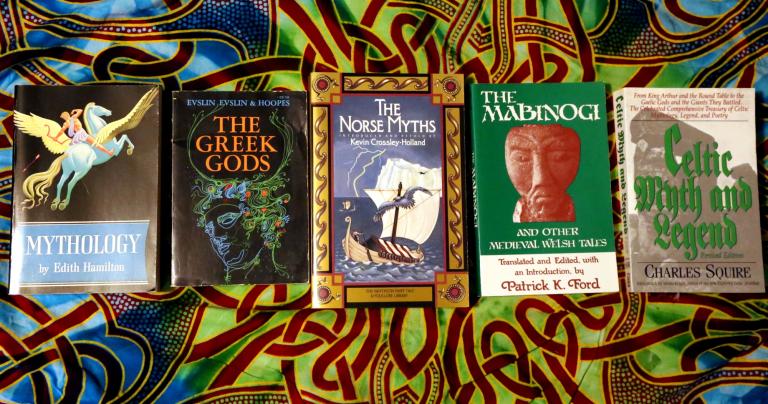
Pagan lore is the collective knowledge our ancestors had about the Gods that has survived to our times. It may not be the first place we begin our exploration of Hecate or some other deity, but it should be fairly high on our list of things to do.
Read the ancient stories of the Gods. Read the history that tells how and where They were worshipped. Learn about the people who followed Them. With Hecate, we know quite a bit. With others, like Cernunnos, we know next to nothing. Take advantage of what’s available – this is our common foundation for knowledge of the Gods.
The collection and preservation of lore is a human endeavor, and like all human endeavors it is subject to error. I shouldn’t have to remind Pagans not to become “lore literalists” and “lore fundamentalists” but at least occasionally I do. Also, scholarship is never perfect and almost always reflects the worldview and biases of the culture that produces it. In general, older primary sources and newer analyses are better, but not always.
Lore is where we begin on our journeys to get to know the Gods.
The essence of a deity remains constant
Polytheists wiser than me insist the Gods never change. As I see it, the Gods are living beings, and all living beings change over time. But I think we agree that while Their actions differ in response to changing times and changing cultures, the essence of who and what They are does not change.
A while back Morgan Daimler wrote Dressing Old Gods in a New World, which talks about how we tend to picture deities in archaic clothing. Morgan said:
What I think we forget is that the images we base our ideas of the Gods off of were not archaic when they were made. As far as I have been able to tell through my own research, the images of deities in ancient art largely feature depictions of contemporary fashion.
and also
How do I picture Macha? Well I certainly can see her as a 1st century Irish warrior queen, but I can also see her as thoroughly modern, clad in dark jeans and a leather jacket, driving around in a dark red Ford Mustang.
I’m the same person whether I’m wearing a business suit or a Druid robe. Even when the deities appear to us in different guises, and even when They interact with the modern world, They are still the same divine beings They were 2500 years ago.
Your experiences are always real – your interpretations may be more or less accurate
One of the central themes running through this blog – and especially in my first book The Path of Paganism – is that your experiences are undeniably real. You see what you see, hear what you hear, and feel what you feel. Never let anyone tell you “it’s all in your head” or “you’re making it up” when you know it’s more than that.
The difficulty comes when we begin to interpret our experiences – when we try to figure out what’s behind them and what they mean. I wrote a whole post on discernment last year – if you missed it, or if you don’t remember it, I suggest you read the whole thing. Here’s a key paragraph:
Discernment keeps us from jumping to conclusions that are simple, pleasant, and wrong. Discernment keeps us from putting our experiences under glass and ignoring calls and messages that are important even if they’re also difficult and scary. Discernment helps us distill the truth from our Pagan experiences.
I see two main sources of interpretive error.
The first is projection. Someone wants something to be true or thinks it should be true, so they project those desires onto their experience and try to make it out to be something that doesn’t really fit what happened.
The second is misidentification. I’ve seen people insist they were talking to the Morrigan, but the being they described bore little resemblance to how the Great Queen was understood either in ancient times or by contemporary devotees. I don’t know why the Gods don’t make it perfectly clear who They are, but They rarely do.
An experiences of a deity is sacred. Give your interpretation the time and effort you need to get it right.

UPG: Unverified Personal Gnosis
The information we receive during our direct experiences of the Gods is the textbook example of UPG. It is gnosis – knowledge – therefore it is meaningful and valuable. It is personal – it comes through one person, and is necessarily filtered through them. And it is unverified – there is no way to independently confirm that what we learn is true.
It is a tremendous challenge to order our lives based on what a God tell us directly, and at the same time remain humble enough to understand others are unlikely to accept what we report as truth. Yet that is the fine line we must walk.
I can’t think of a single instance where a God chose one and only one person to be Their evangelist. If They want something known in the wider world, it comes through multiple channels. You may be the first, but if it’s for general distribution, others will get the same message before too long.
So if what you hear is unusual or not in alignment with lore, look for others getting the same message. If you don’t, consider that perhaps this particular gnosis is meant only for you.
Why this matters
I’ve seen some responses to this on-going argument that basically say “don’t you have anything better to do?” I get it – Paganism is heavy on practice and light on theology. What we do is more important than what we believe. And that’s true, but I think we’re too light on theology.
Our contemporary Pagan theology is mostly based in personal experience, but it’s more than that:
Theology is a never-ending project of a religious movement. One person thinks about the Gods and then writes about their thoughts. Other people read their theology and affirm some parts of it, while rebutting other parts. More importantly, they dive deeper into this area or that.
And our polytheist theology grows.
If the Gods are the mightiest of spirits and if They are holy powers – and I think They are – then how we understand Them (both individually and collectively) matters.
I have neither the need nor the desire – nor the time – to worry about the details of everyone’s theology. Or anyone’s theology. What you believe is your business – I’ll form my opinion of you based on what you do.
But if I see ideas and concepts published in Pagan spaces I think are inaccurate, wrong, or unhelpful, I’m going to challenge them. And so will others. This is how we have mature discussions about the concepts that support our Pagan religions. Not by attacking people we think are wrong, or by saying “everybody’s truth is true for them,” but by challenging suspect ideas, keeping the ones that hold up under pressure, and discarding the ones that don’t.
This is how we build deep, robust Pagan religions.
Previous Post

June 11, 2019
Celebrating Summer Solstice in an Era of Climate Change
Next Post

June 16, 2019 6 Roles For Solitary Practitioners in the Pagan Future
Browse Our Archives
Select a Category Books Community CUUPS Druidry Foundations and Context Gods and Goddesses Magic Myth Nature Ritual Spiritual Practice Theology Travel Uncategorized Videos
Select a Month October 2026 September 2026 August 2026 July 2026 June 2026 May 2026 April 2026 March 2026 February 2026 January 2026 December 2025 November 2025 October 2025 September 2025 August 2025 July 2025 June 2025 May 2025 April 2025 March 2025 February 2025 January 2025 December 2024 November 2024 October 2024 September 2024 August 2024 July 2024 June 2024 May 2024 April 2024 March 2024 February 2024 January 2024 December 2023 November 2023 October 2023 September 2023 August 2023 July 2023 June 2023 May 2023 April 2023 March 2023 February 2023 January 2023 December 2022 November 2022 October 2022 September 2022 August 2022 July 2022 June 2022 May 2022 April 2022 March 2022 February 2022 January 2022 December 2021 November 2021 October 2021 September 2021 August 2021 July 2021 June 2021 May 2021 April 2021 March 2021 February 2021 January 2021 December 2020 November 2020 October 2020 September 2020 August 2020 July 2020 June 2020 May 2020 April 2020 March 2020 February 2020 January 2020 December 2019 November 2019 October 2019 September 2019 August 2019 July 2019 June 2019 May 2019 April 2019 March 2019 February 2019 January 2019 December 2018 November 2018 October 2018 September 2018 August 2018 July 2018 June 2018 May 2018 April 2018 March 2018 February 2018 January 2018 December 2017 November 2017 October 2017 September 2017 August 2017 July 2017 June 2017 May 2017 April 2017 March 2017 February 2017 January 2017 December 2016 November 2016 October 2016 September 2016 August 2016 July 2016 June 2016 May 2016 April 2016 March 2016 February 2016 January 2016 December 2015 November 2015 October 2015 September 2015 August 2015 July 2015 June 2015 May 2015 April 2015 March 2015 February 2015 January 2015 December 2014 November 2014 October 2014 September 2014 August 2014 July 2014 June 2014 May 2014 April 2014 March 2014 February 2014 January 2014 December 2013 November 2013 October 2013 September 2013 August 2013 July 2013 June 2013 May 2013 April 2013 March 2013 February 2013 January 2013 December 2012 November 2012 October 2012 September 2012 August 2012 July 2012 June 2012 May 2012 April 2012 March 2012 February 2012 January 2012 December 2011 November 2011 October 2011 September 2011 August 2011 July 2011 June 2011 May 2011 April 2011 March 2011 February 2011 January 2011 December 2010 November 2010 October 2010 September 2010 August 2010 July 2010 June 2010 May 2010 April 2010 March 2010 February 2010 January 2010 December 2009 November 2009 October 2009 September 2009 August 2009 July 2009 June 2009 May 2009 April 2009 March 2009 February 2009 January 2009 December 2008 November 2008 October 2008 September 2008 August 2008 July 2008 June 2008
Follow Us!
TAKE THE
Religious Wisdom Quiz
What does Proverbs say about a soft answer?
Select your answer to see how you score.
It turns away wrath It is useless It brings wealth It starts a fight
Related posts from John Beckett




What We Lose When “Ask AI” Becomes A...
TRENDING AT PATHEOS Pagan

The Iron Gates and the Lion of the...
Yesterday, I didn't finish my report about, well, yesterday. So I'll...

Dolly Parton’s Last Song Wins Dove Award with...
Bluegrass band The Grascals, speaking on the red carpet at the 57th...

The Image: On the Horror of Capitalism and...
The Image Then went the Pharisees, and took counsel how they might...

We are approaching the date of our new American national holiday: October...

Letters on Living the Faith by C.S. Lewis
Most of us met C.S. Lewis as a public intellectual. Mere Christianity....

When Halloween Unmasks Married Hearts
Written by Dr. David K. Ewen from Eternal Truth Bible College Behind...
view all Pagan blogs
Ad-Free & Subscriber Log-In Subscription Support
- About Us
- 2026 Calendar
- Videos
- Podcasts
- Library of World Religions
- Faith In Media Tracker
- Advertise With Us
- Write for Us
- Privacy Policy
- Terms of Service
- Do Not Sell My Data
- Contact Us
- Radiant Digital
- Manage Newsletter Subscriptions
- Unsubscribe From Notifications
- Sitemap
Copyright 2008-2026, Patheos. All rights reserved.
Subscription Support Ad-Free & Subscriber Log-In
Follow Patheos