
BuddhistCatholicContemplativeEvangelicalGeneral ChristianHinduJewishLatter-day SaintMuslimNew VisionsProgressive Christian
Beliefs
- Buddhist
- Catholic
- Contemplative
- Evangelical
- General Christian
- Hindu
- Jewish
- Latter-day Saint
- More Voices
- Muslim
- New Visions
- Pagan
- Progressive Christian
Topics
- Religion News
- Food and Religion
- Sports and Religion
- Religious Art
- Religious Music and Entertainment
- Religious Events
- History and Religion
- Style and Religion
- Politics and Religion
- Women in Religion
- Recreation Outdoors and Religion
- Business Finance and Religion
- Careers Workplace and Religion
- Education and Religion
- Family Parenting and Religion
- Health Fitness and Religion
- Home and Religion
- Relationships and Religion
- Technology and Religion
- Travel and Religion
Columnists
- Buddhist Columnists
- Business Finance and Religion Columnists
- Careers Workplace and Religion Columnists
- Catholic Columnists
- Contemplative Columnists
- Education and Religion Columnists
- Evangelists Columnists
- Family Parenting and Religion Columnists
- General Christian Columnists
- Health Fitness and Religion Columnists
- Hindu Columnists
- History and Religion Columnists
- Home and Religion Columnists
- Jewish Columnists
- More Voices Columnists
- Latter Day Columnists
- Muslim Columnists
- New Visions Columnists
- Nonreligious Columnists
- Pagan Columnists
- Politics and Religion Columnists
- Progressive Columnists
- Recreation Outdoors and Religion Columnists
- Relationships and Religion Columnists
- Religion News Columnists
- Religious Art Columnists
- Religious Events Columnists
- Religious Music and Entertainment Columnists
- Sports and Religion Columnists
- Style and Religion Columnists
- Technology and Religion Columnists
- Travel and Religion Columnists
- Women in Religion Columnists
Resource Library
- 2026 Calendar
- Library of World Religions
- The 100 Most Holy Places on Earth
- Patheos Answers
- Podcasts
- Videos
- Faith Leaders Database
- Anglican Episcopalian
- Bahai
- Baptist
- Buddhism
- Christianity
- Confucianism
- Eastern Orthodoxy
- Hinduism
- Holiness and Pentecostal
- ISKCON
- Islam
- Judaism
- Lutheran
- Methodist
- The Church of Jesus Christ of Latter-day Saints
- New Age
- Paganism
- Presbytarian and Reformed
- Protestantism
- Religion Behind the Scenes
- Roman Catholic
- Scientology
- Shia Islam
- Sikhism
- Sufism
- Sunni Islam
- Taoism
- Zen
- See all religions
Research Tools
 Ad-Free & Subscriber Log-In Subscription Support
Ad-Free & Subscriber Log-In Subscription Support
Follow Patheos 

- Trending:
- Forgiveness
- |
- Marriage
- |
- Consciousness
- |
- Death Penalty
- |
- Election
- |
- Halloween

- Home
- Pagan
- “I Didn’t Expect It To Be So Real” – The Power of Good Public Rituals
“I Didn’t Expect It To Be So Real” – The Power of Good Public Rituals
Last updated on: May 12, 2019 at 3:00 am by John Beckett
“I Didn’t Expect It To Be So Real” – The Power of Good Public Rituals 2019-05-06T19:00:25-06:00 John Beckett
Patheos Explore the world's faith through different perspectives on religion and spirituality! Patheos has the views of the prevalent religions and spiritualities of the world.
“I didn’t expect it to be so real.”
Of all the post-ritual comments I’ve ever heard, this one from a first-time guest at last Saturday’s Denton CUUPS Beltane circle is possibly the strongest and most meaningful.
Now, I didn’t ask our guest to elaborate – I don’t know what he was expecting, or why he thought this ritual was more real than others he’s attended. It’s entirely possible his reasoning was rather different from what I’m writing here. But as unique as his words were, the message is one I heard from others at our Beltane ritual, and also from participants at the Morrigan Devotional ritual at Sacred Space this March and at Mystic South last July: this is deep, this is meaningful, this is real.
The theme of this year’s Beltane was “Pantheon” – all the Gods. At the beginning of the ritual, we said:
We are Unitarian Universalist Pagans. We welcome all who come in love and friendship, whether they worship many Gods, one God, or no Gods. But over the years we have developed our own Pantheon – a collection of deities who we know and serve. We have no ornate temples with domed roofs. But we do have sacred images of our Goddesses and Gods to help us see them and relate to them.
We set up shrines – grouped mostly by geography – to all the deities for whom we have statues or other physical representations. We encouraged people to browse the shrines before the ritual. After beginning with the traditional Maypole Dance, I led a procession back to our ritual area – the procession went directly by the shrines.
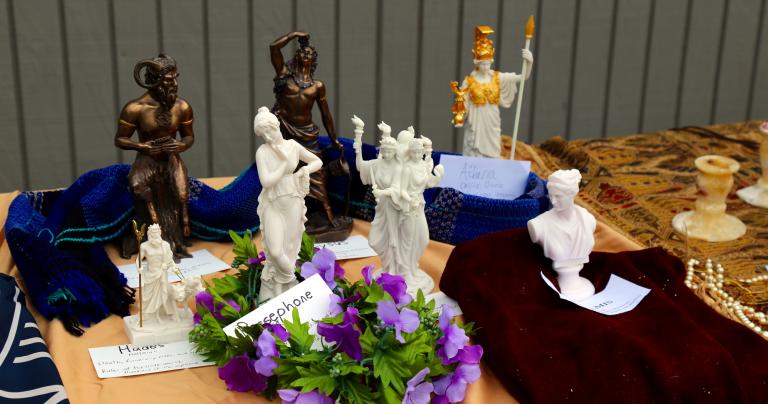
the Greek section of our Pantheon
When I completed the procession and turned around, I noticed the line was backing up. People weren’t just walking past the shrines – they were stopping to look, and in at least a few cases, to pray. That was my first clue that the ritual was working better than I had expected.
After our usual invocations and offerings, our main event was rather simple. We introduced each of the enshrined deities by name – 35 in total, if I counted correctly – and made offerings to Them. We asked people “who calls to you?” If no one calls to you, we asked “who do you want to call to?” And then:
Come to the shrines. We have paper and pencils: write your prayers. Ask your questions, give your answers, speak the yearnings of your heart. When you are done, place your papers in the amphora. And when we are done, we will send the amphora to the Gods.
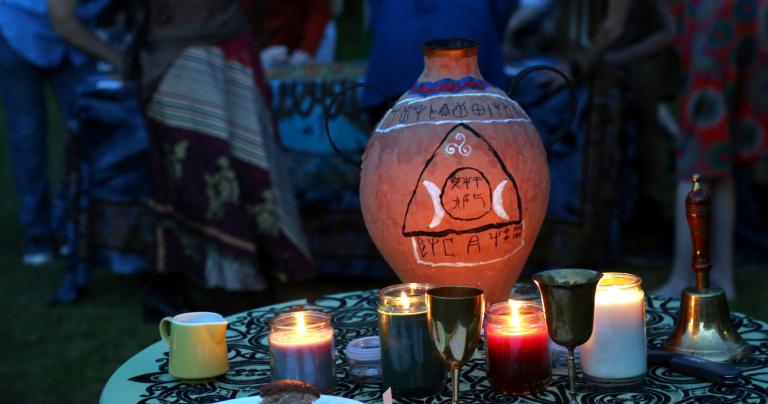
I had almost 9 minutes of background music queued up for this part of the ritual – I had to repeat the final song. As with the procession, people were taking this seriously and were in no hurry to finish. Not what I expected, but that’s a very good thing.
When everyone was done, we placed the amphora in the fire.
Goddesses and Gods of Denton CUUPS, Divine Ones from many places and many ages, Deities who we do not know but who are here just the same, we ask you to hear our prayers. As the fire consumes and transforms these papers, may our thoughts and words be carried to you.
O mighty Gods, hear our prayers!”

Based on the comments of the participants, They did.
This was not a particularly complicated ritual: there were no special preparations, no elaborate ritual plays, no arcane incantations. But there were elements that helped make it so powerful, and that’s what I’d like to discuss.
Atmosphere matters
Walk into one of the beautiful medieval churches and you instantly realize you’re in a sacred space. I’m sure it was the same walking into the ancient Pagan temples. We don’t have those kind of buildings, and we’re not likely to have them any time soon. But with a little imagination and a little work, ordinary spaces can be made extraordinary.
For the Morrigan Devotional rituals, we turned hotel meetings rooms into temples. For this ritual, we turned the front yard of Denton UU into a shrine to the Many Gods. Statues aren’t cheap, but they aren’t prohibitively expensive, and many Pagans have one or two or twelve. We bought nothing for this ritual – we made the amphora from paper mache.
A central fire is important for religious reasons, but also for aesthetic ones. Fire bowls are perfect for this. If you’re indoors, burn rubbing alcohol in a cast iron cauldron or use a candle. In a hotel where open flames aren’t permitted? Use an electric candle.
Ritual leaders should dress like ritual leaders! This can be robes and Pagan jewelry, or fancy clothes, or even nice ordinary clothes. If you’re functioning as a priest, dress like a priest. Look like this is important to you, like you gave some thought to how you present yourself. It really does matter.
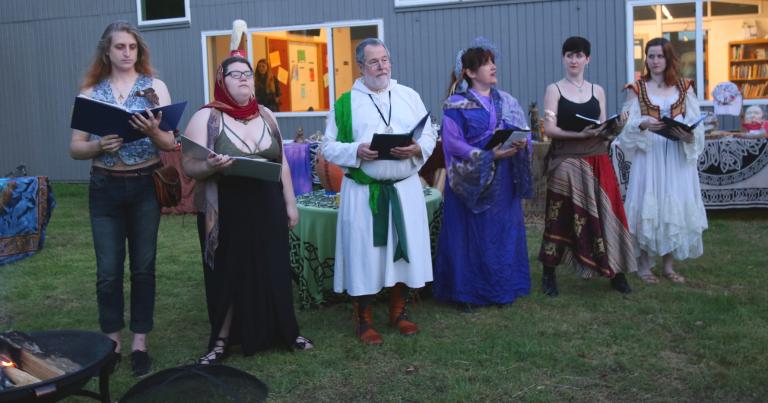
Paganism is not Puritanism with its plain meeting houses and expository sermons – it’s a religion of the senses. Make your space beautiful. Burn incense and play music at the appropriate times. Dress to impress. Atmosphere matters.
Reverence is contagious
There’s a time for fun and frivolity – we had a great time laughing and dancing and falling on the ground during the Maypole. But there are also times that call for seriousness, and some of those call for reverence.
Even many long-time Pagans are unsure how to conduct themselves in a ritual. So they look at what others are doing, especially the leaders. If the leaders are reciting or reading their lines with respect in their voices, the participants will pick up on it. If the leaders are treating the statues as sacred representations of the Gods, so will the participants. Set the right atmosphere and people will intuitively follow.
So little is sacred in our ordinary world. Most people are hungry for something not-ordinary, something holy. Present them with something worthy of reverence and they’ll eagerly respond.
Sacred theater is powerful and holy
The most powerful myths of today are not told in churches or temples or groves – they’re told in movie theaters and on television screens. People are inspired and moved by The Lord of the Rings, Harry Potter, and Game of Thrones. Star Wars led to the beginnings of an actual religion. As much as some of us (me included) like to rant about “pop culture religion” the fact is that theater has always been an effective way of communicating deep and complex ideas and messages.
Read this now 10-year-old essay by UU minster Rev. Victoria Weinstein titled Serving Dionysus, where she talks about how what she learned in community theater helps her lead Sunday services:
The “secrets” of good liturgy are held mostly by the clergy, who rarely openly discuss with the laity how important technique and craft are to the successful “performance” of it. To refer to worship as a “performance” is to cheapen and defile its sanctity.
And yet, of course, liturgy is a performance of sorts.
Learn to project, so your voice can be heard by those on the other side of the circle – and by those who don’t hear so well. Learn to perform your lines, not just recite them. Practice movements and motions. Rehearse your rituals, so everyone knows what to do when. And when you’re not actively leading, pay close and reverent attention to those who are – model the behavior you want to encourage in the participants.
Pagan ritual should never degenerate into melodrama, but sacred theater has been a part of religion at least since the ancient Greeks. Make it a part of your rituals.
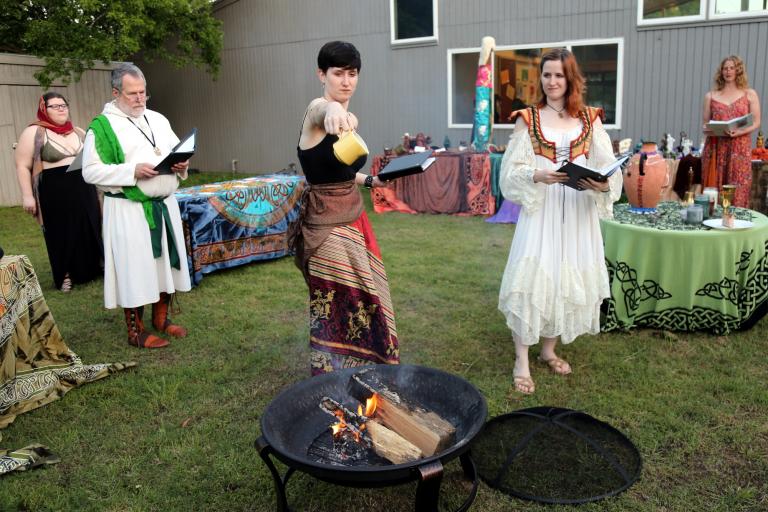
“We make this offering, that our journeys may be safe and fruitful.”
The Gods will speak if we will listen
All this atmosphere, reverence, and theater has a purpose: putting everyone in the right frame of mind to hear the Gods.
For all Their power and might, They rarely choose to present Themselves in a loud and boisterous manner. I do not know why this is, though I suspect the kind of people who are attracted to loud and boisterous aren’t well-suited for the work of the Gods. In any case, hearing Them usually requires listening with intent.
This need not and should not be complicated. For the Morrigan Devotional rituals we invited people to simply approach the altar and make an offering. For this ritual we asked them to write their prayers. The look on people’s faces as they participated made it clear communication was happening.
Perhaps I should say “the God are speaking – will we listen?” If you want people to experience the Gods in your ritual, make it easy for them to listen.
Relationships are the foundation
I am certain that the deities present at our ritual were not there because we commanded Them to appear. They came because They wanted to be there, and because people who know Them invited them to come.
We often think of deities as the God of This or the Goddess of That. Certainly the many Gods have their own areas of interest and responsibility. But more than that, Gods have people, and people have Gods. We approach our deities through relationships rather than through functions. Those relationships have persisted through generations of migration, across continents and across oceans.
And they continue to this day. If you would introduce the Gods to the people, first build a relationship based on honor and respect, on hospitality and reciprocity.
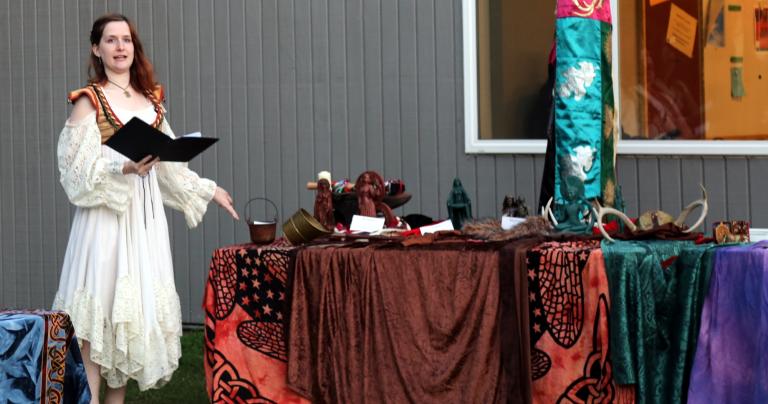
a devotee of Brighid presents her Goddess and our other Celtic deities
There is a yearning for depth
There is a tendency in Paganism to save the good stuff for private rituals. Some traditions are built on oath-bound material, or on the kind of intense work that few people can or want to do. I participate in some of those traditions, and there are things I do in private I will not do in public.
But that’s no reason dumb down our public rituals. The Gods are for everyone. While I encourage us all to read and study and learn, no special knowledge is required to pray or meditate or make offerings. Show people the Gods in all Their power and majesty – They’ll do the rest.
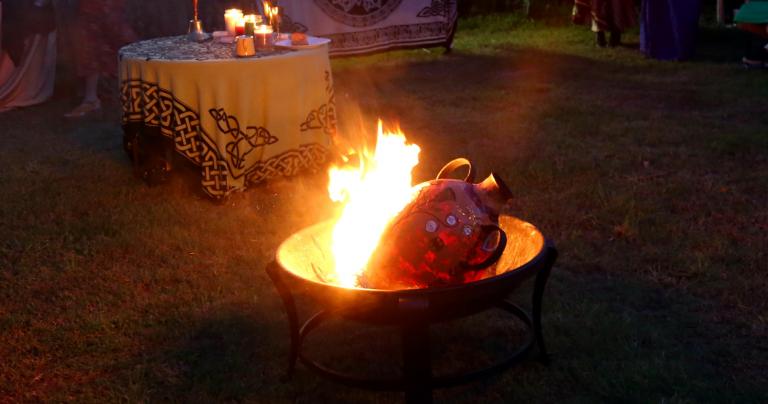
I coordinated this ritual, but it is not my creation. The theme of Pantheon was presented to me by several deities at once: “you, Druid – do this.” The rest was just me filling in the blanks.
In the days before the ritual, I told my fellow leaders “let’s make our Pantheon as beautiful as we can – not just statues on tables. Bring fabric, flowers, jewelry – anything to enhance the display of the images of our Gods.” And they did. The beauty of the shrines is the work of the people you see in these pictures, and some not pictured: Cynthia Talbot, Morgan Milburn, Gabrielle Milburn, Ruth Gibbs, Erik Kolderup, Heather Campbell, Sami Snow, Al Dent, Michi Harper, and Russell Griffin.
Special thanks to Cynthia Talbot, Erik Kolderup, and Gabrielle Milburn, who designed, made, and decorated the amphora.
And that’s another key to a powerful ritual – teamwork by dedicated leaders.
Previous Post

May 9, 2019
Moving From Raw Spiritual Experience to Religion
Next Post
May 14, 2019 Sacrificing Women’s Lives on the Altar of Political Purity
Browse Our Archives
Select a Category Books Community CUUPS Druidry Foundations and Context Gods and Goddesses Magic Myth Nature Ritual Spiritual Practice Theology Travel Uncategorized Videos
Select a Month October 2026 September 2026 August 2026 July 2026 June 2026 May 2026 April 2026 March 2026 February 2026 January 2026 December 2025 November 2025 October 2025 September 2025 August 2025 July 2025 June 2025 May 2025 April 2025 March 2025 February 2025 January 2025 December 2024 November 2024 October 2024 September 2024 August 2024 July 2024 June 2024 May 2024 April 2024 March 2024 February 2024 January 2024 December 2023 November 2023 October 2023 September 2023 August 2023 July 2023 June 2023 May 2023 April 2023 March 2023 February 2023 January 2023 December 2022 November 2022 October 2022 September 2022 August 2022 July 2022 June 2022 May 2022 April 2022 March 2022 February 2022 January 2022 December 2021 November 2021 October 2021 September 2021 August 2021 July 2021 June 2021 May 2021 April 2021 March 2021 February 2021 January 2021 December 2020 November 2020 October 2020 September 2020 August 2020 July 2020 June 2020 May 2020 April 2020 March 2020 February 2020 January 2020 December 2019 November 2019 October 2019 September 2019 August 2019 July 2019 June 2019 May 2019 April 2019 March 2019 February 2019 January 2019 December 2018 November 2018 October 2018 September 2018 August 2018 July 2018 June 2018 May 2018 April 2018 March 2018 February 2018 January 2018 December 2017 November 2017 October 2017 September 2017 August 2017 July 2017 June 2017 May 2017 April 2017 March 2017 February 2017 January 2017 December 2016 November 2016 October 2016 September 2016 August 2016 July 2016 June 2016 May 2016 April 2016 March 2016 February 2016 January 2016 December 2015 November 2015 October 2015 September 2015 August 2015 July 2015 June 2015 May 2015 April 2015 March 2015 February 2015 January 2015 December 2014 November 2014 October 2014 September 2014 August 2014 July 2014 June 2014 May 2014 April 2014 March 2014 February 2014 January 2014 December 2013 November 2013 October 2013 September 2013 August 2013 July 2013 June 2013 May 2013 April 2013 March 2013 February 2013 January 2013 December 2012 November 2012 October 2012 September 2012 August 2012 July 2012 June 2012 May 2012 April 2012 March 2012 February 2012 January 2012 December 2011 November 2011 October 2011 September 2011 August 2011 July 2011 June 2011 May 2011 April 2011 March 2011 February 2011 January 2011 December 2010 November 2010 October 2010 September 2010 August 2010 July 2010 June 2010 May 2010 April 2010 March 2010 February 2010 January 2010 December 2009 November 2009 October 2009 September 2009 August 2009 July 2009 June 2009 May 2009 April 2009 March 2009 February 2009 January 2009 December 2008 November 2008 October 2008 September 2008 August 2008 July 2008 June 2008
Follow Us!
TAKE THE
Religious Wisdom Quiz
Why was it significant that Jesus spoke to a Samaritan woman at the well?
Select your answer to see how you score.
She was wealthy She was a prophet It was raining Jews typically avoided Samaritans
Related posts from John Beckett




What We Lose When “Ask AI” Becomes A...
TRENDING AT PATHEOS Pagan

The Sermon on the Mount, Part I: Matthew...
The Sermon on the Mount, Part I (Matthew 4:12-5:12) St. Matthew moves...

What's up from Crossway: Reviewing some of their latest A few weeks...

Janie Learns the Way of the Cross: A...
Teaching children about Jesus' Passion can be challenging. Many parents and educators...

Looking For Good Catholic Writing - October 2026
He alone extends the heavens, and he walks upon the waves of...

In "Irreplaceable," our book on vocation and technology, Trevor Sutton and I...

I was strolling through the top floor of the brand new Parthenon...
view all Pagan blogs
Ad-Free & Subscriber Log-In Subscription Support
- About Us
- 2026 Calendar
- Videos
- Podcasts
- Library of World Religions
- Faith In Media Tracker
- Advertise With Us
- Write for Us
- Privacy Policy
- Terms of Service
- Do Not Sell My Data
- Contact Us
- Radiant Digital
- Manage Newsletter Subscriptions
- Unsubscribe From Notifications
- Sitemap
Copyright 2008-2026, Patheos. All rights reserved.
Subscription Support Ad-Free & Subscriber Log-In
Follow Patheos