
BuddhistCatholicContemplativeEvangelicalGeneral ChristianHinduJewishLatter-day SaintMuslimNew VisionsProgressive Christian
Beliefs
- Buddhist
- Catholic
- Contemplative
- Evangelical
- General Christian
- Hindu
- Jewish
- Latter-day Saint
- More Voices
- Muslim
- New Visions
- Pagan
- Progressive Christian
Topics
- Religion News
- Food and Religion
- Sports and Religion
- Religious Art
- Religious Music and Entertainment
- Religious Events
- History and Religion
- Style and Religion
- Politics and Religion
- Women in Religion
- Recreation Outdoors and Religion
- Business Finance and Religion
- Careers Workplace and Religion
- Education and Religion
- Family Parenting and Religion
- Health Fitness and Religion
- Home and Religion
- Relationships and Religion
- Technology and Religion
- Travel and Religion
Columnists
- Buddhist Columnists
- Business Finance and Religion Columnists
- Careers Workplace and Religion Columnists
- Catholic Columnists
- Contemplative Columnists
- Education and Religion Columnists
- Evangelists Columnists
- Family Parenting and Religion Columnists
- General Christian Columnists
- Health Fitness and Religion Columnists
- Hindu Columnists
- History and Religion Columnists
- Home and Religion Columnists
- Jewish Columnists
- More Voices Columnists
- Latter Day Columnists
- Muslim Columnists
- New Visions Columnists
- Nonreligious Columnists
- Pagan Columnists
- Politics and Religion Columnists
- Progressive Columnists
- Recreation Outdoors and Religion Columnists
- Relationships and Religion Columnists
- Religion News Columnists
- Religious Art Columnists
- Religious Events Columnists
- Religious Music and Entertainment Columnists
- Sports and Religion Columnists
- Style and Religion Columnists
- Technology and Religion Columnists
- Travel and Religion Columnists
- Women in Religion Columnists
Resource Library
- 2026 Calendar
- Library of World Religions
- The 100 Most Holy Places on Earth
- Patheos Answers
- Podcasts
- Videos
- Faith Leaders Database
- Anglican Episcopalian
- Bahai
- Baptist
- Buddhism
- Christianity
- Confucianism
- Eastern Orthodoxy
- Hinduism
- Holiness and Pentecostal
- ISKCON
- Islam
- Judaism
- Lutheran
- Methodist
- The Church of Jesus Christ of Latter-day Saints
- New Age
- Paganism
- Presbytarian and Reformed
- Protestantism
- Religion Behind the Scenes
- Roman Catholic
- Scientology
- Shia Islam
- Sikhism
- Sufism
- Sunni Islam
- Taoism
- Zen
- See all religions
Research Tools
 Ad-Free & Subscriber Log-In Subscription Support
Ad-Free & Subscriber Log-In Subscription Support
Follow Patheos 

- Trending:
- Forgiveness
- |
- Marriage
- |
- Consciousness
- |
- Death Penalty
- |
- Election
- |
- Halloween

- Home
- Pagan
- Memento Mori: The Bone Church of Kutna Hora
Memento Mori: The Bone Church of Kutna Hora
Last updated on: April 23, 2019 at 3:00 am by John Beckett
Memento Mori: The Bone Church of Kutna Hora 2019-04-21T17:54:03-06:00 John Beckett
Patheos Explore the world's faith through different perspectives on religion and spirituality! Patheos has the views of the prevalent religions and spiritualities of the world.
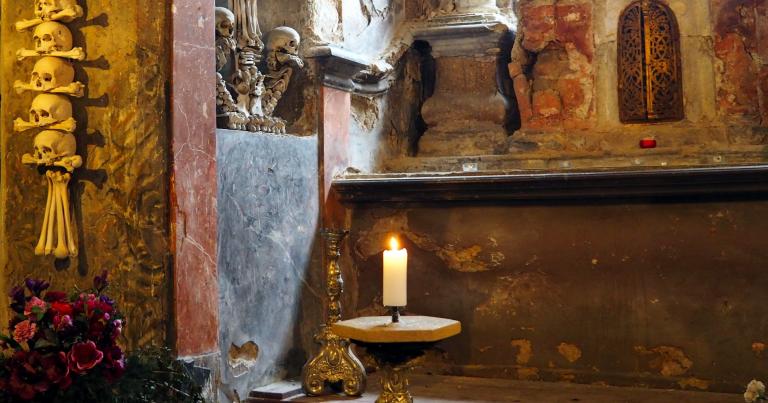
On a recent trip to the Czech Republic I visited Kutna Hora, a small town about an hour east of Prague. It’s a former mining town (the silver ran out in the late Middle Ages) now best known as the home of the Sedlec Ossuary – the Bone Church.
While not common, ossuaries (bone depositories) can be found throughout much of the ancient Christian world. But there’s nothing quite like this. It looks like something built by Goths – that would be fans of Siouxsie and the Banshees, not the Germanic tribe that overran Rome – but it’s a Roman Catholic church.
Taken together with some of the sights around Prague, the Bone Church left me with some strong impressions I think are relevant to all of us, whether Pagan, Christian, or otherwise.
The story of the Bone Church
In 1278 a monk returned to Kutna Hora from a trip to Palestine. He brought back some dirt from where legends said Jesus was crucified, which he spread around the local cemetery. That made Kutna Hora a popular place to be buried. Throw in a few wars and the Black Plague and the cemetery became quite full.
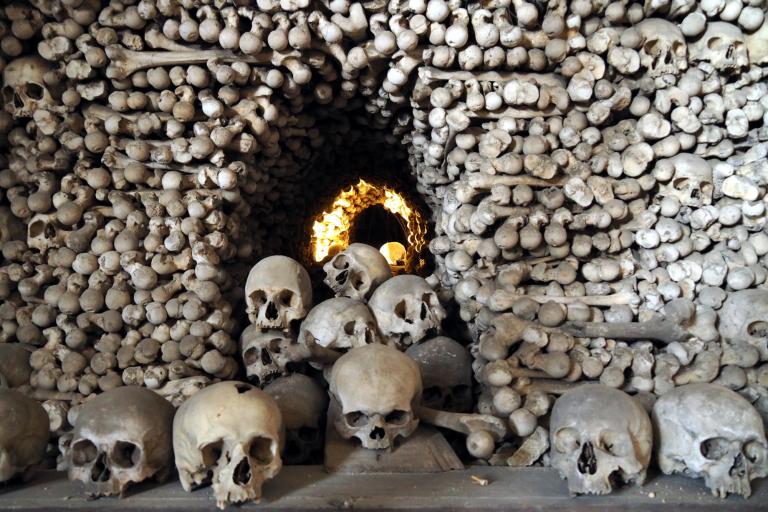
In the 1400s local officials decided to build a new church. When they started digging the foundation they found bones. Lots of bones. At least 40,000 people worth of bones.
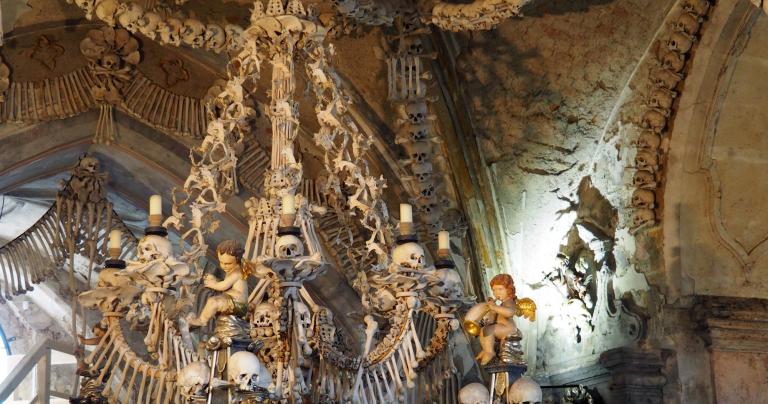
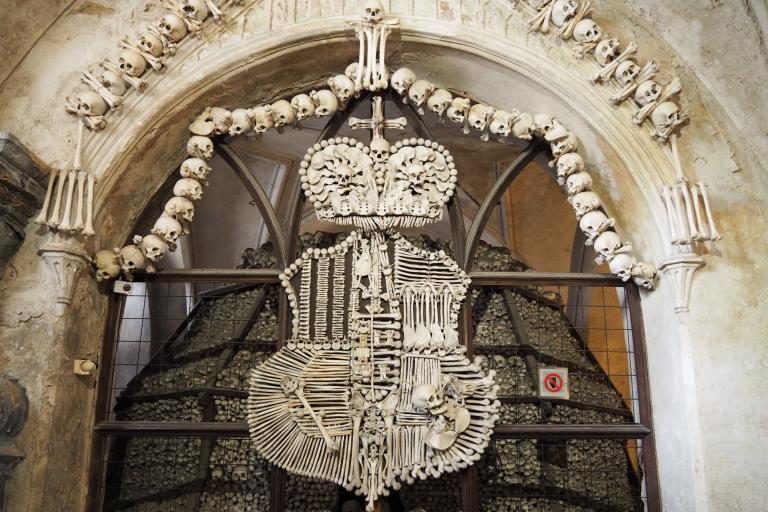
At first they simply stacked them up. In the 1800s they began to arrange them as you see today.
If you want more details, the Wikipedia entry lines up well with the story our local guide told us, so I assume it’s more or less correct.
Any attempt to provide a simple interpretation of something that is the product of so many people and so many forces (religious, social, and economic) over so many centuries is bound to be wrong. The Bone Church is a work of art, and works of art have lives of their own, speaking different things to different people at different times.
It certainly spoke to me.
Memento Mori
I never heard the words memento mori (“remember you will die”) until I watched Penny Dreadful – one of the many things I missed growing up Baptist. I heard plenty of hellfire sermons that served the same purpose, but Protestants and especially Calvinists prefer words to images. That’s another topic for another time, and possibly for another blog.
Life expectancy in medieval Europe was a little over 30 years. Childhood diseases, childbirth, war, plague, and famine made death ever-present. But this imagery does not merely speak of death.
It speaks of judgement.
Artwork of the period shows a stark division of the dead. Live as the church tells you to live and angels will carry you to heaven. Do otherwise and demons will drag you to hell. Even today Christians disagree on what it takes to end up in the good place and not the bad place. As a Unitarian Universalist I reject the idea of eternal punishment for anyone. As a Pagan I believe our actions in this life affect our place in the next life, but I do not believe anyone is forever damned.
I find it interesting that I visited the Bone Church in between the time I wrote What To Do With My Body After I’m Dead and the time it was posted. As I said in that post, it is good and necessary to think about your death, for death is certain. Our contemporary culture denies death, hides it away and sanitizes it. This is not healthy. Surely there is a middle way in between these two approaches.
As a Pagan I’m committed to finding one, and then following it.
The bodies of the dead are not ours
Someone asked me about the energy in the Bone Church. I’m not sure “energy” is the proper word, though in the modern Pagan sense of the term we all understand what that means. I prefer to think of the spirits of that church, and the spirits in the church.
From my impressions and in the context of my thoughts on such things, I think the vast majority of the souls have moved on. I’m not sensitive enough to tell how much of what’s still there are Earth-bound spirits and how much are simply residual impressions. Of the spirits that are there, most are happy to be in a sacred place, a place that is not forgotten even if it is not the home of an active congregation.
But some of the spirits are not happy. They wanted to be buried in the “super consecrated” soil. They were, but then their bones were dug up, scrubbed up, and hung up on display.
As with the Celtic bog bodies and Egyptian mummies in museums, these dead have not been treated according to their wishes in life.
I do not call for their reburial. That’s a very complicated issue and I do not have enough connections to this church, these people, and their descendants to form a strong opinion. But I do encourage all of us to think of the dead as persons who, like all persons, are due our respect and our reverent care.
Live life – accept death
There is, I think, a good middle way between the death-obsessed culture of the Middle Ages and the death-denying culture of the contemporary West.
You will probably live long – prepare for the future. You may die tomorrow – enjoy life today. You will certainly die someday – make your final arrangements.
What comes after death remains a mystery. I am convinced we live on in the Otherworld for a while, and then return to this world to continue learning, growing, and doing the great work of humanity.
And though I come to very different conclusions, I left Kutna Hora very much in the spirit of memento mori: think on your death.
Previous Post
April 21, 2019
16 Years of Beltane
Next Post

April 25, 2019 The Limits of Accessibility for Pagan Clergy
Browse Our Archives
Select a Category Books Community CUUPS Druidry Foundations and Context Gods and Goddesses Magic Myth Nature Ritual Spiritual Practice Theology Travel Uncategorized Videos
Select a Month October 2026 September 2026 August 2026 July 2026 June 2026 May 2026 April 2026 March 2026 February 2026 January 2026 December 2025 November 2025 October 2025 September 2025 August 2025 July 2025 June 2025 May 2025 April 2025 March 2025 February 2025 January 2025 December 2024 November 2024 October 2024 September 2024 August 2024 July 2024 June 2024 May 2024 April 2024 March 2024 February 2024 January 2024 December 2023 November 2023 October 2023 September 2023 August 2023 July 2023 June 2023 May 2023 April 2023 March 2023 February 2023 January 2023 December 2022 November 2022 October 2022 September 2022 August 2022 July 2022 June 2022 May 2022 April 2022 March 2022 February 2022 January 2022 December 2021 November 2021 October 2021 September 2021 August 2021 July 2021 June 2021 May 2021 April 2021 March 2021 February 2021 January 2021 December 2020 November 2020 October 2020 September 2020 August 2020 July 2020 June 2020 May 2020 April 2020 March 2020 February 2020 January 2020 December 2019 November 2019 October 2019 September 2019 August 2019 July 2019 June 2019 May 2019 April 2019 March 2019 February 2019 January 2019 December 2018 November 2018 October 2018 September 2018 August 2018 July 2018 June 2018 May 2018 April 2018 March 2018 February 2018 January 2018 December 2017 November 2017 October 2017 September 2017 August 2017 July 2017 June 2017 May 2017 April 2017 March 2017 February 2017 January 2017 December 2016 November 2016 October 2016 September 2016 August 2016 July 2016 June 2016 May 2016 April 2016 March 2016 February 2016 January 2016 December 2015 November 2015 October 2015 September 2015 August 2015 July 2015 June 2015 May 2015 April 2015 March 2015 February 2015 January 2015 December 2014 November 2014 October 2014 September 2014 August 2014 July 2014 June 2014 May 2014 April 2014 March 2014 February 2014 January 2014 December 2013 November 2013 October 2013 September 2013 August 2013 July 2013 June 2013 May 2013 April 2013 March 2013 February 2013 January 2013 December 2012 November 2012 October 2012 September 2012 August 2012 July 2012 June 2012 May 2012 April 2012 March 2012 February 2012 January 2012 December 2011 November 2011 October 2011 September 2011 August 2011 July 2011 June 2011 May 2011 April 2011 March 2011 February 2011 January 2011 December 2010 November 2010 October 2010 September 2010 August 2010 July 2010 June 2010 May 2010 April 2010 March 2010 February 2010 January 2010 December 2009 November 2009 October 2009 September 2009 August 2009 July 2009 June 2009 May 2009 April 2009 March 2009 February 2009 January 2009 December 2008 November 2008 October 2008 September 2008 August 2008 July 2008 June 2008
Follow Us!
TAKE THE
Religious Wisdom Quiz
Who was turned into a pillar of salt?
Select your answer to see how you score.
Sarah Rachel Lot’s wife Lot
Related posts from John Beckett
The Pillar of the Boatmen: the Ancient Monument...



TRENDING AT PATHEOS Pagan

Catholic Evangelization: Sharing Your Faith Every Day
Welcome back to the Graceful Awakening mini-series called, “From Faith to Mission.” ...

The Pillar of the Boatmen: the Ancient Monument...
The Pillar of the Boatmen is a Romano-Gaulish sculpture that dates from...

In one sense walking into Westminster Abbey is like walking down the...

'Super Scam Me' Exposes AI Jon Bon Jovi...
Leslie Pickett believed she was in a relationship with Jon Bon Jovi....

The Brazilian Remake of Kendricks' 'Flywheel' Opens in...
“Flywheel,” the story that launched the Kendrick Brothers’ filmmaking career is getting...

The Dangers of Gradual Accommodation (Winking at Sin)
Recently, the “law of gradualness” resurfaced during the opening of a weeklong,...
view all Pagan blogs
Ad-Free & Subscriber Log-In Subscription Support
- About Us
- 2026 Calendar
- Videos
- Podcasts
- Library of World Religions
- Faith In Media Tracker
- Advertise With Us
- Write for Us
- Privacy Policy
- Terms of Service
- Do Not Sell My Data
- Contact Us
- Radiant Digital
- Manage Newsletter Subscriptions
- Unsubscribe From Notifications
- Sitemap
Copyright 2008-2026, Patheos. All rights reserved.
Subscription Support Ad-Free & Subscriber Log-In
Follow Patheos