
BuddhistCatholicContemplativeEvangelicalGeneral ChristianHinduJewishLatter-day SaintMuslimNew VisionsProgressive Christian
Beliefs
- Buddhist
- Catholic
- Contemplative
- Evangelical
- General Christian
- Hindu
- Jewish
- Latter-day Saint
- More Voices
- Muslim
- New Visions
- Pagan
- Progressive Christian
Topics
- Religion News
- Food and Religion
- Sports and Religion
- Religious Art
- Religious Music and Entertainment
- Religious Events
- History and Religion
- Style and Religion
- Politics and Religion
- Women in Religion
- Recreation Outdoors and Religion
- Business Finance and Religion
- Careers Workplace and Religion
- Education and Religion
- Family Parenting and Religion
- Health Fitness and Religion
- Home and Religion
- Relationships and Religion
- Technology and Religion
- Travel and Religion
Columnists
- Buddhist Columnists
- Business Finance and Religion Columnists
- Careers Workplace and Religion Columnists
- Catholic Columnists
- Contemplative Columnists
- Education and Religion Columnists
- Evangelists Columnists
- Family Parenting and Religion Columnists
- General Christian Columnists
- Health Fitness and Religion Columnists
- Hindu Columnists
- History and Religion Columnists
- Home and Religion Columnists
- Jewish Columnists
- More Voices Columnists
- Latter Day Columnists
- Muslim Columnists
- New Visions Columnists
- Nonreligious Columnists
- Pagan Columnists
- Politics and Religion Columnists
- Progressive Columnists
- Recreation Outdoors and Religion Columnists
- Relationships and Religion Columnists
- Religion News Columnists
- Religious Art Columnists
- Religious Events Columnists
- Religious Music and Entertainment Columnists
- Sports and Religion Columnists
- Style and Religion Columnists
- Technology and Religion Columnists
- Travel and Religion Columnists
- Women in Religion Columnists
Resource Library
- 2026 Calendar
- Library of World Religions
- The 100 Most Holy Places on Earth
- Patheos Answers
- Podcasts
- Videos
- Faith Leaders Database
- Anglican Episcopalian
- Bahai
- Baptist
- Buddhism
- Christianity
- Confucianism
- Eastern Orthodoxy
- Hinduism
- Holiness and Pentecostal
- ISKCON
- Islam
- Judaism
- Lutheran
- Methodist
- The Church of Jesus Christ of Latter-day Saints
- New Age
- Paganism
- Presbytarian and Reformed
- Protestantism
- Religion Behind the Scenes
- Roman Catholic
- Scientology
- Shia Islam
- Sikhism
- Sufism
- Sunni Islam
- Taoism
- Zen
- See all religions
Research Tools
 Ad-Free & Subscriber Log-In Subscription Support
Follow Patheos 

- Trending:
- Advent
- |
- Forgiveness
- |
- Thanksgiving
- |
- Election
- |
- Seasonal Holidays
- |
- Marriage

- Home
- Pagan
- 4 Mundane Skills To Support Your Spiritual Work
4 Mundane Skills To Support Your Spiritual Work
Last updated on: February 26, 2019 at 4:00 am by John Beckett
4 Mundane Skills To Support Your Spiritual Work 2019-02-20T19:12:08-06:00 John Beckett
Patheos Explore the world's faith through different perspectives on religion and spirituality! Patheos has the views of the prevalent religions and spiritualities of the world.
There are two popular attitudes around the role of the spiritual and the mundane in our lives and both of them are wrong.
One says that everything is spiritual. We’re in constant communion with all living beings. Our Gods and ancestors walk beside us every step. We inhale energy and exhale magic. All those pesky little things like rent and disease and a dysfunctional society? Those are just distractions on our path toward enlightenment.
The other says that the spiritual is sacred, everything else is profane, and we must always keep them separate. We’ll talk about Pagan virtues in ritual but on Monday morning business is business. Keep politics out of Paganism, no matter who’s being hurt. And don’t dare bring anything from mundane society – much less from the evil corporate world – into our work as Pagans and polytheists.
Both of these approaches are unhelpful. The first subtly reinforces the Christian idea that the world is fallen and needs to be escaped. The second locks our spirituality away in temples (most metaphorical, some literal) where it remains frozen in time, unable to respond to our needs here and now. The first is a useless religion. The second is a dead religion.
A good religion stays with us always – we should not have one set of values for Pagan circles on Saturday and another set for our paying jobs on Monday. But while we may be walkers between the worlds, that doesn’t mean we live in a permanent liminal state. Sometimes we’re in sacred space but most times we’re in ordinary space.

The phrase “dual use technology” refers to items and software that can be used in both military and civilian applications. I sometimes speak of “dual use skills” – things I learn in my paying job that I can use in my religious work, or things I learn in my Pagan practice I can use in secular situations.
Here are four mundane skills that can be very helpful in spiritual applications.
Critical thinking skills
There is no more universally applicable skill than critical thinking. Also no other skill that’s in such short supply in both our wider society and in the Pagan community.
At its most basic level, critical thinking is about separating facts from opinions and about properly establishing cause and effect. It’s about separating experiences (which are undeniably true) from interpretations (which can be more or less accurate, and more or less helpful). Critical thinking is accepting that many times our knowledge must be expressed as probabilities rather than as certainties.
The biggest challenge to critical thinking is setting aside what we’ve always thought was true and what we wish was true and instead seeing what the evidence – all the evidence – tells us is true.
Critical thinking requires a rational approach and a certain amount of skepticism. It does not require materialism. Sometimes critical thinking leads us to an ordinary, this-world conclusion. Other times, though, it leads us to conclude that something Otherworldly is going on.
We need critical thinking in our religions and in our paying jobs; we need it in our spirituality and in our politics. We need critical thinking in all aspects of our lives.

Writing skills
Has my blogging improved my business communication skills, or has business communication improved my blogging? A little of both.
Like most of us, I learned composition in high school and college. I got better at it in graduate school where I wrote paper after paper. Still, Ray Bradbury’s old adage that everyone’s first million words are crap was as true for me as it is for anyone else. Best I can tell I hit a million words sometime in 2011. My blog posts from mid-2011 and on have a fairly consistent feel to them, whereas the older ones are all over the place.
Business writing taught me the value of “executive summaries.” Teenagers aren’t the only ones with short attention spans – executives don’t want to spend the time to read a wall of text either. Be concise and make things easy to read or it won’t get read.
And although ritual composition is different from both Pagan blogging and business communication, the same writing skills are helpful here too. What are you trying to communicate and how can you do it without losing people’s attention? Ritual uses more than words (good ritual does, anyway) but the principles work the same.
Speaking and presentation skills
Every place I’ve worked has either had a Toastmasters group or has encouraged employees to participate in one off-site. Virtually everyone where I work now gets coaching on making presentations: how you can communicate clearly and effectively, without losing people’s attention. And nobody gets promoted past a certain level without being at least an adequate speaker – otherwise you can’t do the job.
For me, this is a case of sacred skills being used in a secular context. I always avoided public speaking as much as I could. I learned how to do it because I wanted to lead public ritual – because I was called to lead public ritual. But the skills definitely transfer. I’m far more capable and confident in my business presentations because of all the work I’ve done leading Pagan rituals and speaking in UU Sunday services.
There has been an element of sacred theatre in ritual since at least the ancient Greeks. The skills are the same whether you use them in a sacred setting or in a mundane one.
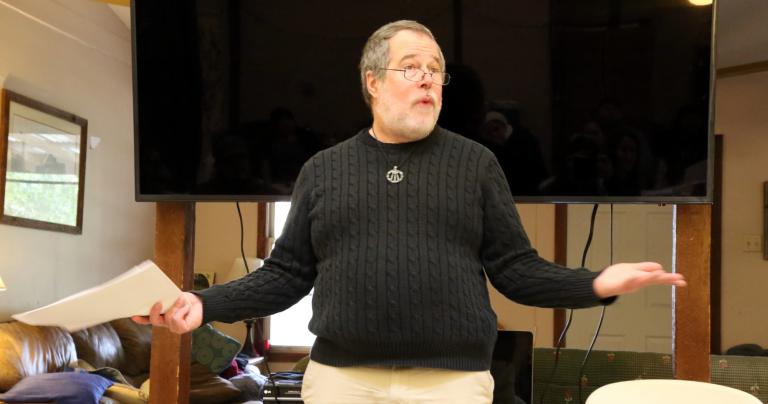
leading a workshop at the 2019 ADF Texas Imbolc Retreat
Time management
Some Pagans like to rant against the Western obsession with time. But they’re fighting the wrong battle. The problem isn’t time management – it’s feeling like we have to do so much to avoid missing out. Or in some cases, being forced to do so much to avoid poverty and homelessness. They have a valid complaint, but rejecting time management skills doesn’t fix the problem. It just takes away one of our best tools for dealing with it.
At its core, time management is simply knowing how much time a task will take, planning your day so that you have at least that much time available to work on it, and then doing it. It can’t put more hours in the day and it can’t eliminate the need to spend some of them on things like sleep and eating and doing a few seemingly-trivial things that bring you pleasure and joy.
But when it’s time to get serious, good time management practices will help you get done what you need and want to get done, whether those things are sacred or mundane.


Browse Our Archives
Select a Category Books Community CUUPS Druidry Foundations and Context Gods and Goddesses Magic Myth Nature Ritual Spiritual Practice Theology Travel Uncategorized Videos
Select a Month November 2026 October 2026 September 2026 August 2026 July 2026 June 2026 May 2026 April 2026 March 2026 February 2026 January 2026 December 2025 November 2025 October 2025 September 2025 August 2025 July 2025 June 2025 May 2025 April 2025 March 2025 February 2025 January 2025 December 2024 November 2024 October 2024 September 2024 August 2024 July 2024 June 2024 May 2024 April 2024 March 2024 February 2024 January 2024 December 2023 November 2023 October 2023 September 2023 August 2023 July 2023 June 2023 May 2023 April 2023 March 2023 February 2023 January 2023 December 2022 November 2022 October 2022 September 2022 August 2022 July 2022 June 2022 May 2022 April 2022 March 2022 February 2022 January 2022 December 2021 November 2021 October 2021 September 2021 August 2021 July 2021 June 2021 May 2021 April 2021 March 2021 February 2021 January 2021 December 2020 November 2020 October 2020 September 2020 August 2020 July 2020 June 2020 May 2020 April 2020 March 2020 February 2020 January 2020 December 2019 November 2019 October 2019 September 2019 August 2019 July 2019 June 2019 May 2019 April 2019 March 2019 February 2019 January 2019 December 2018 November 2018 October 2018 September 2018 August 2018 July 2018 June 2018 May 2018 April 2018 March 2018 February 2018 January 2018 December 2017 November 2017 October 2017 September 2017 August 2017 July 2017 June 2017 May 2017 April 2017 March 2017 February 2017 January 2017 December 2016 November 2016 October 2016 September 2016 August 2016 July 2016 June 2016 May 2016 April 2016 March 2016 February 2016 January 2016 December 2015 November 2015 October 2015 September 2015 August 2015 July 2015 June 2015 May 2015 April 2015 March 2015 February 2015 January 2015 December 2014 November 2014 October 2014 September 2014 August 2014 July 2014 June 2014 May 2014 April 2014 March 2014 February 2014 January 2014 December 2013 November 2013 October 2013 September 2013 August 2013 July 2013 June 2013 May 2013 April 2013 March 2013 February 2013 January 2013 December 2012 November 2012 October 2012 September 2012 August 2012 July 2012 June 2012 May 2012 April 2012 March 2012 February 2012 January 2012 December 2011 November 2011 October 2011 September 2011 August 2011 July 2011 June 2011 May 2011 April 2011 March 2011 February 2011 January 2011 December 2010 November 2010 October 2010 September 2010 August 2010 July 2010 June 2010 May 2010 April 2010 March 2010 February 2010 January 2010 December 2009 November 2009 October 2009 September 2009 August 2009 July 2009 June 2009 May 2009 April 2009 March 2009 February 2009 January 2009 December 2008 November 2008 October 2008 September 2008 August 2008 July 2008 June 2008
Follow Us!
TAKE THE
Religious Wisdom Quiz
Who was the first person raised from the dead by Jesus?
Select your answer to see how you score.
Widow's son Lazarus The Centurion's servant Jairus' daughter
Related posts from John Beckett

Pagans And The Rise Of The Religious Left

Why Halloween Is So Popular – And So...

The Pillar of the Boatmen: the Ancient Monument...
TRENDING AT PATHEOS Pagan

When Worry Gets You Nowhere, How Can Faith...
Sometimes, we think that by worrying, we can somehow predict the future....

The Wasp And I: Meditations on Repentance
How can we enter the power and joy of the repentant self...

Reflections on the Evangelical Theological Society
As I mentioned before, this year, for the first time since 2005,...

Demmed if it do and demmed if it...
"First Presidency Announces Salt Lake Temple Rededication Date" Apropos of that,...

Stop Making Thanksgiving Problematic And Just Give Thanks
“What if, today, we were grateful for everything?” –Charlie Brown I...

Sunday Readings: Stay Awake and Hope
The First Sunday of Advent begins a new liturgical year, and the...
view all Pagan blogs
Ad-Free & Subscriber Log-In Subscription Support
- About Us
- 2026 Calendar
- Videos
- Podcasts
- Library of World Religions
- Faith In Media Tracker
- Advertise With Us
- Write for Us
- Privacy Policy
- Terms of Service
- Do Not Sell My Data
- Contact Us
- Radiant Digital
- Manage Newsletter Subscriptions
- Unsubscribe From Notifications
- Sitemap
Copyright 2008-2026, Patheos, part of the Radiant Digital network of media brands. All rights reserved.
Subscription Support Ad-Free & Subscriber Log-In
Follow Patheos