
BuddhistCatholicContemplativeEvangelicalGeneral ChristianHinduJewishLatter-day SaintMuslimNew VisionsProgressive Christian
Beliefs
- Buddhist
- Catholic
- Contemplative
- Evangelical
- General Christian
- Hindu
- Jewish
- Latter-day Saint
- More Voices
- Muslim
- New Visions
- Pagan
- Progressive Christian
Topics
- Religion News
- Food and Religion
- Sports and Religion
- Religious Art
- Religious Music and Entertainment
- Religious Events
- History and Religion
- Style and Religion
- Politics and Religion
- Women in Religion
- Recreation Outdoors and Religion
- Business Finance and Religion
- Careers Workplace and Religion
- Education and Religion
- Family Parenting and Religion
- Health Fitness and Religion
- Home and Religion
- Relationships and Religion
- Technology and Religion
- Travel and Religion
Columnists
- Buddhist Columnists
- Business Finance and Religion Columnists
- Careers Workplace and Religion Columnists
- Catholic Columnists
- Contemplative Columnists
- Education and Religion Columnists
- Evangelists Columnists
- Family Parenting and Religion Columnists
- General Christian Columnists
- Health Fitness and Religion Columnists
- Hindu Columnists
- History and Religion Columnists
- Home and Religion Columnists
- Jewish Columnists
- More Voices Columnists
- Latter Day Columnists
- Muslim Columnists
- New Visions Columnists
- Nonreligious Columnists
- Pagan Columnists
- Politics and Religion Columnists
- Progressive Columnists
- Recreation Outdoors and Religion Columnists
- Relationships and Religion Columnists
- Religion News Columnists
- Religious Art Columnists
- Religious Events Columnists
- Religious Music and Entertainment Columnists
- Sports and Religion Columnists
- Style and Religion Columnists
- Technology and Religion Columnists
- Travel and Religion Columnists
- Women in Religion Columnists
Resource Library
- 2026 Calendar
- Library of World Religions
- The 100 Most Holy Places on Earth
- Patheos Answers
- Podcasts
- Videos
- Faith Leaders Database
- Anglican Episcopalian
- Bahai
- Baptist
- Buddhism
- Christianity
- Confucianism
- Eastern Orthodoxy
- Hinduism
- Holiness and Pentecostal
- ISKCON
- Islam
- Judaism
- Lutheran
- Methodist
- The Church of Jesus Christ of Latter-day Saints
- New Age
- Paganism
- Presbytarian and Reformed
- Protestantism
- Religion Behind the Scenes
- Roman Catholic
- Scientology
- Shia Islam
- Sikhism
- Sufism
- Sunni Islam
- Taoism
- Zen
- See all religions
Research Tools
 Ad-Free & Subscriber Log-In Subscription Support
Ad-Free & Subscriber Log-In Subscription Support
Follow Patheos 

- Trending:
- Forgiveness
- |
- Marriage
- |
- Consciousness
- |
- Death Penalty
- |
- Election
- |
- Halloween

- Home
- Pagan
- Trickster Gods, How Magic Works, Magic For Yourself, and More
Trickster Gods, How Magic Works, Magic For Yourself, and More
Last updated on: October 23, 2018 at 3:00 am by John Beckett
Trickster Gods, How Magic Works, Magic For Yourself, and More 2018-10-16T19:53:56-06:00 John Beckett
Patheos Explore the world's faith through different perspectives on religion and spirituality! Patheos has the views of the prevalent religions and spiritualities of the world.
The last two posts have addressed questions from this month’s Conversation Under the Oaks Q&A. Here are the remaining questions.
“What do you think about people blaming everything wrong or bad on Trickster Gods? Some Pagans use them the way some Christians blame everything wrong or bad on the devil instead of human error or lack of human action.”
The comparison is accurate. For the most part, it’s intellectual laziness. It’s far easier to blame bad stuff on Loki or Coyote or the devil than it is to accept that sometimes bad things happen because you make bad decisions. It’s the same thing with conspiracy theories. Some people feel better believing the world is run by a cabal of evil geniuses than to accept that no one is in charge and we’re on our own.
Which is not to say that there aren’t evil people conspiring to do evil things – there are. But they aren’t pulling all the strings.
But also, this attitude is disrespectful to Trickster Gods. They aren’t evil. I love order, but without chaos the world would stagnate. In many traditions, it is a trickster who gives humanity fire, or magic, or even language. They know we can’t possibly use it without burning ourselves, literally or figuratively. And that provides them with amusement.
But in our failures, we learn. And then we grow.
So accept responsibility for your own mistakes. Blame human greed and fear for building oppressive systems, not deities you don’t like. And give thanks for the opportunities that come with chaos.
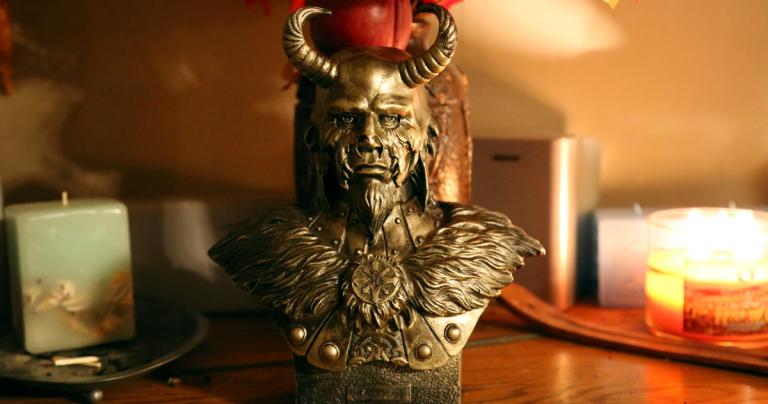
Loki
“What is the nature of Trickster deities and why might one wish to serve them or avoid them?”
I’ve never had a Trickster question before, and now I get two from two different people. Apparently October is Trickster month.
I can’t really speak to the nature of Trickster deities. I can speak to their area of responsibility, which is to keep us from getting too comfortable and too set in our ways. I don’t think they’re having fun at our expense so much as they’re really dedicated to their work and they really enjoy it.
I have a strong preference for order, and so I avoid Trickster Gods. A few years I told Loki “NO!” in no uncertain terms. He accepted my answer, although I had some backup to help (“this one is ours and we’re keeping him plenty busy”).
But that’s me. If you like chaos and the opportunities it brings, you might enjoy serving or working with one.
“How can a solitary with no established practice beat fear and reach out to the universe / gods / goddesses and believe that they are worthy of true connection to them?”
The short answer is to establish a regular spiritual practice. Make a choice. Build a foundation of reason and experience. Begin a devotional practice. And keep it up.
If you have religious trauma in your background, you will need to address it sooner rather than later. In 2015 I wrote Escaping Fundamentalism. It was geared toward people who grew up in a Christian fundamentalist environment, but the steps are the same whether you’re trying to move on from conservative Catholicism, aggressive atheism, or simply your own doubts and fears.
This takes time. If you’re young and grew up in a religiously neutral environment, it can take months. If you’re older, or if you have significant negative religious experiences in your background, it can take years.
But the best time to start is now. Speaking for myself, it has been – and remains – a ton of work. But it’s worth it a million times over.

“How does one welcome change that is at so deep a level that we have no conscious control over the outcome?”
This question – at least as I read it – has a strong Buddhist assumption behind it. Namely, that quiet equanimity is the proper response to all change. I’m a Pagan, not a Buddhist. Sometime welcoming acceptance is the best response to deep change. Other times the best response is determined and even violent opposition. The trick is knowing which approach to use in which situation.
A few years ago I came up with what I call the Willow Pentagram – five steps to deal with changes we find challenging.
- First, do no harm.
- Feel what you feel.
- Accept what is.
- Do what must be done.
- Return to center.
For example, I welcome the experience and perspective that comes with getting old. I do not welcome the declining physical capabilities. But I accept that they are, and I’m learning to deal with them.
“How does magic work, if it can be explained?”
Countless volumes have been written about magic over the centuries, but the vast majority of it has been from the perspective of “how do I do it?” not “how does it work?” If it works, does it really matter how? But in our modern materialist world, if something can’t be explained “rationally” then we assume it can’t exist, even if it’s staring us right in the face.
Still, that’s the environment in which we work. And I am an engineer – I want to know how everything works. I’ve thought about this a lot… probably more than I should.
I have a three-fold model for how magic works. Sometimes it works by the manipulation of unseen forces. Sometimes it works by the intercession of Gods and spirits. Sometimes it works by psychological programming. And sometimes it works by a combination of two or all three of those means.
Alternatively Dr. Dean Radin has proposed that magic works because consciousness is fundamental.
Will we ever know exactly how magic works in the same way we know how electricity works? Probably not. Then again, how many of us really understand electricity? But we keep on using it anyway.

“Is magic effective if someone else performs a working on one’s behalf (even if that person does not know you and does it as a commercial service), or must magic always be done by oneself to be effective?”
Interesting question. I usually hear people claim the opposite, that magic worked for yourself will never be effective. I don’t think either of those are true. Magic is magic. If it’s done well, it works. If it’s done poorly, it doesn’t.
The advantage of doing magic for yourself is that you can keep doing it over and over again, taking a step by step progressive approach.
The advantage of hiring a magical professional is that they’re likely to have expertise you don’t, and they can bring an objectivity to the working that you’re can’t, because you’re too close to the situation.
Choose the right approach for your situation.
“What is the relationship between Nature and the Gods? And between the Gods and the cosmic order?”
I think you’re probably asking an ontological question that would be better posed to a philosopher than to a Druid and priest. But you asked me, so…
As I see it, Gods are the mightiest of beings, but They are beings, not being itself. They participate in being itself, as do humans, as do all living things.
Some Gods are the personification of natural forces. Others aren’t. Some Gods help maintain the cosmic order. Others disrupt it.
Did the Gods always exist? Can They die? Did They create the universe in which we live? I don’t know, and I don’t think much about these questions – they have little impact in my mundane life or in my spiritual life.
But they can be fun to contemplate. Just bring whiskey.
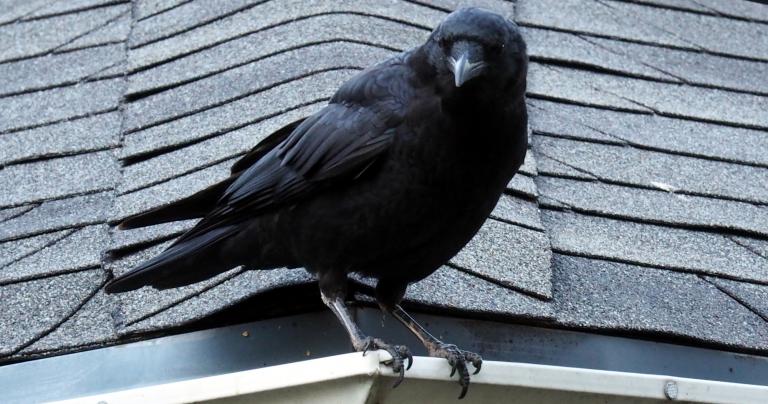
Candy Wilcox McKinney asks “Most Pagans believe in being able to call upon the ancestors, to honor them and be helped by them. Also a lot of us believe in reincarnation as part of the great circle of life, death, and rebirth. I’ve always wondered how the spirit of my ancestor can be in the Otherworld and be already reincarnated at the same time. Or once they have been reincarnated will their presence in the Otherworld cease to exist?”
This is another deep question with no easy answers.
We know that time runs differently in the Otherworld than in this world. Perhaps it also runs on parallel tracks, so that a person can simultaneously be alive in this world and also in the Otherworld. I’m not particularly fond of that idea, but it’s possible.
I tend to think that we usually spend more time (by this-world standards, anyway) in between lives than living in this world. So when we call on our ancestors, the odds are good they’re there and not here. By the time they’re ready to be reincarnated, everyone who knew them has joined them in the Otherworld.
But this is all speculation. As with the question above, it can be fun to contemplate, but it doesn’t have much impact on my day to day practice. I honor my ancestors and I call the names of those I know. And some of them respond.
Previous Post

October 21, 2018
Called by Problematic Gods
Next Post

October 25, 2018 Rethinking the Big Tent of Paganism
Browse Our Archives
Select a Category Books Community CUUPS Druidry Foundations and Context Gods and Goddesses Magic Myth Nature Ritual Spiritual Practice Theology Travel Uncategorized Videos
Select a Month October 2026 September 2026 August 2026 July 2026 June 2026 May 2026 April 2026 March 2026 February 2026 January 2026 December 2025 November 2025 October 2025 September 2025 August 2025 July 2025 June 2025 May 2025 April 2025 March 2025 February 2025 January 2025 December 2024 November 2024 October 2024 September 2024 August 2024 July 2024 June 2024 May 2024 April 2024 March 2024 February 2024 January 2024 December 2023 November 2023 October 2023 September 2023 August 2023 July 2023 June 2023 May 2023 April 2023 March 2023 February 2023 January 2023 December 2022 November 2022 October 2022 September 2022 August 2022 July 2022 June 2022 May 2022 April 2022 March 2022 February 2022 January 2022 December 2021 November 2021 October 2021 September 2021 August 2021 July 2021 June 2021 May 2021 April 2021 March 2021 February 2021 January 2021 December 2020 November 2020 October 2020 September 2020 August 2020 July 2020 June 2020 May 2020 April 2020 March 2020 February 2020 January 2020 December 2019 November 2019 October 2019 September 2019 August 2019 July 2019 June 2019 May 2019 April 2019 March 2019 February 2019 January 2019 December 2018 November 2018 October 2018 September 2018 August 2018 July 2018 June 2018 May 2018 April 2018 March 2018 February 2018 January 2018 December 2017 November 2017 October 2017 September 2017 August 2017 July 2017 June 2017 May 2017 April 2017 March 2017 February 2017 January 2017 December 2016 November 2016 October 2016 September 2016 August 2016 July 2016 June 2016 May 2016 April 2016 March 2016 February 2016 January 2016 December 2015 November 2015 October 2015 September 2015 August 2015 July 2015 June 2015 May 2015 April 2015 March 2015 February 2015 January 2015 December 2014 November 2014 October 2014 September 2014 August 2014 July 2014 June 2014 May 2014 April 2014 March 2014 February 2014 January 2014 December 2013 November 2013 October 2013 September 2013 August 2013 July 2013 June 2013 May 2013 April 2013 March 2013 February 2013 January 2013 December 2012 November 2012 October 2012 September 2012 August 2012 July 2012 June 2012 May 2012 April 2012 March 2012 February 2012 January 2012 December 2011 November 2011 October 2011 September 2011 August 2011 July 2011 June 2011 May 2011 April 2011 March 2011 February 2011 January 2011 December 2010 November 2010 October 2010 September 2010 August 2010 July 2010 June 2010 May 2010 April 2010 March 2010 February 2010 January 2010 December 2009 November 2009 October 2009 September 2009 August 2009 July 2009 June 2009 May 2009 April 2009 March 2009 February 2009 January 2009 December 2008 November 2008 October 2008 September 2008 August 2008 July 2008 June 2008
Follow Us!
TAKE THE
Religious Wisdom Quiz
Which book of the Bible contains the story of Gideon?
Select your answer to see how you score.
2 Kings Joshua Judges 1 Samuel
Related posts from John Beckett




What We Lose When “Ask AI” Becomes A...
TRENDING AT PATHEOS Pagan

Nearly every morning, I make the drive to Detroit with my high-school-age...

The Real AI Story Is Adoption Without Trust
Artificial intelligence has crossed a political threshold. It is no longer a...

A new article, written by Jeff Lindsay and Gale L. Pooley,...

Swimfan: Forgotten Aughts Pleasures
This is a recovery effort. In 2002, My Big Fat Greek Wedding...

Top Three Anti-Catholic Lies About Catholicism
This is my initial transcript for the video, "THE 3 WORST...

Pope Leo Celebrates Mass for Nurses & Docs...
I don't have any idea how he did it, but Pope Leo...
view all Pagan blogs
Ad-Free & Subscriber Log-In Subscription Support
- About Us
- 2026 Calendar
- Videos
- Podcasts
- Library of World Religions
- Faith In Media Tracker
- Advertise With Us
- Write for Us
- Privacy Policy
- Terms of Service
- Do Not Sell My Data
- Contact Us
- Radiant Digital
- Manage Newsletter Subscriptions
- Unsubscribe From Notifications
- Sitemap
Copyright 2008-2026, Patheos. All rights reserved.
Subscription Support Ad-Free & Subscriber Log-In
Follow Patheos