
BuddhistCatholicContemplativeEvangelicalGeneral ChristianHinduJewishLatter-day SaintMuslimNew VisionsProgressive Christian
Beliefs
- Buddhist
- Catholic
- Contemplative
- Evangelical
- General Christian
- Hindu
- Jewish
- Latter-day Saint
- More Voices
- Muslim
- New Visions
- Pagan
- Progressive Christian
Topics
- Religion News
- Food and Religion
- Sports and Religion
- Religious Art
- Religious Music and Entertainment
- Religious Events
- History and Religion
- Style and Religion
- Politics and Religion
- Women in Religion
- Recreation Outdoors and Religion
- Business Finance and Religion
- Careers Workplace and Religion
- Education and Religion
- Family Parenting and Religion
- Health Fitness and Religion
- Home and Religion
- Relationships and Religion
- Technology and Religion
- Travel and Religion
Columnists
- Buddhist Columnists
- Business Finance and Religion Columnists
- Careers Workplace and Religion Columnists
- Catholic Columnists
- Contemplative Columnists
- Education and Religion Columnists
- Evangelists Columnists
- Family Parenting and Religion Columnists
- General Christian Columnists
- Health Fitness and Religion Columnists
- Hindu Columnists
- History and Religion Columnists
- Home and Religion Columnists
- Jewish Columnists
- More Voices Columnists
- Latter Day Columnists
- Muslim Columnists
- New Visions Columnists
- Nonreligious Columnists
- Pagan Columnists
- Politics and Religion Columnists
- Progressive Columnists
- Recreation Outdoors and Religion Columnists
- Relationships and Religion Columnists
- Religion News Columnists
- Religious Art Columnists
- Religious Events Columnists
- Religious Music and Entertainment Columnists
- Sports and Religion Columnists
- Style and Religion Columnists
- Technology and Religion Columnists
- Travel and Religion Columnists
- Women in Religion Columnists
Resource Library
- 2026 Calendar
- Library of World Religions
- The 100 Most Holy Places on Earth
- Patheos Answers
- Podcasts
- Videos
- Faith Leaders Database
- Anglican Episcopalian
- Bahai
- Baptist
- Buddhism
- Christianity
- Confucianism
- Eastern Orthodoxy
- Hinduism
- Holiness and Pentecostal
- ISKCON
- Islam
- Judaism
- Lutheran
- Methodist
- The Church of Jesus Christ of Latter-day Saints
- New Age
- Paganism
- Presbytarian and Reformed
- Protestantism
- Religion Behind the Scenes
- Roman Catholic
- Scientology
- Shia Islam
- Sikhism
- Sufism
- Sunni Islam
- Taoism
- Zen
- See all religions
Research Tools
 Ad-Free & Subscriber Log-In Subscription Support
Follow Patheos 

- Trending:
- Advent
- |
- Forgiveness
- |
- Thanksgiving
- |
- Election
- |
- Seasonal Holidays
- |
- Marriage

- Home
- Pagan
- Animal Gods and Gods of the Animals
Animal Gods and Gods of the Animals
Last updated on: September 23, 2018 at 3:00 am by John Beckett
Animal Gods and Gods of the Animals 2018-09-14T20:43:31-06:00 John Beckett
Patheos Explore the world's faith through different perspectives on religion and spirituality! Patheos has the views of the prevalent religions and spiritualities of the world.
The ancient Greek philosopher Xenophanes said:
But if cattle and horses and lions had hands or could paint with their hands and create works such as men do, horses like horses and cattle like cattle also would depict the Gods’ shapes and make their bodies of such a sort as the form they themselves have.
We still tend to assume the Gods look like us. And we often assume They think like us. In our time, Christian writer Anne Lamott said:
You can safely assume you’ve created God in your own image when it turns out that God hates all the same people you do.
Yet as polytheists, we recognize that this isn’t always true. Some of our Gods are not in our image.
It’s most evident in Egypt, where many of the deities have the heads of non-human animals. Horus is depicted as a falcon, or as a man with the head of a falcon. Thoth has the head of an ibis, Anubis the head of a jackal, and Sekhmet the head of a lioness.
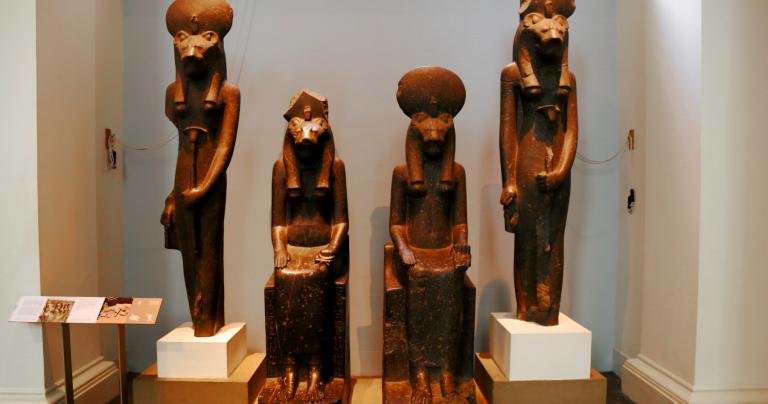
Sekhmet – The British Museum
The Babylonian Goddess Tiamat is usually depicted as a sea serpent.
Some of the European traditions have horned or antlered Gods, such as Pan or Cernunnos. And while the Morrigan is most often depicted as a human woman, She shapeshifts into a cow, an eel, a wolf, and a crow.
The typical academic explanation for these representations is that the artists wanted to illustrate how a particular deity has the characteristics of a particular animal: Sekhmet is fierce and Anubis cleans up the dead. There is almost certainly an aspect of reciprocity (and of sympathetic magic) in the depiction of Gods as animals who are hunted – if we honor the Stag God, He will bring the stags to our hunt. There is some truth to these explanations.
One thing is certain: the true forms of the Gods are beyond our knowledge, and likely beyond our ability to know. Which is the main point Xenophanes was trying to make, unlike those who’ve appropriated him as some sort of proto-monotheist.
Yet as polytheists who worship the not-entirely-human Gods as real, distinct, individual beings, there is another possible explanation: these are the forms in which They have chosen to reveal Themselves. If that’s the case – and I believe it is – what does that say to us?
Our Gods are their Gods too
One of Cernunnos’ epithets is Lord of the Animals. This is a modern epithet – we know virtually nothing about how He was understood and worshipped in ancient times. Still, given the cave painting The Sorcerer in the Cave of the Trois-Frères in France (from around 13,000 BCE), the artwork of the Gundestrup Cauldron (from around 100 BCE), and the numerous reports of contemporary UPG (including my own), that title seems both reasonable and appropriate.
The Lord of the Animals does not merely deliver animals to humans to be used as food. He both rules over the generative forces of Nature and personifies them (remember that there are both human persons and other-than-human persons). He is the God of all persons, not just humans.

I do not believe other animals worship the Gods as we do, as is sometimes depicted in “First Christmas” stories of animals worshipping the baby Jesus. That’s too much anthropomorphization for my tastes. Though, I wouldn’t be surprised to discover that some species do, such as dolphins, elephants, and corvids. But if a God has responsibility for a particular aspect of Nature, it stands to reason that They will have a relationship with the persons that comprise that aspect – and those persons will have a relationship with Them.
We do not have exclusive relationships with our Gods. The Gods of humans are the Gods of other species as well.
It’s not all about us!
If our Gods are their Gods too, we have no reason to expect Them to preference us above the rabbits and squirrels, or above the wolves and bears.
Christianity argues for Imago Dei – that humans alone are made in the image of their God. Yet other than the combination of language and opposable thumbs, what do we have that other species do not? We share 96% of our DNA with chimps and bonobos, who are more closely related to us than they are to gorillas. We are the most powerful species on this planet – whether we are the wisest is another question altogether. Our power – that we often abuse – entitles us to no special favors from the Gods.
That the Gods devote attention to us reminds us that we are important to Them, and that we can form relationships with Them that are mutually respectful and mutually beneficial. But let us never be so arrogant as to believe we are their sole or even their primary concern.

But beware your unexamined guilt
I regularly come across comments from Pagans that say things like “humans are an infection on the Earth that must be wiped out!” Now, I understand and appreciate the damage our species has done to the Earth. There have been five mass extinctions in the history of our planet. We’re in the middle of the sixth and unlike the first five this one is almost entirely due to human activity. There are significant changes we need to make, some at the individual level and many more at the societal level.
But each and every one of the seven and a half billion people alive today are persons of inherent value and worth who, whatever their sins, do not deserve death and extinction. When I hear people wishing our species would die off, what I really hear is “it’s easier to wish death on billions of people than to work through my Catholic and/or Calvinist guilt, which I’m not really aware of, because self-reflection is hard and scary.”
You don’t get off that easy. We don’t get off that easy. We’ve made a mess of things, and we’re going to have to clean it up. The sooner we get started, the sooner it will be done.
Not the head and not the center, but a part
We are not the center of the universe. We are not its head. We are not even the favorite children of the Gods.
Rather, we are one part of the living world. We are the biological relatives of every species on this planet, and we are the spiritual relatives of every person in every realm. Our part is important and valued and sacred. And so is every other part.
Praise be to the Animal Gods and to the Gods of the Animals!
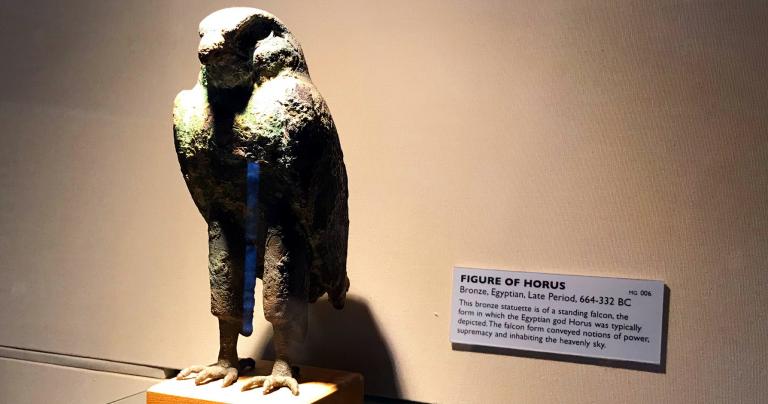
Horus – The Hunt Museum – Limerick, Ireland
Thanks to Rynn Fox for inspiring this post in private conversation.
Thanks to Dr. Edward Butler for the Xenophanes references that clearly show he was a critically thinking polytheist, not a proto-monotheist.

Next Post

September 25, 2018 Everything Is Important But Everything Can’t Be First
Browse Our Archives
Select a Category Books Community CUUPS Druidry Foundations and Context Gods and Goddesses Magic Myth Nature Ritual Spiritual Practice Theology Travel Uncategorized Videos
Select a Month November 2026 October 2026 September 2026 August 2026 July 2026 June 2026 May 2026 April 2026 March 2026 February 2026 January 2026 December 2025 November 2025 October 2025 September 2025 August 2025 July 2025 June 2025 May 2025 April 2025 March 2025 February 2025 January 2025 December 2024 November 2024 October 2024 September 2024 August 2024 July 2024 June 2024 May 2024 April 2024 March 2024 February 2024 January 2024 December 2023 November 2023 October 2023 September 2023 August 2023 July 2023 June 2023 May 2023 April 2023 March 2023 February 2023 January 2023 December 2022 November 2022 October 2022 September 2022 August 2022 July 2022 June 2022 May 2022 April 2022 March 2022 February 2022 January 2022 December 2021 November 2021 October 2021 September 2021 August 2021 July 2021 June 2021 May 2021 April 2021 March 2021 February 2021 January 2021 December 2020 November 2020 October 2020 September 2020 August 2020 July 2020 June 2020 May 2020 April 2020 March 2020 February 2020 January 2020 December 2019 November 2019 October 2019 September 2019 August 2019 July 2019 June 2019 May 2019 April 2019 March 2019 February 2019 January 2019 December 2018 November 2018 October 2018 September 2018 August 2018 July 2018 June 2018 May 2018 April 2018 March 2018 February 2018 January 2018 December 2017 November 2017 October 2017 September 2017 August 2017 July 2017 June 2017 May 2017 April 2017 March 2017 February 2017 January 2017 December 2016 November 2016 October 2016 September 2016 August 2016 July 2016 June 2016 May 2016 April 2016 March 2016 February 2016 January 2016 December 2015 November 2015 October 2015 September 2015 August 2015 July 2015 June 2015 May 2015 April 2015 March 2015 February 2015 January 2015 December 2014 November 2014 October 2014 September 2014 August 2014 July 2014 June 2014 May 2014 April 2014 March 2014 February 2014 January 2014 December 2013 November 2013 October 2013 September 2013 August 2013 July 2013 June 2013 May 2013 April 2013 March 2013 February 2013 January 2013 December 2012 November 2012 October 2012 September 2012 August 2012 July 2012 June 2012 May 2012 April 2012 March 2012 February 2012 January 2012 December 2011 November 2011 October 2011 September 2011 August 2011 July 2011 June 2011 May 2011 April 2011 March 2011 February 2011 January 2011 December 2010 November 2010 October 2010 September 2010 August 2010 July 2010 June 2010 May 2010 April 2010 March 2010 February 2010 January 2010 December 2009 November 2009 October 2009 September 2009 August 2009 July 2009 June 2009 May 2009 April 2009 March 2009 February 2009 January 2009 December 2008 November 2008 October 2008 September 2008 August 2008 July 2008 June 2008
Follow Us!
TAKE THE
Religious Wisdom Quiz
What does "apostle" literally mean in Greek?
Select your answer to see how you score.
Sent one Writer Leader Friend
Related posts from John Beckett

Pagans And The Rise Of The Religious Left

Why Halloween Is So Popular – And So...
The Pillar of the Boatmen: the Ancient Monument...

TRENDING AT PATHEOS Pagan

Chapter 5, Sarah: The Quest for Safety in...
Open and Relational Theology & Social Psychology About this series: This series...

When Worry Gets You Nowhere, How Can Faith...
Sometimes, we think that by worrying, we can somehow predict the future....

The Wasp And I: Meditations on Repentance
How can we enter the power and joy of the repentant self...

Reflections on the Evangelical Theological Society
As I mentioned before, this year, for the first time since 2005,...

Demmed if it do and demmed if it...
"First Presidency Announces Salt Lake Temple Rededication Date" Apropos of that,...

Stop Making Thanksgiving Problematic And Just Give Thanks
“What if, today, we were grateful for everything?” –Charlie Brown I...
view all Pagan blogs
Ad-Free & Subscriber Log-In Subscription Support
- About Us
- 2026 Calendar
- Videos
- Podcasts
- Library of World Religions
- Faith In Media Tracker
- Advertise With Us
- Write for Us
- Privacy Policy
- Terms of Service
- Do Not Sell My Data
- Contact Us
- Radiant Digital
- Manage Newsletter Subscriptions
- Unsubscribe From Notifications
- Sitemap
Copyright 2008-2026, Patheos, part of the Radiant Digital network of media brands. All rights reserved.
Subscription Support Ad-Free & Subscriber Log-In
Follow Patheos