
BuddhistCatholicContemplativeEvangelicalGeneral ChristianHinduJewishLatter-day SaintMuslimNew VisionsProgressive Christian
Beliefs
- Buddhist
- Catholic
- Contemplative
- Evangelical
- General Christian
- Hindu
- Jewish
- Latter-day Saint
- More Voices
- Muslim
- New Visions
- Pagan
- Progressive Christian
Topics
- Religion News
- Food and Religion
- Sports and Religion
- Religious Art
- Religious Music and Entertainment
- Religious Events
- History and Religion
- Style and Religion
- Politics and Religion
- Women in Religion
- Recreation Outdoors and Religion
- Business Finance and Religion
- Careers Workplace and Religion
- Education and Religion
- Family Parenting and Religion
- Health Fitness and Religion
- Home and Religion
- Relationships and Religion
- Technology and Religion
- Travel and Religion
Columnists
- Buddhist Columnists
- Business Finance and Religion Columnists
- Careers Workplace and Religion Columnists
- Catholic Columnists
- Contemplative Columnists
- Education and Religion Columnists
- Evangelists Columnists
- Family Parenting and Religion Columnists
- General Christian Columnists
- Health Fitness and Religion Columnists
- Hindu Columnists
- History and Religion Columnists
- Home and Religion Columnists
- Jewish Columnists
- More Voices Columnists
- Latter Day Columnists
- Muslim Columnists
- New Visions Columnists
- Nonreligious Columnists
- Pagan Columnists
- Politics and Religion Columnists
- Progressive Columnists
- Recreation Outdoors and Religion Columnists
- Relationships and Religion Columnists
- Religion News Columnists
- Religious Art Columnists
- Religious Events Columnists
- Religious Music and Entertainment Columnists
- Sports and Religion Columnists
- Style and Religion Columnists
- Technology and Religion Columnists
- Travel and Religion Columnists
- Women in Religion Columnists
Resource Library
- 2026 Calendar
- Library of World Religions
- The 100 Most Holy Places on Earth
- Patheos Answers
- Podcasts
- Videos
- Faith Leaders Database
- Anglican Episcopalian
- Bahai
- Baptist
- Buddhism
- Christianity
- Confucianism
- Eastern Orthodoxy
- Hinduism
- Holiness and Pentecostal
- ISKCON
- Islam
- Judaism
- Lutheran
- Methodist
- The Church of Jesus Christ of Latter-day Saints
- New Age
- Paganism
- Presbytarian and Reformed
- Protestantism
- Religion Behind the Scenes
- Roman Catholic
- Scientology
- Shia Islam
- Sikhism
- Sufism
- Sunni Islam
- Taoism
- Zen
- See all religions
Research Tools
 Ad-Free & Subscriber Log-In Subscription Support
Ad-Free & Subscriber Log-In Subscription Support
Follow Patheos 

- Trending:
- Forgiveness
- |
- Marriage
- |
- Consciousness
- |
- Death Penalty
- |
- Election
- |
- Halloween

- Home
- Pagan
- Becoming Invincible: Overcoming Fear Through Reason and Experience
Becoming Invincible: Overcoming Fear Through Reason and Experience
Last updated on: August 12, 2018 at 1:49 pm by John Beckett
Becoming Invincible: Overcoming Fear Through Reason and Experience 2018-08-12T13:49:54-06:00 John Beckett
Patheos Explore the world's faith through different perspectives on religion and spirituality! Patheos has the views of the prevalent religions and spiritualities of the world.
The Denton Unitarian Universalist Fellowship
August 12, 2018
“Fear is the path to the dark side. Fear leads to anger… anger leads to hate… hate leads to suffering.”
So said the great philosopher Master Yoda. I’m a Pagan and not a Jedi, and I’m leery of Hollywood wisdom, but there is much truth in that saying. Sooner or later, fear leads to suffering.
We live in fearful times. I won’t torture you with a litany of all the political, economic, social, and environmental challenges that have us anxious – that could keep us here all day.
And as if we didn’t have enough real problems to worry about, political consultants have figured out that if they can make us afraid, we’ll vote for candidates who promise to take care of us, even if all they promise is something as vague as “make American great again.”
Meanwhile, advertisers make us afraid of smelling bad, driving an unfashionable car, and the worst sin of all, getting old. They count on our fears to make us buy what they’re selling.
On the other side, there are people who spout a lot of naïve psychobabble about fear. They say F-E-A-R stands for “False Evidence Appearing Real.” They claim fear is only an illusion, they attempt to shame those who are afraid, and they offer clichéd solutions with no more power than a plastic charm made by a fictional witch.
Sometimes fear is rational. Other times it’s not. Most times it’s a little of both, and that makes it really complicated.
I’ve walked confidently into situations that would send most people into panic attacks. And I’ve broken down in fits of crying terror over possibilities so remote no reasonable person should care. If fear is complicated, our responses to fear are impossibly complex.
But if I’ve learned anything about fears, it’s that examining them and thinking about them and talking about them can be very helpful. So this morning I want to explore the nature of fear and fears and see where it takes us. I don’t just want us to overcome our fears. I want us to become invincible.

Fear can be useful
To start with, let’s understand that fear can be useful. Most of us have a fear of spiders and snakes, to one degree or another. While most spiders and snakes are not poisonous, some can be deadly, and the bites of those who aren’t are still quite painful. Humans have an evolutionary fear of spiders and snakes, a fear shared by our primate relatives like chimps and gorillas. That means it’s several million years old.
And it’s effective. Our fear helps us recognize real risks so we can avoid them.
Useful fear is a beginning, not an end. We’re afraid of spiders and snakes and so we stay away from them, but we may have a need to go into areas where we’re likely to encounter them. And sometimes they just show up, seemingly out of nowhere. So if we are wise, we are motivated to learn about the objects of our fears.
Which snakes are venomous and which aren’t? In which locations and at what times of day are they likely to be found? How can they be handled safely? And what are the countermeasures if, despite our best efforts, we’re bitten by a rattlesnake?
Fear can motivate us to learn, and learning reduces our fears.
But not all fears can be managed so simply and reasonably.
Fear of the unknown
In his non-fiction book Danse Macabre, horror writer Stephen King explained how not showing the monster is scarier than letting it be seen:
After mounting apprehension about the fear we are about to confront, somebody eventually has to respond to the scratching sound at the door and throw it open — only to reveal, before our terrified eyes … a ten-foot-bug!
And no sooner do we register that fear – hairs standing erect on our necks, gooseflesh crawling up our arms – than we begin assessing and processing it; in an instant, an equal-and-opposite reaction sets in, tinged with disappointment: “Oh,” we think. “A ten-foot bug. That I can deal with. I was afraid it was going to be a hundred-foot bug!”
The imagination is a powerful thing. It lets us see things that have never existed, so we can make them real. Every technological invention and every work of art began as an act of imagination. Our imagination magnifies our possibilities.
Our imagination can also take an unknown and create a seemingly infinite number of possible outcomes, most of which are unlikely and none of which are pleasant.
And there is no bigger unknown than death, and what comes afterwards.

Overcoming the fear of death
I’ll be honest – I’ve never really feared death. I went to a lot of funerals as a small child. It was presented in a rather matter-of-fact manner: people got old, they got sick, and they died. Sometimes something bad happened and they died before they got old. But good people went to heaven when they died and we didn’t know any bad people. By the time I started questioning the religious assumptions behind that concept, the idea of death as a natural transition was firmly fixed in my mind.
But the thought of dying a bad death has always scared me. Good Friday sermons on crucifixion. Horror movies with medieval tortures. And worse – because it’s all too possible – the kind of lingering, painful deaths we inflict on our loved ones with medical treatment after medical treatment designed to prolong life by a few more weeks, because we’re afraid to let them go.
Logic and reason can dispel the fears of dying like Mel Gibson in Braveheart – short of falling into the hands of Daesh (the terrorist group that likes to call themselves the Islamic State) it’s not going to happen. For the things that are realistically possible, I have an advance medical directive, with copies in the hands of those who would be called on to make decisions for me if I’m incapacitated. And I support death with dignity and physician assisted suicide laws. I hope to live to a ripe old age, but I’d rather die early than die badly.
Mark Twain said “I do not fear death. I had been dead for billions and billions of years before I was born, and had not suffered the slightest inconvenience from it.”
This we know – all that lives will someday die. It’s happened to everyone who came before us, and it will happen to everyone who comes after us. Death is universal – can it really be all that bad?
Overcoming the fear of a bad afterlife
Death is certain, but what comes after death is the biggest unknown of all. Different religions have radically different ideas about the afterlife, and many of them are decidedly unpleasant. The Egyptians promised a place with Ra in the Boat of a Million Years for those whose hearts are as light as a feather, but oblivion for everyone else. The Greeks (or at least, some of them) offered the Elysian Fields for heroes, but a rather dull afterlife for the masses, and torments in Tartarus for those who particularly offended the Gods.
I grew up Baptist – it is impossible to listen to hellfire and brimstone sermons week after week, year after year, and not be afraid of ending up in hell.
My journey out of fundamentalism is its own story. Rejecting the false premises of fundamentalism with evidence and reason was the start. Reading books from different religions and talking to different practitioners teaches us that there are many possible afterlifes. Do they all exist? Do any of them exist? I don’t know. But I do know that after studying the traditional afterlifes of the Egyptians, Greeks, Celts, and Norse – and for that matter, of universalist and other progressive Christians – the certainty of fundamentalists seems rather silly.
Still, this was only a start. Stories, concepts, and experiences from early childhood have deep tentacles that do not let go easily. Reason alone was never enough to rid me of the fear of hell. I could not remove those beliefs – I had to crowd them out with something better.
In 2003 I participated in my first Pagan initiation. Initiations are traditional in many forms of Paganism – I was certain this was the path for me and I wanted a ceremony to confirm that choice. The group I was working with set a date and began to make preparations.
In the weeks leading up to the initiation, I kept channel-surfing onto TV preachers talking about how everybody but them was going to hell. It sounded like a call to turn back. I knew this was what I wanted to do and I knew it was what I needed to do, but I was afraid.
In some traditional initiations, the candidate is challenged at knife-point with these words: “You who would cross the boundary between the worlds, have you the courage to face the tests which will be required? For I tell you, it is better to throw yourself upon this sacred blade and perish now than to attempt the trials with fear in your heart.”
Well that’s rather dramatic! But the real challenge isn’t to enter the circle with no fear. The real challenge is to move forward boldly in spite of your fears.
My desire for initiation was greater than my fear. I entered the circle. The details of that ritual are oath-bound and I will continue to honor that oath. But I can say that after all the oaths and object lessons there was a formal investiture. The priestess became a conduit for something magical, and at that point I experienced something I had never felt before.
And it felt right. My fear of hell and the angry old man in the sky was silent and it wasn’t noticed by its absence. All that was there was the call of the Gods and of Nature, a call I continue answering to this day.
I do not suggest that Pagan initiation is a universal cure for the fear of a bad afterlife. This was my journey – yours will be different. What’s important is that a positive religious experience crowded out the years of negative religious experiences. Reason provided the foundation, but experience made it real.
Dealing with the fear of ordinary hardship
We can debate what is or isn’t coming after death, but we can be sure that life will bring its share of ordinary hardships. We all encounter them, though they’re never distributed evenly or fairly.
Our Buddhist friends have an answer for this: let go of your desires and simply accept what is. I have tremendous respect for Buddhism, but I’m a Pagan. I’ll take the hardships of life in order to enjoy its beauties and pleasures.
If we know hardships are likely to occur, it makes sense to prepare for them. I do not expect to have a car wreck, but I still maintain auto insurance. We can try to avoid hardships: don’t smoke, drink in moderation, and wash your hands regularly.
More importantly, have confidence in your ability to deal with the ordinary hardships that come your way. Humans are resilient creatures. We can overcome pain and suffering, sickness and loss. You don’t know what you can handle until you have to handle it.
This can be problematic, especially when we’re talking to other people. You know, “pull yourself up by your bootstraps” or “take some personal responsibility!” How about we have a bit of compassion and exercise a bit of reason. The fact that you overcame your ordinary hardships doesn’t mean someone else can do the same, particularly if they’re playing at a higher level of difficulty due to systematic racism, sexism, and other forms of discrimination.
But what is unworkable as a universal solution can be quite helpful for individuals. No one has more of an impact on your life than you. Dealing with your hardships not only makes them better, it increases your confidence that you can deal with whatever comes next.
Ralph Waldo Emerson said “Do not be too timid and squeamish about your actions. All life is an experiment. The more experiments you make the better. What if they are a little coarse and you may get your coat soiled or torn? What if you do fail, and get fairly rolled in the dirt once or twice? Up again, you shall never be so afraid of a tumble.”
Drawing on our ancestors
Ancestor veneration is a nearly universal human impulse. Some religions place great emphasis on it and some place less, but walk into the homes your least religious friends and you’ll see pictures of grandparents and great grandparents, and mementos of all descriptions. It’s intuitive that we should remember and honor those who came before us.
We UUs like to say “that which is remembered, lives.” Whatever you believe or don’t believe about an afterlife, when we remember our ancestors, they live on in us. This is a good and holy thing.
But there are also practical benefits to honoring our ancestors. We are the descendants of people who survived wars, famines, and plagues. Our earlier ancestors survived an ice age.
And they didn’t just survive. They lived, and loved, and they built homes and traditions that made their way down to us. Because they lived, we are.
There’s a t-shirt I see occasionally at Pagan gatherings – it says “we’re the daughters of the witches you couldn’t burn.” Whether that’s historically true or not is irrelevant. It’s a reminder that our ancestors survived and succeeded during times that were at least as challenging as anything we face. We are their children – what they did, we can do too.
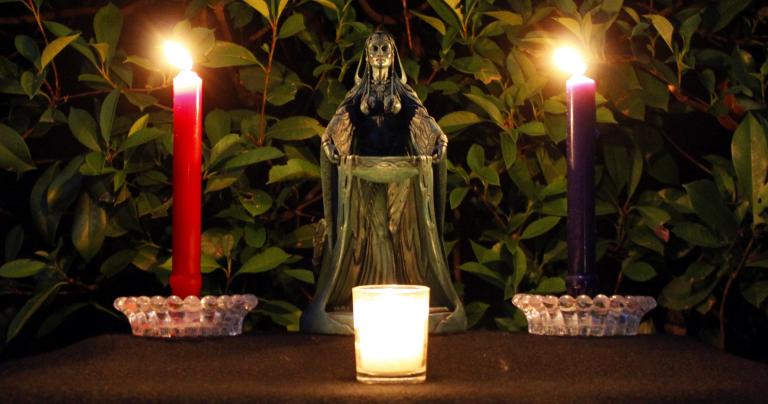
As with all spiritual practices, ancestor veneration works best if we build a solid foundation during good times. Set up a shrine to your ancestors. Do a bit of research, even if it’s just to call your cousin who’s really into genealogy and borrow their work. Speak the names of your ancestors, light candles in their honor, and tell their stories to your children, or just to yourself.
Then when trouble comes, we need not be afraid. We know our ancestors faced worse than this, and they made it through OK. So can we.

Becoming invincible
In his book The Chaos Protocols, author Gordon White talks about “becoming invincible,” which he defines as “the process of immunising yourself against the monoculture” and the fears it generates. Becoming invincible begins with reason: with learning what we need not fear, what we should fear, and how to mitigate the risks and dangers inherent in life.
But reason alone is not enough. Becoming invincible requires having enough first-hand experiences so you are confident in your ability to handle whatever comes your way. Some of this comes with age and the life experiences that go along with it. The first time I was handed a layoff notice because the factory where I worked was closing, I had a moment of panic and several weeks of intense fear. By the time I got my third notice – the one that would bring me to Texas in 2001 – I was like “oh well, here we go again.” I wasn’t happy about having to move, but I knew I could find another job before the old one ended, because I had done it twice before.
We need not experience every single possibility before losing our fear of them. Success in one area breeds confidence in many areas. A quote often misattributed to Eleanor Roosevelt but properly credited to Chicago Tribune columnist Mary Schmich says “do one thing every day that scares you” – not because we’re seeking thrills but because with each successive day, we can mark one more thing off the list of things we’re afraid of. We tried it, and even if we didn’t like it we still came out OK. The unknown is now known, and we’re not afraid of it anymore. After a few weeks, not only is the list of what we fear getting shorter, we’re starting to wonder why we ever had a list in the first place.
At its core, though, becoming invincible isn’t about overcoming fear. It’s about realigning the way you see the world and what’s really important.
What would you be afraid of if you knew, in the depths of your soul, that your value as a person is not dependent on your job or your wealth? What would you be afraid of if you knew your happiness isn’t dependent on your house, your clothes, or even your health? What would you be afraid of if you saw the world and your place in it as it really is, unobscured by the manipulative filters of advertising executives and political consultants?
This knowledge does not come from reading books or even from diligent study. It comes from years and years of dedicated and consistent spiritual practice: meditation, prayer, and devotion.
Or, it comes from a one-time first-hand ecstatic religious experience so powerful it rewires your consciousness, changes your foundational assumptions about what is and isn’t possible, and basically turns your life upside down.
These experiences happen in every religion. It’s the near-shipwreck that turned slave trader John Newton into the author of “Amazing Grace.” It’s Siddhartha sitting under the tree until he almost starved to death, and then suddenly he received enlightenment and became the Buddha. It’s the visions of Joan of Arc, that led to a teenage girl leading an army to victory in battle… and ended with her being burned at the stake.
These experiences happen to less famous people as well. And sometimes they come milder doses, though that approach may take multiple experiences over time to accomplish the same thing. But if you want to become invincible without years of work, be prepared to have your life turned upside down.
Am I invincible? No. There are still ordinary risks that I worry about more than I should. There are still things that, under the wrong circumstances, will send me into fits of panic and terror. But those things are far fewer than they used to be, and I’ve learned to recover from them faster that I could years ago.
Some of that comes from reason – from learning what should be feared and what shouldn’t, and from learning to do a better job of risk assessment. Some of it comes from experience – from dealing with various unpleasantries and coming out OK. Much of it comes from spiritual practice – from enough prayer, meditation, and devotion to know in my soul that my true calling is to be a Druid and a priest, and if I do that well, everything else will take care of itself.
And some of it comes from first-hand ecstatic religious experiences that make it impossible for me to believe that either fundamentalists or materialists have a clue as to what the world is really like.
We live in fearful times, but through reason, experience, and becoming invincible, we need not be afraid.
Benediction
An excellent way of dispelling fear is humor. Harry Potter fans are familiar with the riddikulus spell, which turns a scary boggart into something silly that can be laughed away. And so in the spirit of humor, let me leave you with this quote from British author Terry Pratchett:
“A witch ought never to be frightened in the darkest forest … because she should be sure in her soul that the most terrifying thing in the forest was her.”
Go in courage, go in power, and go in peace.
Previous Post

August 9, 2018
A World With Many Religions is Better Than a World With Only One
Next Post

August 14, 2018 No, We’re Not Married – And Why Wrong Assumptions Are A Problem
Browse Our Archives
Select a Category Books Community CUUPS Druidry Foundations and Context Gods and Goddesses Magic Myth Nature Ritual Spiritual Practice Theology Travel Uncategorized Videos
Select a Month October 2026 September 2026 August 2026 July 2026 June 2026 May 2026 April 2026 March 2026 February 2026 January 2026 December 2025 November 2025 October 2025 September 2025 August 2025 July 2025 June 2025 May 2025 April 2025 March 2025 February 2025 January 2025 December 2024 November 2024 October 2024 September 2024 August 2024 July 2024 June 2024 May 2024 April 2024 March 2024 February 2024 January 2024 December 2023 November 2023 October 2023 September 2023 August 2023 July 2023 June 2023 May 2023 April 2023 March 2023 February 2023 January 2023 December 2022 November 2022 October 2022 September 2022 August 2022 July 2022 June 2022 May 2022 April 2022 March 2022 February 2022 January 2022 December 2021 November 2021 October 2021 September 2021 August 2021 July 2021 June 2021 May 2021 April 2021 March 2021 February 2021 January 2021 December 2020 November 2020 October 2020 September 2020 August 2020 July 2020 June 2020 May 2020 April 2020 March 2020 February 2020 January 2020 December 2019 November 2019 October 2019 September 2019 August 2019 July 2019 June 2019 May 2019 April 2019 March 2019 February 2019 January 2019 December 2018 November 2018 October 2018 September 2018 August 2018 July 2018 June 2018 May 2018 April 2018 March 2018 February 2018 January 2018 December 2017 November 2017 October 2017 September 2017 August 2017 July 2017 June 2017 May 2017 April 2017 March 2017 February 2017 January 2017 December 2016 November 2016 October 2016 September 2016 August 2016 July 2016 June 2016 May 2016 April 2016 March 2016 February 2016 January 2016 December 2015 November 2015 October 2015 September 2015 August 2015 July 2015 June 2015 May 2015 April 2015 March 2015 February 2015 January 2015 December 2014 November 2014 October 2014 September 2014 August 2014 July 2014 June 2014 May 2014 April 2014 March 2014 February 2014 January 2014 December 2013 November 2013 October 2013 September 2013 August 2013 July 2013 June 2013 May 2013 April 2013 March 2013 February 2013 January 2013 December 2012 November 2012 October 2012 September 2012 August 2012 July 2012 June 2012 May 2012 April 2012 March 2012 February 2012 January 2012 December 2011 November 2011 October 2011 September 2011 August 2011 July 2011 June 2011 May 2011 April 2011 March 2011 February 2011 January 2011 December 2010 November 2010 October 2010 September 2010 August 2010 July 2010 June 2010 May 2010 April 2010 March 2010 February 2010 January 2010 December 2009 November 2009 October 2009 September 2009 August 2009 July 2009 June 2009 May 2009 April 2009 March 2009 February 2009 January 2009 December 2008 November 2008 October 2008 September 2008 August 2008 July 2008 June 2008
Follow Us!
TAKE THE
Religious Wisdom Quiz
What was the name of the disciple who replaced Judas Iscariot?
Select your answer to see how you score.
Timothy Matthias Barnabas Silas
Related posts from John Beckett




What We Lose When “Ask AI” Becomes A...
TRENDING AT PATHEOS Pagan

57th Dove Awards Honor Dolly Parton, Crown New...
On gospel music’s biggest night, the 57th annual GMA Dove Awards honored...

The First Eucharistic Controversy: Christ’s Real Presence
For Catholics, the Eucharist is the source and summit of the Christian...

What a Stop Sign Can Teach Us About...
How to Make a Decision When You Can't Hear God Main point:...

Archdiocese Hosts Military Marriage Retreat in Germany
RASTATT, Germany — The transient military lifestyle, with its frequent deployments and...

Nearly every morning, I make the drive to Detroit with my high-school-age...

The Real AI Story Is Adoption Without Trust
Artificial intelligence has crossed a political threshold. It is no longer a...
view all Pagan blogs
Ad-Free & Subscriber Log-In Subscription Support
- About Us
- 2026 Calendar
- Videos
- Podcasts
- Library of World Religions
- Faith In Media Tracker
- Advertise With Us
- Write for Us
- Privacy Policy
- Terms of Service
- Do Not Sell My Data
- Contact Us
- Radiant Digital
- Manage Newsletter Subscriptions
- Unsubscribe From Notifications
- Sitemap
Copyright 2008-2026, Patheos. All rights reserved.
Subscription Support Ad-Free & Subscriber Log-In
Follow Patheos