
BuddhistCatholicContemplativeEvangelicalGeneral ChristianHinduJewishLatter-day SaintMuslimNew VisionsProgressive Christian
Beliefs
- Buddhist
- Catholic
- Contemplative
- Evangelical
- General Christian
- Hindu
- Jewish
- Latter-day Saint
- More Voices
- Muslim
- New Visions
- Pagan
- Progressive Christian
Topics
- Religion News
- Food and Religion
- Sports and Religion
- Religious Art
- Religious Music and Entertainment
- Religious Events
- History and Religion
- Style and Religion
- Politics and Religion
- Women in Religion
- Recreation Outdoors and Religion
- Business Finance and Religion
- Careers Workplace and Religion
- Education and Religion
- Family Parenting and Religion
- Health Fitness and Religion
- Home and Religion
- Relationships and Religion
- Technology and Religion
- Travel and Religion
Columnists
- Buddhist Columnists
- Business Finance and Religion Columnists
- Careers Workplace and Religion Columnists
- Catholic Columnists
- Contemplative Columnists
- Education and Religion Columnists
- Evangelists Columnists
- Family Parenting and Religion Columnists
- General Christian Columnists
- Health Fitness and Religion Columnists
- Hindu Columnists
- History and Religion Columnists
- Home and Religion Columnists
- Jewish Columnists
- More Voices Columnists
- Latter Day Columnists
- Muslim Columnists
- New Visions Columnists
- Nonreligious Columnists
- Pagan Columnists
- Politics and Religion Columnists
- Progressive Columnists
- Recreation Outdoors and Religion Columnists
- Relationships and Religion Columnists
- Religion News Columnists
- Religious Art Columnists
- Religious Events Columnists
- Religious Music and Entertainment Columnists
- Sports and Religion Columnists
- Style and Religion Columnists
- Technology and Religion Columnists
- Travel and Religion Columnists
- Women in Religion Columnists
Resource Library
- 2026 Calendar
- Library of World Religions
- The 100 Most Holy Places on Earth
- Patheos Answers
- Podcasts
- Videos
- Faith Leaders Database
- Anglican Episcopalian
- Bahai
- Baptist
- Buddhism
- Christianity
- Confucianism
- Eastern Orthodoxy
- Hinduism
- Holiness and Pentecostal
- ISKCON
- Islam
- Judaism
- Lutheran
- Methodist
- The Church of Jesus Christ of Latter-day Saints
- New Age
- Paganism
- Presbytarian and Reformed
- Protestantism
- Religion Behind the Scenes
- Roman Catholic
- Scientology
- Shia Islam
- Sikhism
- Sufism
- Sunni Islam
- Taoism
- Zen
- See all religions
Research Tools
 Ad-Free & Subscriber Log-In Subscription Support
Follow Patheos 

- Trending:
- Advent
- |
- Forgiveness
- |
- Thanksgiving
- |
- Election
- |
- Seasonal Holidays
- |
- Marriage

- Home
- Pagan
- Toward a Common Polytheist Theology
Toward a Common Polytheist Theology
Last updated on: May 31, 2018 at 3:00 am by John Beckett
Toward a Common Polytheist Theology 2018-05-28T19:25:11-06:00 John Beckett
Patheos Explore the world's faith through different perspectives on religion and spirituality! Patheos has the views of the prevalent religions and spiritualities of the world.
In the last post I said that over time, modern Paganism will settle into three main groupings: polytheism, traditional witchcraft, and non-theistic Nature worship. That’s more of a guess than any sort of prediction, much less an oracular proclamation. But it’s a reasonable guess based on where I see energy, enthusiasm, and deep commitment in the Pagan movement.
Of those three I am most personally involved with polytheism. While I love Nature and I have a life-long interest in magic, my Paganism is first and foremost a religion that is centered on the worship of several of the many Gods.
I have no desire to see all polytheists lumped together in one big Church of Polytheism. By its very nature, polytheism lends itself towards diversity and decentralization. Different Gods call different people to worship Them in different ways. Interactions with the Gods are often mediated through the local landscape, and thus the ancestral polytheist religions of Northern Europe are different from the ancestral polytheist religions of, say, the Near East.
But many – though far from all – of our contemporary polytheist religions and traditions are arising out of North America and Europe. The vast majority of contemporary polytheist writing is in English, which gives its expression a decidedly Anglo-American flavor. And many contemporary polytheists – though again, not all – came into polytheism through the Pagan movement.
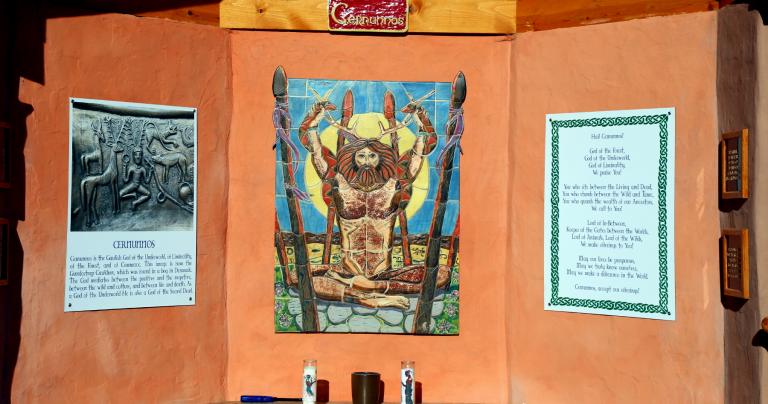
the Cernunnos shrine – Trout Lake Abbey
Further, our first-hand experiences of the Gods are strikingly similar. Our Gods speak to us in thoughts and feelings, in signs and omens. They instruct us to restore, rebuild, and reimagine Their worship for our time and place. They push us to embody Their virtues and to promote Their values. And They encourage – and sometimes demand – us to form alliances with other groups and traditions who do not share all our beliefs and practices, but with whom we have common cause.
Where we can do so without compromising the uniqueness and diversity that provide depth and meaning, our contemporary polytheist religions will be better off if we compare notes, work together, and pool our limited resources.
One of the first places I believe we can do this is in the realm of theology.
The only doctrine universal to polytheism
One of the good things that came out of the Great Polytheist – Atheist Kerfuffle of 2015 was this brief statement by Dr. Edward Butler on the only doctrine universal to polytheism. The full statement can be found here – the opening sentence is most important:
“The one and only thing that we can regard as a doctrine universal to Polytheism as such is the genuine existence of many Gods, and whatever we may, arguably and provisionally, infer from that single affirmation.”
That’s not much. But considering we are operating in an environment where the largest theological debate is over whether there is one God or whether there are none, the genuine existence of many Gods is a pretty important place to start.
One of the inferences that came out of the universal doctrine was this definition of polytheism by the Anomalous Thracian:
“Polytheism is the religious regard for many real Gods.”
As the Thracian said in his explanation:
“Polytheists do not merely acknowledge the reality of many Gods, but further, we hold Them in religious regard … It is entirely possible to view the Gods as real, and also not worship Them, value Them, or respect Them in any way … As Polytheists we worship the many Gods.”
This is our foundation for a common polytheist theology. By “common” I don’t mean “universal” but rather the dictionary definition: “done by many people; occurring or appearing frequently: not rare.” Over time, through discussion and debate, we can develop a polytheist theology that is helpful to many people even if it is never universal among all polytheists.
Gods are the mightiest of spirits
What does “God” mean? Etymology is helpful here. “God” is of Germanic origins, likely from the Proto-Indo-European root words *ghut- “that which is invoked” and *gheu- “to pour a libation”; and the Sanskrit hutá which can be interpreted as “one to whom sacrifices are made.” It was originally a gender-neutral term – only when Christianity insisted there was only one God who is male was “Goddess” needed as a differentiation.
We may invite people or summon them or command them, but we don’t invoke them. We invoke concepts and principles (such as invoking your 5th Amendment right against self-incrimination). And we invoke spirits.

Animism is not polytheism, but many polytheist religions have animist roots. Animism says that everything is not a thing but a person who has a spirit. Or perhaps, persons are spirits, some of whom have bodies. If Gods are not things but persons, they are also spirits.
My own definition of a God is “the mightiest of spirits.” They are spirits who are both the personification and the rulers of virtues and of natural forces, of cultures and traditions. So if all living things – all persons – are spirits, then the Gods are simply at the big end of a spectrum of spirits. Unlike conservative monotheists, polytheists have no need to insist that our Gods are “wholly other” from everything else (a concept many Christians rightly reject).
Some people have objected to “the mightiest of spirits” because it implies that might makes right, a concept that is carried to harmful conclusions in Calvinist theology. Certainly might does not make right, and I welcome alternative terms. But this works for me, at least until someone comes up with something better.
Individual beings with Their own sovereignty and agency
What do we mean by “genuine existence” and “real Gods”? The word “real” has been abused of late, with some insisting that if something can’t be measured and classified it can’t be real, and others insisting that anything they can imagine is real.
One of the stickiest of points in the 2015 arguments was whether the Gods are psychological archetypes, or rather, whether They are only archetypes. Morpheus Ravenna addressed this very well in the keynote address at the first Many Gods West conference.
Our sensory experiences of the Gods are not the Gods themselves, because They are inherently grander than our capacity to experience Them … the presence we experience is always a mask or manifestation of that God, shaped in such a way as to translate into our more limited consciousness and frame of reference.
So people often find it difficult to separate the psychological experience of an archetypal form from a spiritual experience of a God, because the knowledge of how to recognize the difference is a matter of not just subtle awareness, but also trained awareness.
Morpheus’ address is long (almost 6000 words) but it is well worth your time to read. Her key point is that what makes the Gods real is agency – the ability to act independently, for Their own reasons. Agency is also the primary determiner of personhood in animism.
Whatever else They may be, the Gods are persons who are not dependent on humans for Their existence.

Religions of relationships
Those Proto-Indo-European root words don’t really tell us what the Gods are, but they do tell us how our ancestors related to Them: with prayers and offerings – with worship.
“Worship” is a loaded word in many Pagan circles, largely due to the bad experiences many of us had in Christian churches. The English word “worship” comes from the Old English weorthscipe meaning worthiness and respect. We worship that which we believe is worthy.
Now we’re starting to get away from where we have common thinking and into the areas where we have diverse practices. But there is still much commonality in the polytheist belief that worship is not about self-debasement before a jealous deity, but rather about forming and maintaining honorable relationships.
There are two core principles and practices involved with this worship: hospitality and reciprocity.
Hospitality is about being a good and proper host and tending to the needs of your guests. If you invite someone to your house, you offer them food and drink, you give them a comfortable seat, and you engage in conversation with them. Likewise, when we invite our Gods to join our rituals, we greet Them politely, we offer Them food and drink, and we engage in conversation with Them. That means we don’t just speak, we also listen.
Reciprocity means “I give so that you may give.” At its lowest level, this is a quid pro quo transaction: I give you this, you give me that. Certainly we find examples of that in ancient polytheist religions. But at a higher level, it’s how you do a favor for a friend with no expectation of payment. But your friend has done favors for you in the past, and likely will again in the future. Reciprocity makes the world go round.
Offerings are more about hospitality than reciprocity – the mightiest of spirits cannot be bribed with a few ounces of wine. But ask for favors from a deity often enough and eventually you’ll be asked for something in return.
Real experiences lead to real diversity
When we interact with the Gods in hospitality and in reciprocity, we have our own first-hand experiences of Them. Some of these experiences are quite ordinary and are best explained in strictly naturalist terms. Others defy the materialist assumptions of the mainstream society and force us to re-evaluate our ideas about the world and how it works.
And some of them turn our lives upside down.
While the essence of these experiences are often similar across traditions, the details are not. Our diverse experiences of diverse Gods lead to diverse ideas about how we can best respond to the Gods. This is how we begin to move from common theology to uncommon religions. This is why even when they’re all practiced by 21st century Americans, Hellenism is different from Kemeticism is different from Celtic Reconstructionism is different from every other polytheist religion in practice today. There is power, depth, and authenticity in that diversity, something we must never forget.
But where we can work together, let’s work together. Where we can compare notes, let’s share our academic research and our religious experiences. Where our thinking is common, let us think together.
These are my thoughts as a polytheist. What are yours?
Previous Post
May 29, 2018
Paganism Doesn’t Need Unity
Next Post

June 3, 2018 Pouring Offerings to the Morrigan in Ireland
Browse Our Archives
Select a Category Books Community CUUPS Druidry Foundations and Context Gods and Goddesses Magic Myth Nature Ritual Spiritual Practice Theology Travel Uncategorized Videos
Select a Month November 2026 October 2026 September 2026 August 2026 July 2026 June 2026 May 2026 April 2026 March 2026 February 2026 January 2026 December 2025 November 2025 October 2025 September 2025 August 2025 July 2025 June 2025 May 2025 April 2025 March 2025 February 2025 January 2025 December 2024 November 2024 October 2024 September 2024 August 2024 July 2024 June 2024 May 2024 April 2024 March 2024 February 2024 January 2024 December 2023 November 2023 October 2023 September 2023 August 2023 July 2023 June 2023 May 2023 April 2023 March 2023 February 2023 January 2023 December 2022 November 2022 October 2022 September 2022 August 2022 July 2022 June 2022 May 2022 April 2022 March 2022 February 2022 January 2022 December 2021 November 2021 October 2021 September 2021 August 2021 July 2021 June 2021 May 2021 April 2021 March 2021 February 2021 January 2021 December 2020 November 2020 October 2020 September 2020 August 2020 July 2020 June 2020 May 2020 April 2020 March 2020 February 2020 January 2020 December 2019 November 2019 October 2019 September 2019 August 2019 July 2019 June 2019 May 2019 April 2019 March 2019 February 2019 January 2019 December 2018 November 2018 October 2018 September 2018 August 2018 July 2018 June 2018 May 2018 April 2018 March 2018 February 2018 January 2018 December 2017 November 2017 October 2017 September 2017 August 2017 July 2017 June 2017 May 2017 April 2017 March 2017 February 2017 January 2017 December 2016 November 2016 October 2016 September 2016 August 2016 July 2016 June 2016 May 2016 April 2016 March 2016 February 2016 January 2016 December 2015 November 2015 October 2015 September 2015 August 2015 July 2015 June 2015 May 2015 April 2015 March 2015 February 2015 January 2015 December 2014 November 2014 October 2014 September 2014 August 2014 July 2014 June 2014 May 2014 April 2014 March 2014 February 2014 January 2014 December 2013 November 2013 October 2013 September 2013 August 2013 July 2013 June 2013 May 2013 April 2013 March 2013 February 2013 January 2013 December 2012 November 2012 October 2012 September 2012 August 2012 July 2012 June 2012 May 2012 April 2012 March 2012 February 2012 January 2012 December 2011 November 2011 October 2011 September 2011 August 2011 July 2011 June 2011 May 2011 April 2011 March 2011 February 2011 January 2011 December 2010 November 2010 October 2010 September 2010 August 2010 July 2010 June 2010 May 2010 April 2010 March 2010 February 2010 January 2010 December 2009 November 2009 October 2009 September 2009 August 2009 July 2009 June 2009 May 2009 April 2009 March 2009 February 2009 January 2009 December 2008 November 2008 October 2008 September 2008 August 2008 July 2008 June 2008
Follow Us!
TAKE THE
Religious Wisdom Quiz
Which Psalm is an ancient call to worship: "Make a joyful noise to the Lord"?
Select your answer to see how you score.
Psalm 117 Psalm 90 Psalm 23 Psalm 100
Related posts from John Beckett

Pagans And The Rise Of The Religious Left

Why Halloween Is So Popular – And So...
The Pillar of the Boatmen: the Ancient Monument...
TRENDING AT PATHEOS Pagan

Chapter 5, Sarah: The Quest for Safety in...
Open and Relational Theology & Social Psychology About this series: This series...

When Worry Gets You Nowhere, How Can Faith...
Sometimes, we think that by worrying, we can somehow predict the future....

The Wasp And I: Meditations on Repentance
How can we enter the power and joy of the repentant self...

Reflections on the Evangelical Theological Society
As I mentioned before, this year, for the first time since 2005,...

Demmed if it do and demmed if it...
"First Presidency Announces Salt Lake Temple Rededication Date" Apropos of that,...

Stop Making Thanksgiving Problematic And Just Give Thanks
“What if, today, we were grateful for everything?” –Charlie Brown I...
view all Pagan blogs
Ad-Free & Subscriber Log-In Subscription Support
- About Us
- 2026 Calendar
- Videos
- Podcasts
- Library of World Religions
- Faith In Media Tracker
- Advertise With Us
- Write for Us
- Privacy Policy
- Terms of Service
- Do Not Sell My Data
- Contact Us
- Radiant Digital
- Manage Newsletter Subscriptions
- Unsubscribe From Notifications
- Sitemap
Copyright 2008-2026, Patheos, part of the Radiant Digital network of media brands. All rights reserved.
Subscription Support Ad-Free & Subscriber Log-In
Follow Patheos