
BuddhistCatholicContemplativeEvangelicalGeneral ChristianHinduJewishLatter-day SaintMuslimNew VisionsProgressive Christian
Beliefs
- Buddhist
- Catholic
- Contemplative
- Evangelical
- General Christian
- Hindu
- Jewish
- Latter-day Saint
- More Voices
- Muslim
- New Visions
- Pagan
- Progressive Christian
Topics
- Religion News
- Food and Religion
- Sports and Religion
- Religious Art
- Religious Music and Entertainment
- Religious Events
- History and Religion
- Style and Religion
- Politics and Religion
- Women in Religion
- Recreation Outdoors and Religion
- Business Finance and Religion
- Careers Workplace and Religion
- Education and Religion
- Family Parenting and Religion
- Health Fitness and Religion
- Home and Religion
- Relationships and Religion
- Technology and Religion
- Travel and Religion
Columnists
- Buddhist Columnists
- Business Finance and Religion Columnists
- Careers Workplace and Religion Columnists
- Catholic Columnists
- Contemplative Columnists
- Education and Religion Columnists
- Evangelists Columnists
- Family Parenting and Religion Columnists
- General Christian Columnists
- Health Fitness and Religion Columnists
- Hindu Columnists
- History and Religion Columnists
- Home and Religion Columnists
- Jewish Columnists
- More Voices Columnists
- Latter Day Columnists
- Muslim Columnists
- New Visions Columnists
- Nonreligious Columnists
- Pagan Columnists
- Politics and Religion Columnists
- Progressive Columnists
- Recreation Outdoors and Religion Columnists
- Relationships and Religion Columnists
- Religion News Columnists
- Religious Art Columnists
- Religious Events Columnists
- Religious Music and Entertainment Columnists
- Sports and Religion Columnists
- Style and Religion Columnists
- Technology and Religion Columnists
- Travel and Religion Columnists
- Women in Religion Columnists
Resource Library
- 2026 Calendar
- Library of World Religions
- The 100 Most Holy Places on Earth
- Patheos Answers
- Podcasts
- Videos
- Faith Leaders Database
- Anglican Episcopalian
- Bahai
- Baptist
- Buddhism
- Christianity
- Confucianism
- Eastern Orthodoxy
- Hinduism
- Holiness and Pentecostal
- ISKCON
- Islam
- Judaism
- Lutheran
- Methodist
- The Church of Jesus Christ of Latter-day Saints
- New Age
- Paganism
- Presbytarian and Reformed
- Protestantism
- Religion Behind the Scenes
- Roman Catholic
- Scientology
- Shia Islam
- Sikhism
- Sufism
- Sunni Islam
- Taoism
- Zen
- See all religions
Research Tools
 Ad-Free & Subscriber Log-In Subscription Support
Ad-Free & Subscriber Log-In Subscription Support
Follow Patheos 

- Trending:
- Forgiveness
- |
- Marriage
- |
- Consciousness
- |
- Death Penalty
- |
- Election
- |
- Halloween

- Home
- Pagan
- Conversations Under the Oaks: May Q&A
Conversations Under the Oaks: May Q&A
Last updated on: May 10, 2018 at 3:00 am by John Beckett
Conversations Under the Oaks: May Q&A 2018-05-08T19:37:54-06:00 John Beckett
Patheos Explore the world's faith through different perspectives on religion and spirituality! Patheos has the views of the prevalent religions and spiritualities of the world.
As a Pagan how do you feel about angels? I always feel conflicted personally as they don’t fit in with the Druidry I practice – it feels like trying to Christianise an earth based religion.
I have to answer that question on two levels.
I believe angels exist. They’re part of the religious environment of the ancient Near East and are attested to in countless encounters over the centuries. As a polytheist, I need not deny the religious beings and structures of other religions just because I don’t worship them in mine.
Angels are part of the magical tradition that gave rise to the modern Pagan movement, and they’ve carried over into some Pagan practices. And of course, they’re very popular in New Age circles.
But as a Pagan of Celtic heritage and calling, I choose not to work with angels. They’re not part of my Druid tradition and as I pointed out in the question above about religious trauma, I needed to make a clean break with Christianity.
I reject all attempts to combine and conflate angels with the fae and other Otherworldly beings of the Northwest European traditions. That erases the uniqueness and dignity of the fae (something I don’t advise doing under any circumstances).
So are angels real? Of course. Do I work with them in my own practice? No. Others must make their own decisions, but my strong preference is to keep Paganism as Pagan as possible.

All of the Pagan mythologies that I’m aware of, especially the European ones, have a strong emphasis upon heroic individuals. How does one use these stories to help develop communities of belonging when most of them don’t focus on communal life?
I encourage you to go back and read those stories again. Yes, they emphasize the mighty deeds of heroic individuals. But why were they attempting these deeds in the first place? Usually, it was to defend their homes and their people, and to raise the standing of their kith and kin.
Cormac wanted the Silver Branch to keep peace at his court. When he realized he had traded his family for it, he went in search of them. Lugh, the Dadga, the Morrigan, and many others fought mightily so they could secure Ireland from the Fomorians. Bran had his head cut off so he could continue conversing with his compatriots, and when he finally fell silent it was buried on the White Hill to ward off invasions.
Ancient communities needed heroic individuals to do the heroic things that made community possible. Our contemporary communities do too.
How do we handle leadership transitions in Pagan churches so that those who have given service feel valued and those who want to serve are listened to?
Your use of the term “Pagan churches” outs you as an ADF member. I agree with the ADF founders’ goal of creating a Pagan religious institution, but I wish they had found a different term for it. Or, in the spirit of the RDNA, if they had made one up.
Whether we call our Pagan religious institutions churches or orders or just groups, the question of leadership transition is valid and important. And it’s one that I’m personally involved with. Last year I stepped away from formal leadership in Denton CUUPS after 12 years as Coordinating Officer. I gave the membership six months’ notice that I wasn’t going to run for a 13th term and that I wasn’t going to hand-pick my successor. So far so good.
Leadership can be a thankless task. Ordinary members sometimes (often) don’t recognize the huge amount of work necessary to keep a group up and running. That’s even more true in a large organization like ADF, where most members never see the Mother Grove (the Board of Directors) and only speak up when the leaders do something the members don’t like… and in any group above coven size any decision is going to rub some people the wrong way. Leaders need thick skins and a commitment to a vision for the group strong enough to sustain them when the inevitable criticism comes.
There is no substitute for a shared vision. If we agree on where we want to go, then even passionate disagreements over how to get there can end with everyone supporting the group’s decisions. With a shared vision, new members know exactly what they’re joining, and those who don’t like that vision know they’ll be happier in a different group.
Some highly progressive groups (some religious, some political) like to say “we’re all about process” – they think that by emphasizing consensus and the democratic process, everyone will feel like they’ve been heard and feel like they’re valued. While we should listen to everyone, the unifying effect of being heard can’t hold a candle to the unifying effect of a shared vision.
This is true in organizations of all sizes, whether you’re as small as Denton CUUPS or as large as ADF… or if you’re as large as a major American political party…
There are many ways to handle the mechanics of leadership transition – pick the one that’s right for your group. But transitions are far more pleasant and far more effective when both the outgoing and incoming leaders are part of a shared vision for the group.
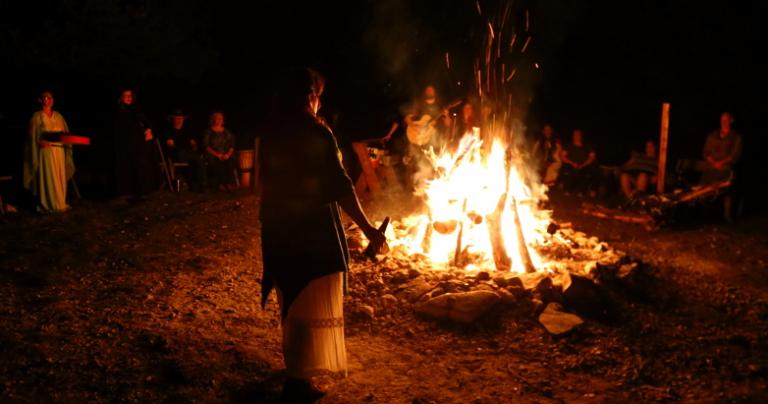
ADF Texas Imbolc Retreat 2017
When you travel on pilgrimage, do you give offerings or prayers to spirits of the road or travel spirits of any kinds? If so, how do you do so?
You’re the first person who’s ever mentioned travel spirits or spirits of the road to me. So, no – but I very well may do so in the future.
Before I leave, I pray and make offerings to the Gods and spirits I’m allied with, asking for safe and timely travels, for protection for my home while I’m gone, and that my experience on the journey be what it needs to be.
When I arrive in a new land, I make offerings to the spirits of the place. I introduce myself and ask for safe passage through the land. I do the same when I’m visiting sacred sites. Usually I offer water – since it’s what I’m carrying – though for special occasions I’ll get a small bottle of whiskey or mead. If I go to a place where votive offerings are appropriate I always offer an American coin or two – a tangible connection from my land to the land I’m visiting.
And then I offer prayers and offerings of thanksgiving when I get home.
Why do well-studied Pagans dismiss those who have found Paganism through experiences and meditative introspection/exterior forces? I know it’s difficult to explain how I know X or Y to be true to someone because I found it in the void or inside but why am I “less” for that? It took me about 2 years to even come to understanding of what I see of the under-workings of the world. It’s really hard to engage in those discussions when faced with immediate judgement. I don’t pretend to be an expert or anything.
Speculating about other people’s motivation is always difficult. But in general I see two reasons.
One is that academically inclined Pagans tend to have a bias for academic sources. They favor known history and lore, and research that meets rigorous standards. There’s certainly nothing wrong with that, so long as it doesn’t cause them to dismiss other sources… but sometimes it does.
The second reason is that there is still so much garbage passing for factual information (and not just in Paganism, but that’s the topic of this conversation). After you hear “the Morrigan is a Sex Goddess” for the eighteenth time, you tend to be skeptical of any claims that aren’t in alignment with tradition and lore.
Earlier this week Angelo Nasios had a very good post on Agora titled Hearth of Hellenism: Personal Gnosis and Tradition. He linked to a post I wrote in 2015 The Lore vs. UPG – A False Dichotomy. Both of these posts make a similar argument – a healthy religion needs both lore and personal gnosis. Or as Angelo put it in his piece
When UPG is the sole guiding principle for someone without any cultural context, that is appropriation and it is damaging to the cultural source from which the gods are expressed in … When we side ourselves too far on tradition and lore we run the risk of killing the tradition in the long run because we fossilize the tradition.
The task at hand is to know the tradition as best as we can so we can make sense of UPG in the most effective way that is meaningful to the individual without altering tradition with every new experience.
The comments to Aine Llewellyn’s question on theological disagreements also apply here. Honest questions and challenges are good for our religious integrity. Being rude or dismissive is not.
And finally, Kenneth Isles asks “How can I support your work? Only thru Patheos? Do you have a direct way to contribute?”
Thanks for asking – I appreciate the support.
I have no direct way to contribute – I don’t have a Patreon or anything like that. My paying job covers the mortgage and other ordinary expenses. That’s good, but it means I don’t have time to create special content for patrons.
The best way to support my work is to read it and share it. Facebook shares don’t go nearly as far as they used to (Facebook is trying to keep readers on their site as long as possible) but I still get about 30% of my traffic through them. It used to be 50%. I’m also on Twitter, Google+, and MeWe. Shares there help too, particularly if you have a large Twitter following. Commenting on the Facebook posts helps – the more interaction, the more people Facebook will show it to. But only if you have something to say.
Sign up for e-mail notifications and/or the Patheos Pagan Newsletter in the box on the right side of the screen. You can’t count on Facebook letting you know when I update.
Buy my book! I do better if you order The Path of Paganism directly from Llewellyn (Amazon is not kind to authors), but buying it anywhere helps. If you like it, leave a review on Amazon, Goodreads, or other book sites.
And remember that not all support is financial. This blog has always been part of a larger project in modern Paganism. Read what I write, then try it and see if it works for you. If it helps, let me know. If it doesn’t, let me know that too. I have many ideas, but I don’t have all the answers. Feedback helps me – and all of us – build a stronger and more robust Paganism.
Thanks to everyone who made it all the way to the end! We’ll do it again next month.
Previous Post

May 8, 2018
The Value of Chaos
Next Post

May 13, 2018 Animism, Personhood, and Killing to Eat
Browse Our Archives
Select a Category Books Community CUUPS Druidry Foundations and Context Gods and Goddesses Magic Myth Nature Ritual Spiritual Practice Theology Travel Uncategorized Videos
Select a Month October 2026 September 2026 August 2026 July 2026 June 2026 May 2026 April 2026 March 2026 February 2026 January 2026 December 2025 November 2025 October 2025 September 2025 August 2025 July 2025 June 2025 May 2025 April 2025 March 2025 February 2025 January 2025 December 2024 November 2024 October 2024 September 2024 August 2024 July 2024 June 2024 May 2024 April 2024 March 2024 February 2024 January 2024 December 2023 November 2023 October 2023 September 2023 August 2023 July 2023 June 2023 May 2023 April 2023 March 2023 February 2023 January 2023 December 2022 November 2022 October 2022 September 2022 August 2022 July 2022 June 2022 May 2022 April 2022 March 2022 February 2022 January 2022 December 2021 November 2021 October 2021 September 2021 August 2021 July 2021 June 2021 May 2021 April 2021 March 2021 February 2021 January 2021 December 2020 November 2020 October 2020 September 2020 August 2020 July 2020 June 2020 May 2020 April 2020 March 2020 February 2020 January 2020 December 2019 November 2019 October 2019 September 2019 August 2019 July 2019 June 2019 May 2019 April 2019 March 2019 February 2019 January 2019 December 2018 November 2018 October 2018 September 2018 August 2018 July 2018 June 2018 May 2018 April 2018 March 2018 February 2018 January 2018 December 2017 November 2017 October 2017 September 2017 August 2017 July 2017 June 2017 May 2017 April 2017 March 2017 February 2017 January 2017 December 2016 November 2016 October 2016 September 2016 August 2016 July 2016 June 2016 May 2016 April 2016 March 2016 February 2016 January 2016 December 2015 November 2015 October 2015 September 2015 August 2015 July 2015 June 2015 May 2015 April 2015 March 2015 February 2015 January 2015 December 2014 November 2014 October 2014 September 2014 August 2014 July 2014 June 2014 May 2014 April 2014 March 2014 February 2014 January 2014 December 2013 November 2013 October 2013 September 2013 August 2013 July 2013 June 2013 May 2013 April 2013 March 2013 February 2013 January 2013 December 2012 November 2012 October 2012 September 2012 August 2012 July 2012 June 2012 May 2012 April 2012 March 2012 February 2012 January 2012 December 2011 November 2011 October 2011 September 2011 August 2011 July 2011 June 2011 May 2011 April 2011 March 2011 February 2011 January 2011 December 2010 November 2010 October 2010 September 2010 August 2010 July 2010 June 2010 May 2010 April 2010 March 2010 February 2010 January 2010 December 2009 November 2009 October 2009 September 2009 August 2009 July 2009 June 2009 May 2009 April 2009 March 2009 February 2009 January 2009 December 2008 November 2008 October 2008 September 2008 August 2008 July 2008 June 2008
Follow Us!
TAKE THE
Religious Wisdom Quiz
How many years between David's reign and the Babylonian exile?
Select your answer to see how you score.
500 years 450 years 400 years 300 years
Related posts from John Beckett




What We Lose When “Ask AI” Becomes A...
TRENDING AT PATHEOS Pagan

The Sermon on the Mount, Part I: Matthew...
The Sermon on the Mount, Part I (Matthew 4:12-5:12) St. Matthew moves...

What's up from Crossway: Reviewing some of their latest A few weeks...

Janie Learns the Way of the Cross: A...
Teaching children about Jesus' Passion can be challenging. Many parents and educators...

Looking For Good Catholic Writing - October 2026
He alone extends the heavens, and he walks upon the waves of...

In "Irreplaceable," our book on vocation and technology, Trevor Sutton and I...

I was strolling through the top floor of the brand new Parthenon...
view all Pagan blogs
Ad-Free & Subscriber Log-In Subscription Support
- About Us
- 2026 Calendar
- Videos
- Podcasts
- Library of World Religions
- Faith In Media Tracker
- Advertise With Us
- Write for Us
- Privacy Policy
- Terms of Service
- Do Not Sell My Data
- Contact Us
- Radiant Digital
- Manage Newsletter Subscriptions
- Unsubscribe From Notifications
- Sitemap
Copyright 2008-2026, Patheos. All rights reserved.
Subscription Support Ad-Free & Subscriber Log-In
Follow Patheos