
BuddhistCatholicContemplativeEvangelicalGeneral ChristianHinduJewishLatter-day SaintMuslimNew VisionsProgressive Christian
Beliefs
- Buddhist
- Catholic
- Contemplative
- Evangelical
- General Christian
- Hindu
- Jewish
- Latter-day Saint
- More Voices
- Muslim
- New Visions
- Pagan
- Progressive Christian
Topics
- Religion News
- Food and Religion
- Sports and Religion
- Religious Art
- Religious Music and Entertainment
- Religious Events
- History and Religion
- Style and Religion
- Politics and Religion
- Women in Religion
- Recreation Outdoors and Religion
- Business Finance and Religion
- Careers Workplace and Religion
- Education and Religion
- Family Parenting and Religion
- Health Fitness and Religion
- Home and Religion
- Relationships and Religion
- Technology and Religion
- Travel and Religion
Columnists
- Buddhist Columnists
- Business Finance and Religion Columnists
- Careers Workplace and Religion Columnists
- Catholic Columnists
- Contemplative Columnists
- Education and Religion Columnists
- Evangelists Columnists
- Family Parenting and Religion Columnists
- General Christian Columnists
- Health Fitness and Religion Columnists
- Hindu Columnists
- History and Religion Columnists
- Home and Religion Columnists
- Jewish Columnists
- More Voices Columnists
- Latter Day Columnists
- Muslim Columnists
- New Visions Columnists
- Nonreligious Columnists
- Pagan Columnists
- Politics and Religion Columnists
- Progressive Columnists
- Recreation Outdoors and Religion Columnists
- Relationships and Religion Columnists
- Religion News Columnists
- Religious Art Columnists
- Religious Events Columnists
- Religious Music and Entertainment Columnists
- Sports and Religion Columnists
- Style and Religion Columnists
- Technology and Religion Columnists
- Travel and Religion Columnists
- Women in Religion Columnists
Resource Library
- 2026 Calendar
- Library of World Religions
- The 100 Most Holy Places on Earth
- Patheos Answers
- Podcasts
- Videos
- Faith Leaders Database
- Anglican Episcopalian
- Bahai
- Baptist
- Buddhism
- Christianity
- Confucianism
- Eastern Orthodoxy
- Hinduism
- Holiness and Pentecostal
- ISKCON
- Islam
- Judaism
- Lutheran
- Methodist
- The Church of Jesus Christ of Latter-day Saints
- New Age
- Paganism
- Presbytarian and Reformed
- Protestantism
- Religion Behind the Scenes
- Roman Catholic
- Scientology
- Shia Islam
- Sikhism
- Sufism
- Sunni Islam
- Taoism
- Zen
- See all religions
Research Tools
 Ad-Free & Subscriber Log-In Subscription Support
Ad-Free & Subscriber Log-In Subscription Support
Follow Patheos 

- Trending:
- Forgiveness
- |
- Marriage
- |
- Consciousness
- |
- Death Penalty
- |
- Election
- |
- Halloween

- Home
- Pagan
- The Impact of Human Activity on Sacred Sites
The Impact of Human Activity on Sacred Sites
Last updated on: April 5, 2018 at 3:00 am by John Beckett
The Impact of Human Activity on Sacred Sites 2018-03-31T15:04:34-06:00 John Beckett
Patheos Explore the world's faith through different perspectives on religion and spirituality! Patheos has the views of the prevalent religions and spiritualities of the world.
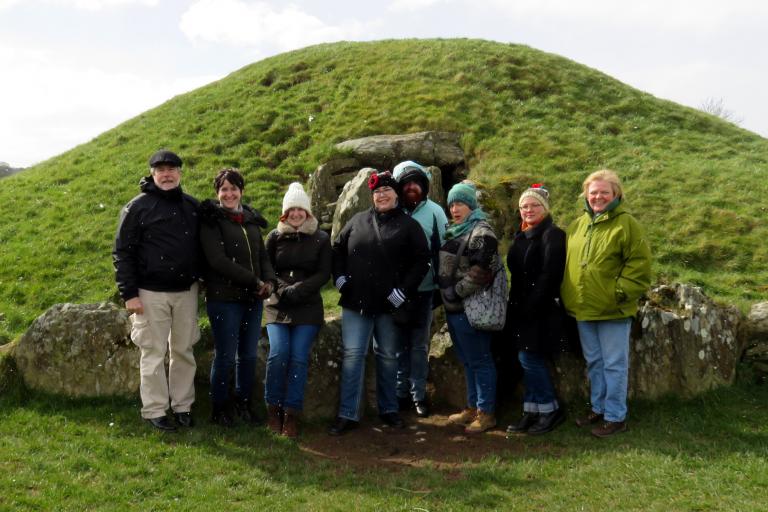
Take a good look at the picture below. The bare ground on the slope of the ditch catches your eye – follow it up and to the right. See how it bends toward the stones that frame the opening in the mound. See not just wear on the grass, but indentations in the ground. A path has been worn into the ground – a new path, the result of 27 years of modern Druid processions.
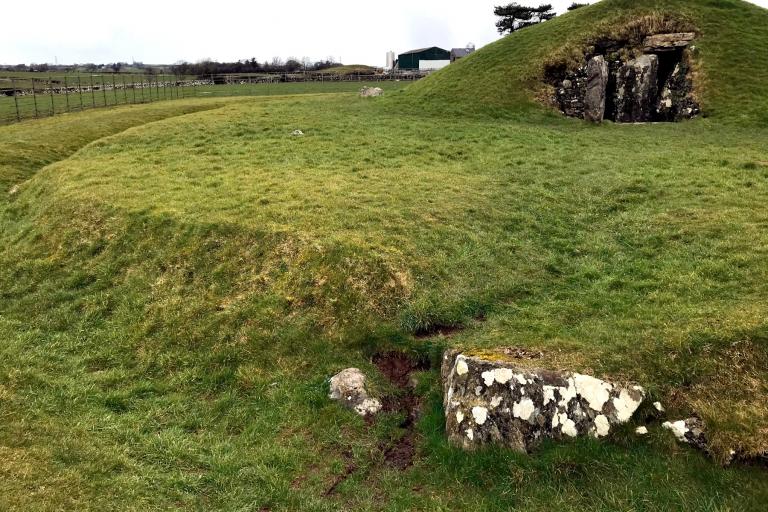
Is this a bad thing? If your initial response was disapproval or even shock, you may want to give the question some deeper thought.
Bryn Celli Ddu
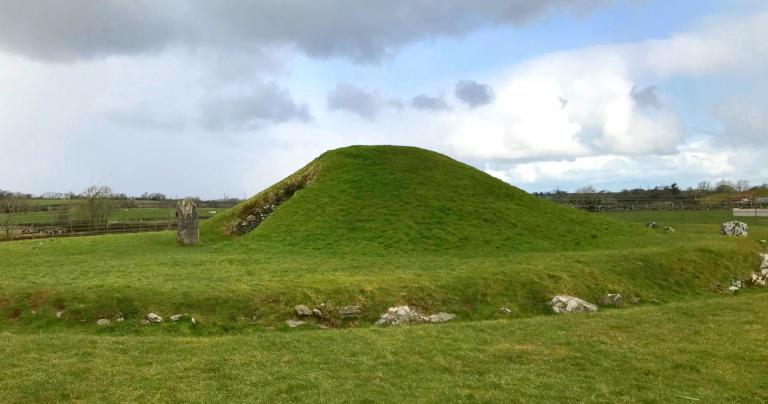
This is the ancient site of Bryn Celli Ddu on Anglesey in Wales. The site was first used 6000 years ago. About 5000 years ago, a henge (ditch and bank) was constructed and standing stones were erected. The ditch is still there, though the bank is gone. A thousand years later most of the standing stones were removed and a passage tomb was constructed. And then it was closed and forgotten for millennia.
Modern exploration began in the early 19th century, with the first formal excavation in 1928. Some reconstruction was done, including installing concrete roof pillars to insure the safety of those who go inside.
Archaeological exploration continues on the site, with members of the Anglesey Druid Order – who frequently hold public high day celebrations at Bryn Celli Ddu – assisting professional archaeologists on the digs.
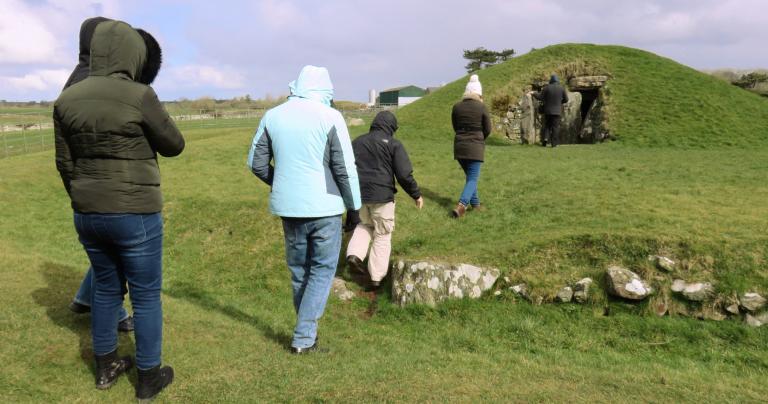
This was my second visit to Bryn Celli Ddu. The first was the highlight of my 2014 trip to England, Wales, and Ireland. You can never re-create the specialness of your first experience of a sacred site, but it’s still a powerful place, and being there again – especially with four friends who had never been there before – was a wonderful experience.
The animism of places
Animism is the philosophical concept that things are not things but persons. This is easy to see with other animals – many of us intuitively treat our cats and dogs like persons. It’s harder to see with plants, though some of us are able to form relationships with trees and flowers. And it’s harder still with natural features like mountains and rivers, much less a human-built place like Bryn Celli Ddu.
But many of us have feelings for and relationships with cities, houses, and even cars. If we can relate to them as persons, surely we can relate to ancient sites of power and beauty as persons too.
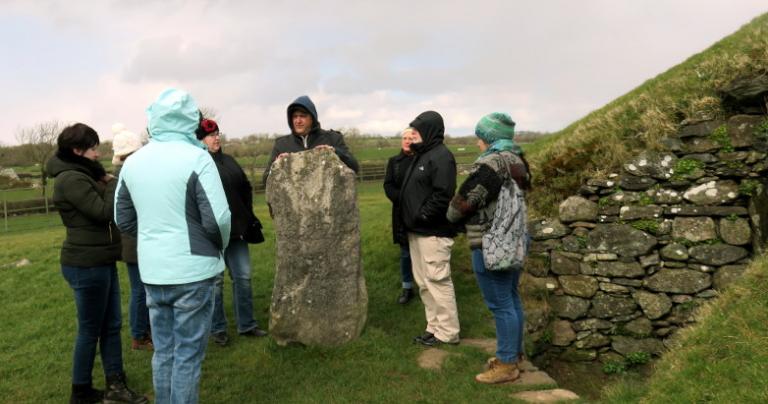
Bryn Celli Ddu is alive. Kristoffer Hughes, head of the Anglesey Druid Order and our gracious host for our weekend on Ynys Môn, says “she loves all the attention.” After we entered the henge, Kris asked us to put our hands on one of the stones and say something we noticed about the place. After we all took a turn, he said “now say hello!” And so we did. I felt welcomed, once again.
I didn’t have the same experience at every site. Other places are alive too, and some of them are none too happy to have humans bothering them.
But Bryn Celli Ddu wants visitors. She wants Pagans coming on pilgrimages. She wants Druids celebrating the Summer Solstice with her (when the sun rises at 4:49 AM). She wants archaeologists uncovering the secrets of the ancient people who lived, worked, and worshipped there.
And none of that can be done if we treat her like a museum piece to be kept behind glass and never disturbed.
She changes everything she touches
Remember the Starhawk chant “she changes everything she touches, and everything she touches changes”? “She” can be anyone. When we interact with another person (human or otherwise) we are changed – and so are they. The changes can be small or large, positive or negative or hard to tell. But we are not the same person we were before the interaction.
All species – all persons – modify their environments. Beavers build dams on rivers. Kudzu does a wonderful job of stopping soil erosion… and also chokes out most native plants, as the Southern United States learned the hard way in the 20th century. The story of removing wolves from Yellowstone National Park and then reintroducing them is an excellent case study on the interaction of different species in an environment.
All persons modify their environments. Only humans have bulldozers, explosives, and concrete – with great power comes great responsibility. But we can’t not change our environment, which includes the places we visit.
Which modifications are ethical and proper and which are not?
Purposes, themes, and multiple incarnations
While it is easy to sense the welcoming spirit of some places and the unwelcoming spirit of others, it is impossible to say with certainty what places want for themselves. That leads skeptics to say “then land should be property to be used as its human owners see fit.” But it is not hard to understand that like all living beings, places want to continue living and want to exercise their sovereignty and autonomy to live in the ways they want to live.
If modern Druids are wearing a new path into the land, that’s in keeping with the purposes and themes Bryn Celli Ddu has had since it was first constructed. If someone wants to level the mound and build a McDonalds in its place, that’s something very different.
Actual questions are rarely so black and white. When Professor Michael O’Kelly rebuilt Newgrange in the 1960s and 70s, he was certain that the white quartz stones found around the mound were used to cover the exterior. But in order to hold them in place, he had to use modern concrete and steel. Professor George Eogan thought they formed a walkway, so when he curated Knowth for visitors, that’s how he rebuilt it.
Who’s right? More importantly, what do we mean by “right”? It’s easy to say “like it was originally” but which time? If we were to restore Bryn Celli Ddu to its “original” state, would we enlarge the mound? Replace the standing stones? Rebuild the bank? Take the mound out completely? All of a sudden the question of wearing a path into the ground doesn’t seem very important.
Loving places to death
Bryn Celli Ddu doesn’t get anywhere close to the traffic that more popular sites get. The impact of visitors is small and slow. In other places, visitors are “loving places to death.” To combat this, Newgrange allows access only on timed tickets, to restrict the impact of visitors. Stonehenge does not allow ordinary visitors to enter the stone circle except on “free days” like the Summer Solstice. At both sites, parking and reception are at an off-site visitors center, then guests are transported to and from the monument on busses.
You cannot see the Paleolithic cave art of Lascaux and Chauvet yourself. The fantastic cave paintings were preserved for tens of thousands of years only because the caves were sealed, protecting them not just from human activity, but also from environmental changes. When humans enter the caves, our mere presence raises humidity and carbon dioxide levels, promoting the growth of lichens and crystals and damaging the artwork. A replica of Lascaux was built to allow people to see the artwork in a context very close to the originals, without endangering them further.
If 30,000 year old art is destroyed, it cannot be restored. I tend to think of it as a very fragile living being that is not well suited for change. If a species goes extinct, that is a sad but natural occurrence. If we drive a species to extinction, that’s an act of criminal negligence.
What is good and proper at one place with one level of activity is dangerous and unethical at another place with a different level of activity.
Respectful, reciprocal relationships
What is true for Bryn Celli Ddu is true for your back yard as well. Places aren’t things, they’re persons – persons we can form relationships with. We will change the land – we’re animals, that’s what animals do. But if we are mindful, we won’t just use the land. We will listen to the land, and we will respect its needs and desires as much as we respect our own.
I am honored to have visited Bryn Celli Ddu on two occasions. It is a joy to walk where my ancestors (of spirit if not of blood) walked thousands of years ago. And it is equally a joy to see Bryn Celli Ddu as a living being interacting with visitors from across the island and across the world.
May she always be alive and well and changing, and never turned into a lifeless artifact of an “original” past that never was.
Previous Post

April 3, 2018
Rathcroghan and the Cave of the Morrigan
Next Post

April 8, 2018 Learning to Cook in the Kitchen of the Gods
Browse Our Archives
Select a Category Books Community CUUPS Druidry Foundations and Context Gods and Goddesses Magic Myth Nature Ritual Spiritual Practice Theology Travel Uncategorized Videos
Select a Month October 2026 September 2026 August 2026 July 2026 June 2026 May 2026 April 2026 March 2026 February 2026 January 2026 December 2025 November 2025 October 2025 September 2025 August 2025 July 2025 June 2025 May 2025 April 2025 March 2025 February 2025 January 2025 December 2024 November 2024 October 2024 September 2024 August 2024 July 2024 June 2024 May 2024 April 2024 March 2024 February 2024 January 2024 December 2023 November 2023 October 2023 September 2023 August 2023 July 2023 June 2023 May 2023 April 2023 March 2023 February 2023 January 2023 December 2022 November 2022 October 2022 September 2022 August 2022 July 2022 June 2022 May 2022 April 2022 March 2022 February 2022 January 2022 December 2021 November 2021 October 2021 September 2021 August 2021 July 2021 June 2021 May 2021 April 2021 March 2021 February 2021 January 2021 December 2020 November 2020 October 2020 September 2020 August 2020 July 2020 June 2020 May 2020 April 2020 March 2020 February 2020 January 2020 December 2019 November 2019 October 2019 September 2019 August 2019 July 2019 June 2019 May 2019 April 2019 March 2019 February 2019 January 2019 December 2018 November 2018 October 2018 September 2018 August 2018 July 2018 June 2018 May 2018 April 2018 March 2018 February 2018 January 2018 December 2017 November 2017 October 2017 September 2017 August 2017 July 2017 June 2017 May 2017 April 2017 March 2017 February 2017 January 2017 December 2016 November 2016 October 2016 September 2016 August 2016 July 2016 June 2016 May 2016 April 2016 March 2016 February 2016 January 2016 December 2015 November 2015 October 2015 September 2015 August 2015 July 2015 June 2015 May 2015 April 2015 March 2015 February 2015 January 2015 December 2014 November 2014 October 2014 September 2014 August 2014 July 2014 June 2014 May 2014 April 2014 March 2014 February 2014 January 2014 December 2013 November 2013 October 2013 September 2013 August 2013 July 2013 June 2013 May 2013 April 2013 March 2013 February 2013 January 2013 December 2012 November 2012 October 2012 September 2012 August 2012 July 2012 June 2012 May 2012 April 2012 March 2012 February 2012 January 2012 December 2011 November 2011 October 2011 September 2011 August 2011 July 2011 June 2011 May 2011 April 2011 March 2011 February 2011 January 2011 December 2010 November 2010 October 2010 September 2010 August 2010 July 2010 June 2010 May 2010 April 2010 March 2010 February 2010 January 2010 December 2009 November 2009 October 2009 September 2009 August 2009 July 2009 June 2009 May 2009 April 2009 March 2009 February 2009 January 2009 December 2008 November 2008 October 2008 September 2008 August 2008 July 2008 June 2008
Follow Us!
TAKE THE
Religious Wisdom Quiz
What Jewish festival celebrates deliverance from Egypt?
Select your answer to see how you score.
Passover Purim Tabernacles Pentecost
Related posts from John Beckett




What We Lose When “Ask AI” Becomes A...
TRENDING AT PATHEOS Pagan

Pope Leo Celebrates Mass for Nurses & Docs...
I don't have any idea how he did it, but Pope Leo...

The Sermon on the Mount, Part I: Matthew...
The Sermon on the Mount, Part I (Matthew 4:12-5:12) St. Matthew moves...

What's up from Crossway: Reviewing some of their latest A few weeks...

Janie Learns the Way of the Cross: A...
Teaching children about Jesus' Passion can be challenging. Many parents and educators...

Looking For Good Catholic Writing - October 2026
He alone extends the heavens, and he walks upon the waves of...

In "Irreplaceable," our book on vocation and technology, Trevor Sutton and I...
view all Pagan blogs
Ad-Free & Subscriber Log-In Subscription Support
- About Us
- 2026 Calendar
- Videos
- Podcasts
- Library of World Religions
- Faith In Media Tracker
- Advertise With Us
- Write for Us
- Privacy Policy
- Terms of Service
- Do Not Sell My Data
- Contact Us
- Radiant Digital
- Manage Newsletter Subscriptions
- Unsubscribe From Notifications
- Sitemap
Copyright 2008-2026, Patheos. All rights reserved.
Subscription Support Ad-Free & Subscriber Log-In
Follow Patheos