
BuddhistCatholicContemplativeEvangelicalGeneral ChristianHinduJewishLatter-day SaintMuslimNew VisionsProgressive Christian
Beliefs
- Buddhist
- Catholic
- Contemplative
- Evangelical
- General Christian
- Hindu
- Jewish
- Latter-day Saint
- More Voices
- Muslim
- New Visions
- Pagan
- Progressive Christian
Topics
- Religion News
- Food and Religion
- Sports and Religion
- Religious Art
- Religious Music and Entertainment
- Religious Events
- History and Religion
- Style and Religion
- Politics and Religion
- Women in Religion
- Recreation Outdoors and Religion
- Business Finance and Religion
- Careers Workplace and Religion
- Education and Religion
- Family Parenting and Religion
- Health Fitness and Religion
- Home and Religion
- Relationships and Religion
- Technology and Religion
- Travel and Religion
Columnists
- Buddhist Columnists
- Business Finance and Religion Columnists
- Careers Workplace and Religion Columnists
- Catholic Columnists
- Contemplative Columnists
- Education and Religion Columnists
- Evangelists Columnists
- Family Parenting and Religion Columnists
- General Christian Columnists
- Health Fitness and Religion Columnists
- Hindu Columnists
- History and Religion Columnists
- Home and Religion Columnists
- Jewish Columnists
- More Voices Columnists
- Latter Day Columnists
- Muslim Columnists
- New Visions Columnists
- Nonreligious Columnists
- Pagan Columnists
- Politics and Religion Columnists
- Progressive Columnists
- Recreation Outdoors and Religion Columnists
- Relationships and Religion Columnists
- Religion News Columnists
- Religious Art Columnists
- Religious Events Columnists
- Religious Music and Entertainment Columnists
- Sports and Religion Columnists
- Style and Religion Columnists
- Technology and Religion Columnists
- Travel and Religion Columnists
- Women in Religion Columnists
Resource Library
- 2026 Calendar
- Library of World Religions
- The 100 Most Holy Places on Earth
- Patheos Answers
- Podcasts
- Videos
- Faith Leaders Database
- Anglican Episcopalian
- Bahai
- Baptist
- Buddhism
- Christianity
- Confucianism
- Eastern Orthodoxy
- Hinduism
- Holiness and Pentecostal
- ISKCON
- Islam
- Judaism
- Lutheran
- Methodist
- The Church of Jesus Christ of Latter-day Saints
- New Age
- Paganism
- Presbytarian and Reformed
- Protestantism
- Religion Behind the Scenes
- Roman Catholic
- Scientology
- Shia Islam
- Sikhism
- Sufism
- Sunni Islam
- Taoism
- Zen
- See all religions
Research Tools
 Ad-Free & Subscriber Log-In Subscription Support
Ad-Free & Subscriber Log-In Subscription Support
Follow Patheos 

- Trending:
- Forgiveness
- |
- Marriage
- |
- Consciousness
- |
- Death Penalty
- |
- Election
- |
- Halloween

- Home
- Pagan
- Learning to Cook in the Kitchen of the Gods
Learning to Cook in the Kitchen of the Gods
Last updated on: April 8, 2018 at 3:00 am by John Beckett
Learning to Cook in the Kitchen of the Gods 2018-04-03T19:19:18-06:00 John Beckett
Patheos Explore the world's faith through different perspectives on religion and spirituality! Patheos has the views of the prevalent religions and spiritualities of the world.
Last week Damh the Bard had an excellent post on his blog titled Thinking About – Belief and Experience. It’s not long and it’s well worth your time to read in its entirety. Here’s a key quote:
Pagans don’t have a book. We do have myths, poetry, sacred sites, places of power, folklore, but no one book. So when a person’s feet fall for the first time upon a Pagan path, we might read the myths, or take a walk to an ancient sacred site, we might find out if there is a place nearby that has connections to stories of the Fair Folk. If there is, maybe those first few steps might take us there, to that hill with the three trees, or the old Barrow, or the crossroads in the woods.
We actively seek out experience.
If you’ve read this blog for very long – and especially if you’ve read The Path of Paganism – you know the emphasis I place on experience. We live in a society where the loudest voices scream there is only one God and the second loudest voices scream there are none. But when we’re open to new experiences, we can sense the presence of the Gods and hear Their messages.
Skeptics laugh at magic, but when you do the spells you get the results.

After a while our experiences of Gods, magic, spirits, ancestors, and Fair Folk become so numerous and so strong – and so meaningful – that they change our understanding of the world and what is and isn’t possible. No amount of belief could heal the damage caused by the fundamentalism of my childhood – it took positive Pagan experiences.
Damh points out how experience leads to belief, as we try to make sense of our experiences and place them in a wider context. Or it can go the other way, with belief leading to experience. Experience, belief, and practice form a virtuous circle, and that circle can go in either direction.
In the Kitchen of the Gods
I don’t disagree with anything Damh wrote. But I’d like to use part of his post to make a slightly different point. Here’s another key quote:
Over the years I’ve heard some Pagans lament that our Pagan ancestors, particularly the Druids, didn’t write anything down. That it would be a lot easier if we all just had a book, like the Bible, that told us what to believe. I couldn’t disagree more…
A book like the Bible is useful if, as Philip Carr-Gomm has said over the years, you like to be in the restaurant. You can read through the menu (books) and chose your denomination and off you go. The meal has been made for you. Enjoy it. But most Pagans and Druids I know prefer to be in the kitchen, with all of the ingredients, creating something that exactly suits their taste.
I think the restaurant vs. kitchen metaphor is helpful. But it needs to be extended further.
Some people go into the restaurant (the marketplace of religions), read the menu, and find exactly what they want. Their calling is to become a Zen Buddhist or a Roman Catholic or Sufi Muslim and when they find that dish (religious path) they’re satisfied. Or maybe they aren’t completely satisfied, but they don’t want to do the work of cooking (finding their own path). Or they really want the benefits of a large established tradition. So they pick the closest thing they can find and go with that.
But Damh and Philip are right – some of us want to go into the kitchen. It’s not just that we don’t see what we want on the menu, we want to cook for ourselves. So we leave the dining room and barge through the swinging doors. We see the sinks and counters, the pots and pans, the knives and mixers. We look through the pantry and the refrigerator, and we carefully examine the spice rack.
Now what do we do?
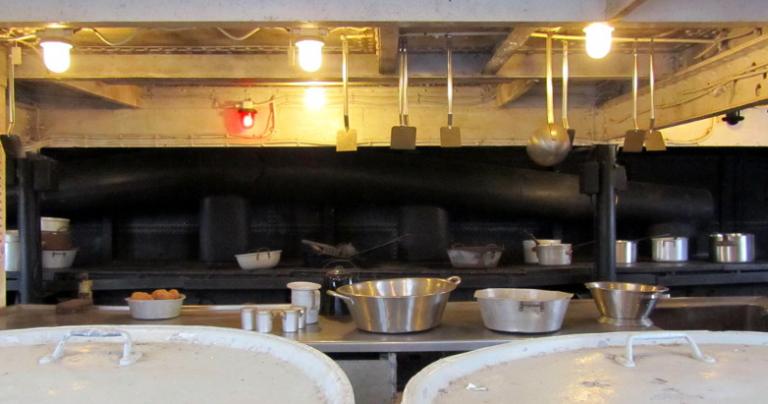
galley of the Battleship Texas
Cookbooks and recipes get us started
We grow up spending so much time in and around kitchens that we think we know how to cook. But the first time we’re alone and hungry and wander into the kitchen, we usually end up with a baloney sandwich.
I remember being 10 or 11 years old and wanting to learn to cook. I was happy that my mother and my grandmother cooked for me, but I knew I’d be leaving home at some point and I wanted to be able to take care of myself. Plus it looked like fun.
My mother – who learned to cook by helping her mother over many years – really didn’t have the time to give me cooking lessons. And at that age, I doubt I had the patience for it. But it was easy for her to hand me a recipe and say “here, bake a cake.” And so I did. My early cooking lessons came from recipes and cookbooks. I didn’t have to guess and I didn’t have to figure it out by trial and error, I could just follow the recipe.
Walking into the Kitchen of the Gods can be every bit as intimidating as walking into your mother’s kitchen “with intent” for the first time. And so many people walk out with the spiritual equivalent of a baloney sandwich: quick, easy, and filling, but not particularly nutritious or satisfying.
Religious traditions preserved in books, arts, rituals, and practices are the recipes that get us started. They let us know that those who came before us did certain things in certain ways at certain times. Those practices produced certain experiences. And they formed beliefs around those experiences, to help them understand them and incorporate them into their lives.
Our religious cookbooks and recipes get us started.
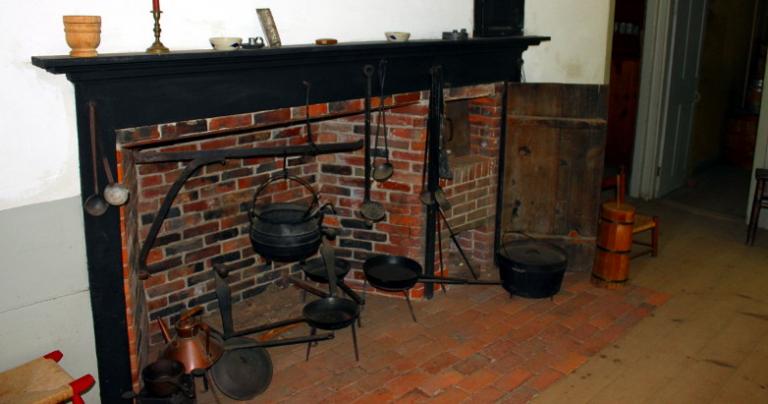
Revolutionary War era kitchen in Hartwell Tavern, Minute Man National Park
Learn the rules so you can break them
Cooking with a recipe is a step beyond ordering off the menu, but you’re still following instructions written by someone else. For many people, that’s enough. The chocolate cake recipe my mother handed me worked out pretty well – there was no need to tinker with it.
On the other hand, I’ve been working for years to learn how to cook a steak just right. I’ve experimented with grill temperatures, cooking times, turning times, seasonings, and resting times. I’ve mostly got it figured out, but I still make adjustments based on cut, grade, and thickness… and sometimes I still end up overcooking it.
If I’m writing a high day ritual, I’ll start with liturgy and themes I’ve used in the past, but then I’ll make adjustments based on the location, the audience, current events, and what various Gods and spirits are telling me to do. If you know the “Beltane recipe” you can make tweaks and changes and be confident things will turn out OK.
Learn the rules, then break them mindfully.
Becoming a master chef takes years of practice
I like cooking, and I love it when I try something new and it turns out really tasty. But at the end of the day, I just want to eat good food at a good price, when I want to eat it. I have no desire to put the time and effort into cooking elaborate gourmet meals. But I have great respect for those who do, and I enjoy eating their cooking, at least occasionally.
Not every Pagan wants to be a priest, a ritualist, or a theologian. Some are satisfied to live virtuous lives and honor the Gods according to their tradition. Some like to find their own way, but only want to take their journeys so far.
But others want to go as deep as they can go. They follow their tradition as far as it will take them. And then, since our ancestral religions were wiped out in the conversion to Christianity, they do their best to reimagine and re-create them. They end up off the map. And they make notes and draw maps so those who come after them can follow the trails they blazed.
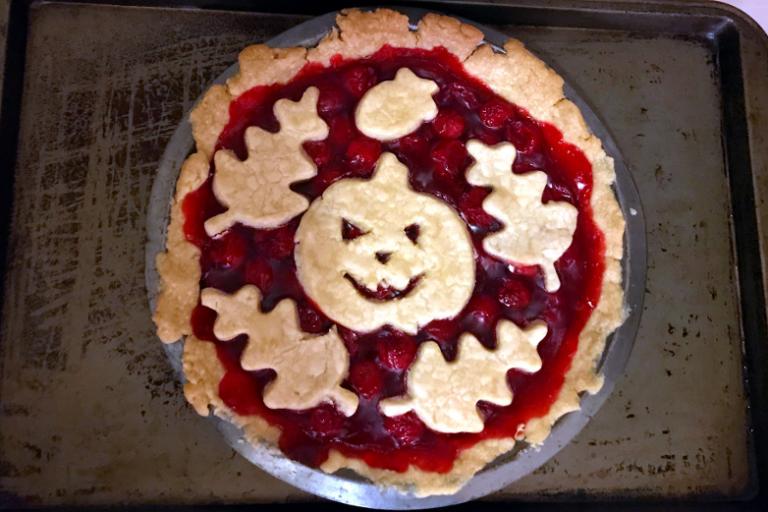
a thoroughly divine pie by Gabrielle Milburn and Cynthia Talbot
The proof is in the pudding
And that brings us back to Damh the Bard’s blog post and the emphasis on experience.
Whether you’re ordering off the menu, cooking from a recipe, or developing your own culinary creations, the most important question is “how’s your dinner?” Is it filling, or does it leave you hungry and weak? Is it delicious (wouldst thou like to live deliciously?), or is bland or even bitter? Does it nourish your body and your soul, or is it full of empty calories?
Do your beliefs and practices help you find your place in the world? Do they help you form and maintain healthy relationships with your families and communities, in this world and beyond? Do they help you live a life that’s virtuous and even heroic?
If so, you’ve got a pretty good meal, no matter who cooked it.
If not, maybe you need to find a new restaurant, or take some cooking lessons.
But whatever you do, don’t settle for a baloney sandwich.
Previous Post

April 5, 2018
The Impact of Human Activity on Sacred Sites
Next Post

April 10, 2018 Conversations Under the Oaks: April Q&A
Browse Our Archives
Select a Category Books Community CUUPS Druidry Foundations and Context Gods and Goddesses Magic Myth Nature Ritual Spiritual Practice Theology Travel Uncategorized Videos
Select a Month October 2026 September 2026 August 2026 July 2026 June 2026 May 2026 April 2026 March 2026 February 2026 January 2026 December 2025 November 2025 October 2025 September 2025 August 2025 July 2025 June 2025 May 2025 April 2025 March 2025 February 2025 January 2025 December 2024 November 2024 October 2024 September 2024 August 2024 July 2024 June 2024 May 2024 April 2024 March 2024 February 2024 January 2024 December 2023 November 2023 October 2023 September 2023 August 2023 July 2023 June 2023 May 2023 April 2023 March 2023 February 2023 January 2023 December 2022 November 2022 October 2022 September 2022 August 2022 July 2022 June 2022 May 2022 April 2022 March 2022 February 2022 January 2022 December 2021 November 2021 October 2021 September 2021 August 2021 July 2021 June 2021 May 2021 April 2021 March 2021 February 2021 January 2021 December 2020 November 2020 October 2020 September 2020 August 2020 July 2020 June 2020 May 2020 April 2020 March 2020 February 2020 January 2020 December 2019 November 2019 October 2019 September 2019 August 2019 July 2019 June 2019 May 2019 April 2019 March 2019 February 2019 January 2019 December 2018 November 2018 October 2018 September 2018 August 2018 July 2018 June 2018 May 2018 April 2018 March 2018 February 2018 January 2018 December 2017 November 2017 October 2017 September 2017 August 2017 July 2017 June 2017 May 2017 April 2017 March 2017 February 2017 January 2017 December 2016 November 2016 October 2016 September 2016 August 2016 July 2016 June 2016 May 2016 April 2016 March 2016 February 2016 January 2016 December 2015 November 2015 October 2015 September 2015 August 2015 July 2015 June 2015 May 2015 April 2015 March 2015 February 2015 January 2015 December 2014 November 2014 October 2014 September 2014 August 2014 July 2014 June 2014 May 2014 April 2014 March 2014 February 2014 January 2014 December 2013 November 2013 October 2013 September 2013 August 2013 July 2013 June 2013 May 2013 April 2013 March 2013 February 2013 January 2013 December 2012 November 2012 October 2012 September 2012 August 2012 July 2012 June 2012 May 2012 April 2012 March 2012 February 2012 January 2012 December 2011 November 2011 October 2011 September 2011 August 2011 July 2011 June 2011 May 2011 April 2011 March 2011 February 2011 January 2011 December 2010 November 2010 October 2010 September 2010 August 2010 July 2010 June 2010 May 2010 April 2010 March 2010 February 2010 January 2010 December 2009 November 2009 October 2009 September 2009 August 2009 July 2009 June 2009 May 2009 April 2009 March 2009 February 2009 January 2009 December 2008 November 2008 October 2008 September 2008 August 2008 July 2008 June 2008
Follow Us!
TAKE THE
Religious Wisdom Quiz
How many years between David's reign and the Babylonian exile?
Select your answer to see how you score.
500 years 450 years 400 years 300 years
Related posts from John Beckett




What We Lose When “Ask AI” Becomes A...
TRENDING AT PATHEOS Pagan

The Sermon on the Mount, Part I: Matthew...
The Sermon on the Mount, Part I (Matthew 4:12-5:12) St. Matthew moves...

What's up from Crossway: Reviewing some of their latest A few weeks...

Janie Learns the Way of the Cross: A...
Teaching children about Jesus' Passion can be challenging. Many parents and educators...

Looking For Good Catholic Writing - October 2026
He alone extends the heavens, and he walks upon the waves of...

In "Irreplaceable," our book on vocation and technology, Trevor Sutton and I...

I was strolling through the top floor of the brand new Parthenon...
view all Pagan blogs
Ad-Free & Subscriber Log-In Subscription Support
- About Us
- 2026 Calendar
- Videos
- Podcasts
- Library of World Religions
- Faith In Media Tracker
- Advertise With Us
- Write for Us
- Privacy Policy
- Terms of Service
- Do Not Sell My Data
- Contact Us
- Radiant Digital
- Manage Newsletter Subscriptions
- Unsubscribe From Notifications
- Sitemap
Copyright 2008-2026, Patheos. All rights reserved.
Subscription Support Ad-Free & Subscriber Log-In
Follow Patheos