
BuddhistCatholicContemplativeEvangelicalGeneral ChristianHinduJewishLatter-day SaintMuslimNew VisionsProgressive Christian
Beliefs
- Buddhist
- Catholic
- Contemplative
- Evangelical
- General Christian
- Hindu
- Jewish
- Latter-day Saint
- More Voices
- Muslim
- New Visions
- Pagan
- Progressive Christian
Topics
- Religion News
- Food and Religion
- Sports and Religion
- Religious Art
- Religious Music and Entertainment
- Religious Events
- History and Religion
- Style and Religion
- Politics and Religion
- Women in Religion
- Recreation Outdoors and Religion
- Business Finance and Religion
- Careers Workplace and Religion
- Education and Religion
- Family Parenting and Religion
- Health Fitness and Religion
- Home and Religion
- Relationships and Religion
- Technology and Religion
- Travel and Religion
Columnists
- Buddhist Columnists
- Business Finance and Religion Columnists
- Careers Workplace and Religion Columnists
- Catholic Columnists
- Contemplative Columnists
- Education and Religion Columnists
- Evangelists Columnists
- Family Parenting and Religion Columnists
- General Christian Columnists
- Health Fitness and Religion Columnists
- Hindu Columnists
- History and Religion Columnists
- Home and Religion Columnists
- Jewish Columnists
- More Voices Columnists
- Latter Day Columnists
- Muslim Columnists
- New Visions Columnists
- Nonreligious Columnists
- Pagan Columnists
- Politics and Religion Columnists
- Progressive Columnists
- Recreation Outdoors and Religion Columnists
- Relationships and Religion Columnists
- Religion News Columnists
- Religious Art Columnists
- Religious Events Columnists
- Religious Music and Entertainment Columnists
- Sports and Religion Columnists
- Style and Religion Columnists
- Technology and Religion Columnists
- Travel and Religion Columnists
- Women in Religion Columnists
Resource Library
- 2026 Calendar
- Library of World Religions
- The 100 Most Holy Places on Earth
- Patheos Answers
- Podcasts
- Videos
- Faith Leaders Database
- Anglican Episcopalian
- Bahai
- Baptist
- Buddhism
- Christianity
- Confucianism
- Eastern Orthodoxy
- Hinduism
- Holiness and Pentecostal
- ISKCON
- Islam
- Judaism
- Lutheran
- Methodist
- The Church of Jesus Christ of Latter-day Saints
- New Age
- Paganism
- Presbytarian and Reformed
- Protestantism
- Religion Behind the Scenes
- Roman Catholic
- Scientology
- Shia Islam
- Sikhism
- Sufism
- Sunni Islam
- Taoism
- Zen
- See all religions
Research Tools
 Ad-Free & Subscriber Log-In Subscription Support
Ad-Free & Subscriber Log-In Subscription Support
Follow Patheos 

- Trending:
- Forgiveness
- |
- Marriage
- |
- Consciousness
- |
- Death Penalty
- |
- Election
- |
- Halloween

- Home
- Pagan
- Conversations Under the Oaks: April Q&A
Conversations Under the Oaks: April Q&A
Last updated on: April 10, 2018 at 3:00 am by John Beckett
Conversations Under the Oaks: April Q&A 2018-04-04T18:50:13-06:00 John Beckett
Patheos Explore the world's faith through different perspectives on religion and spirituality! Patheos has the views of the prevalent religions and spiritualities of the world.
Welcome to the fourth Conversations Under the Oaks, a monthly Q&A feature. I skipped March because of my travels, but I’m back this month with your chance to ask me anything.
Questions have been edited for brevity – names are used where I have explicit permission.
Ana Simoes has questions about Druid teachings in two contemporary orders. “I am currently working on both the Bardic Grade (OBOD) and the Dedicant Path (ADF). I am a polytheist, so the vision of the God/Goddess duality makes no sense, nor does the Triple Goddess (maiden, mother, and crone). I also do not believe in the Three Worlds.
Another teaching I am finding a hard time working with is the Shining Ones. I tend to use what makes sense to me and respectfully discard what does not. What I would like to know was what is your input concerning the Shining Ones.”
I don’t believe in the Three Worlds either. While the duotheist idea of God and Goddess provides a gender balance lacking in monotheism, too frequently (though not always) it degenerates into gender essentialism. And while there are numerous Triple Goddesses in our ancient traditions (the Morrigan being one of them, though She may be even more complex than that) the whole maiden-mother-crone thing is a 20th century invention.
The good news is that neither OBOD nor ADF demand fidelity to orthodox beliefs or interpretations. OBOD in particular is intentionally vague about the nature of the Gods and the universe. OBOD’s greatest value lies in the set of spiritual practices it teaches, and the journey of self-discovery and service those practices promote. OBOD is a set of spiritual technologies that will work in the context of almost any religion or religious approach.

ADF’s Cosmos Sigil – Trout Lake Abbey, Washington
ADF is much less vague about cosmology and theology, but as they like to say, they are orthopraxic (right action) rather than orthodoxic (right belief), and there is plenty of room for differing ideas and interpretations. As a polytheist I’ve always felt very much at home in ADF, and my personal liturgy draws heavily from ADF’s Core Order of Ritual.
And that brings us to your question about the Shining Ones. Let’s start with this definition by former Archdruid Ian Corrigan:
The Shining Ones are the eldest, mightiest and wisest of the beings in the Great Weaving. The First Mother and First Father, the Triple Kingship and the Goddesses of Sovereignty, Inspiration and Bounty; the powers of Love, Artisanry and Healing; the Child of Light and Shadow; all are reflected in the many cultural pantheons of the Celtic peoples.
That sounds like Gods to me.
My understanding is that ADF’s founders wanted to avoid the baggage around the “G-word.” But also, if you read the Celtic tales, you’ll find some of the “eldest, mightiest and wisest” described as “shining ones.”
Is that because the Tuatha De Danann are part of the Fae, some of whom are also described as “shining”? Is it because the Christian monks who first committed these stories to writing would not call them Gods and grabbed a convenient term instead? Or perhaps our Celtic ancestors saw the various spiritual beings as existing on a spectrum rather than in distinct categories (an idea I’m rather fond of). We don’t know, and likely we never will.
But when I hear “Shining Ones” in ADF ritual, I think “Gods” and keep moving.
Also, when going through your Druid path studies, was there any information that clashed with your Pagan beliefs? How did you cope with that?
That happened numerous times, although none of them come to mind… which should tell you something about how much I worried about these “clashes.” Again, neither OBOD nor ADF demand fidelity to a creed or statement of belief.
When I come across new and/or challenging ideas and concepts, I give them fair consideration. OBOD was my training as a Druid, and I wanted to absorb everything they taught, even the parts I knew I wouldn’t agree with (such as much of the Anglican-influenced material of the Druid Revival). This is my heritage as a Druid, and I want to understand it as fully as I can.
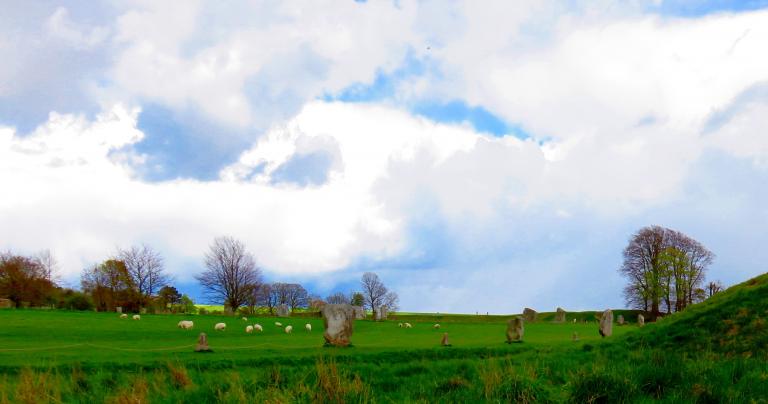
Avebury – 2016
A few times I decided the OBOD concepts were right and my own thinking was wrong. Most times I simply sought to understand it without judging it. And a few times I said “no, that’s flat-out wrong.”
So I think using what makes sense and discarding what doesn’t is a good approach. Just make sure you learn the material that is part of your heritage, and that you don’t dismiss challenging ideas without giving them fair consideration.
An anonymous reader asks “I was discussing polytheism with someone and they asked if, although each God is their own separate being, there is one that rules them all, or if there is a source. Do you have an opinion on either of these things?”
Is there a source? If you believe the Universe was created then there must be a source. Our many creation myths (including the Big Bang, which is both a myth and a scientific theory) require either primordial materials or a creator or both. But these myths tend to be rather vague as to where said materials or creators came from, and the creator Gods tend to die or fade away or be conquered by their children. Think of the Titans being defeated by the Olympians, or of Ra growing old and Isis taking his power.
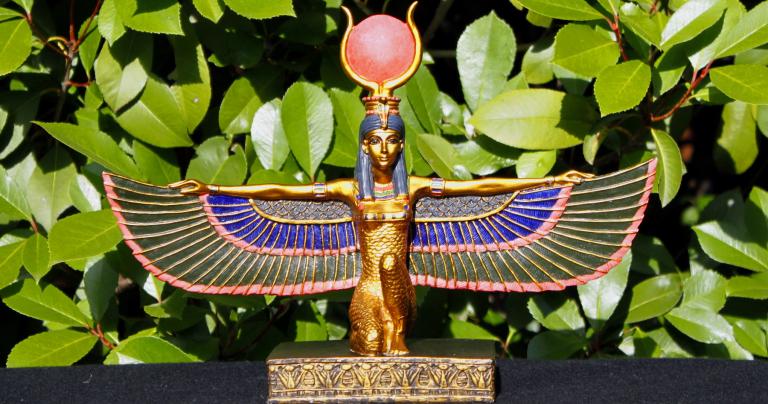
Isis (Auset)
On the other hand, if you believe the Universe is a steady state then the Gods have always existed and there is no source.
Either way, the source – if it even exists – is difficult if not impossible for humans to relate to and to communicate with. But we can and do relate to and communicate with the many Gods. Those relationships are the focus of my polytheism.
Is there one God who rules them all? We have no indication – from lore or from UPG – that there is a Supreme God over all the many deities from all the many cultures of the world.
Many of the individual pantheons are hierarchical: Zeus is King of the Olympians. The Tuatha De Danann have had several kings, including Nuada, Bres, and Lugh. The Morrigan’s name translates as “the Great Queen,” though exactly what She’s queen of is somewhat uncertain. But their stories make it clear that like human kings and queens, while their power is great it is far from absolute.
Protestant Christianity – the dominant religion and religious worldview of our culture – places an inordinate emphasis on only worshipping the “Supreme God.” This concept is decidedly unhelpful in polytheist religions. As polytheists, we worship many divine beings, and we honor many other beings who are not divine… and we sometimes speculate about just how useful that “divine / not divine” categorization really is.
Anne of The Gods Are Bored has a problem. “I have a very hard time uprooting seedling trees. Can you devise a prayer or devotion I can say before, during, or after this process?”
I’m reminded of the “scientific” definition of a weed: a plant that’s in a place unfavorable to humans. We have no problem uprooting ragweed and crabgrass, but many of us of a Druid persuasion feel differently about trees. We know we’re ending what could be a long life of beauty and power.
Could be.
Different species have different reproductive strategies. Some – like humans – produce offspring one at a time (for the most part). Each individual is important to the survival of the species. Others – like dogs and cats – have small litters, knowing that some of them will die before they’re old enough to reproduce. And others – like frogs – lay hundreds of eggs, knowing that the majority of them will die early, but a critical few will live.
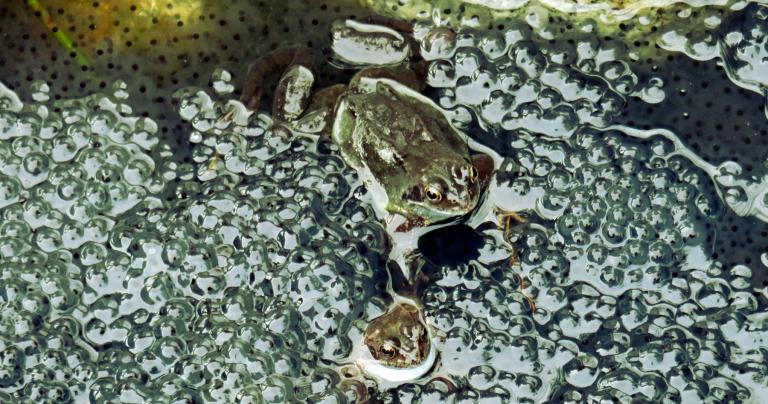
frogs and eggs at Newgrange
An oak tree can produce thousands of acorns in a year. Most of those will be food for squirrels and other animals. Some will sprout and take root. Some of those will end up being food, some won’t get enough water, and some will grow in areas where there’s a strong competition for sunlight. Only a tiny fraction will actually become trees.
If you didn’t uproot them (and something didn’t eat them), odds are good one of them would outgrow the others and starve them into a sunless death. Yes, you’re killing a potential tree, but if you didn’t do it, the odds are very likely that something else would.
Still, we recognize that in the moment, a seedling is a living being – a person for those of us with animist views. I see uprooting a seedling less like uprooting ragweed and more like killing an animal or a plant for food. We sacrifice an individual for our own needs, but – if we are ethical… and if we have any sense – we commit to insuring that the species will continue.
So I think a prayer for uprooted seedlings should be very similar to a prayer for a butchered chicken or for harvested grain. Something like this:
Hail to you, seedling trees.
Because of your sacrifice, these (trees, flowers, grasses, etc. – whatever is growing where the seedling is) can grow and thrive.
Your family continues (point toward an existing tree of the same species, or if there are none nearby, name a place where they grow).
May your journey to the Otherworld be safe and pleasant.
Thank you for your sacrifice
Hail and farewell.
Previous Post

April 8, 2018
Learning to Cook in the Kitchen of the Gods
Next Post

April 12, 2018 Solas Bhride: A Goddess Speaks Softly in Many Forms
Browse Our Archives
Select a Category Books Community CUUPS Druidry Foundations and Context Gods and Goddesses Magic Myth Nature Ritual Spiritual Practice Theology Travel Uncategorized Videos
Select a Month October 2026 September 2026 August 2026 July 2026 June 2026 May 2026 April 2026 March 2026 February 2026 January 2026 December 2025 November 2025 October 2025 September 2025 August 2025 July 2025 June 2025 May 2025 April 2025 March 2025 February 2025 January 2025 December 2024 November 2024 October 2024 September 2024 August 2024 July 2024 June 2024 May 2024 April 2024 March 2024 February 2024 January 2024 December 2023 November 2023 October 2023 September 2023 August 2023 July 2023 June 2023 May 2023 April 2023 March 2023 February 2023 January 2023 December 2022 November 2022 October 2022 September 2022 August 2022 July 2022 June 2022 May 2022 April 2022 March 2022 February 2022 January 2022 December 2021 November 2021 October 2021 September 2021 August 2021 July 2021 June 2021 May 2021 April 2021 March 2021 February 2021 January 2021 December 2020 November 2020 October 2020 September 2020 August 2020 July 2020 June 2020 May 2020 April 2020 March 2020 February 2020 January 2020 December 2019 November 2019 October 2019 September 2019 August 2019 July 2019 June 2019 May 2019 April 2019 March 2019 February 2019 January 2019 December 2018 November 2018 October 2018 September 2018 August 2018 July 2018 June 2018 May 2018 April 2018 March 2018 February 2018 January 2018 December 2017 November 2017 October 2017 September 2017 August 2017 July 2017 June 2017 May 2017 April 2017 March 2017 February 2017 January 2017 December 2016 November 2016 October 2016 September 2016 August 2016 July 2016 June 2016 May 2016 April 2016 March 2016 February 2016 January 2016 December 2015 November 2015 October 2015 September 2015 August 2015 July 2015 June 2015 May 2015 April 2015 March 2015 February 2015 January 2015 December 2014 November 2014 October 2014 September 2014 August 2014 July 2014 June 2014 May 2014 April 2014 March 2014 February 2014 January 2014 December 2013 November 2013 October 2013 September 2013 August 2013 July 2013 June 2013 May 2013 April 2013 March 2013 February 2013 January 2013 December 2012 November 2012 October 2012 September 2012 August 2012 July 2012 June 2012 May 2012 April 2012 March 2012 February 2012 January 2012 December 2011 November 2011 October 2011 September 2011 August 2011 July 2011 June 2011 May 2011 April 2011 March 2011 February 2011 January 2011 December 2010 November 2010 October 2010 September 2010 August 2010 July 2010 June 2010 May 2010 April 2010 March 2010 February 2010 January 2010 December 2009 November 2009 October 2009 September 2009 August 2009 July 2009 June 2009 May 2009 April 2009 March 2009 February 2009 January 2009 December 2008 November 2008 October 2008 September 2008 August 2008 July 2008 June 2008
Follow Us!
TAKE THE
Religious Wisdom Quiz
Who was the high priest during the boyhood of Samuel?
Select your answer to see how you score.
Eli Phinehas Hophni Ahijah
Related posts from John Beckett




What We Lose When “Ask AI” Becomes A...
TRENDING AT PATHEOS Pagan

Janie Learns the Way of the Cross: A...
Teaching children about Jesus' Passion can be challenging. Many parents and educators...

Looking For Good Catholic Writing - October 2026
He alone extends the heavens, and he walks upon the waves of...

In "Irreplaceable," our book on vocation and technology, Trevor Sutton and I...

I was strolling through the top floor of the brand new Parthenon...

What Does Gêvâh Mean For Kimberley Guifoyle &...
This week, a lot of the news is focused on Kimberly Guilfoyle....

INNER CIRCLE: Profound Mystery (Of Christ In All...
Ephesians 5:31-32 “For this reason, a man will leave his father and...
view all Pagan blogs
Ad-Free & Subscriber Log-In Subscription Support
- About Us
- 2026 Calendar
- Videos
- Podcasts
- Library of World Religions
- Faith In Media Tracker
- Advertise With Us
- Write for Us
- Privacy Policy
- Terms of Service
- Do Not Sell My Data
- Contact Us
- Radiant Digital
- Manage Newsletter Subscriptions
- Unsubscribe From Notifications
- Sitemap
Copyright 2008-2026, Patheos. All rights reserved.
Subscription Support Ad-Free & Subscriber Log-In
Follow Patheos