
BuddhistCatholicContemplativeEvangelicalGeneral ChristianHinduJewishLatter-day SaintMuslimNew VisionsProgressive Christian
Beliefs
- Buddhist
- Catholic
- Contemplative
- Evangelical
- General Christian
- Hindu
- Jewish
- Latter-day Saint
- More Voices
- Muslim
- New Visions
- Pagan
- Progressive Christian
Topics
- Religion News
- Food and Religion
- Sports and Religion
- Religious Art
- Religious Music and Entertainment
- Religious Events
- History and Religion
- Style and Religion
- Politics and Religion
- Women in Religion
- Recreation Outdoors and Religion
- Business Finance and Religion
- Careers Workplace and Religion
- Education and Religion
- Family Parenting and Religion
- Health Fitness and Religion
- Home and Religion
- Relationships and Religion
- Technology and Religion
- Travel and Religion
Columnists
- Buddhist Columnists
- Business Finance and Religion Columnists
- Careers Workplace and Religion Columnists
- Catholic Columnists
- Contemplative Columnists
- Education and Religion Columnists
- Evangelists Columnists
- Family Parenting and Religion Columnists
- General Christian Columnists
- Health Fitness and Religion Columnists
- Hindu Columnists
- History and Religion Columnists
- Home and Religion Columnists
- Jewish Columnists
- More Voices Columnists
- Latter Day Columnists
- Muslim Columnists
- New Visions Columnists
- Nonreligious Columnists
- Pagan Columnists
- Politics and Religion Columnists
- Progressive Columnists
- Recreation Outdoors and Religion Columnists
- Relationships and Religion Columnists
- Religion News Columnists
- Religious Art Columnists
- Religious Events Columnists
- Religious Music and Entertainment Columnists
- Sports and Religion Columnists
- Style and Religion Columnists
- Technology and Religion Columnists
- Travel and Religion Columnists
- Women in Religion Columnists
Resource Library
- 2026 Calendar
- Library of World Religions
- The 100 Most Holy Places on Earth
- Patheos Answers
- Podcasts
- Videos
- Faith Leaders Database
- Anglican Episcopalian
- Bahai
- Baptist
- Buddhism
- Christianity
- Confucianism
- Eastern Orthodoxy
- Hinduism
- Holiness and Pentecostal
- ISKCON
- Islam
- Judaism
- Lutheran
- Methodist
- The Church of Jesus Christ of Latter-day Saints
- New Age
- Paganism
- Presbytarian and Reformed
- Protestantism
- Religion Behind the Scenes
- Roman Catholic
- Scientology
- Shia Islam
- Sikhism
- Sufism
- Sunni Islam
- Taoism
- Zen
- See all religions
Research Tools
 Ad-Free & Subscriber Log-In Subscription Support
Ad-Free & Subscriber Log-In Subscription Support
Follow Patheos 

- Trending:
- Forgiveness
- |
- Marriage
- |
- Consciousness
- |
- Death Penalty
- |
- Election
- |
- Halloween

- Home
- Pagan
- Pragmatism Is Necessary But Not Sufficient – A Pagan Interfaith Approach
Pragmatism Is Necessary But Not Sufficient – A Pagan Interfaith Approach
Last updated on: October 24, 2017 at 8:32 am by John Beckett
Pragmatism Is Necessary But Not Sufficient – A Pagan Interfaith Approach 2017-10-24T08:32:21-06:00 John Beckett
Patheos Explore the world's faith through different perspectives on religion and spirituality! Patheos has the views of the prevalent religions and spiritualities of the world.
I love it when a blog post inspires a response from another blogger. Whether we agree, disagree, or a little of both, continuing conversation is how ideas are tested and refined.
Last week, Kimberly Kirner of The Wild Druid blog at Pagan Bloggers posted Pragmatism and Outcomes-Oriented Religion, a response to the post on another site that also inspired my The Otherworld Needs to be Experienced, Not Escaped. Kim’s post is excellent and I encourage you to read it in its entirety. Here’s a key quote:
How else could we think about religion and its diversity, if we care about forging broad interfaith or inter-Pagan movements to change the world for the better? I would offer that one way to proceed would be pragmatism, and particularly thinking of religion in an outcomes-oriented way.
Pragmatism evaluates truth (of a belief, worldview, practice) based on its practical application. Successes mean that truth is present, regardless of whether that truth makes sense for another person.
I strongly agree with this – I’ve been talking about it on an individual basis for years. Religious truth claims are virtually impossible to prove or disprove with any degree of certainty. Rather than attempting to “prove” your beliefs and practices are true with misinterpretations of science or with references to sacred texts of dubious accuracy, simply ask “does this work?” Does it make your life better? Does it help you live a life that’s connected, compassionate, and sustainable? Does it motivate you to leave the world a better place than you found it? If so, then it’s as true as you’re going to get.
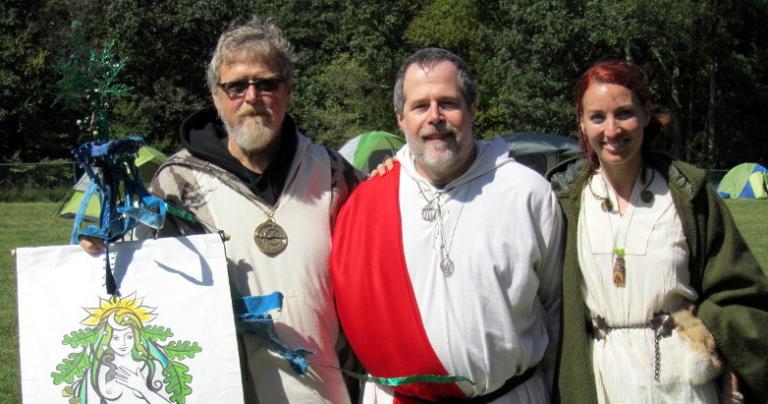
with the late James Bianchi and Kimberly Kirner at the 2012 OBOD East Coast Gathering
Worldview has no impact on behavior
Our Protestant-dominated culture emphasizes the importance of right belief. Many of us – even Pagans, even atheists – like to think that if everyone just believed the right things they’d do the right things. I’ve argued that if more people saw Nature as a living being and understood the interconnectedness of all things they’d do a better job of preserving ecosystems and living sustainably.
Unfortunately, the evidence says that’s not true. Kimberly Kirner is an anthropology professor – she has the data to back it up.
The idea that thought generates action underlies most educational-type social service programs, ranging from educating women about family planning to educating people about why it’s important to recycle and buy solar panels.
The problem is, I don’t think it works that way (and a lot of research indicates it doesn’t, as well).
So if believing the “right” things has little or no effect on our behaviors, and since only behaviors impact other people, we have no right to insist that other people believe the things we think are right. As Kim suggests, the only grounds we have from which to judge anyone else’s religion are pragmatic grounds.
An interfaith approach
The interfaith movement has operated on this approach for decades. While it has mostly consisted of various Christian denominations with the occasional token Jew, recently it’s become much more inclusive. I’ve represented Paganism in interfaith events with Buddhists, Hindus, Muslims, Baha’is, and Unitarian Universalists, as well as with Christians and Jews.
We have few shared beliefs – we have many shared values. If a Wiccan cares for the Earth because it’s the body of the Goddess, a Christian cares for the Earth because it’s God’s creation, and an atheist cares for the Earth because it’s the only planet we’ve got, all three are doing good work. Their differing motivation is irrelevant.
Paganism is not one religion. It’s a religious movement, a Big Tent that includes many religions and religious outlooks. The outcomes-oriented, pragmatic religious approach that Kim recommends in her conclusions are an excellent way to approach relations between our various Pagan traditions.

Differences still matter
When I first read Kimberly Kirner’s blog post, I told her I didn’t agree with all of it. On further reflection, I do agree with all of it. But now I want to pick up the conversation where she left off.
Some people are only looking for a positive outcome. They want a pragmatic religion that makes their lives better and easier, and they don’t much care what it is. For some that’s an Evangelical megachurch. For some it’s Buddhist meditation. For some it’s no religion at all.
For others, though, the particular path matters a lot.
Maybe you don’t care if the many Gods are individuals or if they’re aspects of one God – I do. Maybe your focus is so much on the future that ancestors aren’t important to you – they are to me. Maybe magic isn’t important to you – it is to me.
These are core aspects of my religion. No pragmatic this-world action can substitute for growing in understanding of the Gods, embodying Their values and virtues, and interacting with Them in hospitality and reciprocity. If this isn’t important to you, trust me – I understand. But it’s extremely important to me. The pragmatism that is enough for some leaves me unfulfilled.
This is why humanity has many religions and not just one. Religious differences matter to individual practitioners and their collective traditions, even if they make no pragmatic difference, and even if non-practitioners don’t understand them.
When you criticize my beliefs, interfaith becomes intrafaith
I’m happy to interact with Humanistic Pagans, Christopagans, and soft polytheists on an interfaith basis. We don’t believe the same things and we don’t do the same things in our practices, but we can still work together where we have common interests. I’m happy to share Pagan Pride Day, Pantheacon, and even OBOD with all of them and others.
But when someone who calls themselves a Pagan begins to criticize my beliefs and practices, the encounter moves from interfaith to intrafaith. When that happens, we’re not arguing about pragmatism and outcomes anymore. Now we’re arguing about foundational assumptions, religious experiences, myths and legends and their interpretations. Now we’re into the geeky, nerdy, “inside baseball” details of Pagan and polytheist religions.
Which I love, as those of you who’ve been following this blog for a while figured out a long time ago.
Some people are offended if you challenge their religion. Some are intimidated. I am neither. In the very first post on Under the Ancient Oaks I said:
I’m starting this blog because I need to work through some spiritual issues … I hope to attract some comments and questions that will help point me in the right direction. The end result will be a deeper, more consistent, more meaningful religious theory and practice.
Challenges force me to examine my religion in greater detail – do I really believe that? Does that practice really do what I said it does? Challenges force me to do a better job of articulating my religion – sometimes I’m misunderstood because I didn’t express myself in clear, precise language.
My goal is not to defend some non-existent Pagan orthodoxy. My goal is to test and refine my religion so I can make it as deep, authentic, and meaningful as it can be.
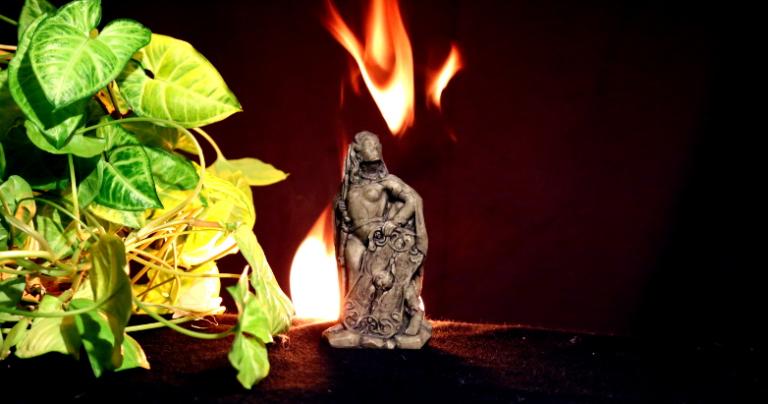
The ground rules of Pagan debate
If you don’t like religious debate, or if you don’t like the fact that debate often turns into argument, simply decline to participate. It’s not required. Say your prayers, pour your offerings, and get on with living your life as you see fit.
But if you do want to debate – and in particular, if you want to debate with me – you have two options.
You can approach me (or anyone else) in an interfaith manner, from a pragmatic viewpoint only, and in light of Kim’s research that shows worldview has no impact on behavior. If you think my actions bring unhelpful outcomes, challenge them… but without attacking my religious beliefs and spiritual practices.
Or you can approach me as a co-religionist, in which case you should prepare to debate religious issues from a foundation built on animism, polytheism, and first-hand experience – because that’s how I’m going to respond.
To be clear: “you’re not a polytheist” isn’t a defense against weak foundations and inconsistent logic. If an atheist thinks something I write doesn’t make sense, I want to hear their critique – I really do want to test and refine my religion and make it as robust as possible. But if all your argument consists of is a baseless claim that “prayer is an utter waste of time” expect to be shown the door.
The future of Paganism
Jason Mankey had a post last week titled Perhaps the Word “Pagan” Has Become Inadequate? I think it’s always been inadequate.
I expect that over time, our individual traditions will grow in both numbers and in depth. As they do, more people will think of themselves as Gardnerian Wiccans or Hellenists or Celtic Polytheists and fewer will think of themselves as Pagans. But the Big Tent of Paganism will remain as an entry point for seekers, and as a banner for us to gather under for censuses and large projects and gatherings.
I hope we don’t end up like Christianity, where Catholics and Evangelicals and everybody else argues over which group are the “real” Christians.
Instead, I hope we agree there are many ways to be a Pagan, and those many ways have names of their own.
Where our ways differ from others, let us meet them respectfully in an interfaith setting, and evaluate each other on a pragmatic, outcomes-oriented basis.
And where we claim the same names, let us challenge each other (again, respectfully) to define our assumptions, to study our lore, to practice deeply, to experience fully, and to interpret all of it in ways that are meaningful and helpful both individually and collectively.
That will bring us a future of many strong and vibrant Pagan religions.

Previous Post

October 22, 2017
I’m Supporting The Wild Hunt Again This Year
Next Post

October 26, 2017 Reclaiming Civilization: A Case For Optimism For The Future Of Humanity
Browse Our Archives
Select a Category Books Community CUUPS Druidry Foundations and Context Gods and Goddesses Magic Myth Nature Ritual Spiritual Practice Theology Travel Uncategorized Videos
Select a Month October 2026 September 2026 August 2026 July 2026 June 2026 May 2026 April 2026 March 2026 February 2026 January 2026 December 2025 November 2025 October 2025 September 2025 August 2025 July 2025 June 2025 May 2025 April 2025 March 2025 February 2025 January 2025 December 2024 November 2024 October 2024 September 2024 August 2024 July 2024 June 2024 May 2024 April 2024 March 2024 February 2024 January 2024 December 2023 November 2023 October 2023 September 2023 August 2023 July 2023 June 2023 May 2023 April 2023 March 2023 February 2023 January 2023 December 2022 November 2022 October 2022 September 2022 August 2022 July 2022 June 2022 May 2022 April 2022 March 2022 February 2022 January 2022 December 2021 November 2021 October 2021 September 2021 August 2021 July 2021 June 2021 May 2021 April 2021 March 2021 February 2021 January 2021 December 2020 November 2020 October 2020 September 2020 August 2020 July 2020 June 2020 May 2020 April 2020 March 2020 February 2020 January 2020 December 2019 November 2019 October 2019 September 2019 August 2019 July 2019 June 2019 May 2019 April 2019 March 2019 February 2019 January 2019 December 2018 November 2018 October 2018 September 2018 August 2018 July 2018 June 2018 May 2018 April 2018 March 2018 February 2018 January 2018 December 2017 November 2017 October 2017 September 2017 August 2017 July 2017 June 2017 May 2017 April 2017 March 2017 February 2017 January 2017 December 2016 November 2016 October 2016 September 2016 August 2016 July 2016 June 2016 May 2016 April 2016 March 2016 February 2016 January 2016 December 2015 November 2015 October 2015 September 2015 August 2015 July 2015 June 2015 May 2015 April 2015 March 2015 February 2015 January 2015 December 2014 November 2014 October 2014 September 2014 August 2014 July 2014 June 2014 May 2014 April 2014 March 2014 February 2014 January 2014 December 2013 November 2013 October 2013 September 2013 August 2013 July 2013 June 2013 May 2013 April 2013 March 2013 February 2013 January 2013 December 2012 November 2012 October 2012 September 2012 August 2012 July 2012 June 2012 May 2012 April 2012 March 2012 February 2012 January 2012 December 2011 November 2011 October 2011 September 2011 August 2011 July 2011 June 2011 May 2011 April 2011 March 2011 February 2011 January 2011 December 2010 November 2010 October 2010 September 2010 August 2010 July 2010 June 2010 May 2010 April 2010 March 2010 February 2010 January 2010 December 2009 November 2009 October 2009 September 2009 August 2009 July 2009 June 2009 May 2009 April 2009 March 2009 February 2009 January 2009 December 2008 November 2008 October 2008 September 2008 August 2008 July 2008 June 2008
Follow Us!
TAKE THE
Religious Wisdom Quiz
Which Christian movement began with John Wesley in the 18th century?
Select your answer to see how you score.
Lutheranism Methodism Calvinism Presbyterianism
Related posts from John Beckett


The Vampire Films of Jean Rollin


Bo French Doesn’t Understand Texas
TRENDING AT PATHEOS Pagan

Letters on Living the Faith by C.S. Lewis
Most of us met C.S. Lewis as a public intellectual. Mere Christianity....

When Halloween Unmasks Married Hearts
Written by Dr. David K. Ewen from Eternal Truth Bible College Behind...

Aristotle. He’s been called the father of logic, the father of the...

Methodist Central Hall and Westminster Abbey
Situated on the same square is Methodist Central Hall and Westminster Abbey. ...

57th Dove Awards Honor Dolly Parton, Crown New...
On gospel music’s biggest night, the 57th annual GMA Dove Awards honored...

The First Eucharistic Controversy: Christ’s Real Presence
For Catholics, the Eucharist is the source and summit of the Christian...
view all Pagan blogs
Ad-Free & Subscriber Log-In Subscription Support
- About Us
- 2026 Calendar
- Videos
- Podcasts
- Library of World Religions
- Faith In Media Tracker
- Advertise With Us
- Write for Us
- Privacy Policy
- Terms of Service
- Do Not Sell My Data
- Contact Us
- Radiant Digital
- Manage Newsletter Subscriptions
- Unsubscribe From Notifications
- Sitemap
Copyright 2008-2026, Patheos. All rights reserved.
Subscription Support Ad-Free & Subscriber Log-In
Follow Patheos