
BuddhistCatholicContemplativeEvangelicalGeneral ChristianHinduJewishLatter-day SaintMuslimNew VisionsProgressive Christian
Beliefs
- Buddhist
- Catholic
- Contemplative
- Evangelical
- General Christian
- Hindu
- Jewish
- Latter-day Saint
- More Voices
- Muslim
- New Visions
- Pagan
- Progressive Christian
Topics
- Religion News
- Food and Religion
- Sports and Religion
- Religious Art
- Religious Music and Entertainment
- Religious Events
- History and Religion
- Style and Religion
- Politics and Religion
- Women in Religion
- Recreation Outdoors and Religion
- Business Finance and Religion
- Careers Workplace and Religion
- Education and Religion
- Family Parenting and Religion
- Health Fitness and Religion
- Home and Religion
- Relationships and Religion
- Technology and Religion
- Travel and Religion
Columnists
- Buddhist Columnists
- Business Finance and Religion Columnists
- Careers Workplace and Religion Columnists
- Catholic Columnists
- Contemplative Columnists
- Education and Religion Columnists
- Evangelists Columnists
- Family Parenting and Religion Columnists
- General Christian Columnists
- Health Fitness and Religion Columnists
- Hindu Columnists
- History and Religion Columnists
- Home and Religion Columnists
- Jewish Columnists
- More Voices Columnists
- Latter Day Columnists
- Muslim Columnists
- New Visions Columnists
- Nonreligious Columnists
- Pagan Columnists
- Politics and Religion Columnists
- Progressive Columnists
- Recreation Outdoors and Religion Columnists
- Relationships and Religion Columnists
- Religion News Columnists
- Religious Art Columnists
- Religious Events Columnists
- Religious Music and Entertainment Columnists
- Sports and Religion Columnists
- Style and Religion Columnists
- Technology and Religion Columnists
- Travel and Religion Columnists
- Women in Religion Columnists
Resource Library
- 2026 Calendar
- Library of World Religions
- The 100 Most Holy Places on Earth
- Patheos Answers
- Podcasts
- Videos
- Faith Leaders Database
- Anglican Episcopalian
- Bahai
- Baptist
- Buddhism
- Christianity
- Confucianism
- Eastern Orthodoxy
- Hinduism
- Holiness and Pentecostal
- ISKCON
- Islam
- Judaism
- Lutheran
- Methodist
- The Church of Jesus Christ of Latter-day Saints
- New Age
- Paganism
- Presbytarian and Reformed
- Protestantism
- Religion Behind the Scenes
- Roman Catholic
- Scientology
- Shia Islam
- Sikhism
- Sufism
- Sunni Islam
- Taoism
- Zen
- See all religions
Research Tools
 Ad-Free & Subscriber Log-In Subscription Support
Follow Patheos 

- Trending:
- Advent
- |
- Forgiveness
- |
- Thanksgiving
- |
- Election
- |
- Seasonal Holidays
- |
- Marriage

- Home
- Pagan
- Religion Is Not Just Mythology
Religion Is Not Just Mythology
Last updated on: September 12, 2017 at 1:07 am by John Beckett
Religion Is Not Just Mythology 2017-09-12T01:07:12-06:00 John Beckett
Patheos Explore the world's faith through different perspectives on religion and spirituality! Patheos has the views of the prevalent religions and spiritualities of the world.
Over the past couple weeks, I’ve heard several people make the statement “all religion is mythology.”
No. Mythology is an important part of religion, but it is far from the only part.
The idea that religion is mythology is the bastard child of Protestantism and atheism. Protestantism invests ultimate authority in the written word, while atheism insists the Gods and spirits described in the written word aren’t real. “Religion is mythology” allows atheo-protestants to hang on to stories that are undeniably meaningful and helpful, while ripping them out of their animistic and theistic context and replanting them in the academically acceptable ground of psychology and sociology. 1
It’s also an attempt to erase the very real and very meaningful differences between religions. “It’s all mythology” is another way of saying “deep down all religions are the same.” That approach sounds nice to those who are disturbed (and rightly so) by religiously motivated violence. But it ignores critical differences in foundational assumptions and operating values that go far beyond “be nice to each other.”
Myths are an important part of religion, but they’re far from the only part.
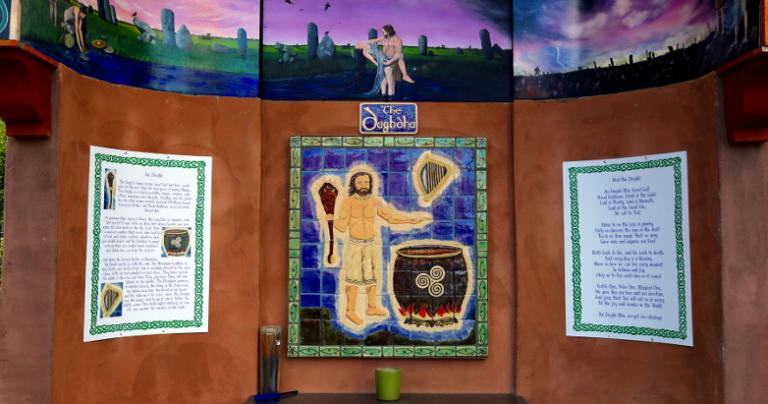
The Dagda Shrine – Trout Lake Abbey
Myths
“Myths are things which never happened, but always are.” This quote originated with the late Roman period writer Sallustius, and it’s as true now as it was then. Myths teach truth. The statement “all myths have an element of truth in them” is poorly worded. Myths may – or may not – have an element of historicity in them, but historicity and truth are not the same thing.
Myths are stories to live by. They tell us who we are, where we came from, and where we belong. They tell what’s important in life – they communicate values. They tell us something about the nature of Gods and heroes – they communicate virtues. Despite what Joseph Campbell taught, no myths are universal to all of humanity. But the presence of myth is universal, or very nearly so.
I’m currently re-reading Star.Ships by Gordon White. It examines the spread of myths around the world and compares it with evidence from archaeology, genetics, and linguistics to paint a fairly accurate picture of the prehistorical migrations of humans out of Africa. These myths were – and are – so important to people that they’ve been preserved for tens of thousands of years despite the lack of writing for most of that period.
Given this importance, it’s no surprise myths are one of the foundations of religion. But they’re not the only foundation.
Non-mythological elements of religion
When we abandon the bad assumption that religion is all about what you believe, we start to see there’s a lot more to religion than the written word.
Religion has cultural elements: Sikhs wear turbans and Jews don’t eat pork. Traditionally black Christian churches have one style of gospel music and traditionally white Southern churches have another. Religion has political elements: walk into the First Baptist Church of Dallas and you’ll hear one brand of politics being preached – walk into First Unitarian Church and you’ll hear something very different.
Most importantly, religion has elements of spiritual practice: Muslims pray five times a day and Buddhists meditate. Catholics pray the rosary and Baptists go to bible study. Pagans do all kinds of things: I pray, meditate, make offerings to my Gods and ancestors, and study both religious and secular materials to deepen my understanding of the world and my place in it.
All of these things are done because the practitioners believe certain things about them, and those beliefs are often explained by myths. But they are not things to be believed – they are things to be done. They are not mythology.

roadside trash pickup – not mythology
Real Gods cannot be reduced to mythology
Myths are one of the ways we know about the Gods. But we also know about the Gods from our first-hand experiences of Them, and from the first-hand experiences of our co-religionists.
We pray to Them and They answer. Or They don’t, which is an answer in itself. Sometimes They speak to us. Our mainstream culture (and sadly, much of the Pagan movement) has no context for hearing a God – it assumes you’re either crazy or you’re making it all up. But while we can and should debate what it means to experience a God first-hand, that we have these experiences is undeniable. How you respond is up to you, but remember that not responding is also a response.
Mythology can help us interpret our religious experiences. It can give us insight into what our ancestors thought about their religious experiences, and provide context for ours. Lore vs. UPG (unverified personal gnosis) is a false dichotomy – a whole religion needs both.
The study of the Gods is theology. Theology is not an exclusively Christian field – the polytheistic Greeks were doing it long before there was a Christianity. It incorporates input from experience, philosophy, and logic. The statement “all religion is mythology” denies the place of theology in religion.

the Ring of Brodgar – Orkney – Scotland
Animism is not mythology
Many myths have an animistic context – they feature characters such as talking animals and walking trees. This reflects the intuitive observation that whatever animates you and me also animates birds and squirrels and rivers and trees. We can relate to all these beings not as things but as persons, even though they’re not human persons. They have their own inherent value and worth that does not depend on their usefulness to humans.
“Religion is mythology” ignores the animistic context of these myths. It makes these stories all about us and ignores the agency of non-human persons – their ability to do their own things for their own reasons.
Though my animism is a spirit-filled animism, that’s not a requirement. Animism works just fine as non-theistic, naturalistic worldview. As with so much else, it relies on our actions, not on our beliefs.
Good religion is uncomfortable
Trying to turn religion into mythology makes religion more comfortable. Though myths are true stories (i.e. – they communicate truth) for the most part they are fictional stories. Labeling something as fiction gives us permission to ignore the parts we don’t like… the parts that scare us… the parts that call us to take on devotions and quests and projects that are long, difficult, and dangerous.
Comfortable religion is weak religion. It tells us everything is OK the way it is, or at least it would be if other people would stop screwing it up. It demands nothing of us beyond what we already want to give.
Good religion is challenging. The challenges are different for all of us – what seems easy to you may be impossible for me, and vice versa. Good religion is uncomfortable, and at times dangerous. Anything worthwhile requires labor and carries risk.
So study the mythology of your religion, whatever it may be. See what truths your sacred stories can teach you.
But then remember there is far more to religion than mythology.

Trout Lake Abbey
1 To be clear: I am not attacking either Protestantism or atheism. Both are valid paths. I’m attacking the unreflective combination of the Protestant sola scriptura with the atheist insistence that there are no Gods or spirits. It is a mixture unworthy of either tradition.
Previous Post

August 30, 2017
Initiation: Mad, Dead, or a Poet
Next Post
September 5, 2017 3 Harmful Common Myths and 3 Better Alternatives
Browse Our Archives
Select a Category Books Community CUUPS Druidry Foundations and Context Gods and Goddesses Magic Myth Nature Ritual Spiritual Practice Theology Travel Uncategorized Videos
Select a Month November 2026 October 2026 September 2026 August 2026 July 2026 June 2026 May 2026 April 2026 March 2026 February 2026 January 2026 December 2025 November 2025 October 2025 September 2025 August 2025 July 2025 June 2025 May 2025 April 2025 March 2025 February 2025 January 2025 December 2024 November 2024 October 2024 September 2024 August 2024 July 2024 June 2024 May 2024 April 2024 March 2024 February 2024 January 2024 December 2023 November 2023 October 2023 September 2023 August 2023 July 2023 June 2023 May 2023 April 2023 March 2023 February 2023 January 2023 December 2022 November 2022 October 2022 September 2022 August 2022 July 2022 June 2022 May 2022 April 2022 March 2022 February 2022 January 2022 December 2021 November 2021 October 2021 September 2021 August 2021 July 2021 June 2021 May 2021 April 2021 March 2021 February 2021 January 2021 December 2020 November 2020 October 2020 September 2020 August 2020 July 2020 June 2020 May 2020 April 2020 March 2020 February 2020 January 2020 December 2019 November 2019 October 2019 September 2019 August 2019 July 2019 June 2019 May 2019 April 2019 March 2019 February 2019 January 2019 December 2018 November 2018 October 2018 September 2018 August 2018 July 2018 June 2018 May 2018 April 2018 March 2018 February 2018 January 2018 December 2017 November 2017 October 2017 September 2017 August 2017 July 2017 June 2017 May 2017 April 2017 March 2017 February 2017 January 2017 December 2016 November 2016 October 2016 September 2016 August 2016 July 2016 June 2016 May 2016 April 2016 March 2016 February 2016 January 2016 December 2015 November 2015 October 2015 September 2015 August 2015 July 2015 June 2015 May 2015 April 2015 March 2015 February 2015 January 2015 December 2014 November 2014 October 2014 September 2014 August 2014 July 2014 June 2014 May 2014 April 2014 March 2014 February 2014 January 2014 December 2013 November 2013 October 2013 September 2013 August 2013 July 2013 June 2013 May 2013 April 2013 March 2013 February 2013 January 2013 December 2012 November 2012 October 2012 September 2012 August 2012 July 2012 June 2012 May 2012 April 2012 March 2012 February 2012 January 2012 December 2011 November 2011 October 2011 September 2011 August 2011 July 2011 June 2011 May 2011 April 2011 March 2011 February 2011 January 2011 December 2010 November 2010 October 2010 September 2010 August 2010 July 2010 June 2010 May 2010 April 2010 March 2010 February 2010 January 2010 December 2009 November 2009 October 2009 September 2009 August 2009 July 2009 June 2009 May 2009 April 2009 March 2009 February 2009 January 2009 December 2008 November 2008 October 2008 September 2008 August 2008 July 2008 June 2008
Follow Us!
TAKE THE
Religious Wisdom Quiz
How long did David reign as king?
Select your answer to see how you score.
50 years 33 years 25 years 40 years
Related posts from John Beckett

Pope Francis and The Devil – A Pagan...

Pagans And The Rise Of The Religious Left

Why Halloween Is So Popular – And So...

The Pillar of the Boatmen: the Ancient Monument...
TRENDING AT PATHEOS Pagan

Ghosts, Spirits, and Wizards in Post-Puritan New England
As it is Thanksgiving, I have a seasonal post concerned with New...

Here are two Thanksgiving columns that I originally wrote for the...

Book III, Chapter 3: Christ "Classic" (Matt. 9:9-34)
Book III, Chapter 3: Christ "Classic" (Matt. 9:9-34) In honor of tomorrow's...

Jesus explicitly mentions the book of Jonah twice, but he retells the...

Peggy Sue Got Married: Coppola’s Always Been Like...
I enjoyed Megalopolis (2024). It’s a mess, but I enjoyed it. The...

My dissertation The Place of Mysticism in the Late Middle Ages concerns...
view all Pagan blogs
Ad-Free & Subscriber Log-In Subscription Support
- About Us
- 2026 Calendar
- Videos
- Podcasts
- Library of World Religions
- Faith In Media Tracker
- Advertise With Us
- Write for Us
- Privacy Policy
- Terms of Service
- Do Not Sell My Data
- Contact Us
- Radiant Digital
- Manage Newsletter Subscriptions
- Unsubscribe From Notifications
- Sitemap
Copyright 2008-2026, Patheos, part of the Radiant Digital network of media brands. All rights reserved.
Subscription Support Ad-Free & Subscriber Log-In
Follow Patheos