
BuddhistCatholicContemplativeEvangelicalGeneral ChristianHinduJewishLatter-day SaintMuslimNew VisionsProgressive Christian
Beliefs
- Buddhist
- Catholic
- Contemplative
- Evangelical
- General Christian
- Hindu
- Jewish
- Latter-day Saint
- More Voices
- Muslim
- New Visions
- Pagan
- Progressive Christian
Topics
- Religion News
- Food and Religion
- Sports and Religion
- Religious Art
- Religious Music and Entertainment
- Religious Events
- History and Religion
- Style and Religion
- Politics and Religion
- Women in Religion
- Recreation Outdoors and Religion
- Business Finance and Religion
- Careers Workplace and Religion
- Education and Religion
- Family Parenting and Religion
- Health Fitness and Religion
- Home and Religion
- Relationships and Religion
- Technology and Religion
- Travel and Religion
Columnists
- Buddhist Columnists
- Business Finance and Religion Columnists
- Careers Workplace and Religion Columnists
- Catholic Columnists
- Contemplative Columnists
- Education and Religion Columnists
- Evangelists Columnists
- Family Parenting and Religion Columnists
- General Christian Columnists
- Health Fitness and Religion Columnists
- Hindu Columnists
- History and Religion Columnists
- Home and Religion Columnists
- Jewish Columnists
- More Voices Columnists
- Latter Day Columnists
- Muslim Columnists
- New Visions Columnists
- Nonreligious Columnists
- Pagan Columnists
- Politics and Religion Columnists
- Progressive Columnists
- Recreation Outdoors and Religion Columnists
- Relationships and Religion Columnists
- Religion News Columnists
- Religious Art Columnists
- Religious Events Columnists
- Religious Music and Entertainment Columnists
- Sports and Religion Columnists
- Style and Religion Columnists
- Technology and Religion Columnists
- Travel and Religion Columnists
- Women in Religion Columnists
Resource Library
- 2026 Calendar
- Library of World Religions
- The 100 Most Holy Places on Earth
- Patheos Answers
- Podcasts
- Videos
- Faith Leaders Database
- Anglican Episcopalian
- Bahai
- Baptist
- Buddhism
- Christianity
- Confucianism
- Eastern Orthodoxy
- Hinduism
- Holiness and Pentecostal
- ISKCON
- Islam
- Judaism
- Lutheran
- Methodist
- The Church of Jesus Christ of Latter-day Saints
- New Age
- Paganism
- Presbytarian and Reformed
- Protestantism
- Religion Behind the Scenes
- Roman Catholic
- Scientology
- Shia Islam
- Sikhism
- Sufism
- Sunni Islam
- Taoism
- Zen
- See all religions
Research Tools
 Ad-Free & Subscriber Log-In Subscription Support
Ad-Free & Subscriber Log-In Subscription Support
Follow Patheos 

- Trending:
- Forgiveness
- |
- Marriage
- |
- Consciousness
- |
- Death Penalty
- |
- Election
- |
- Halloween

- Home
- Pagan
- Why What I Am Takes So Many Words To Describe
Why What I Am Takes So Many Words To Describe
Last updated on: July 19, 2017 at 9:54 am by John Beckett
Why What I Am Takes So Many Words To Describe 2017-07-19T09:54:30-06:00 John Beckett
Patheos Explore the world's faith through different perspectives on religion and spirituality! Patheos has the views of the prevalent religions and spiritualities of the world.
For the final July group writing project, Jason asked Patheos Pagan bloggers to write on “Why I Am A [fill in the blank].” Once again I’ve written on this topic before.
Why I Am a Pagan, in 200 words or less.
Why I Am a Devotional Polytheist, written at the beginning of the Great Polytheist – Atheist Kerfuffle in 2014.
Why I Am (Still) a Unitarian Universalist, even though my practice and my writing are almost entirely Pagan oriented. Still as true today as it was three years ago.
Why I Am Still A Druid, and why I still strongly identify with the path that helped me fully embrace Paganism 16 years ago.
Perhaps the most relevant post is one from early last year titled Druidry Is Not My Religion. In it I said “I do what Druids do – I am a Druid. But Druidry is not my religion.” I got a strong UPG impression that my ancient Druid forebears weren’t happy about that post. The key point was and still is true, but it needed more nuance… and probably a different title.

There is no single term that completely and accurately describes the religion I practice. It has no name, at least not yet. Since last fall, I’ve occasionally described it as “ancestral, devotional, ecstatic, oracular, magical, public polytheism.” I think that’s worth exploring in more depth.
Polytheism. The noun in that list is polytheism – all the other words are modifiers. I still lean on the Anomalous Thracian’s definition of polytheism: “the religious regard for many real Gods.” Or as I sometimes put it, the Gods are real, distinct, individuals with their own sovereignty and agency. At the least, this means the existence of the Gods is not dependent on human thought and activity.
There are many polytheisms. Celtic Reconstructionism is different from Hellenism, and both are different from the African Traditional Religions. A couple years ago I thought we were moving toward a modern Pagan polytheism. That turned out to be wrong, for a variety of reasons. But even if the polytheist movement is much quieter than it was, many polytheists are still worshipping many Gods in many different ways. This is my way.
Ancestral. All of us have a debt of honor to those who came before us. Because of them, we have knowledge, culture, and infrastructure. Because of them, we have life. At the least, we owe them our devotion.
Beyond that, our ancestors are usually our most accessible spiritual allies. A Heathen saying says “if you feel a tap on your shoulder, it’s probably your grandfather, not the Allfather.” Gods and spirits are often busy, and your goals may not line up with their goals. But our ancestors want to see their lines survive and succeed.
Building and maintaining relationships with ancestors of blood and of spirit is a key component of the religion I practice.
Devotional. It’s not enough acknowledge the existence of many Gods and spirits. I also honor them with devotion. For me, this means prayer, meditation, and offerings. I speak to them, I listen for them, and I attempt to make them welcome with offerings of food and drink, and occasionally other things.
The Gods know they’re Gods – they don’t need us to remind them of that. We, on the other hand, frequently need to be reminded that they’re Gods and we aren’t.
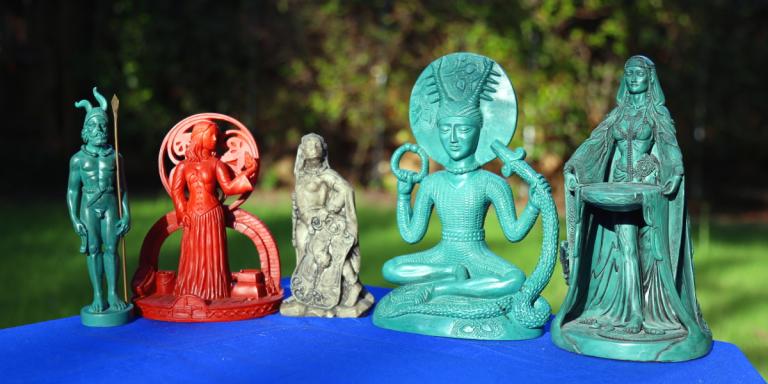
Ecstatic. Although the religion I practice is a reasonable religion, it is first and foremost a religion grounded in experience – the first-hand experience of Gods and spirits. Sometimes this experience is an inaudible voice or a thought you know isn’t yours. Sometimes it’s the intimate presence of a divine being. And sometimes a God takes over your body and if you’re lucky, you get to see it even if you can’t do anything to stop it.
I used to warn people to never expect to see or hear something that violates the laws of physics. Then last summer I saw something that could not be. But there it was.
Religious ecstasy can be addictive. Remember they’re sacred experiences, not an amusement park ride. Also remember they’re UPG – unverified personal gnosis. They may be authoritative for you, but you can’t expect someone else to take your word for what a God wants them to do.
Unless they do. I have, on numerous occasions. When some people tell me a God spoke to them, I smile and nod. When others tell me the same thing, I sit up and pay attention. Figure out who you trust, and which messages strike you as authentic and which don’t.
Oracular. My tradition is an oracular tradition – the Gods speak to us. Sometimes they speak to us in ecstatic experiences, as described above. Other times they speak in omens and auguries. Remember that reading omens and auguries in the natural world requires a familiarity with nature. Sometimes a crow is a message from the Morrigan, but most times it’s just a crow doing crow things.
Got a question and you’re not hearing or seeing anything? Ask – use your favorite divination system. As the word origin implies, divination comes from the divine.
It is rare that the Gods speak to say “hi, I really am here” or “just wanted you to know you’re doing a great job.” Most times they speak to call us to action, or to warn us of something that requires our attention… though those warnings are rarely as specific as we’d like.
Sometimes people are oracles and are given message to relay to others. I’ve had that responsibility a few times – occasionally those messages were unpleasant to deliver. But I relayed them, and so far I’ve never had anyone try to shoot the messenger.
Magical. There are some polytheist traditions that teach magic is impious – it attempts to claim for ourselves what belongs to the Gods. But that rarely stopped anyone from working magic in ancient times, and it rarely stops anyone today if their need is great enough.
If I kept anything from my early explorations of Wicca, it’s the idea that magic is our legacy and our right. It may be stealing fire from the Gods, but it’s also part of learning and growing and taking responsibility for our own lives.
There is no particular form of magic tied to my religion. I tend to be rather utilitarian about magic – if a technique works, I’ll use it.

Public. My religion is not for the few, the skilled, or the special. It’s for anyone and everyone who wants to be a part of it. I agree with ADF that high day celebrations should be public. Part of my calling is to facilitate public rituals for anyone with any degree of interest and commitment. I’m called to be a priest for the plumber and the accountant as much as for the seer and the witch.
Not everything I do is for public consumption. I’m not really concerned about scaring people and giving them a bad impression of Paganism. I’m more concerned with the sanctity of the mysteries. I don’t do ecstatic possession in public ritual (although I came really close at this year’s Beltane) – most people wouldn’t understand it and would walk away with the wrong idea about what they saw.
I want everyone to go as far and as deep as their skills, interests, and willingness to work will take them. It’s unreasonable to expect everyone to be a priest. It’s also unreasonable to hold back some because others are unable or unwilling to do what’s necessary to go deeper.
Pagan. I didn’t put this on my original list, but I should. Some polytheists make a big deal of saying “I’m a polytheist, not a Pagan.” Some like to point out their tradition did not originate in the Pagan revival that began in the late 19th century. But mine did.
My lineage (if it’s accurate to describe it as such, which it might not be) runs through Scott Cunningham and Margot Adler. It runs through Isaac Bonewits and Ross Nichols. It runs through Gerald Gardner and Aleister Crowley. I’ve moved far away from the teachings of those ancestors (except for Isaac – I’m still fairly close to his beliefs and practices, I think), but I would not be where I am today without them.
I am a polytheist above all, but the polytheist religion I practice is firmly and proudly inside the Big Tent of Paganism.
So, why am I an ancestral, devotional, ecstatic, oracular, magical, public, Pagan polytheist? Because this is where my journey led me. Because at each step, I held on to what was meaningful and helpful and I discarded what didn’t work. Because this is what the Gods continue to call me to do and be. Because all these elements are coming together to form one tradition that I practice, explore, and teach to others.
Even if it takes a lot of words to describe it.
Previous Post

July 16, 2017
The 8 of Cups, or, I Like It Here Why Do I Have To Leave?
Next Post

July 20, 2017 The Victory of Lugh
Browse Our Archives
Select a Category Books Community CUUPS Druidry Foundations and Context Gods and Goddesses Magic Myth Nature Ritual Spiritual Practice Theology Travel Uncategorized Videos
Select a Month October 2026 September 2026 August 2026 July 2026 June 2026 May 2026 April 2026 March 2026 February 2026 January 2026 December 2025 November 2025 October 2025 September 2025 August 2025 July 2025 June 2025 May 2025 April 2025 March 2025 February 2025 January 2025 December 2024 November 2024 October 2024 September 2024 August 2024 July 2024 June 2024 May 2024 April 2024 March 2024 February 2024 January 2024 December 2023 November 2023 October 2023 September 2023 August 2023 July 2023 June 2023 May 2023 April 2023 March 2023 February 2023 January 2023 December 2022 November 2022 October 2022 September 2022 August 2022 July 2022 June 2022 May 2022 April 2022 March 2022 February 2022 January 2022 December 2021 November 2021 October 2021 September 2021 August 2021 July 2021 June 2021 May 2021 April 2021 March 2021 February 2021 January 2021 December 2020 November 2020 October 2020 September 2020 August 2020 July 2020 June 2020 May 2020 April 2020 March 2020 February 2020 January 2020 December 2019 November 2019 October 2019 September 2019 August 2019 July 2019 June 2019 May 2019 April 2019 March 2019 February 2019 January 2019 December 2018 November 2018 October 2018 September 2018 August 2018 July 2018 June 2018 May 2018 April 2018 March 2018 February 2018 January 2018 December 2017 November 2017 October 2017 September 2017 August 2017 July 2017 June 2017 May 2017 April 2017 March 2017 February 2017 January 2017 December 2016 November 2016 October 2016 September 2016 August 2016 July 2016 June 2016 May 2016 April 2016 March 2016 February 2016 January 2016 December 2015 November 2015 October 2015 September 2015 August 2015 July 2015 June 2015 May 2015 April 2015 March 2015 February 2015 January 2015 December 2014 November 2014 October 2014 September 2014 August 2014 July 2014 June 2014 May 2014 April 2014 March 2014 February 2014 January 2014 December 2013 November 2013 October 2013 September 2013 August 2013 July 2013 June 2013 May 2013 April 2013 March 2013 February 2013 January 2013 December 2012 November 2012 October 2012 September 2012 August 2012 July 2012 June 2012 May 2012 April 2012 March 2012 February 2012 January 2012 December 2011 November 2011 October 2011 September 2011 August 2011 July 2011 June 2011 May 2011 April 2011 March 2011 February 2011 January 2011 December 2010 November 2010 October 2010 September 2010 August 2010 July 2010 June 2010 May 2010 April 2010 March 2010 February 2010 January 2010 December 2009 November 2009 October 2009 September 2009 August 2009 July 2009 June 2009 May 2009 April 2009 March 2009 February 2009 January 2009 December 2008 November 2008 October 2008 September 2008 August 2008 July 2008 June 2008
Follow Us!
TAKE THE
Religious Wisdom Quiz
What Christian group is known for using the term "General Conference"?
Select your answer to see how you score.
Presbyterians Lutherans Seventh-day Adventists Baptists
Related posts from John Beckett




What We Lose When “Ask AI” Becomes A...
TRENDING AT PATHEOS Pagan

The First Eucharistic Controversy: Christ’s Real Presence
For Catholics, the Eucharist is the source and summit of the Christian...

What a Stop Sign Can Teach Us About...
How to Make a Decision When You Can't Hear God Main point:...

Archdiocese Hosts Military Marriage Retreat in Germany
RASTATT, Germany — The transient military lifestyle, with its frequent deployments and...

Nearly every morning, I make the drive to Detroit with my high-school-age...

The Real AI Story Is Adoption Without Trust
Artificial intelligence has crossed a political threshold. It is no longer a...

A new article, written by Jeff Lindsay and Gale L. Pooley,...
view all Pagan blogs
Ad-Free & Subscriber Log-In Subscription Support
- About Us
- 2026 Calendar
- Videos
- Podcasts
- Library of World Religions
- Faith In Media Tracker
- Advertise With Us
- Write for Us
- Privacy Policy
- Terms of Service
- Do Not Sell My Data
- Contact Us
- Radiant Digital
- Manage Newsletter Subscriptions
- Unsubscribe From Notifications
- Sitemap
Copyright 2008-2026, Patheos. All rights reserved.
Subscription Support Ad-Free & Subscriber Log-In
Follow Patheos