
BuddhistCatholicContemplativeEvangelicalGeneral ChristianHinduJewishLatter-day SaintMuslimNew VisionsProgressive Christian
Beliefs
- Buddhist
- Catholic
- Contemplative
- Evangelical
- General Christian
- Hindu
- Jewish
- Latter-day Saint
- More Voices
- Muslim
- New Visions
- Pagan
- Progressive Christian
Topics
- Religion News
- Food and Religion
- Sports and Religion
- Religious Art
- Religious Music and Entertainment
- Religious Events
- History and Religion
- Style and Religion
- Politics and Religion
- Women in Religion
- Recreation Outdoors and Religion
- Business Finance and Religion
- Careers Workplace and Religion
- Education and Religion
- Family Parenting and Religion
- Health Fitness and Religion
- Home and Religion
- Relationships and Religion
- Technology and Religion
- Travel and Religion
Columnists
- Buddhist Columnists
- Business Finance and Religion Columnists
- Careers Workplace and Religion Columnists
- Catholic Columnists
- Contemplative Columnists
- Education and Religion Columnists
- Evangelists Columnists
- Family Parenting and Religion Columnists
- General Christian Columnists
- Health Fitness and Religion Columnists
- Hindu Columnists
- History and Religion Columnists
- Home and Religion Columnists
- Jewish Columnists
- More Voices Columnists
- Latter Day Columnists
- Muslim Columnists
- New Visions Columnists
- Nonreligious Columnists
- Pagan Columnists
- Politics and Religion Columnists
- Progressive Columnists
- Recreation Outdoors and Religion Columnists
- Relationships and Religion Columnists
- Religion News Columnists
- Religious Art Columnists
- Religious Events Columnists
- Religious Music and Entertainment Columnists
- Sports and Religion Columnists
- Style and Religion Columnists
- Technology and Religion Columnists
- Travel and Religion Columnists
- Women in Religion Columnists
Resource Library
- 2026 Calendar
- Library of World Religions
- The 100 Most Holy Places on Earth
- Patheos Answers
- Podcasts
- Videos
- Faith Leaders Database
- Anglican Episcopalian
- Bahai
- Baptist
- Buddhism
- Christianity
- Confucianism
- Eastern Orthodoxy
- Hinduism
- Holiness and Pentecostal
- ISKCON
- Islam
- Judaism
- Lutheran
- Methodist
- The Church of Jesus Christ of Latter-day Saints
- New Age
- Paganism
- Presbytarian and Reformed
- Protestantism
- Religion Behind the Scenes
- Roman Catholic
- Scientology
- Shia Islam
- Sikhism
- Sufism
- Sunni Islam
- Taoism
- Zen
- See all religions
Research Tools
 Ad-Free & Subscriber Log-In Subscription Support
Ad-Free & Subscriber Log-In Subscription Support
Follow Patheos 

- Trending:
- Forgiveness
- |
- Marriage
- |
- Consciousness
- |
- Death Penalty
- |
- Election
- |
- Halloween

- Home
- Pagan
- Who Is My Co-Religionist?
Who Is My Co-Religionist?
Last updated on: October 16, 2016 at 4:53 pm by John Beckett
Who Is My Co-Religionist? 2016-10-16T16:53:59-06:00 John Beckett
Patheos Explore the world's faith through different perspectives on religion and spirituality! Patheos has the views of the prevalent religions and spiritualities of the world.
 I’ve been somewhat critical of #mypolytheism (though not as critical as some have claimed), but there is some good work coming out of it. One of the best essays I’ve seen under this hashtag is this one by Kemetic reconstructionist, UU Pagan, and Agora columnist Kiya Nicoll titled “What is a co-religionist?” Kiya looks at several possible definitions of co-religionist and different places where she might properly belong, then comes to the conclusion “The whole question, it’s just f*ing weird. I have no answers.”
That post is a follow-up to another very good #mypolytheism essay, this one from the Jack of Many Trades blog titled “Is There Community in #mypolytheism?” Jack says
I have never found … coreligionists. I have friends who have aspects of their practice that align with mine in many ways, but I have no group I can go to where their offerings, their powers, and their metaphors will be the same as mine.
These posts are good and I find myself in near-total agreement with both of them. But I’ve used the term “co-religionists” for years and I feel like I have many of them. Am I all that different, or am I just using the term differently?
I don’t think I’m all that different.
For me, a co-religionist is simply a person I do religion with. And “doing religion” means different things in different contexts.
Unitarian Universalists are my co-religionists. We share the values of the inherent worth and dignity of every person, a free and responsible search for truth and meaning, and a respect for the natural world. We put those values into action with our support for social and environmental justice.
Even within CUUPS (much less outside of it) I don’t share much theology and metaphysics with my fellow UUs. An old joke says that Unitarianism is the belief in one God, at most. I believe in many Gods. That’s OK – we come together around common this-world values, not around Otherworldly beliefs.
UU worship follows the style of the New England Congregationalists, sometimes called “the frozen chosen.” This very intellectual approach provides food for thought, but it doesn’t feed my soul. So I couldn’t be only a Unitarian Universalist, but Unitarian Universalism is one of my religious homes, and UUs are my co-religionists.
I’m a co-religionist with other devotional polytheists. With the exception of my local group (a number of whom are not devotional polytheists – more on that later), I rarely work or worship with these co-religionists. My interaction with them is almost entirely online, except for the occasional Pagan gathering. Our commonality lies in our beliefs about the Gods and our approach to interacting with Them.
My devotional polytheist co-religionists believe the Gods are real individual beings with Their own sovereignty, agency, and will. We don’t agree on exactly what this looks like in practice. We share our thoughts, experiences, and revelations, in an attempt to get closer to the truth about the Gods, both individually and collectively. We understand that none of us has the whole truth nor likely will we ever, but some ideas are more likely and more helpful than others.
We agree that the Gods are worthy of our religious regard, but we don’t agree on what forms that religious regard should take: prayer, offerings, sacrifice, devotion, worship, service… What is required, what is beneficial, what works for some but not others, and what is patently unhelpful? Most of us are still figuring this out, and our devotional polytheist co-religionists help us get there faster and with more certainty than if we worked alone.
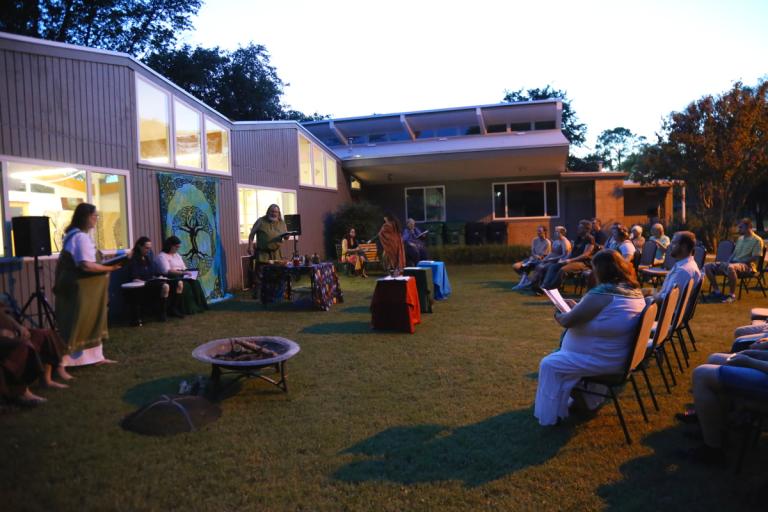 The members of Denton CUUPS are my co-religionists. Denton CUUPS is not a typical CUUPS chapter, but at our core we are a UU covenant group, open to all who come in good will. We share a love of Nature, an affinity for the beliefs and practices of our ancestors, and a view of divinity as female as well as male (and anything else divinity chooses to be). Some of our members are polytheists, some are not. Some of our rituals honor one or more of the many Gods, some don’t.
We are co-religionists because we practice together. We celebrate the seasons and the sabbats together. We eat together, pick up roadside trash together, and go camping together. Here, more than with any of my other groups and groupings, we are doing religion. We don’t all believe the same things, and that’s OK. We do the same things.
I have other groups of co-religionists, but I think you get the point – co-religionists are people we do religion with, even though we don’t agree with them about everything.
Context matters! A person who is a co-religionist in one context is an other-religionist in another context. A Christian who sits beside me at the UU Sunday service is my co-religionist while we’re lighting the chalice, singing “Spirit of Life,” and discussing the state of the creek behind the church at coffee hour. When I’m pouring offerings to Cernunnos, we’re other-religionists – I’m doing something that is antithetical to their religious identity as a Christian.
We can – and should – be polite and friendly with other-religionists. When Christians come to our CUUPS circles (as they do on a semi-regular basis) they are welcome to participate as fully as they like. If they see Cernunnos as an aspect of one almighty God who they honor as Jesus in some sort of panentheistic soft polytheism, I wouldn’t dream of stopping them. If we discuss our beliefs during the social hour, I’m going to say “I’m glad you found it meaningful and I hope you come back next time.” But I’m not going to say “deep down it’s all the same” – because our religious diversity matters.

Those are public rituals. There are other, private rituals to which I would never invite a Christian or an atheist. Doing those rituals well requires me to be open and vulnerable, which I can’t do if I’m concerned about what an other-religionist may think about it, or about the spiritual implications of their presence. Purity may be overrated, but it’s still an important part of good religious practice.
When people (not just the two I quoted in this post) say they have no co-religionists, I wonder what they’re looking for. Are they saying there’s no polytheist group of any kind near them? Nothing in their particular flavor of polytheism? Or are they looking for a group where everyone believes and practices just like they do? While I’d love to be part of a group “where their offerings, their powers, and their metaphors will be the same as mine” I’m happy to be part of several communities of convenience.
I think Jack might agree, at one level or another. In the post I linked to above, he also says:
Unitarian Universalism offers me people to have a conversation with. Maybe none of these people believe the exact same things as me, or work with the same powers and spirits. Who cares? Not me, not them. Neither did most of the the druids or the heathens or any of the explicitly pagan groups I’ve attended. Having my own beliefs, interacting with #mypolytheism, doesn’t stop my from interacting with communities both online and face to face.
We can have our own beliefs and refine them in conversation with others. We can practice parts of our religion with some people and other parts with other people. We can gather with anyone and everyone who shares our values, whether they express those values in the same way or not.
Our co-religionists are those we do religion with, whatever “doing religion” means in that religious context.
Previous Post

October 13, 2016
31 Movies for Halloween
Next Post

October 18, 2016 Samhain – Burning the Old Year
Browse Our Archives
Select a Category Books Community CUUPS Druidry Foundations and Context Gods and Goddesses Magic Myth Nature Ritual Spiritual Practice Theology Travel Uncategorized Videos
Select a Month October 2026 September 2026 August 2026 July 2026 June 2026 May 2026 April 2026 March 2026 February 2026 January 2026 December 2025 November 2025 October 2025 September 2025 August 2025 July 2025 June 2025 May 2025 April 2025 March 2025 February 2025 January 2025 December 2024 November 2024 October 2024 September 2024 August 2024 July 2024 June 2024 May 2024 April 2024 March 2024 February 2024 January 2024 December 2023 November 2023 October 2023 September 2023 August 2023 July 2023 June 2023 May 2023 April 2023 March 2023 February 2023 January 2023 December 2022 November 2022 October 2022 September 2022 August 2022 July 2022 June 2022 May 2022 April 2022 March 2022 February 2022 January 2022 December 2021 November 2021 October 2021 September 2021 August 2021 July 2021 June 2021 May 2021 April 2021 March 2021 February 2021 January 2021 December 2020 November 2020 October 2020 September 2020 August 2020 July 2020 June 2020 May 2020 April 2020 March 2020 February 2020 January 2020 December 2019 November 2019 October 2019 September 2019 August 2019 July 2019 June 2019 May 2019 April 2019 March 2019 February 2019 January 2019 December 2018 November 2018 October 2018 September 2018 August 2018 July 2018 June 2018 May 2018 April 2018 March 2018 February 2018 January 2018 December 2017 November 2017 October 2017 September 2017 August 2017 July 2017 June 2017 May 2017 April 2017 March 2017 February 2017 January 2017 December 2016 November 2016 October 2016 September 2016 August 2016 July 2016 June 2016 May 2016 April 2016 March 2016 February 2016 January 2016 December 2015 November 2015 October 2015 September 2015 August 2015 July 2015 June 2015 May 2015 April 2015 March 2015 February 2015 January 2015 December 2014 November 2014 October 2014 September 2014 August 2014 July 2014 June 2014 May 2014 April 2014 March 2014 February 2014 January 2014 December 2013 November 2013 October 2013 September 2013 August 2013 July 2013 June 2013 May 2013 April 2013 March 2013 February 2013 January 2013 December 2012 November 2012 October 2012 September 2012 August 2012 July 2012 June 2012 May 2012 April 2012 March 2012 February 2012 January 2012 December 2011 November 2011 October 2011 September 2011 August 2011 July 2011 June 2011 May 2011 April 2011 March 2011 February 2011 January 2011 December 2010 November 2010 October 2010 September 2010 August 2010 July 2010 June 2010 May 2010 April 2010 March 2010 February 2010 January 2010 December 2009 November 2009 October 2009 September 2009 August 2009 July 2009 June 2009 May 2009 April 2009 March 2009 February 2009 January 2009 December 2008 November 2008 October 2008 September 2008 August 2008 July 2008 June 2008
Follow Us!
TAKE THE
Religious Wisdom Quiz
True or False: John's Gospel does not record any parables.
Select your answer to see how you score.
TRUE FALSE
Related posts from John Beckett


The Vampire Films of Jean Rollin


Bo French Doesn’t Understand Texas
TRENDING AT PATHEOS Pagan

Swimfan: Forgotten Aughts Pleasures
This is a recovery effort. In 2002, My Big Fat Greek Wedding...

Top Three Anti-Catholic Lies About Catholicism
This is my initial transcript for the video, "THE 3 WORST...

Pope Leo Celebrates Mass for Nurses & Docs...
I don't have any idea how he did it, but Pope Leo...

The Sermon on the Mount, Part I: Matthew...
The Sermon on the Mount, Part I (Matthew 4:12-5:12) St. Matthew moves...

What's up from Crossway: Reviewing some of their latest A few weeks...

Janie Learns the Way of the Cross: A...
Teaching children about Jesus' Passion can be challenging. Many parents and educators...
view all Pagan blogs
Ad-Free & Subscriber Log-In Subscription Support
- About Us
- 2026 Calendar
- Videos
- Podcasts
- Library of World Religions
- Faith In Media Tracker
- Advertise With Us
- Write for Us
- Privacy Policy
- Terms of Service
- Do Not Sell My Data
- Contact Us
- Radiant Digital
- Manage Newsletter Subscriptions
- Unsubscribe From Notifications
- Sitemap
Copyright 2008-2026, Patheos. All rights reserved.
Subscription Support Ad-Free & Subscriber Log-In
Follow Patheos