
BuddhistCatholicContemplativeEvangelicalGeneral ChristianHinduJewishLatter-day SaintMuslimNew VisionsProgressive Christian
Beliefs
- Buddhist
- Catholic
- Contemplative
- Evangelical
- General Christian
- Hindu
- Jewish
- Latter-day Saint
- More Voices
- Muslim
- New Visions
- Pagan
- Progressive Christian
Topics
- Religion News
- Food and Religion
- Sports and Religion
- Religious Art
- Religious Music and Entertainment
- Religious Events
- History and Religion
- Style and Religion
- Politics and Religion
- Women in Religion
- Recreation Outdoors and Religion
- Business Finance and Religion
- Careers Workplace and Religion
- Education and Religion
- Family Parenting and Religion
- Health Fitness and Religion
- Home and Religion
- Relationships and Religion
- Technology and Religion
- Travel and Religion
Columnists
- Buddhist Columnists
- Business Finance and Religion Columnists
- Careers Workplace and Religion Columnists
- Catholic Columnists
- Contemplative Columnists
- Education and Religion Columnists
- Evangelists Columnists
- Family Parenting and Religion Columnists
- General Christian Columnists
- Health Fitness and Religion Columnists
- Hindu Columnists
- History and Religion Columnists
- Home and Religion Columnists
- Jewish Columnists
- More Voices Columnists
- Latter Day Columnists
- Muslim Columnists
- New Visions Columnists
- Nonreligious Columnists
- Pagan Columnists
- Politics and Religion Columnists
- Progressive Columnists
- Recreation Outdoors and Religion Columnists
- Relationships and Religion Columnists
- Religion News Columnists
- Religious Art Columnists
- Religious Events Columnists
- Religious Music and Entertainment Columnists
- Sports and Religion Columnists
- Style and Religion Columnists
- Technology and Religion Columnists
- Travel and Religion Columnists
- Women in Religion Columnists
Resource Library
- 2026 Calendar
- Library of World Religions
- The 100 Most Holy Places on Earth
- Patheos Answers
- Podcasts
- Videos
- Faith Leaders Database
- Anglican Episcopalian
- Bahai
- Baptist
- Buddhism
- Christianity
- Confucianism
- Eastern Orthodoxy
- Hinduism
- Holiness and Pentecostal
- ISKCON
- Islam
- Judaism
- Lutheran
- Methodist
- The Church of Jesus Christ of Latter-day Saints
- New Age
- Paganism
- Presbytarian and Reformed
- Protestantism
- Religion Behind the Scenes
- Roman Catholic
- Scientology
- Shia Islam
- Sikhism
- Sufism
- Sunni Islam
- Taoism
- Zen
- See all religions
Research Tools
 Ad-Free & Subscriber Log-In Subscription Support
Ad-Free & Subscriber Log-In Subscription Support
Follow Patheos 

- Trending:
- Forgiveness
- |
- Marriage
- |
- Consciousness
- |
- Death Penalty
- |
- Election
- |
- Halloween

- Home
- Pagan
- Resetting the Conversation on Purity
Resetting the Conversation on Purity
Last updated on: August 25, 2016 at 6:30 am by John Beckett
Resetting the Conversation on Purity 2016-08-23T19:11:20-06:00 John Beckett
Patheos Explore the world's faith through different perspectives on religion and spirituality! Patheos has the views of the prevalent religions and spiritualities of the world.
The beginning of the Act of Reconsecration for Denton UU included the following line: “our temple was profaned – made impure and unfitting for worship.” And in the introduction to the invocation of blessings, there was this: “the temple is clean, pure, and protected.” If purity is important to UUs, surely it’s important to polytheists.
I wrote the first draft of the Act of Reconsecration after I wrote about purity being overrated but well before the miasma kerfuffle. These words flowed naturally from my Paganism and polytheism, and from my core values. I think this demonstrates a certain intuitiveness about purity that’s worth exploring in a little more depth.
There are theological and magical concerns around the issue of purity that I am not going to address. Those concerns are valid, but they are tradition-specific and I’m attempting to address this issue at a foundational polytheism level. If you want to argue that your tradition’s view on purity is the most helpful or most correct, then make your case – but that’s not what I’m doing here.
The Intuitive Desire For Purity
Practical considerations aside (like no space for religious education classes, which was a major factor in our temporary move to First Christian Church) why did Denton UU not simply continue meeting in our sanctuary? It was usable. But we didn’t want to walk into our sacred space every week and be reminded of the attack on our building. The smell of smoke was a health issue for some of our members, but it was a spiritual issue for all of us. Something wasn’t right in the building – its literal impurity pointed toward a spiritual impurity. The building needed to be fixed and fixed right before moving back.
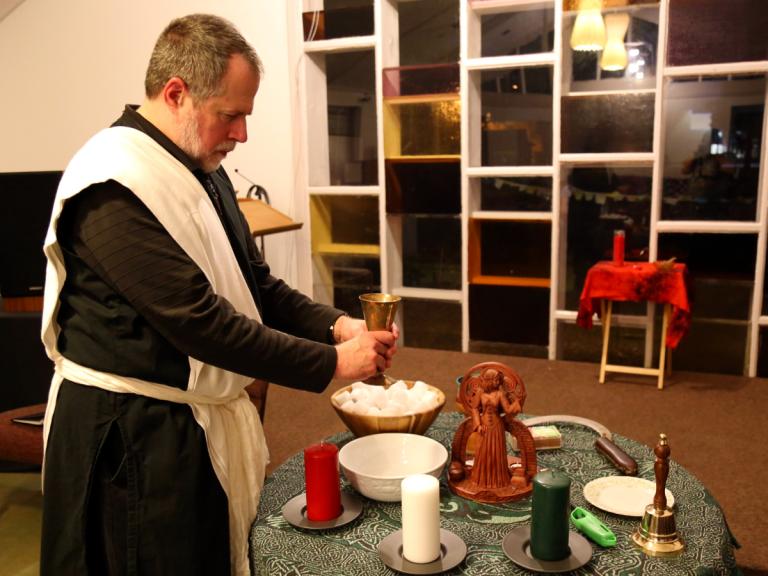
CUUPS continued to use the building – we had no good alternative. But before we allowed our practical needs to overrule our spiritual needs, we performed our own ritual to cleanse, bless, and ward the building. We addressed our spiritual need for purity even though our physical needs would take longer to meet.
The Evolutionary Roots of Purity
Our intuitive desire for purity has very old roots. Pick up an apple and the first thing we do is check it for firmness and for holes. If it’s soft, it may be rotten on the inside. If there’s a hole in the skin, there may be a worm in it. Now consider it’s likely that our most ancient ancestors first got meat by scavenging, not by hunting. Our intuitive concerns about purity have origins in some very this-world concerns.
When we began settling into fixed locations, we learned to keep rats out of our food stores. Not just because the rats would eat our food, but because they would leave droppings in it and otherwise transmit diseases. It was about that time we decided that cats were nice to keep around. We also learned to dig latrines downhill and downstream from water sources, for the same reason. Remember that the germ theory of disease wasn’t proposed until 1546 and wasn’t widely accepted until Pasteur’s work in the mid-1800s. Our intuitive desire for purity helped preserve our health.
The Politics of Purity
According to psychologist Jonathan Haidt, there are six foundations of human moral reasoning: care, fairness, liberty, loyalty, authority, and sanctity or purity. The Wikipedia page does a good job of summarizing the theory, which I find to be helpful but not entirely complete (I think there’s something more behind those six foundations).
What’s interesting is that Haidt has clearly shown there’s a difference in the way that people with different political leanings value and prioritize the six foundations. Relevant to this discussion, conservatives value purity far more than liberals. That’s not surprising. If you want to conserve society, to keep things the way they are (or return them to the way they were), it’s critical to avoid introducing new and potentially dangerous elements into the common culture.
It is no surprise that most (but not all) of the loudest voices emphasizing the need for purity are on the politically conservative side of the polytheist movement.
That doesn’t mean they’re wrong – it means they value purity more than politically liberal polytheists value it. I would hate to see the polytheist movement split along political lines – though I hear voices in the back of my head saying “that happened a long time ago” – but if that’s the only way we can all practice deeply and authentically, then it may be necessary.
But I hope it’s not.

Impure Conversations
I’ve heard both sides of the “Many Gods West miasma warning” story from those most closely involved. Those conversations were private and I will not share them, except to say the two perspectives were very, very different. Who was right, who was wrong, and to what degree is a matter for the principals to work out, not for the rest of us to debate.
What’s relevant to our on-going discussions on purity is that there were two messages in the miasma warning and in the conversation that followed:
1) Purity is important and miasma is real.
2) Many Gods West is impure and therefore a spiritual danger.
Those who issued the warning and those who promoted it genuinely believed both points were true. Fair enough. But those of us who attended MGW – myself included – didn’t experience spiritual pollution. We had a good time, we participated in some good rituals, and we had some excellent conversations. The joking that went on throughout the weekend was not a mockery of miasma. Rather, it was a humorous dismissal of a warning that first hand experience showed was unnecessary.
In the conversations that followed, concerns around matters of spiritual purity have been mixed with feelings about the personalities expressing them. Rather than debating concepts, we’ve had a series of ad hominem dismissals: “Polytheist X is a fascist, therefore their thoughts on purity are wrong.” “Polytheist Y is a Marxist, therefore their thoughts on purity are wrong.” It’s to the point that people who are completely unaware of the context of this argument are picking up on the tension and acrimony and are either running away or falling back on the old Pagan retort of “you can’t tell me what to do.”
We have been unable to separate debate on polytheist concepts from our feelings about individual polytheists. Our discussion of the role of purity in polytheism has been derailed by impurities in our conversation. If I was a hipster I’d revel in the irony.
But I’m not.
Resetting the Conversation
Can we reset the conversation on purity?
Can we recognize that our instinctive desires for physical purity point toward a need for spiritual purity? Can we understand that spiritual impurity is like having dirty hands – it’s a reflection of what you’ve been doing, not of who and what you are? And that like having dirty hands, it’s easily remedied?
Can we accept that purity is more important in some polytheist traditions and to some individual polytheists than others? Can we also accept that we can no more ignore spiritual purity than we can refuse to shower and put on clean clothes before going to dinner with family and friends?
Can we separate the religious and spiritual issues around purity from the personalities who have dominated the conversation?
Can we?
Previous Post
August 23, 2016
You Are What Your Record Says You Are
Next Post

August 28, 2016 Mission and Vision: What Your Chapter Can Learn From the 2014 Surveys
Browse Our Archives
Select a Category Books Community CUUPS Druidry Foundations and Context Gods and Goddesses Magic Myth Nature Ritual Spiritual Practice Theology Travel Uncategorized Videos
Select a Month October 2026 September 2026 August 2026 July 2026 June 2026 May 2026 April 2026 March 2026 February 2026 January 2026 December 2025 November 2025 October 2025 September 2025 August 2025 July 2025 June 2025 May 2025 April 2025 March 2025 February 2025 January 2025 December 2024 November 2024 October 2024 September 2024 August 2024 July 2024 June 2024 May 2024 April 2024 March 2024 February 2024 January 2024 December 2023 November 2023 October 2023 September 2023 August 2023 July 2023 June 2023 May 2023 April 2023 March 2023 February 2023 January 2023 December 2022 November 2022 October 2022 September 2022 August 2022 July 2022 June 2022 May 2022 April 2022 March 2022 February 2022 January 2022 December 2021 November 2021 October 2021 September 2021 August 2021 July 2021 June 2021 May 2021 April 2021 March 2021 February 2021 January 2021 December 2020 November 2020 October 2020 September 2020 August 2020 July 2020 June 2020 May 2020 April 2020 March 2020 February 2020 January 2020 December 2019 November 2019 October 2019 September 2019 August 2019 July 2019 June 2019 May 2019 April 2019 March 2019 February 2019 January 2019 December 2018 November 2018 October 2018 September 2018 August 2018 July 2018 June 2018 May 2018 April 2018 March 2018 February 2018 January 2018 December 2017 November 2017 October 2017 September 2017 August 2017 July 2017 June 2017 May 2017 April 2017 March 2017 February 2017 January 2017 December 2016 November 2016 October 2016 September 2016 August 2016 July 2016 June 2016 May 2016 April 2016 March 2016 February 2016 January 2016 December 2015 November 2015 October 2015 September 2015 August 2015 July 2015 June 2015 May 2015 April 2015 March 2015 February 2015 January 2015 December 2014 November 2014 October 2014 September 2014 August 2014 July 2014 June 2014 May 2014 April 2014 March 2014 February 2014 January 2014 December 2013 November 2013 October 2013 September 2013 August 2013 July 2013 June 2013 May 2013 April 2013 March 2013 February 2013 January 2013 December 2012 November 2012 October 2012 September 2012 August 2012 July 2012 June 2012 May 2012 April 2012 March 2012 February 2012 January 2012 December 2011 November 2011 October 2011 September 2011 August 2011 July 2011 June 2011 May 2011 April 2011 March 2011 February 2011 January 2011 December 2010 November 2010 October 2010 September 2010 August 2010 July 2010 June 2010 May 2010 April 2010 March 2010 February 2010 January 2010 December 2009 November 2009 October 2009 September 2009 August 2009 July 2009 June 2009 May 2009 April 2009 March 2009 February 2009 January 2009 December 2008 November 2008 October 2008 September 2008 August 2008 July 2008 June 2008
Follow Us!
TAKE THE
Religious Wisdom Quiz
How did Nehemiah show concern for the poor in Jerusalem's community?
Select your answer to see how you score.
He doubled taxes He expelled foreigners He gave up rebuilding He canceled debts and returned land
Related posts from John Beckett


The Vampire Films of Jean Rollin


Bo French Doesn’t Understand Texas
TRENDING AT PATHEOS Pagan

How to Make a Decision When You Can't...
Main point: It’s much more valuable to stay close to God so...

Archdiocese Hosts Military Marriage Retreat in Germany
RASTATT, Germany — The transient military lifestyle, with its frequent deployments and...

Nearly every morning, I make the drive to Detroit with my high-school-age...

The Real AI Story Is Adoption Without Trust
Artificial intelligence has crossed a political threshold. It is no longer a...

A new article, written by Jeff Lindsay and Gale L. Pooley,...

Swimfan: Forgotten Aughts Pleasures
This is a recovery effort. In 2002, My Big Fat Greek Wedding...
view all Pagan blogs
Ad-Free & Subscriber Log-In Subscription Support
- About Us
- 2026 Calendar
- Videos
- Podcasts
- Library of World Religions
- Faith In Media Tracker
- Advertise With Us
- Write for Us
- Privacy Policy
- Terms of Service
- Do Not Sell My Data
- Contact Us
- Radiant Digital
- Manage Newsletter Subscriptions
- Unsubscribe From Notifications
- Sitemap
Copyright 2008-2026, Patheos. All rights reserved.
Subscription Support Ad-Free & Subscriber Log-In
Follow Patheos