
BuddhistCatholicContemplativeEvangelicalGeneral ChristianHinduJewishLatter-day SaintMuslimNew VisionsProgressive Christian
Beliefs
- Buddhist
- Catholic
- Contemplative
- Evangelical
- General Christian
- Hindu
- Jewish
- Latter-day Saint
- More Voices
- Muslim
- New Visions
- Pagan
- Progressive Christian
Topics
- Religion News
- Food and Religion
- Sports and Religion
- Religious Art
- Religious Music and Entertainment
- Religious Events
- History and Religion
- Style and Religion
- Politics and Religion
- Women in Religion
- Recreation Outdoors and Religion
- Business Finance and Religion
- Careers Workplace and Religion
- Education and Religion
- Family Parenting and Religion
- Health Fitness and Religion
- Home and Religion
- Relationships and Religion
- Technology and Religion
- Travel and Religion
Columnists
- Buddhist Columnists
- Business Finance and Religion Columnists
- Careers Workplace and Religion Columnists
- Catholic Columnists
- Contemplative Columnists
- Education and Religion Columnists
- Evangelists Columnists
- Family Parenting and Religion Columnists
- General Christian Columnists
- Health Fitness and Religion Columnists
- Hindu Columnists
- History and Religion Columnists
- Home and Religion Columnists
- Jewish Columnists
- More Voices Columnists
- Latter Day Columnists
- Muslim Columnists
- New Visions Columnists
- Nonreligious Columnists
- Pagan Columnists
- Politics and Religion Columnists
- Progressive Columnists
- Recreation Outdoors and Religion Columnists
- Relationships and Religion Columnists
- Religion News Columnists
- Religious Art Columnists
- Religious Events Columnists
- Religious Music and Entertainment Columnists
- Sports and Religion Columnists
- Style and Religion Columnists
- Technology and Religion Columnists
- Travel and Religion Columnists
- Women in Religion Columnists
Resource Library
- 2026 Calendar
- Library of World Religions
- The 100 Most Holy Places on Earth
- Patheos Answers
- Podcasts
- Videos
- Faith Leaders Database
- Anglican Episcopalian
- Bahai
- Baptist
- Buddhism
- Christianity
- Confucianism
- Eastern Orthodoxy
- Hinduism
- Holiness and Pentecostal
- ISKCON
- Islam
- Judaism
- Lutheran
- Methodist
- The Church of Jesus Christ of Latter-day Saints
- New Age
- Paganism
- Presbytarian and Reformed
- Protestantism
- Religion Behind the Scenes
- Roman Catholic
- Scientology
- Shia Islam
- Sikhism
- Sufism
- Sunni Islam
- Taoism
- Zen
- See all religions
Research Tools
 Ad-Free & Subscriber Log-In Subscription Support
Ad-Free & Subscriber Log-In Subscription Support
Follow Patheos 

- Trending:
- Forgiveness
- |
- Marriage
- |
- Consciousness
- |
- Death Penalty
- |
- Election
- |
- Halloween

- Home
- Pagan
- How We See the Gods
How We See the Gods
Last updated on: June 12, 2016 at 3:11 pm by John Beckett
How We See the Gods 2016-06-12T15:11:49-06:00 John Beckett
Patheos Explore the world's faith through different perspectives on religion and spirituality! Patheos has the views of the prevalent religions and spiritualities of the world.
 If I mention Cernunnos, what do you see in your mind? The cross-legged antlered figure from the Gundestrup Cauldron? Seán George from The Spirit of Albion? A mighty stag with no human characteristics? Perhaps you don’t see anything at all and instead feel the presence of a wise and powerful animal, or the essence of the forest.
Some of our ancient ancestors carved their Gods in stone, and much of the work of the Egyptians, the Greeks, and the Romans has survived to our time. But the Celts were mostly different.
Last week I came across an excellent post titled Depicting the Gods on The Way of the Awenydd website. It’s a very good historical survey of the practices of the Celts in regards to images of the Gods. The writer quotes the Roman historian Tacitus, who said
“they do not think it in keeping with divine majesty to confine gods within walls or to portray them in the likeness of any human countenance. Their holy places are woods and groves, and they apply the names of deities to that hidden presence which is seen only by the eye of reverence.”
The blog writer (whose name I can’t find, beyond “Greg”) also said
Many of the surviving representations of Celtic deities were made by people who had become thoroughly Romanised, though they often also retain distinct Celtic features.
There’s an important point here, and it isn’t whether or not we should depict our Gods in material form. The key point is that however we depict the Gods, however we see Them or feel Them or recognize Their presence, Their reality is even greater.
I have been privileged to experience the presence of Cernunnos in ecstatic communion. Some of that experience is sacred and not to be shared. Some of it is ineffable – beyond the reach of words. But I can’t tell you anything about His true appearance from these experiences because it wasn’t part of them. Perhaps I’m not worthy to see it and perhaps I’m not capable of seeing it, but I suspect the main reason is that it’s not very important. What’s important is experiencing His presence, knowing (in that moment) His absolute reality, tasting His essence, and absorbing just a bit of His virtue.
The reality of the Gods is greater than any image we can make.
 Now, this doesn’t mean Pagans should take after the Abrahamics and forbid “graven images” – a prohibition Muslims take very seriously, Protestants take mostly seriously, and Catholics and Orthodox pretty much ignore. Images of the Gods are useful. Whether three-dimensional, two-dimensional, or mental, they help us focus our attention on Them.
Sitting in meditation is hard. As the Buddhists remind us, our “monkey mind” is constantly jumping from the events of the day to what you have to do tomorrow to that sound you just heard outside your window. We are easily distracted. Having a physical image to hold our concentration, and to remind us of our intentions when our minds wander anyway, helps us to stay focused on the Deity of the Occasion, Their attributes, Their virtues, and most importantly, what They’re trying to tell us.
Beyond that, some traditions teach that images of Gods can become houses of the Gods: with the proper offerings and invocations – and with the cooperation of the deity in question – the Gods can take up permanent or semi-permanent resident in a statue. Thus the images are shown the reverence due the Gods Themselves. In our Egyptian temple rituals, we do our best to never turn our backs to the Gods, which was considered a sign of disrespect. This can be extremely difficult in a ritual where the intent is to present to the participants as much as it is to honor the Gods (the public was rarely if ever allowed inside Egyptian temples), but we do our best.
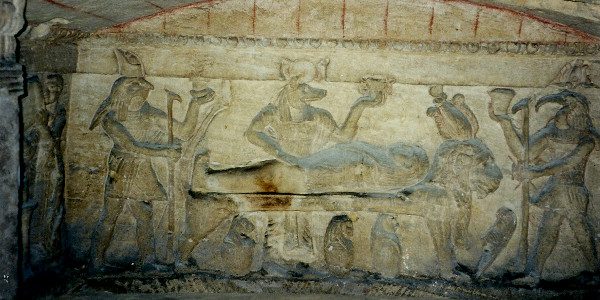
photo by Cyn Qoaad
What should our images of the Gods look like? How should They be depicted? How should They be dressed? Many of us favor “authentic” images of artwork from antiquity – certainly I’ve found great power in the classical image of Cernunnos. But many of the ancient images of the Gods are simply dressed in the fashion of a powerful person of that time. Why should we not portray the Gods in the fashions of our time?
Back in April, Morgan Daimler explored this issue in a post titled Dressing Old Gods in a New World. It’s a short post that’s worth your time to read – here are two excerpts:
How do I see the Gods I honor? How do I picture Macha? Well I certainly can see her as a 1st century Irish warrior queen, but I can also see her as thoroughly modern, clad in dark jeans and a leather jacket, driving around in a dark red Ford Mustang.
and
Odin I can see easily enough in a variety of guises, from a nondescript older man in a grey hooded sweatshirt with the hood pulled down over one eye, to a younger man wearing an eye patch and a business suit – or jeans and a t-shirt for a Viking metal band. Because Odin is pretty flexible like that.
Our images – whether classical or modern; human, animal, or abstract – should reflect Them as best we understand Them. Good religious art – in any religion – doesn’t just draw pretty pictures. It tells stories, conveys emotions, expresses values and virtues, and connects us with all that through our senses. These elements are timeless.
But be careful with being tied too closely to familiar conceptions. A few years ago, there was a small uproar when Idris Elba – who is black – portrayed the Norse God Heimdall in the movie Thor. I didn’t join the uproar. 1) It’s a comic book movie, not a historical film, and 2) the stories of our ancestors (much less contemporary UPG) are pretty clear that the Gods can take whatever form they like.
At the end of the day, let’s remember the wisdom of our pre-Roman Celtic ancestors. While images of the Gods can be beautiful, powerful, and helpful, the Gods Themselves are far more than anything we can envision. Let us never forget we can also see them with the eye of reverence.

Previous Post

June 9, 2016
The Otherworld is Bleeding Through
Next Post

June 14, 2016 Go Make The World Better
Browse Our Archives
Select a Category Books Community CUUPS Druidry Foundations and Context Gods and Goddesses Magic Myth Nature Ritual Spiritual Practice Theology Travel Uncategorized Videos
Select a Month October 2026 September 2026 August 2026 July 2026 June 2026 May 2026 April 2026 March 2026 February 2026 January 2026 December 2025 November 2025 October 2025 September 2025 August 2025 July 2025 June 2025 May 2025 April 2025 March 2025 February 2025 January 2025 December 2024 November 2024 October 2024 September 2024 August 2024 July 2024 June 2024 May 2024 April 2024 March 2024 February 2024 January 2024 December 2023 November 2023 October 2023 September 2023 August 2023 July 2023 June 2023 May 2023 April 2023 March 2023 February 2023 January 2023 December 2022 November 2022 October 2022 September 2022 August 2022 July 2022 June 2022 May 2022 April 2022 March 2022 February 2022 January 2022 December 2021 November 2021 October 2021 September 2021 August 2021 July 2021 June 2021 May 2021 April 2021 March 2021 February 2021 January 2021 December 2020 November 2020 October 2020 September 2020 August 2020 July 2020 June 2020 May 2020 April 2020 March 2020 February 2020 January 2020 December 2019 November 2019 October 2019 September 2019 August 2019 July 2019 June 2019 May 2019 April 2019 March 2019 February 2019 January 2019 December 2018 November 2018 October 2018 September 2018 August 2018 July 2018 June 2018 May 2018 April 2018 March 2018 February 2018 January 2018 December 2017 November 2017 October 2017 September 2017 August 2017 July 2017 June 2017 May 2017 April 2017 March 2017 February 2017 January 2017 December 2016 November 2016 October 2016 September 2016 August 2016 July 2016 June 2016 May 2016 April 2016 March 2016 February 2016 January 2016 December 2015 November 2015 October 2015 September 2015 August 2015 July 2015 June 2015 May 2015 April 2015 March 2015 February 2015 January 2015 December 2014 November 2014 October 2014 September 2014 August 2014 July 2014 June 2014 May 2014 April 2014 March 2014 February 2014 January 2014 December 2013 November 2013 October 2013 September 2013 August 2013 July 2013 June 2013 May 2013 April 2013 March 2013 February 2013 January 2013 December 2012 November 2012 October 2012 September 2012 August 2012 July 2012 June 2012 May 2012 April 2012 March 2012 February 2012 January 2012 December 2011 November 2011 October 2011 September 2011 August 2011 July 2011 June 2011 May 2011 April 2011 March 2011 February 2011 January 2011 December 2010 November 2010 October 2010 September 2010 August 2010 July 2010 June 2010 May 2010 April 2010 March 2010 February 2010 January 2010 December 2009 November 2009 October 2009 September 2009 August 2009 July 2009 June 2009 May 2009 April 2009 March 2009 February 2009 January 2009 December 2008 November 2008 October 2008 September 2008 August 2008 July 2008 June 2008
Follow Us!
TAKE THE
Religious Wisdom Quiz
What Christian group is known for using the term "General Conference"?
Select your answer to see how you score.
Presbyterians Lutherans Seventh-day Adventists Baptists
Related posts from John Beckett




What We Lose When “Ask AI” Becomes A...
TRENDING AT PATHEOS Pagan

The First Eucharistic Controversy: Christ’s Real Presence
For Catholics, the Eucharist is the source and summit of the Christian...

What a Stop Sign Can Teach Us About...
How to Make a Decision When You Can't Hear God Main point:...

Archdiocese Hosts Military Marriage Retreat in Germany
RASTATT, Germany — The transient military lifestyle, with its frequent deployments and...

Nearly every morning, I make the drive to Detroit with my high-school-age...

The Real AI Story Is Adoption Without Trust
Artificial intelligence has crossed a political threshold. It is no longer a...

A new article, written by Jeff Lindsay and Gale L. Pooley,...
view all Pagan blogs
Ad-Free & Subscriber Log-In Subscription Support
- About Us
- 2026 Calendar
- Videos
- Podcasts
- Library of World Religions
- Faith In Media Tracker
- Advertise With Us
- Write for Us
- Privacy Policy
- Terms of Service
- Do Not Sell My Data
- Contact Us
- Radiant Digital
- Manage Newsletter Subscriptions
- Unsubscribe From Notifications
- Sitemap
Copyright 2008-2026, Patheos. All rights reserved.
Subscription Support Ad-Free & Subscriber Log-In
Follow Patheos