
BuddhistCatholicContemplativeEvangelicalGeneral ChristianHinduJewishLatter-day SaintMuslimNew VisionsProgressive Christian
Beliefs
- Buddhist
- Catholic
- Contemplative
- Evangelical
- General Christian
- Hindu
- Jewish
- Latter-day Saint
- More Voices
- Muslim
- New Visions
- Pagan
- Progressive Christian
Topics
- Religion News
- Food and Religion
- Sports and Religion
- Religious Art
- Religious Music and Entertainment
- Religious Events
- History and Religion
- Style and Religion
- Politics and Religion
- Women in Religion
- Recreation Outdoors and Religion
- Business Finance and Religion
- Careers Workplace and Religion
- Education and Religion
- Family Parenting and Religion
- Health Fitness and Religion
- Home and Religion
- Relationships and Religion
- Technology and Religion
- Travel and Religion
Columnists
- Buddhist Columnists
- Business Finance and Religion Columnists
- Careers Workplace and Religion Columnists
- Catholic Columnists
- Contemplative Columnists
- Education and Religion Columnists
- Evangelists Columnists
- Family Parenting and Religion Columnists
- General Christian Columnists
- Health Fitness and Religion Columnists
- Hindu Columnists
- History and Religion Columnists
- Home and Religion Columnists
- Jewish Columnists
- More Voices Columnists
- Latter Day Columnists
- Muslim Columnists
- New Visions Columnists
- Nonreligious Columnists
- Pagan Columnists
- Politics and Religion Columnists
- Progressive Columnists
- Recreation Outdoors and Religion Columnists
- Relationships and Religion Columnists
- Religion News Columnists
- Religious Art Columnists
- Religious Events Columnists
- Religious Music and Entertainment Columnists
- Sports and Religion Columnists
- Style and Religion Columnists
- Technology and Religion Columnists
- Travel and Religion Columnists
- Women in Religion Columnists
Resource Library
- 2026 Calendar
- Library of World Religions
- The 100 Most Holy Places on Earth
- Patheos Answers
- Podcasts
- Videos
- Faith Leaders Database
- Anglican Episcopalian
- Bahai
- Baptist
- Buddhism
- Christianity
- Confucianism
- Eastern Orthodoxy
- Hinduism
- Holiness and Pentecostal
- ISKCON
- Islam
- Judaism
- Lutheran
- Methodist
- The Church of Jesus Christ of Latter-day Saints
- New Age
- Paganism
- Presbytarian and Reformed
- Protestantism
- Religion Behind the Scenes
- Roman Catholic
- Scientology
- Shia Islam
- Sikhism
- Sufism
- Sunni Islam
- Taoism
- Zen
- See all religions
Research Tools
 Ad-Free & Subscriber Log-In Subscription Support
Ad-Free & Subscriber Log-In Subscription Support
Follow Patheos 

- Trending:
- Forgiveness
- |
- Marriage
- |
- Consciousness
- |
- Death Penalty
- |
- Election
- |
- Halloween

- Home
- Pagan
- Star.Ships – A Book Review
Star.Ships – A Book Review
Last updated on: March 1, 2016 at 7:30 am by John Beckett
Star.Ships – A Book Review 2016-02-29T20:00:26-06:00 John Beckett
Patheos Explore the world's faith through different perspectives on religion and spirituality! Patheos has the views of the prevalent religions and spiritualities of the world.

Gordon White
Star.Ships: A Prehistory of the Spirits
by Gordon White
published by Scarlet Imprint, February 2016
Paperback £16, Hardback £50, plus shipping from the UK
312 pages
One of the questions any religion seeks to answer is “where did we come from?” Religious answers are mythical answers – they give us meaning that is helpful even if its historical accuracy is dubious. But we also know that most myths contain at least a hint of history.
The relationship between history and myth troubles our contemporary society, with fundamentalists insisting their myths are history and materialists insisting that only history has value. Meanwhile, the rest of us are left wondering where our religious traditions really came from and what those origins mean to us here and now.
Gordon White’s new book Star.Ships: A Prehistory of the Spirits addresses the question of our spiritual origins. It’s published by Scarlet Imprint, who summarizes it thusly:
White applies his globally-recognised data and demographics skills to realise a groundbreaking work of truly interdisciplinary research. Utilising mythological, linguistic and astronomical data to reconstruct palaeolithic magical beliefs, he maps them to the human journey out of Africa; explores which aspects of these beliefs and practices have survived into the Western tradition; and what the implications (and applications) of those survivals may be for us.
Unlike some works of prehistory, Star.Ships is a book that deals in facts, including some facts that have been suppressed for reasons of politics, religion, and individual ambition. It organizes these facts into theories that, while ultimately unprovable, are grounded in evidence and reason. And it does all this not to confirm our myths or to give us new myths to “believe,” but to provide context for our myths and for our spiritual and religious exploration of them.
I’ve done my own research in this area, though nothing approaching the volume and depth that Gordon White has done. I can find no factual errors in the book. Where I disagree with Gordon, our differences are matters of emphasis and interpretation. He’s an occultist, I’m a polytheist – you wouldn’t expect us to agree on everything.
The bottom line is that this is the best work of prehistory I’ve ever found. Gordon White, best known for his Rune Soup blog and podcast, has written a scholarly work that can stand with anything coming out of mainstream academia.
Where do our myths come from? More specifically, where does the Western tradition of interaction with Gods and spirits come from? The evidence – historical, archaeological, mythological, linguistic, and genetic – points to answers far older and much further east than we usually assume.
We know that about 70,000 years ago, a small group of modern humans (essentially identical to us) left Africa and began to move east. Every person alive today not of sub-Saharan African ancestry is their descendant. Within 20,000 years they had reached Australia, Southeast Asia, and the Pacific Islands. Some of this journey was accomplished overland – sea levels were much lower up until the end of the last ice age around 10,000 years ago – but some covered open oceans, navigating by the stars.
We know that the Biblical flood story is not unique – many cultures have such a myth. But not all cultures – these stories are rare in Africa. Not coincidentally, Africa was by and large unaffected by the rising seas following the end of the last ice age. The area that’s now the Pacific Islands, however, was quite literally inundated. This is also an area that’s largely been ignored by Western academics. Star.Ships shows how it’s highly likely there was an early civilization in that area with considerable sophistication. After their homeland was flooded, they began moving west: into India, into Mesopotamia, and into Egypt.
The discovery of Göbekli Tepe in southeastern Turkey in 1994 has forced us to rethink the origins of civilization. While the site is far from fully excavated, we’ve learned enough to know that it was built well over 10,000 years ago – the earliest Egyptian pyramids are closer to us in time than to Göbekli Tepe. We know that it was huge by all but modern standards. We know it was a ritual site, not a place where people lived. And we know that it was built before the development of agriculture and settled living.
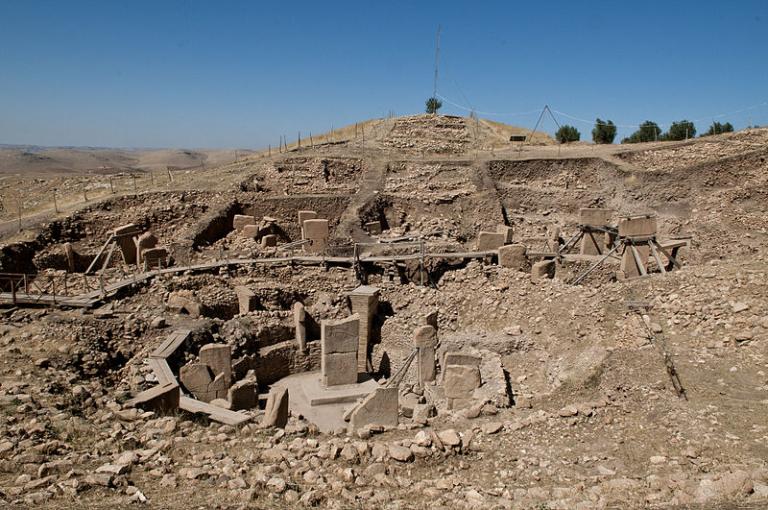
Göbekli Tepe – image via Wikimedia Commons

We’ve always assumed that after people begin farming, building cities, and generally settling down, religion evolved from tribal religion to what would become the organized religions of Sumer, Babylon, and Egypt, and eventually into their classical and modern offshoots. Göbekli Tepe tells us that’s wrong. Instead, organized religion came first. Then, because people gathered together, they began looking for ways to feed everyone. Necessity was the mother of the invention of agriculture… and of brewing. Göbekli Tepe has our first evidence of large-scale beer production.
The first seven chapters of Star.Ships take us from the last great journey out of Africa through the great floods that followed the end of the last ice age, then from East back to West through a time period where history (or at least, the dating of history) is still more speculative than factual. The rather long eighth chapter looks at Egypt and how the evidence tells us we should be reconsidering its origins and the origins of its earliest monuments, including the Sphinx and the pyramids. The final two chapters and the conclusion describe the effects this long journey has had on Western esotericism.
Lest the title scare you, Gordon examines the “ancient aliens” theories and finds them both unnecessary and unsupported by evidence. He does see several key points in human history where we took a huge leap forward in consciousness and in technology. Are these points of contact, not with material beings from other planets but with spiritual beings, however you care to conceive of them? While the evidence is far from conclusive, for those of us who see the world as more than material it is convincing.
So, what do we do with this new information? I’ll let Gordon White answer that himself:
As with all aspects of western magic, the race to reconstruction is heartily discouraged. In fact, if your takeaway from reading this far is an urgent need to recreate a Paleolithic spirituality based on the implications of the partially excavated site of Göbekli Tepe, I will find you and personally knock this book out of your hands on a crowded train. Instead, recontextualization of existing practices as they have arrived down through the centuries to us is encouraged. I would say even mandatory.
Who should read Star.Ships? Anyone who’s interested in the origins of human civilization and culture. Pagans, polytheists, the spiritual-but-not-religious, and open minded people of all religions will find it informative and helpful. Atheists will love 80% of the book and hate the other 20%. Anyone who reads the Bible literally or who thinks Victorian antiquarians (who did some good work but reached some very wrong conclusions) are still reliable sources will want to burn it.

I don’t review books differently based on how I get them, but for those of you who care about such things, I bought my copy of Star.Ships. I bought the hardback because it was available first – it was the most I’ve spent on a book since I was in graduate school. It was worth it. As always, my obligation in a review is to the readers, not the writer. If I couldn’t honestly give it a good review, I’d say so. This is a good book and I highly recommend it.
Previous Post

February 25, 2016
6 Thoughts on Scalia, Trump, and American Politics
Next Post
March 3, 2016 Gorged on Information, Starving for Wisdom
Browse Our Archives
Select a Category Books Community CUUPS Druidry Foundations and Context Gods and Goddesses Magic Myth Nature Ritual Spiritual Practice Theology Travel Uncategorized Videos
Select a Month October 2026 September 2026 August 2026 July 2026 June 2026 May 2026 April 2026 March 2026 February 2026 January 2026 December 2025 November 2025 October 2025 September 2025 August 2025 July 2025 June 2025 May 2025 April 2025 March 2025 February 2025 January 2025 December 2024 November 2024 October 2024 September 2024 August 2024 July 2024 June 2024 May 2024 April 2024 March 2024 February 2024 January 2024 December 2023 November 2023 October 2023 September 2023 August 2023 July 2023 June 2023 May 2023 April 2023 March 2023 February 2023 January 2023 December 2022 November 2022 October 2022 September 2022 August 2022 July 2022 June 2022 May 2022 April 2022 March 2022 February 2022 January 2022 December 2021 November 2021 October 2021 September 2021 August 2021 July 2021 June 2021 May 2021 April 2021 March 2021 February 2021 January 2021 December 2020 November 2020 October 2020 September 2020 August 2020 July 2020 June 2020 May 2020 April 2020 March 2020 February 2020 January 2020 December 2019 November 2019 October 2019 September 2019 August 2019 July 2019 June 2019 May 2019 April 2019 March 2019 February 2019 January 2019 December 2018 November 2018 October 2018 September 2018 August 2018 July 2018 June 2018 May 2018 April 2018 March 2018 February 2018 January 2018 December 2017 November 2017 October 2017 September 2017 August 2017 July 2017 June 2017 May 2017 April 2017 March 2017 February 2017 January 2017 December 2016 November 2016 October 2016 September 2016 August 2016 July 2016 June 2016 May 2016 April 2016 March 2016 February 2016 January 2016 December 2015 November 2015 October 2015 September 2015 August 2015 July 2015 June 2015 May 2015 April 2015 March 2015 February 2015 January 2015 December 2014 November 2014 October 2014 September 2014 August 2014 July 2014 June 2014 May 2014 April 2014 March 2014 February 2014 January 2014 December 2013 November 2013 October 2013 September 2013 August 2013 July 2013 June 2013 May 2013 April 2013 March 2013 February 2013 January 2013 December 2012 November 2012 October 2012 September 2012 August 2012 July 2012 June 2012 May 2012 April 2012 March 2012 February 2012 January 2012 December 2011 November 2011 October 2011 September 2011 August 2011 July 2011 June 2011 May 2011 April 2011 March 2011 February 2011 January 2011 December 2010 November 2010 October 2010 September 2010 August 2010 July 2010 June 2010 May 2010 April 2010 March 2010 February 2010 January 2010 December 2009 November 2009 October 2009 September 2009 August 2009 July 2009 June 2009 May 2009 April 2009 March 2009 February 2009 January 2009 December 2008 November 2008 October 2008 September 2008 August 2008 July 2008 June 2008
Follow Us!
TAKE THE
Religious Wisdom Quiz
What are the names of the two witnesses in Revelation who prophesy for 1,260 days?
Select your answer to see how you score.
Peter and Paul Enoch and Elijah Moses and Elijah They are not named
Related posts from John Beckett




What We Lose When “Ask AI” Becomes A...
TRENDING AT PATHEOS Pagan

Pope Leo Celebrates Mass for Nurses & Docs...
I don't have any idea how he did it, but Pope Leo...

The Sermon on the Mount, Part I: Matthew...
The Sermon on the Mount, Part I (Matthew 4:12-5:12) St. Matthew moves...

What's up from Crossway: Reviewing some of their latest A few weeks...

Janie Learns the Way of the Cross: A...
Teaching children about Jesus' Passion can be challenging. Many parents and educators...

Looking For Good Catholic Writing - October 2026
He alone extends the heavens, and he walks upon the waves of...

In "Irreplaceable," our book on vocation and technology, Trevor Sutton and I...
view all Pagan blogs
Ad-Free & Subscriber Log-In Subscription Support
- About Us
- 2026 Calendar
- Videos
- Podcasts
- Library of World Religions
- Faith In Media Tracker
- Advertise With Us
- Write for Us
- Privacy Policy
- Terms of Service
- Do Not Sell My Data
- Contact Us
- Radiant Digital
- Manage Newsletter Subscriptions
- Unsubscribe From Notifications
- Sitemap
Copyright 2008-2026, Patheos. All rights reserved.
Subscription Support Ad-Free & Subscriber Log-In
Follow Patheos