
BuddhistCatholicContemplativeEvangelicalGeneral ChristianHinduJewishLatter-day SaintMuslimNew VisionsProgressive Christian
Beliefs
- Buddhist
- Catholic
- Contemplative
- Evangelical
- General Christian
- Hindu
- Jewish
- Latter-day Saint
- More Voices
- Muslim
- New Visions
- Pagan
- Progressive Christian
Topics
- Religion News
- Food and Religion
- Sports and Religion
- Religious Art
- Religious Music and Entertainment
- Religious Events
- History and Religion
- Style and Religion
- Politics and Religion
- Women in Religion
- Recreation Outdoors and Religion
- Business Finance and Religion
- Careers Workplace and Religion
- Education and Religion
- Family Parenting and Religion
- Health Fitness and Religion
- Home and Religion
- Relationships and Religion
- Technology and Religion
- Travel and Religion
Columnists
- Buddhist Columnists
- Business Finance and Religion Columnists
- Careers Workplace and Religion Columnists
- Catholic Columnists
- Contemplative Columnists
- Education and Religion Columnists
- Evangelists Columnists
- Family Parenting and Religion Columnists
- General Christian Columnists
- Health Fitness and Religion Columnists
- Hindu Columnists
- History and Religion Columnists
- Home and Religion Columnists
- Jewish Columnists
- More Voices Columnists
- Latter Day Columnists
- Muslim Columnists
- New Visions Columnists
- Nonreligious Columnists
- Pagan Columnists
- Politics and Religion Columnists
- Progressive Columnists
- Recreation Outdoors and Religion Columnists
- Relationships and Religion Columnists
- Religion News Columnists
- Religious Art Columnists
- Religious Events Columnists
- Religious Music and Entertainment Columnists
- Sports and Religion Columnists
- Style and Religion Columnists
- Technology and Religion Columnists
- Travel and Religion Columnists
- Women in Religion Columnists
Resource Library
- 2026 Calendar
- Library of World Religions
- The 100 Most Holy Places on Earth
- Patheos Answers
- Podcasts
- Videos
- Faith Leaders Database
- Anglican Episcopalian
- Bahai
- Baptist
- Buddhism
- Christianity
- Confucianism
- Eastern Orthodoxy
- Hinduism
- Holiness and Pentecostal
- ISKCON
- Islam
- Judaism
- Lutheran
- Methodist
- The Church of Jesus Christ of Latter-day Saints
- New Age
- Paganism
- Presbytarian and Reformed
- Protestantism
- Religion Behind the Scenes
- Roman Catholic
- Scientology
- Shia Islam
- Sikhism
- Sufism
- Sunni Islam
- Taoism
- Zen
- See all religions
Research Tools
 Ad-Free & Subscriber Log-In Subscription Support
Ad-Free & Subscriber Log-In Subscription Support
Follow Patheos 

- Trending:
- Forgiveness
- |
- Marriage
- |
- Consciousness
- |
- Death Penalty
- |
- Election
- |
- Halloween

- Home
- Pagan
- The Future of Polytheism: Keeping the Gods at the Front
The Future of Polytheism: Keeping the Gods at the Front
Last updated on: August 23, 2015 at 3:00 pm by John Beckett
The Future of Polytheism: Keeping the Gods at the Front 2015-08-22T10:44:42-06:00 John Beckett
Patheos Explore the world's faith through different perspectives on religion and spirituality! Patheos has the views of the prevalent religions and spiritualities of the world.
It’s somewhat ironic that in the same month where I attended a major polytheist gathering and gave a presentation on how we can’t predict the future I find myself writing about the future of polytheism. But Patheos asked all its channels to write about the future of their traditions this summer and I want polytheists to be represented.
I don’t know what the future of polytheism looks like. I have dreams of temples in every city, huge public rituals on holy days, and perhaps most importantly, a culture dominated by polytheist virtues and values. These include honor, hospitality, reciprocity, the sovereignty of the land and of each individual, and a multi-generation approach to decision making. But the needs of future polytheists may be very different from what I’m imagining – they may need something other than temples and large public rituals.
I do know what we need to do to insure that polytheism will thrive in the future: keep our focus on our spiritual and devotional practice as polytheists. And at the top of that list of practices is honoring the Gods and keeping Them at the front.
 Good religion motivates us to live better lives. It encourages us to build a better world here and now. It inspires us to work and sacrifice for the benefit of future generations. Unless you’re a cloistered monk or a mystic who spends so much time in the Otherworld you’re barely functional in this world, I would argue that if your religion doesn’t have a strong this-world component you’re doing it wrong.
However…
Our this-world concerns are enormous. They’re here, in front of us, right now. They demand our attention, they demand our time, they demand our effort. And they never end. If we are not mindful, if we are not – dare I say it – devout and pious, it is all too easy to let our this-world concerns become our gods and take Their place in our lives.
There are three problems with this.
We cut ourselves off from our source. Good religion motivates us to live better lives. There’s a simple flow diagram in that sentence:
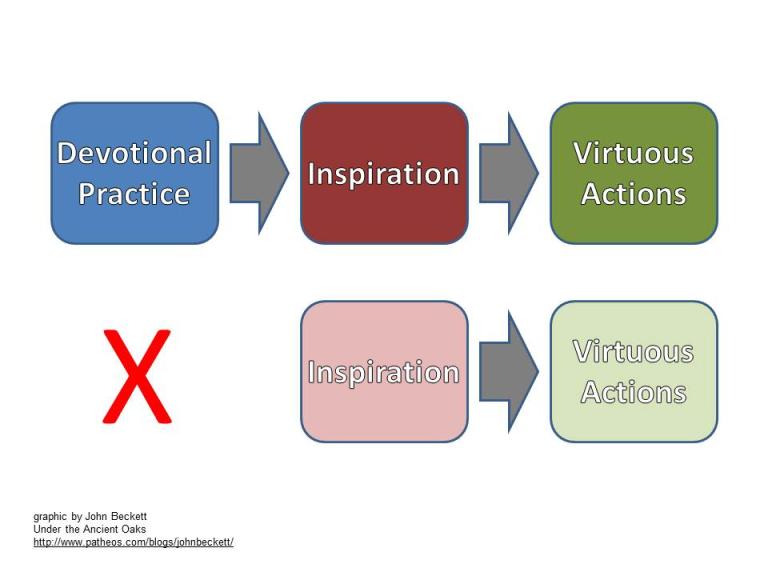 Now perhaps doing the right thing is motivation enough for doing the right thing. Many of us have atheist friends who work alongside us to care for the Earth and to build a fair and just society. But if your religious beliefs and practices inspired you to take up the great work of the world, they will also inspire you to keep working when things get hard. One of keys to self-care is to continue to do the things that give you strength even when they aren’t convenient.
A strong, consistent polytheist practice maintains our connections to our Gods, to our ancestors, and to the spirits of the places where we live and work. While we aren’t the primary concern of the Gods (though we may be a primary concern of our ancestors) if we are working on projects, causes, and practices that fall under Their purview They are likely to be helpful to us, subtly if not overtly.
When we keep the Gods at the front we maintain our connection to our source.
We stop practicing polytheism. Last week philosopher and polytheist Edward Butler said:
The one and only thing that we can regard as a doctrine universal to polytheism as such is the genuine existence of many Gods, and whatever we may, arguably and provisionally, infer from that single affirmation. Whatever does not follow from this single affirmation, however commonly held it should prove to be in this or that polytheistic tradition, cannot be said to be a property of polytheism as such.
As the header of this blog announces, my religion is more than polytheism. Paganism, Druidry, and Unitarian Universalism are also part of my religious life, and I bring a polytheistic approach to all of them. But the only thing I do that is truly polytheism is my devotion to the Gods.
I have no desire to argue over who is and isn’t a polytheist. I support the right of self-identification. I also recognize the need to point out relevant distinctions, particularly around the meaning of “genuine existence” in Dr. Butler’s statement above. But that’s another post for another time.
What I’m very interested in doing is pointing out that a practice with the Gods at the front is going to look and feel different from a practice that puts something else at the front, be that personal growth, political reform, social change, or anything else. It will also produce different results.
A practice with the Gods at the front will build a foundation on Their virtues and values that will support us as we attempt to achieve personal growth, political reform, social change, or anything else. And that foundation will be there in good times and in bad… if we keep the Gods at the front.
We delay the polytheist restoration. Or if you prefer, the polytheist revolution, since the traditions we will build in the future won’t be exactly the same as those of ancient times.
All of us in the Big Tent of Paganism like to emphasize “orthopraxy not orthodoxy” – do the right things and don’t worry about believing the right things. But while that’s a good approach when dealing with others (if you’re helping with roadside cleanup, I don’t care if you’re a Druid, an atheist, or a Baptist), it’s less than ideal when we apply it to ourselves.
Truly changing the world begins with truly changing ourselves. It’s practicing polytheism so deeply that it becomes part of your identity – it’s no longer something you believe or something you do, it’s something you are. This isn’t “believe what you want just do the right things.” It’s “do the right things to the extent that doing something else isn’t conceivable any more.” It’s the deep knowing that comes only from intimate first-hand experience.
The only people I know who are like this are devout, pious polytheists who keep the Gods at the front of their practices. I’m there when I’m in ritual or in meditation, but not in ordinary times. Yet.
When we don’t keep the Gods at the forefront of our practice, we put something else there. That something else may be helpful or it may be a distraction, but whatever it is weakens our relationships with the Gods, lessens our understanding of Their values and virtues, and hinders us from developing a deep, intuitive polytheist identity.
The future of polytheism. The future of polytheism will be many different traditions honoring many different Gods. That’s not much of a prediction – we’ve already got that today. Some of these traditions will flounder, while others will grow and prosper. Those that do well will do all the things healthy organizations of all types do, but they’ll also keep the Gods at the front of their practice.
There is room in our many ethnic and regional traditions for people for whom the Gods are secondary to community, Nature, or their own better selves. There is room for people who simply want to honor the Gods and live ordinary lives. Our polytheist traditions are not all or nothing propositions and I hope they never will be.
But the future of polytheism will be built by those who keep the Gods at the front of their practice.
Previous Post

August 20, 2015
Destiny, Availability, and a Lot of Work
Next Post

August 25, 2015 What I Learned From Isaac Bonewits
Browse Our Archives
Select a Category Books Community CUUPS Druidry Foundations and Context Gods and Goddesses Magic Myth Nature Ritual Spiritual Practice Theology Travel Uncategorized Videos
Select a Month October 2026 September 2026 August 2026 July 2026 June 2026 May 2026 April 2026 March 2026 February 2026 January 2026 December 2025 November 2025 October 2025 September 2025 August 2025 July 2025 June 2025 May 2025 April 2025 March 2025 February 2025 January 2025 December 2024 November 2024 October 2024 September 2024 August 2024 July 2024 June 2024 May 2024 April 2024 March 2024 February 2024 January 2024 December 2023 November 2023 October 2023 September 2023 August 2023 July 2023 June 2023 May 2023 April 2023 March 2023 February 2023 January 2023 December 2022 November 2022 October 2022 September 2022 August 2022 July 2022 June 2022 May 2022 April 2022 March 2022 February 2022 January 2022 December 2021 November 2021 October 2021 September 2021 August 2021 July 2021 June 2021 May 2021 April 2021 March 2021 February 2021 January 2021 December 2020 November 2020 October 2020 September 2020 August 2020 July 2020 June 2020 May 2020 April 2020 March 2020 February 2020 January 2020 December 2019 November 2019 October 2019 September 2019 August 2019 July 2019 June 2019 May 2019 April 2019 March 2019 February 2019 January 2019 December 2018 November 2018 October 2018 September 2018 August 2018 July 2018 June 2018 May 2018 April 2018 March 2018 February 2018 January 2018 December 2017 November 2017 October 2017 September 2017 August 2017 July 2017 June 2017 May 2017 April 2017 March 2017 February 2017 January 2017 December 2016 November 2016 October 2016 September 2016 August 2016 July 2016 June 2016 May 2016 April 2016 March 2016 February 2016 January 2016 December 2015 November 2015 October 2015 September 2015 August 2015 July 2015 June 2015 May 2015 April 2015 March 2015 February 2015 January 2015 December 2014 November 2014 October 2014 September 2014 August 2014 July 2014 June 2014 May 2014 April 2014 March 2014 February 2014 January 2014 December 2013 November 2013 October 2013 September 2013 August 2013 July 2013 June 2013 May 2013 April 2013 March 2013 February 2013 January 2013 December 2012 November 2012 October 2012 September 2012 August 2012 July 2012 June 2012 May 2012 April 2012 March 2012 February 2012 January 2012 December 2011 November 2011 October 2011 September 2011 August 2011 July 2011 June 2011 May 2011 April 2011 March 2011 February 2011 January 2011 December 2010 November 2010 October 2010 September 2010 August 2010 July 2010 June 2010 May 2010 April 2010 March 2010 February 2010 January 2010 December 2009 November 2009 October 2009 September 2009 August 2009 July 2009 June 2009 May 2009 April 2009 March 2009 February 2009 January 2009 December 2008 November 2008 October 2008 September 2008 August 2008 July 2008 June 2008
Follow Us!
TAKE THE
Religious Wisdom Quiz
Which prophet confronted King Ahab about his sins?
Select your answer to see how you score.
Elisha Jeremiah Ezekiel Elijah
Related posts from John Beckett




What We Lose When “Ask AI” Becomes A...
TRENDING AT PATHEOS Pagan

In one sense walking into Westminster Abbey is like walking down the...

'Super Scam Me' Exposes AI Jon Bon Jovi...
Leslie Pickett believed she was in a relationship with Jon Bon Jovi....

The Brazilian Remake of Kendricks' 'Flywheel' Opens in...
“Flywheel,” the story that launched the Kendrick Brothers’ filmmaking career is getting...

The Dangers of Gradual Accommodation (Winking at Sin)
Recently, the “law of gradualness” resurfaced during the opening of a weeklong,...

The Iron Gates and the Lion of the...
Yesterday, I didn't finish my report about, well, yesterday. So I'll...

The Image: On the Horror of Capitalism and...
The Image Then went the Pharisees, and took counsel how they might...
view all Pagan blogs
Ad-Free & Subscriber Log-In Subscription Support
- About Us
- 2026 Calendar
- Videos
- Podcasts
- Library of World Religions
- Faith In Media Tracker
- Advertise With Us
- Write for Us
- Privacy Policy
- Terms of Service
- Do Not Sell My Data
- Contact Us
- Radiant Digital
- Manage Newsletter Subscriptions
- Unsubscribe From Notifications
- Sitemap
Copyright 2008-2026, Patheos. All rights reserved.
Subscription Support Ad-Free & Subscriber Log-In
Follow Patheos