
BuddhistCatholicContemplativeEvangelicalGeneral ChristianHinduJewishLatter-day SaintMuslimNew VisionsProgressive Christian
Beliefs
- Buddhist
- Catholic
- Contemplative
- Evangelical
- General Christian
- Hindu
- Jewish
- Latter-day Saint
- More Voices
- Muslim
- New Visions
- Pagan
- Progressive Christian
Topics
- Religion News
- Food and Religion
- Sports and Religion
- Religious Art
- Religious Music and Entertainment
- Religious Events
- History and Religion
- Style and Religion
- Politics and Religion
- Women in Religion
- Recreation Outdoors and Religion
- Business Finance and Religion
- Careers Workplace and Religion
- Education and Religion
- Family Parenting and Religion
- Health Fitness and Religion
- Home and Religion
- Relationships and Religion
- Technology and Religion
- Travel and Religion
Columnists
- Buddhist Columnists
- Business Finance and Religion Columnists
- Careers Workplace and Religion Columnists
- Catholic Columnists
- Contemplative Columnists
- Education and Religion Columnists
- Evangelists Columnists
- Family Parenting and Religion Columnists
- General Christian Columnists
- Health Fitness and Religion Columnists
- Hindu Columnists
- History and Religion Columnists
- Home and Religion Columnists
- Jewish Columnists
- More Voices Columnists
- Latter Day Columnists
- Muslim Columnists
- New Visions Columnists
- Nonreligious Columnists
- Pagan Columnists
- Politics and Religion Columnists
- Progressive Columnists
- Recreation Outdoors and Religion Columnists
- Relationships and Religion Columnists
- Religion News Columnists
- Religious Art Columnists
- Religious Events Columnists
- Religious Music and Entertainment Columnists
- Sports and Religion Columnists
- Style and Religion Columnists
- Technology and Religion Columnists
- Travel and Religion Columnists
- Women in Religion Columnists
Resource Library
- 2026 Calendar
- Library of World Religions
- The 100 Most Holy Places on Earth
- Patheos Answers
- Podcasts
- Videos
- Faith Leaders Database
- Anglican Episcopalian
- Bahai
- Baptist
- Buddhism
- Christianity
- Confucianism
- Eastern Orthodoxy
- Hinduism
- Holiness and Pentecostal
- ISKCON
- Islam
- Judaism
- Lutheran
- Methodist
- The Church of Jesus Christ of Latter-day Saints
- New Age
- Paganism
- Presbytarian and Reformed
- Protestantism
- Religion Behind the Scenes
- Roman Catholic
- Scientology
- Shia Islam
- Sikhism
- Sufism
- Sunni Islam
- Taoism
- Zen
- See all religions
Research Tools
 Ad-Free & Subscriber Log-In Subscription Support
Ad-Free & Subscriber Log-In Subscription Support
Follow Patheos 

- Trending:
- Forgiveness
- |
- Marriage
- |
- Consciousness
- |
- Death Penalty
- |
- Election
- |
- Halloween

- Home
- Pagan
- Showing Up
Showing Up
Last updated on: July 1, 2014 at 5:00 pm by John Beckett
Showing Up 2014-06-30T18:27:32-06:00 John Beckett
Patheos Explore the world's faith through different perspectives on religion and spirituality! Patheos has the views of the prevalent religions and spiritualities of the world.
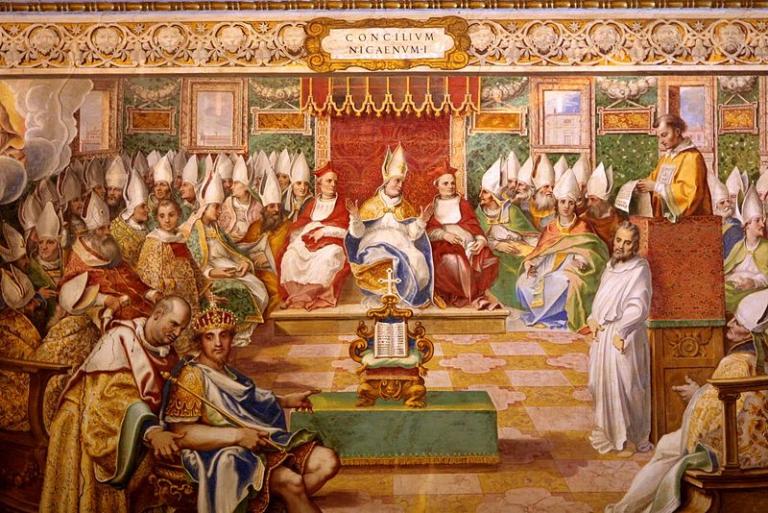
The Council of Nicaea – photo via Wikimedia Commons
Decisions are made by those who show up.
Every time I compare the running debates on the Pagan internet to the Council of Nicaea I get pushback. Some of this is understandable. The Council of Nicaea was one of the most important events in the establishment of Christianity as the dominant religion of Europe and its output has helped define Christian orthodoxy for over 1600 years. It is no surprise that Pagans – many of whom left Christianity under unpleasant circumstances – have no desire to emulate Christian institutions and processes.
The comparison is not perfect. We Pagans have no imperial mandate, we have no fixed agenda, we will issue no creeds and we will canonize no scriptures. The outcome of our debates will be many varieties of Pagan belief and practice, not one catholic (i.e. – universal) Paganism.
But there is an important lesson to be learned from the Council of Nicaea, so please bear with me while I summarize what happened.
In 325 CE the Roman Emperor Constantine sent out a call for all Christian bishops to participate in a council to settle various disagreements within the still-new Christian church – the nature of the relationship between the Father and the Son and the date of Easter being the most prominent. The precise agenda isn’t relevant to the modern Pagan comparison.
What’s relevant is that 1800 bishops were invited to participate in the council. 300 showed up. Those 300 bishops made decisions that are still in effect today.
What would the Council of Nicaea been like if the other 1500 bishops had attended? What would it have done differently if ordinary priests had also been invited, or lay Christians?
The orthodox Christian position is that the Council was guided by the Holy Spirit and thus would have reached the same conclusions no matter who was involved. Perhaps. Others say those 300 bishops were a representative sample of Christian thought at the time and thus reached the same conclusions as if Constantine had polled all of Christendom. Perhaps. Still others argue that those who made the long and difficult journey to Nicaea (in what is now northern Turkey) were the most invested and most passionate and therefore would have carried the argument no matter who attended. Perhaps.
What would the Council of Nicaea been like if more than 300 bishops had participated? We’ll never know. Here’s what we do know: major decisions were made by those who showed up.
We can debate when modern Pagan religion began, but such a debate is impossible to settle. What’s important for our purposes is that modern Pagan religion is a new religion. We’re still figuring out what we want to be when we grow up. Even if we work within the Four Centers model, there is little agreement as to what constitutes Nature-centered, Deity-centered, Self-centered, and Community-centered religion. To use a biological comparison, we are in the middle (or perhaps even the beginning) of an evolutionary explosion where many species arise. Over time, the less fit variations will die off and the more fit variations will continue.
The first phase of modern Paganism spread by direct personal contact, through one on one teaching and initiation. The second phase spread by books, with writers like Starhawk, Margot Adler, and Scott Cunningham making the rise of solitary practitioners possible. The current phase of Paganism is being spread by the internet and while some voices are louder than others, anyone with a computer and some basic writing skills can contribute to the discussion.
Jason Mankey argues that Pagan bloggers have little influence because our readership is so low. He’s right, if you’re talking about any one individual. But ideas spread through social media, and those that are particularly helpful (or sadly, particularly controversial) can quickly find their way to thousands of Pagans worldwide.
Who are the Gods? What are the Gods? How can we best interact with Them? Why do we want to interact with Them?
What are Pagan values and virtues? How can we best embody them in a society that seems interested only in the next shiny new distraction?
What are our obligations to Nature? What are our obligations to other humans and other species?
How can we best learn and grow ourselves?
What stories best help us live full and honorable lives?
These are some of the many questions any religion must answer. What answers will Pagans propose? What answers will Pagans find helpful? What answers will Pagans discard?
Every generation builds on the foundations laid by the previous generation. I look at my bookshelf and I see Isaac Bonewits, Philip Carr-Gomm, and Ronald Hutton. I see Thorn Coyle and Brendan Myers. These and many others have influenced my Paganism – my practice starts here.
What will the Pagans of 2050 use as a starting point? The Pagans of 2100? The Pagans of centuries and millennia to come?
I don’t know.
What I do know is that our conversations are shaping the future of Paganism. Slowly, incrementally, by trial and error, by consensus and by strength of will, decisions are being made and they’re being made by those who participate in the discussions.
Decisions are made by those who show up.
You say you don’t like theology? That’s fine – we’re also trying to figure out which holidays to celebrate and how to celebrate them. We’re trying to figure out which spiritual practices draw us closer to the Gods, to each other, and to our better selves… and we’re trying to figure out which practices are a colossal waste of time. We’re trying to figure out what our pre-Christian ancestors really thought and did, and how much of that we should adopt into our lives.
Decisions are being made by those who show up.
You prefer a this-world, this-life religion? We’re trying to decide how we can best change the world through mainstream politics… or if we should participate in politics at all. We’re trying to figure out where direct personal action is needed. We’re trying to decide what our obligations are to other people, other species, and other ecosystems, and how we can best fulfill those obligations.
Decisions are being made by those who show up.
You couldn’t participate in all these discussions even if you wanted to – you’d spend all your time debating and have nothing left for doing, for actually being a Pagan. That’s why my favorite blogs (see the blogroll on the right) are mostly written by people who aren’t just talking Paganism, they’re doing Paganism.
These are some of the people who are showing up. They’re showing up to do the work and then they’re showing up to tell the rest of us what they’ve done and how well it worked.
What an amazing opportunity we have. What an awesome responsibility we have.
You don’t have to participate, but remember those 1500 bishops who stayed home. Decisions are made by those who show up.
Previous Post

June 29, 2014
Serving Many Gods
Next Post

July 3, 2014 Religious Freedom, Religious Bullying
Browse Our Archives
Select a Category Books Community CUUPS Druidry Foundations and Context Gods and Goddesses Magic Myth Nature Ritual Spiritual Practice Theology Travel Uncategorized Videos
Select a Month October 2026 September 2026 August 2026 July 2026 June 2026 May 2026 April 2026 March 2026 February 2026 January 2026 December 2025 November 2025 October 2025 September 2025 August 2025 July 2025 June 2025 May 2025 April 2025 March 2025 February 2025 January 2025 December 2024 November 2024 October 2024 September 2024 August 2024 July 2024 June 2024 May 2024 April 2024 March 2024 February 2024 January 2024 December 2023 November 2023 October 2023 September 2023 August 2023 July 2023 June 2023 May 2023 April 2023 March 2023 February 2023 January 2023 December 2022 November 2022 October 2022 September 2022 August 2022 July 2022 June 2022 May 2022 April 2022 March 2022 February 2022 January 2022 December 2021 November 2021 October 2021 September 2021 August 2021 July 2021 June 2021 May 2021 April 2021 March 2021 February 2021 January 2021 December 2020 November 2020 October 2020 September 2020 August 2020 July 2020 June 2020 May 2020 April 2020 March 2020 February 2020 January 2020 December 2019 November 2019 October 2019 September 2019 August 2019 July 2019 June 2019 May 2019 April 2019 March 2019 February 2019 January 2019 December 2018 November 2018 October 2018 September 2018 August 2018 July 2018 June 2018 May 2018 April 2018 March 2018 February 2018 January 2018 December 2017 November 2017 October 2017 September 2017 August 2017 July 2017 June 2017 May 2017 April 2017 March 2017 February 2017 January 2017 December 2016 November 2016 October 2016 September 2016 August 2016 July 2016 June 2016 May 2016 April 2016 March 2016 February 2016 January 2016 December 2015 November 2015 October 2015 September 2015 August 2015 July 2015 June 2015 May 2015 April 2015 March 2015 February 2015 January 2015 December 2014 November 2014 October 2014 September 2014 August 2014 July 2014 June 2014 May 2014 April 2014 March 2014 February 2014 January 2014 December 2013 November 2013 October 2013 September 2013 August 2013 July 2013 June 2013 May 2013 April 2013 March 2013 February 2013 January 2013 December 2012 November 2012 October 2012 September 2012 August 2012 July 2012 June 2012 May 2012 April 2012 March 2012 February 2012 January 2012 December 2011 November 2011 October 2011 September 2011 August 2011 July 2011 June 2011 May 2011 April 2011 March 2011 February 2011 January 2011 December 2010 November 2010 October 2010 September 2010 August 2010 July 2010 June 2010 May 2010 April 2010 March 2010 February 2010 January 2010 December 2009 November 2009 October 2009 September 2009 August 2009 July 2009 June 2009 May 2009 April 2009 March 2009 February 2009 January 2009 December 2008 November 2008 October 2008 September 2008 August 2008 July 2008 June 2008
Follow Us!
TAKE THE
Religious Wisdom Quiz
True or False: The mystery hidden for ages is Christ in us, the hope of glory.
Select your answer to see how you score.
FALSE TRUE
Related posts from John Beckett


The Vampire Films of Jean Rollin


Bo French Doesn’t Understand Texas
TRENDING AT PATHEOS Pagan

The Sermon on the Mount, Part I: Matthew...
The Sermon on the Mount, Part I (Matthew 4:12-5:12) St. Matthew moves...

What's up from Crossway: Reviewing some of their latest A few weeks...

Janie Learns the Way of the Cross: A...
Teaching children about Jesus' Passion can be challenging. Many parents and educators...

Looking For Good Catholic Writing - October 2026
He alone extends the heavens, and he walks upon the waves of...

In "Irreplaceable," our book on vocation and technology, Trevor Sutton and I...

I was strolling through the top floor of the brand new Parthenon...
view all Pagan blogs
Ad-Free & Subscriber Log-In Subscription Support
- About Us
- 2026 Calendar
- Videos
- Podcasts
- Library of World Religions
- Faith In Media Tracker
- Advertise With Us
- Write for Us
- Privacy Policy
- Terms of Service
- Do Not Sell My Data
- Contact Us
- Radiant Digital
- Manage Newsletter Subscriptions
- Unsubscribe From Notifications
- Sitemap
Copyright 2008-2026, Patheos. All rights reserved.
Subscription Support Ad-Free & Subscriber Log-In
Follow Patheos