
BuddhistCatholicContemplativeEvangelicalGeneral ChristianHinduJewishLatter-day SaintMuslimNew VisionsProgressive Christian
Beliefs
- Buddhist
- Catholic
- Contemplative
- Evangelical
- General Christian
- Hindu
- Jewish
- Latter-day Saint
- More Voices
- Muslim
- New Visions
- Pagan
- Progressive Christian
Topics
- Religion News
- Food and Religion
- Sports and Religion
- Religious Art
- Religious Music and Entertainment
- Religious Events
- History and Religion
- Style and Religion
- Politics and Religion
- Women in Religion
- Recreation Outdoors and Religion
- Business Finance and Religion
- Careers Workplace and Religion
- Education and Religion
- Family Parenting and Religion
- Health Fitness and Religion
- Home and Religion
- Relationships and Religion
- Technology and Religion
- Travel and Religion
Columnists
- Buddhist Columnists
- Business Finance and Religion Columnists
- Careers Workplace and Religion Columnists
- Catholic Columnists
- Contemplative Columnists
- Education and Religion Columnists
- Evangelists Columnists
- Family Parenting and Religion Columnists
- General Christian Columnists
- Health Fitness and Religion Columnists
- Hindu Columnists
- History and Religion Columnists
- Home and Religion Columnists
- Jewish Columnists
- More Voices Columnists
- Latter Day Columnists
- Muslim Columnists
- New Visions Columnists
- Nonreligious Columnists
- Pagan Columnists
- Politics and Religion Columnists
- Progressive Columnists
- Recreation Outdoors and Religion Columnists
- Relationships and Religion Columnists
- Religion News Columnists
- Religious Art Columnists
- Religious Events Columnists
- Religious Music and Entertainment Columnists
- Sports and Religion Columnists
- Style and Religion Columnists
- Technology and Religion Columnists
- Travel and Religion Columnists
- Women in Religion Columnists
Resource Library
- 2026 Calendar
- Library of World Religions
- The 100 Most Holy Places on Earth
- Patheos Answers
- Podcasts
- Videos
- Faith Leaders Database
- Anglican Episcopalian
- Bahai
- Baptist
- Buddhism
- Christianity
- Confucianism
- Eastern Orthodoxy
- Hinduism
- Holiness and Pentecostal
- ISKCON
- Islam
- Judaism
- Lutheran
- Methodist
- The Church of Jesus Christ of Latter-day Saints
- New Age
- Paganism
- Presbytarian and Reformed
- Protestantism
- Religion Behind the Scenes
- Roman Catholic
- Scientology
- Shia Islam
- Sikhism
- Sufism
- Sunni Islam
- Taoism
- Zen
- See all religions
Research Tools
 Ad-Free & Subscriber Log-In Subscription Support
Ad-Free & Subscriber Log-In Subscription Support
Follow Patheos 

- Trending:
- Forgiveness
- |
- Marriage
- |
- Consciousness
- |
- Death Penalty
- |
- Election
- |
- Halloween

- Home
- Pagan
- Expanding Circles
Expanding Circles
Last updated on: June 5, 2014 at 5:28 pm by John Beckett
Expanding Circles 2014-06-05T17:28:15-06:00 John Beckett
Patheos Explore the world's faith through different perspectives on religion and spirituality! Patheos has the views of the prevalent religions and spiritualities of the world.
Pagan groups are notoriously volatile, in the chemical sense of the word: they evaporate quickly. Sometimes they’re volatile in the commonly used sense of the word: they change rapidly, unpredictably, and for the worse. Much of this volatility comes from a lack of understanding of what is required to form and maintain a functional and healthy religious group.
Good religious groups may evolve organically without any structural planning (or even structural awareness) but like biological evolution, for every successful species there are many that go extinct. If you attempt to duplicate the evolutionary process of such a lucky group you’re likely to fail – you won’t have the same people in the same location in the same circumstances at the same time.
Fortunately, there are some commonalities among healthy religious groups that can be duplicated. I touched on some of this when I wrote about how to start a CUUPS chapter. Today I’d like to expand on the structure of religious groups. While some of this comes from formal education in business organizations and leadership, most of it comes from a lifetime of experience in churches, fraternal orders, religious orders and Pagan groups of all descriptions.
Think of the structure of a religious group not as a hierarchy but as a set of concentric circles. Start at the core and work your way outward.
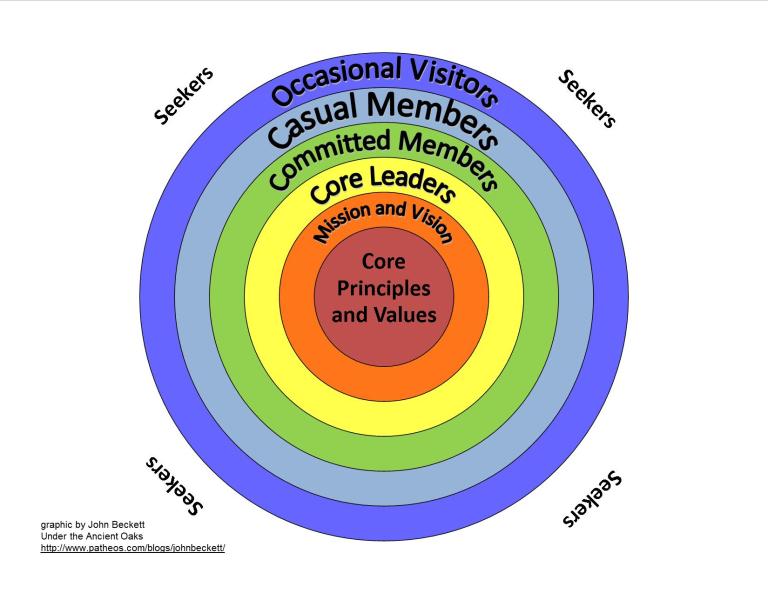
Core principles and values. This is the core, the center, the foundation. This is why the group exists in the first place. Too often this core is ignored, or assumed to be something other than what it really is.
You want to start a Pagan group? Great. Will it be Nature centered, Deity centered, Self centered or Community centered? You want to start a polytheist group? Which pantheon? Which deities? You want to start a CUUPS group? How do you see UU Paganism? General UUism with an emphasis on the Seventh Principle and the Sixth Source? Generic Wicca? Devotional polytheism in an inclusive setting? If members have different core principles and values they simply must negotiate which principles and values the group will be formed around or conflict is inevitable.
The core principles and values are who and what the group exists to serve. Devotion to that core is what keeps people moving forward when times get tough. Without it, it’s very easy to abandon a group when the work gets hard.
Mission and vision. This is what you’re doing to do. It’s how you’re going to serve your core principles and values.
Ten or fifteen years ago, mission and vision statements were the trendy thing in business: create a pithy mission statement that sums up who you are and what you do. A lot of that trendiness carried over into the religious world. But too many of those professionally-crafted mission statements were printed, posted, and then promptly forgotten.
Before I arrived in 2003 the members of Denton CUUPS created a very nice mission statement. But if you want to know what our mission is today, go look at our calendar and see what we’re actually doing: holding public rituals on the eight high days, participating in roadside cleanup, teaching classes and providing other opportunities for learning, and spending time in the natural world.
What are you going to do and how are you going to do it?
Core leaders. Individual members don’t show up until the third circle. This is critical: the core principles and the mission are more important than any one person or subgroup of people.
Large, established, well-funded groups can function via institutional controls and operations. Small groups rely on individual people to get things done. One person can do this if she’s very strong, very capable, very grounded, and very committed. Most times it takes two or three. In a large group it takes more.
These are the people who keep the calendar and make sure everything gets done and done right. They don’t do all the work – they can’t, that’s a recipe for fast burnout – but they make sure all the work gets done. They are extremely committed to the principles and the mission and they do their best to keep everyone focused on why they’re there. They understand people sometimes fail, but the group can never be allowed to fail.
It’s not enough to be dedicated. A core leader also has be a good leader: he has to have good communication skills, attention to detail, and the ability to embody the ideals of the group. Don’t just tell people what a good member is, show them.
The core leaders aren’t necessarily the most skilled priests and priestesses – facilitating ritual and leading a group are two very different skill sets. In churches, it’s common to find good pastors who are mediocre preachers or inspiring speakers who are lousy church managers. Match the group’s needs with the capabilities of its members and don’t expect people to do things they can’t do.
Right or wrong, core leaders’ voices usually carry the most weight. This is why groups need more than one core leader: even the most committed and the most knowledgeable leaders aren’t right all the time.
Committed members. These are the folks you can count on to be at every circle, every dinner, and every service project. Maybe not at every single event, but if they aren’t there you can bet there’s a very good reason. You can count on them as financial contributors, within their means. They’re every bit as committed as the core leaders, but for whatever reason, they’re not leaders. Maybe they don’t have leadership skills. Maybe they’ve been burned in other organizations. Maybe they just don’t like being in front. They may accept short-term leadership roles, but don’t look for them to drive the train.
Occasionally a committed member will become a core leader, but be very hesitant to push them in that direction. If they accept only out of obligation, they may be hurt when – through no fault of their own – they aren’t able to get the results they know the group needs.
Casual members. These are the folks you can count on to be at some events some of the time. If they commit to something they’ll do it, but they’re not likely to commit to much. They may have other obligations (work, family, other religious groups) that also have a claim on their time, the core principles and values may not be of great importance to them, they may be new to the group or they may be old members who are stepping back, either out of fatigue or to allow someone else to step forward.
Accept the reality of casual members and be thankful for what they contribute. If you push them to become committed members before they’re ready, you’ll lose them.
Occasional visitors. Some of these are the people who show up to three events in a row and then you don’t see them again for six months. Others are people who show up to six high day rituals every year but who show no indication they want to join.
Some may be potential members who just haven’t joined yet. Maybe they want to be sure what they’re getting into. Maybe they’re reluctant to commit. Or maybe they’re just waiting to be asked.
Listen to occasional visitors. They have a different viewpoint from the active membership and they may see things you overlook. But be wary of giving them too much influence. They aren’t invested in the group and they won’t be the ones who have to clean up if things go badly.
Seekers. These are people who are looking for something. They may not know what they’re looking for, but your group might be it. Or not. After a couple times, they may dive right in. Or you may never see them again.
Seekers are your guests – treat them with the hospitality they deserve. Seekers are potential members – be honest about who you are, what do, and what you can’t do. Make sure the path to the inner circles is clearly communicated. But seekers are unpredictable – don’t allow them to distract you from your core principles and values.
Governance. This is a model of how small groups are structured. It says nothing about how those groups make decisions. This model works with direct democracy, it works with representative democracy, and it works with autocracy. The Order of Bards, Ovates and Druids is essentially a benevolent dictatorship under Chosen Chief Philip Carr-Gomm and his hand-picked lieutenants. It works because Philip is a highly competent leader who is strongly committed to OBOD’s core principles and values, as are those who work under him (individual groves select their own leaders and governance style).
Democracy is often fetishized in liberal religious circles. While the democratic process provides natural checks against the abuse of power, it is no substitute for commitment to core principles and values or for effective leadership. Done right, democracy is a great thing, but democracy alone accomplishes nothing. Choose the governance method that works best for your mission and for the people who are carrying it out.
Building. If you’re trying to build a coven, a grove, a CUUPS group, or a priesthood for a deity, start with the core principles and values. Why are you here? What’s most important? Who do you serve?
Figure out how you’re going to approach those principles and values – this is your mission.
Then start looking for people who share those principles and values and who want to work on that mission. Don’t expect people to be something they aren’t – no matter how badly you need them to be something else – and don’t get caught off guard when they move from one circle to another.
Get that right and the rest is simple. It’s a lot of work, but it’s simple work compared to this.
Previous Post
June 3, 2014
Planning Special Rituals
Next Post

June 8, 2014 Tending the Altar
Browse Our Archives
Select a Category Books Community CUUPS Druidry Foundations and Context Gods and Goddesses Magic Myth Nature Ritual Spiritual Practice Theology Travel Uncategorized Videos
Select a Month October 2026 September 2026 August 2026 July 2026 June 2026 May 2026 April 2026 March 2026 February 2026 January 2026 December 2025 November 2025 October 2025 September 2025 August 2025 July 2025 June 2025 May 2025 April 2025 March 2025 February 2025 January 2025 December 2024 November 2024 October 2024 September 2024 August 2024 July 2024 June 2024 May 2024 April 2024 March 2024 February 2024 January 2024 December 2023 November 2023 October 2023 September 2023 August 2023 July 2023 June 2023 May 2023 April 2023 March 2023 February 2023 January 2023 December 2022 November 2022 October 2022 September 2022 August 2022 July 2022 June 2022 May 2022 April 2022 March 2022 February 2022 January 2022 December 2021 November 2021 October 2021 September 2021 August 2021 July 2021 June 2021 May 2021 April 2021 March 2021 February 2021 January 2021 December 2020 November 2020 October 2020 September 2020 August 2020 July 2020 June 2020 May 2020 April 2020 March 2020 February 2020 January 2020 December 2019 November 2019 October 2019 September 2019 August 2019 July 2019 June 2019 May 2019 April 2019 March 2019 February 2019 January 2019 December 2018 November 2018 October 2018 September 2018 August 2018 July 2018 June 2018 May 2018 April 2018 March 2018 February 2018 January 2018 December 2017 November 2017 October 2017 September 2017 August 2017 July 2017 June 2017 May 2017 April 2017 March 2017 February 2017 January 2017 December 2016 November 2016 October 2016 September 2016 August 2016 July 2016 June 2016 May 2016 April 2016 March 2016 February 2016 January 2016 December 2015 November 2015 October 2015 September 2015 August 2015 July 2015 June 2015 May 2015 April 2015 March 2015 February 2015 January 2015 December 2014 November 2014 October 2014 September 2014 August 2014 July 2014 June 2014 May 2014 April 2014 March 2014 February 2014 January 2014 December 2013 November 2013 October 2013 September 2013 August 2013 July 2013 June 2013 May 2013 April 2013 March 2013 February 2013 January 2013 December 2012 November 2012 October 2012 September 2012 August 2012 July 2012 June 2012 May 2012 April 2012 March 2012 February 2012 January 2012 December 2011 November 2011 October 2011 September 2011 August 2011 July 2011 June 2011 May 2011 April 2011 March 2011 February 2011 January 2011 December 2010 November 2010 October 2010 September 2010 August 2010 July 2010 June 2010 May 2010 April 2010 March 2010 February 2010 January 2010 December 2009 November 2009 October 2009 September 2009 August 2009 July 2009 June 2009 May 2009 April 2009 March 2009 February 2009 January 2009 December 2008 November 2008 October 2008 September 2008 August 2008 July 2008 June 2008
Follow Us!
TAKE THE
Religious Wisdom Quiz
What was the capacity of a bath?
Select your answer to see how you score.
15 liters 10 liters 30 liters 22 liters
Related posts from John Beckett


The Vampire Films of Jean Rollin


Bo French Doesn’t Understand Texas
TRENDING AT PATHEOS Pagan

Pope Leo Celebrates Mass for Nurses & Docs...
I don't have any idea how he did it, but Pope Leo...

The Sermon on the Mount, Part I: Matthew...
The Sermon on the Mount, Part I (Matthew 4:12-5:12) St. Matthew moves...

What's up from Crossway: Reviewing some of their latest A few weeks...

Janie Learns the Way of the Cross: A...
Teaching children about Jesus' Passion can be challenging. Many parents and educators...

Looking For Good Catholic Writing - October 2026
He alone extends the heavens, and he walks upon the waves of...

In "Irreplaceable," our book on vocation and technology, Trevor Sutton and I...
view all Pagan blogs
Ad-Free & Subscriber Log-In Subscription Support
- About Us
- 2026 Calendar
- Videos
- Podcasts
- Library of World Religions
- Faith In Media Tracker
- Advertise With Us
- Write for Us
- Privacy Policy
- Terms of Service
- Do Not Sell My Data
- Contact Us
- Radiant Digital
- Manage Newsletter Subscriptions
- Unsubscribe From Notifications
- Sitemap
Copyright 2008-2026, Patheos. All rights reserved.
Subscription Support Ad-Free & Subscriber Log-In
Follow Patheos