
BuddhistCatholicContemplativeEvangelicalGeneral ChristianHinduJewishLatter-day SaintMuslimNew VisionsProgressive Christian
Beliefs
- Buddhist
- Catholic
- Contemplative
- Evangelical
- General Christian
- Hindu
- Jewish
- Latter-day Saint
- More Voices
- Muslim
- New Visions
- Pagan
- Progressive Christian
Topics
- Religion News
- Food and Religion
- Sports and Religion
- Religious Art
- Religious Music and Entertainment
- Religious Events
- History and Religion
- Style and Religion
- Politics and Religion
- Women in Religion
- Recreation Outdoors and Religion
- Business Finance and Religion
- Careers Workplace and Religion
- Education and Religion
- Family Parenting and Religion
- Health Fitness and Religion
- Home and Religion
- Relationships and Religion
- Technology and Religion
- Travel and Religion
Columnists
- Buddhist Columnists
- Business Finance and Religion Columnists
- Careers Workplace and Religion Columnists
- Catholic Columnists
- Contemplative Columnists
- Education and Religion Columnists
- Evangelists Columnists
- Family Parenting and Religion Columnists
- General Christian Columnists
- Health Fitness and Religion Columnists
- Hindu Columnists
- History and Religion Columnists
- Home and Religion Columnists
- Jewish Columnists
- More Voices Columnists
- Latter Day Columnists
- Muslim Columnists
- New Visions Columnists
- Nonreligious Columnists
- Pagan Columnists
- Politics and Religion Columnists
- Progressive Columnists
- Recreation Outdoors and Religion Columnists
- Relationships and Religion Columnists
- Religion News Columnists
- Religious Art Columnists
- Religious Events Columnists
- Religious Music and Entertainment Columnists
- Sports and Religion Columnists
- Style and Religion Columnists
- Technology and Religion Columnists
- Travel and Religion Columnists
- Women in Religion Columnists
Resource Library
- 2026 Calendar
- Library of World Religions
- The 100 Most Holy Places on Earth
- Patheos Answers
- Podcasts
- Videos
- Faith Leaders Database
- Anglican Episcopalian
- Bahai
- Baptist
- Buddhism
- Christianity
- Confucianism
- Eastern Orthodoxy
- Hinduism
- Holiness and Pentecostal
- ISKCON
- Islam
- Judaism
- Lutheran
- Methodist
- The Church of Jesus Christ of Latter-day Saints
- New Age
- Paganism
- Presbytarian and Reformed
- Protestantism
- Religion Behind the Scenes
- Roman Catholic
- Scientology
- Shia Islam
- Sikhism
- Sufism
- Sunni Islam
- Taoism
- Zen
- See all religions
Research Tools
 Ad-Free & Subscriber Log-In Subscription Support
Ad-Free & Subscriber Log-In Subscription Support
Follow Patheos 

- Trending:
- Forgiveness
- |
- Marriage
- |
- Consciousness
- |
- Death Penalty
- |
- Election
- |
- Halloween

- Home
- Pagan
- The Four Centers of Paganism
The Four Centers of Paganism
Last updated on: May 28, 2014 at 5:42 pm by John Beckett
The Four Centers of Paganism 2014-05-28T17:42:21-06:00 John Beckett
Patheos Explore the world's faith through different perspectives on religion and spirituality! Patheos has the views of the prevalent religions and spiritualities of the world.
Welcome to Under the Ancient Oaks, a thoughtful little blog on the Patheos Pagan Channel. I’m John Beckett, and as the header says, I’m a Pagan, a Druid, and a Unitarian Universalist. Earlier this week I felt called to respond to the misogyny in our society after the killings in Isla Vista, California. Apparently what I had to say resonated with a lot of people, because traffic on this blog is up. A lot. More people read Dude, It’s You in its first 24 hours than visit in a typical month.
I think it’s safe to assume a lot of these new readers don’t know much about Paganism. That’s what I do here – write about modern Pagan religion as I understand it and as I practice it. I’ve been needing to put an introductory piece together and this is a good time to do it.
There is no clear, generally accepted definition of Paganism. That’s because Paganism isn’t an institution – it’s a movement. Institutions have boundaries: clear distinctions between who’s in and who’s out. Movements are more amorphous – they don’t have boundaries. Instead, they have centers. You aren’t in or out of a movement – you’re more or less close to the center.
The Pagan movement has four centers – four key concepts and practices around which modern Pagans gather. They are Nature, Deities, the Self, and Community. The Four Centers model was first proposed by John Halstead last year. I found it to be very helpful in understanding the diversity of modern Paganism, and I’ve incorporated it into my own writing and teaching.
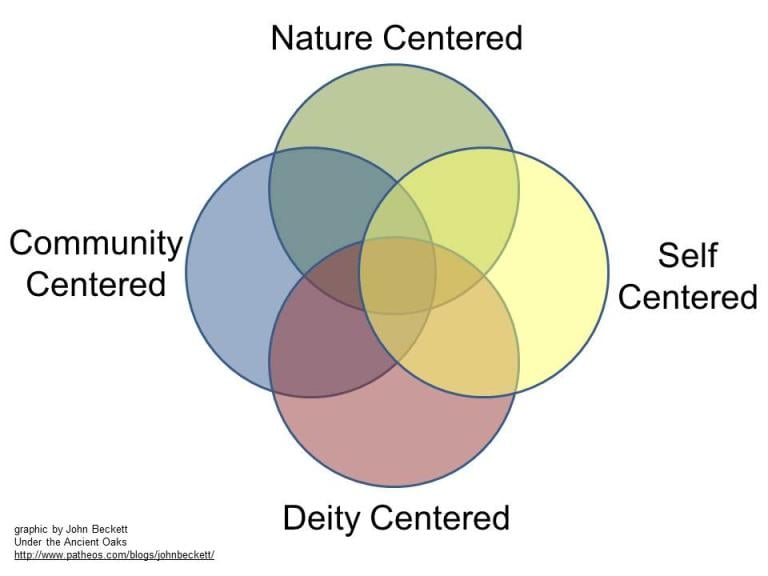 If you aren’t familiar with Paganism, or if you are but you aren’t quite sure how to describe it, read on. Don’t worry – this isn’t an exercise in proselytization. My job is to talk about Paganism, but in the end, the Gods call who They call.
Nature Centered Paganism
Nature Centered Pagans find the Divine in Nature – their primary concern is the natural world and our relationship with it. You may hear terms like “Earth centered” “tree hugger” and “dirt worshipper.”
This may be a non-theistic practice, though not necessarily so. It includes Animism, the idea that whatever animates you and me and the birds and bees also animates the wind and rain and even the mountains.
We know that life on Earth evolved once – all living things share a common ancestor and are therefore related. Nature centered Pagans understand the Earth is sacred in and of itself – its worth does not depend on its usefulness to humans, and so we treat the Earth with honor and respect.
Though none of them called themselves Pagans (and certainly not in the sense the term is usually used today) you see the ideas of Nature centered Paganism expressed in the works of Ralph Waldo Emerson, Henry David Thoreau, Walt Whitman, and John Muir. You see it articulated for our era in Dark Green Religion by Bron Taylor, Professor of Religion and Nature at the University of Florida.
Nature centered practices start with science, the study of Nature. Its creation myths include the Big Bang and evolution. Its daily practices include observing the sun, the moon, trees, and animals, and simply spending time in the natural world. Many Nature centered Pagans are environmental activists.
As for me, I do not have a commitment to Nature because I’m a Pagan. I’m a Pagan because I have a commitment to Nature.
Deity Centered Paganism
Deity centered Pagans find the Divine in the many Goddesses and Gods. This is usually a polytheistic practice, although we’ve had a debate or two about just what “polytheist” means. Deity centered Paganism is mainly concerned with forming and maintaining relationships with the Gods, ancestors, and spirits. Much of this is done through acts of devotion: worship, offerings, sacrifices, prayers and meditation. Some traditions teach ecstatic experience of deities, while others are more reserved and formal.
Monotheists claim their God is the only God and that He (it’s always a He) is infinite. Polytheists look at the world as we actually experience it and see little evidence of an all-powerful, all-good deity. But many deities of limited power and limited scope fits our world very well.
Deity centered Paganism includes most ethnic reconstructionists: groups such as Heathens, Hellenists, and Kemetics who are attempting to reconstruct and reimagine the religions of our pre-Christian ancestors. They emphasize scholarship, both to learn how our ancestors worshipped these deities and to find and share the best ways to worship them here and now. We read Their stories, but we also study mainstream history, archeology and anthropology.
A commitment to the Gods is a commitment to embody Their virtues. Most of our deities have the title “God or Goddess of Somethingorother.” This is not all they are any more than “artist” or “engineer” or “mother” or any of your roles and identities fully describes all you are. Still, it’s an important part of who They are and what They have to teach us. They are different from us, but not so very different. The more we embody Their virtues, the more like Them – the more God-like – we become.
While Nature called me to Paganism, I was never able to devote myself fully to this path – and I was never able to fully extricate myself from the fundamentalist religion of my childhood – until I experienced the Gods first-hand.
Self Centered Paganism
Self centered Paganism doesn’t mean it’s all about you and your ego. It means you find the Divine within yourself. It means the focus of your religious practice is to make yourself stronger, wiser, more compassionate, and more magical, so you can be of greater service to the world.
Wicca – at least in its traditional Gardnerian and Alexandrian forms – is Self centered. So is much of ceremonial magic, traditional witchcraft, and feminist witchcraft. There’s a story that in the early days of Reclaiming, Starhawk would tell her students “Now I will show you a Goddess. Turn and look at the woman beside you.”
Self centered Paganism is perfectly described by the subtitle of Lon Milo DuQuette’s book Low Magick: “It’s All In Your Head … You Just Have No Idea How Big Your Head Is.” It’s also exemplified by the famous quote from the Temple of Apollo at Delphi: gnōthi seautón: know thyself.
Self centered Paganism may be non-theistic, pantheistic, or monistic. It is frequently concerned with magic, which the legendary – and notorious – Aleister Crowley defined as “the Science and Art of causing Change to occur in conformity with Will.” Your Will isn’t what you think you want or what you think you’re supposed to want, it’s why you’re here in this world.
I’m a Self centered Pagan because I can’t do justice to my commitment to Nature and to the Gods without a commitment to excellence in my spiritual life.
Community Centered Paganism
Community centered Pagans find the Divine within the family and the tribe – however they choose to define those groups. Ancient tribal religion was (and is, in the few places where it still exists) about maintaining harmonious relationships and preserving the way things have always been. Individuals are secondary to the family, and immortality is in the continuation of the family, not in the continuation of the individual.
It usually includes some form of ancestor worship, and may include offerings to the Agathos Daimon – the “good spirit” or guardian spirit of the household. Ancestors and family spirits are generally thought to be more accessible than Goddesses and Gods – a Heathen saying goes “if you feel a tap on your shoulder, it’s probably your grandfather, not the Allfather.”
Humans are social animals – we live together, not as lone wolves. Our families of blood and families of choice provide encouragement, reinforcement, and accountability. Communities are their own entities – they are more than a collection of individuals. Communities exist to fulfill their missions and continue their traditions, not to meet your needs – being in community is being a part of something greater than yourself.
Community centered Pagans teach hospitality toward guests, including our divine guests. And they teach reciprocity – are you giving at least as much as you’re receiving?
Communities are helpful and rewarding, but they require work by all their members. Avoiding the unpleasant parts of community marks you as a religious consumer instead of someone who is committed to the goals of the community.
Without the active, caring, and sometimes frustrating religious communities in which I live, work and worship, my practice and my life would be far less than they are.
Synthesis and Exceptions
In practice, most of us identify with more than one center. We feel the call of Nature, but we’re also interested in magic. We worship the Gods, but we prefer to do so along with other Pagans. In general, it’s better to dive deeply into one or two centers than to glaze over all four. You’re certainly not doing it wrong because you aren’t fully committed to all four.
I’m primarily a Nature and Deity centered Pagan, but I also participate in Self centered and Community centered Paganism.
Not everyone who does these things is Pagan. There are atheists who revere Nature, Hindus who worship many Gods, Christians who practice magic, and Jews who love community. And there are people who I think are clearly inside the Big Tent of Paganism who simply don’t like the term and prefer to call themselves something else.
This is Paganism
There is no definition of modern Pagan religion, but these four centers do a very good job of describing what people who go to Pagan events, buy Pagan books, write and comment on Pagan blogs, and call themselves Pagans have in common. This is what Pagans think and do: revere Nature, worship the Gods, refine the Self, and support community.
What about you? Do any of these centers call to you? If you’re curious, there’s almost six years of material here on Under the Ancient Oaks, and there’s plenty more on the other blogs on the Patheos Pagan Channel. Look around and see what seems to fit – and what doesn’t.
And if none of it seems to fit you, that’s fine too. They call who They call. As long as you do the right things and as long as you treat other people and other creatures with dignity and respect, it doesn’t matter which God or Goddess you do or don’t worship.
Blessings to you on your journey through life.
Previous Post

May 26, 2014
Dude, It’s You
Next Post
June 1, 2014 Cernunnos
Browse Our Archives
Select a Category Books Community CUUPS Druidry Foundations and Context Gods and Goddesses Magic Myth Nature Ritual Spiritual Practice Theology Travel Uncategorized Videos
Select a Month October 2026 September 2026 August 2026 July 2026 June 2026 May 2026 April 2026 March 2026 February 2026 January 2026 December 2025 November 2025 October 2025 September 2025 August 2025 July 2025 June 2025 May 2025 April 2025 March 2025 February 2025 January 2025 December 2024 November 2024 October 2024 September 2024 August 2024 July 2024 June 2024 May 2024 April 2024 March 2024 February 2024 January 2024 December 2023 November 2023 October 2023 September 2023 August 2023 July 2023 June 2023 May 2023 April 2023 March 2023 February 2023 January 2023 December 2022 November 2022 October 2022 September 2022 August 2022 July 2022 June 2022 May 2022 April 2022 March 2022 February 2022 January 2022 December 2021 November 2021 October 2021 September 2021 August 2021 July 2021 June 2021 May 2021 April 2021 March 2021 February 2021 January 2021 December 2020 November 2020 October 2020 September 2020 August 2020 July 2020 June 2020 May 2020 April 2020 March 2020 February 2020 January 2020 December 2019 November 2019 October 2019 September 2019 August 2019 July 2019 June 2019 May 2019 April 2019 March 2019 February 2019 January 2019 December 2018 November 2018 October 2018 September 2018 August 2018 July 2018 June 2018 May 2018 April 2018 March 2018 February 2018 January 2018 December 2017 November 2017 October 2017 September 2017 August 2017 July 2017 June 2017 May 2017 April 2017 March 2017 February 2017 January 2017 December 2016 November 2016 October 2016 September 2016 August 2016 July 2016 June 2016 May 2016 April 2016 March 2016 February 2016 January 2016 December 2015 November 2015 October 2015 September 2015 August 2015 July 2015 June 2015 May 2015 April 2015 March 2015 February 2015 January 2015 December 2014 November 2014 October 2014 September 2014 August 2014 July 2014 June 2014 May 2014 April 2014 March 2014 February 2014 January 2014 December 2013 November 2013 October 2013 September 2013 August 2013 July 2013 June 2013 May 2013 April 2013 March 2013 February 2013 January 2013 December 2012 November 2012 October 2012 September 2012 August 2012 July 2012 June 2012 May 2012 April 2012 March 2012 February 2012 January 2012 December 2011 November 2011 October 2011 September 2011 August 2011 July 2011 June 2011 May 2011 April 2011 March 2011 February 2011 January 2011 December 2010 November 2010 October 2010 September 2010 August 2010 July 2010 June 2010 May 2010 April 2010 March 2010 February 2010 January 2010 December 2009 November 2009 October 2009 September 2009 August 2009 July 2009 June 2009 May 2009 April 2009 March 2009 February 2009 January 2009 December 2008 November 2008 October 2008 September 2008 August 2008 July 2008 June 2008
Follow Us!
TAKE THE
Religious Wisdom Quiz
What does the name "Jesus" mean?
Select your answer to see how you score.
The Lord saves Prince of peace Teacher God is with us
Related posts from John Beckett




What We Lose When “Ask AI” Becomes A...
TRENDING AT PATHEOS Pagan

When Halloween Unmasks Married Hearts
Written by Dr. David K. Ewen from Eternal Truth Bible College Behind...

Aristotle. He’s been called the father of logic, the father of the...

Methodist Central Hall and Westminster Abbey
Situated on the same square is Methodist Central Hall and Westminster Abbey. ...

57th Dove Awards Honor Dolly Parton, Crown New...
On gospel music’s biggest night, the 57th annual GMA Dove Awards honored...

The First Eucharistic Controversy: Christ’s Real Presence
For Catholics, the Eucharist is the source and summit of the Christian...

What a Stop Sign Can Teach Us About...
How to Make a Decision When You Can't Hear God Main point:...
view all Pagan blogs
Ad-Free & Subscriber Log-In Subscription Support
- About Us
- 2026 Calendar
- Videos
- Podcasts
- Library of World Religions
- Faith In Media Tracker
- Advertise With Us
- Write for Us
- Privacy Policy
- Terms of Service
- Do Not Sell My Data
- Contact Us
- Radiant Digital
- Manage Newsletter Subscriptions
- Unsubscribe From Notifications
- Sitemap
Copyright 2008-2026, Patheos. All rights reserved.
Subscription Support Ad-Free & Subscriber Log-In
Follow Patheos