
BuddhistCatholicContemplativeEvangelicalGeneral ChristianHinduJewishLatter-day SaintMuslimNew VisionsProgressive Christian
Beliefs
- Buddhist
- Catholic
- Contemplative
- Evangelical
- General Christian
- Hindu
- Jewish
- Latter-day Saint
- More Voices
- Muslim
- New Visions
- Pagan
- Progressive Christian
Topics
- Religion News
- Food and Religion
- Sports and Religion
- Religious Art
- Religious Music and Entertainment
- Religious Events
- History and Religion
- Style and Religion
- Politics and Religion
- Women in Religion
- Recreation Outdoors and Religion
- Business Finance and Religion
- Careers Workplace and Religion
- Education and Religion
- Family Parenting and Religion
- Health Fitness and Religion
- Home and Religion
- Relationships and Religion
- Technology and Religion
- Travel and Religion
Columnists
- Buddhist Columnists
- Business Finance and Religion Columnists
- Careers Workplace and Religion Columnists
- Catholic Columnists
- Contemplative Columnists
- Education and Religion Columnists
- Evangelists Columnists
- Family Parenting and Religion Columnists
- General Christian Columnists
- Health Fitness and Religion Columnists
- Hindu Columnists
- History and Religion Columnists
- Home and Religion Columnists
- Jewish Columnists
- More Voices Columnists
- Latter Day Columnists
- Muslim Columnists
- New Visions Columnists
- Nonreligious Columnists
- Pagan Columnists
- Politics and Religion Columnists
- Progressive Columnists
- Recreation Outdoors and Religion Columnists
- Relationships and Religion Columnists
- Religion News Columnists
- Religious Art Columnists
- Religious Events Columnists
- Religious Music and Entertainment Columnists
- Sports and Religion Columnists
- Style and Religion Columnists
- Technology and Religion Columnists
- Travel and Religion Columnists
- Women in Religion Columnists
Resource Library
- 2026 Calendar
- Library of World Religions
- The 100 Most Holy Places on Earth
- Patheos Answers
- Podcasts
- Videos
- Faith Leaders Database
- Anglican Episcopalian
- Bahai
- Baptist
- Buddhism
- Christianity
- Confucianism
- Eastern Orthodoxy
- Hinduism
- Holiness and Pentecostal
- ISKCON
- Islam
- Judaism
- Lutheran
- Methodist
- The Church of Jesus Christ of Latter-day Saints
- New Age
- Paganism
- Presbytarian and Reformed
- Protestantism
- Religion Behind the Scenes
- Roman Catholic
- Scientology
- Shia Islam
- Sikhism
- Sufism
- Sunni Islam
- Taoism
- Zen
- See all religions
Research Tools
 Ad-Free & Subscriber Log-In Subscription Support
Ad-Free & Subscriber Log-In Subscription Support
Follow Patheos 

- Trending:
- Forgiveness
- |
- Marriage
- |
- Consciousness
- |
- Death Penalty
- |
- Election
- |
- Halloween

- Home
- Pagan
- Walking With The Gods – An Interview
Walking With The Gods – An Interview
Last updated on: May 1, 2014 at 8:49 am by John Beckett
Walking With The Gods – An Interview 2014-05-01T08:49:21-06:00 John Beckett
Patheos Explore the world's faith through different perspectives on religion and spirituality! Patheos has the views of the prevalent religions and spiritualities of the world.
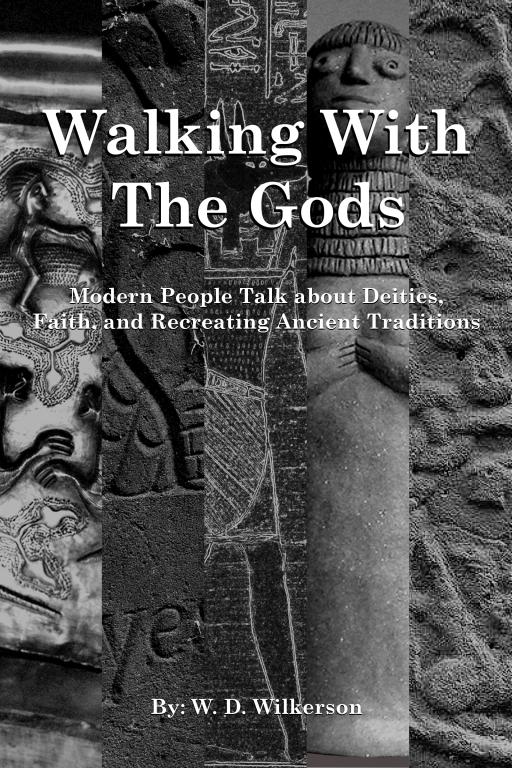 What is polytheism? Over the past year or so there have been many ideas put forward attempting to answer this question – I’ve contributed my own thoughts to the debate. Rather than trying to define polytheism, Dr. W. D. Wilkerson interviewed 120 polytheists – Walking With The Gods is the result of those interviews. This book says “here are some practicing polytheists – what they do, what they think, and what they believe.” We can see the commonalities and the differences and we can see if our own beliefs and practices are mostly like them, somewhat like them, or not very like them. This is a book that needed to be written.
Walking With The Gods runs 390 pages. It is available as a printed book for $18.65 from Lulu or as an e-book for $5.99 from Smashwords. It’s available now. 25% of royalties will be contributed to the Maetreum of Cybele’s legal defense fund.
John: What motivated you to write this book as an ethnography instead of as an exposition of polytheism as you understand it?
W. D. Wilkerson: I’m unhappy with the way that polytheistic religions (and their adherents) are seen by the mainstream world, and wanted to give contemporary devotional polytheists a chance to represent themselves and bust some stereotypes. It’s an ethnography because I’m not a theologian; I’m an academically-trained ethnographer. I always conceived of this work as being primarily a collection of personal experience narratives.

W. D. Wilkerson
Who is your intended audience for Walking With The Gods? How do you hope they’ll use the book?
My audience falls into three tiers: the devotional polytheists who participated in my study; those who are interested in religious studies, theology, mythology and folklore, emergent religions, Paganism, etc.; and other ethnographers who are interested in developing collaborative and reciprocal ethnographic research methods that honor the respondents and give something of value back to the communities being studied.
I hope that everyone who reads this book comes away with something of value. I especially hope that devotional polytheists living in isolated circumstances with little understanding of how to connect with their Holy Powers, ancestors, and land might get ideas on how to proceed and find virtual communities to belong to. I hope that religious studies folk learn to question the assumptions that underpin their perspective and to not assume intellectual and moral superiority over polytheistic peoples on the basis that monotheism, or increasingly atheism, is better because it is “more reasonable.”
I’ve heard Pagan religious scholars say some of their colleagues denigrate their work, saying it lacks objectivity and calling it “by insiders for insiders.” How do you answer that charge? Is it even possible to study religions objectively?
Nobody worth their salt will tell you that absolute objectivity is a realizable goal in academic scholarship. I call “shenanigans” upon that ludicrous and self-serving charge, for it is premised on these false assumptions: that Paganism has nothing of value to offer the disciplines of religious studies and theology and that those who study Paganism are somehow separating themselves from the main business of religious studies because of their chosen subject.
In this context, telling a scholar that their work is “for insiders, by insiders” is a silencing tactic. The goal of stating such things is to convince the scholar that they are somehow outside the realm of academic propriety, thus compelling them to either abandon their research for something more respectable and acceptable, or abandon the realm of scholarly discourse altogether and take their “crazy-town” interests and ideas with them when they leave. I want Pagan religious studies or theology scholars who have been told this to please recognize that it has nothing to do with the worth of your work and everything to do with their desire of your professors or disciplinary colleagues to maintain the near-Eastern monotheist hegemony and the privileges thereof.
My distaste for this particular situation is part of what prompted me to start my own imprint for alternative scholarship and to self-publish. I’m also seeking submissions of manuscripts dealing with Pagan religious studies, if anyone is interested. The Call for Submissions is on my website, connaissancesankofamedia.com.
Several of your respondents criticized “monism” when it appeared they were actually arguing against soft polytheism or perhaps panentheism. Do you see a conflict between a view of the Gods as individual, distinct Holy Powers and the view that ultimately, everything is connected and all – Gods, humans, other animals, plants, rocks, etc. – is One?
Traditional polytheist religions didn’t (and still don’t) have any trouble reconciling all of those ideas into coherent yet distinctly devotional polytheist religions. The fact is, this “there can be only one” mentality that has crept in and taken over on all sides of the discussion is in actuality the result of our living in a monotheist culture. We have seen from living in a monotheist culture that under monotheism, there can be only One—only one Deity, only one correct religion preferred by that Deity, only one group of people who are better at that type of worship, only one answer to every problem, only one correct theory to unify all things… and anyone or anything else is wrong. The insistence that there can be “only one right way” to define the Divine or to define and practice polytheism proceeds directly from that monotheist “There can be only One” mentality. And boy howdy, have we seen some Pagan bloggers go after each other’s heads like MacLeod and the Kurgan. A truly polytheist perspective wouldn’t demand this friction, because it would have probably already found a way to incorporate all points of view into a beautiful, intricate, and coherent system. Several of my respondents are already doing precisely this.
You criticize – rightly, I think – Nongbri for his suggestion that “religion is a modern concept developed by Western monotheists.” But to what extent is he on the right track, because the Western concept of religion (particularly the Protestant view that makes belief the central issue) is so different from the practices of our pre-Christian ancestors?
There is no extent to which I think Nongbri is on the right track. What he does is acknowledge the cultural bias affecting Western scholarship about religion, and then validate the rightness of that bias in discriminating against pre-Christian or non-Abrahamic religions by saying, “we invented religion, so that other stuff can’t possibly be religion because we didn’t invent it and it doesn’t look anything like what we have here.” I call “shenanigans” upon any notion that ethnocentric modern Westerners laboring under the monotheist perspective have the right to say what a religion is or is not solely based on their own cultural biases, and then also get to conveniently ignore the hideously oppressive ethnocentrism inherent in their position. Or that they have the right to survey the vast panoply of pre-Abrahamic religious and spiritual expression and claim that they “invented religion.” It’s as insulting as it is absurd. If Nongbri had tried to do this in virtually any other field of the humanities, he’d have been ripped apart for the way that his myopia and ethnocentrism serve to re-inscribe cultural oppression and erasure. In this sense, Before Religion is the most pro-neocolonialist work I have ever read, and that includes the missionary pamphlets stuffed into my hand yesterday by the Pentecostal Holiness Church women manning the grocery store entrance when I drove my mom to get groceries.
The difference between pre-Christian (or pre-near-Eastern monotheist) religions and Western religion in the form of Christianity isn’t that one is a religion and the other isn’t, but that one is orthodoxic and preoccupied with belief, and the other is orthopraxic, and concerned with practice. That one’s religion privileges practice over belief does not make it less of a religion.
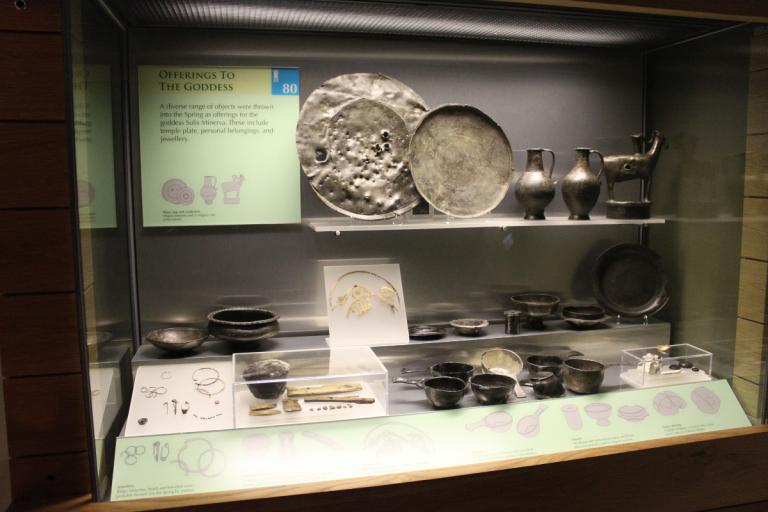
offerings to Sulis Minerva – Bath
In the book, you argue that polytheism is so different from the “Near Eastern Monotheism” that dominates the West that only polytheists can truly understand it. What would you suggest to monotheists or non-theists who genuinely want to understand it, even if they have no desire to become polytheists themselves?
If you truly want to understand something with which you have had no previous experience, you must be willing to sacrifice your preconceived notions, assumptions, and understandings. Some preconceptions to get rid of include:
1. Ask which Divinities your polytheist associate worships rather than which Divinities they believe in. Belief is largely irrelevant. Polytheist religion is predicated on religious ritual and devotional practice.
2. While it’s certainly true that religion generates psychological phenomenon, it is unfair to say that religious experience is purely a mental phenomenon. Just because measurable brainwave activities and psychological things are happening doesn’t mean that direct contact and interaction with the Divine is not also simultaneously taking place.
3. Don’t assume you actually understand what polytheism is about. Your understanding is predicated upon two thousand years of monotheist cultural philosophy. Ask questions and allow yourself to be corrected.
4. It is totally fine if you don’t “get it,” but don’t assume that the reason you don’t “get it” is because you are more intellectually evolved and clever, or your viewpoint is better because your theology or philosophy is more advanced and superior.
I’ve seen others suggest that contemporary devotional polytheism is inspired by – or at least, informed by – evangelical Christianity’s emphasis on “a personal relationship with Jesus.” To what extent do you think the presence of that concept in the mainstream society makes devotional polytheism easier to understand by those who are approaching it? To what extent do you think it encourages unhelpful assumptions about the Gods (i.e. – that They’re most concerned with us and our well being)?
Given what happened with Christmas and Easter, one could also suggest that the Christian focus on a “personal relationship with Jesus” was stolen from the practice of pre-Christian polytheist holy people whose lives were absolutely devoted to the veneration and service of a single deity. Unfortunately, both “suggestions” rely on a fundamental mischaracterization of the devotional relationship between a person and their Matron/Patron deity, and an accompanying misunderstanding of what motivates Christians vs. what motivates polytheists.
Unlike Christianity, which is predicated upon the necessity of Jesus as sin-forgiver and soul-cleanser without whom one may not stand upright and pure before their God Jehovah, polytheists are by and large looking for religious experience and spiritual connectedness to the Deities, the past, the land on which they live, and “All That Is.” Free will and reciprocity are cornerstones of this relationship; there is no prima facie owing of debt or needing to be cleansed of sin, or demand for obedience (or else!) beneath the relationships most devotional polytheists have with their Deities.
The Christian idea that the Holy Powers have nothing better to do than caretake humanity and cleanse our iniquity shortchanges us and Them. It shortchanges Them because it assumes that They don’t have other realms of activity to be concerned with, and that humans are the single most important species on the planet. It shortchanges us because it presupposes that the human condition is filthy, and humanity is incapable of spiritual self-sufficiency, spiritual evolution, or independent action in our own best interests. Devotional polytheists rightly bristle at this comparison.
What’s the most common misunderstanding you see about polytheism from people who call themselves polytheists (whether they were part of your research or just people you encounter on the internet or at gatherings)? Where are too many polytheists getting it wrong, or if not “wrong” then less than it could be?
The most common misunderstandings about polytheism from both hard and soft polytheists that I’ve seen are: the assumption that polytheism is predicated upon belief rather than practice, that polytheists are somehow ridiculous and backward compared with monotheist and non-theist people, and that there is no appropriate way to syncretize a monist view with devotional polytheist view and have it be a valid religious practice because “ only One” of those views could be right, and the assumption that variances in religious practice are irrelevant because everyone deep down believes exactly the same things anyhow.
I’m not sure it is appropriate for me to discuss which polytheists are getting it “wrong” because I think that polytheism as a contemporary religious practice is constantly evolving. That means experimenting with new approaches, even those that I might consider to be “wrong.” My personal opinion is that the Divinities are experimenting with techniques, practices, and materials to see what is going to serve Their efforts to connect with the material world and the people living in it most effectively. One particular Deity might well want different things from different devotional polytheists. Yet if those polytheists are opinionated bloggers, they might well be at each other’s throats in the blogosphere or worse and never stop to consider that their practices are so very different because their Deity is engaged in an experimental and developmental process of helping build a strong new polytheist religious practice that will yield powerful connections. What they are getting wrong here is to be preoccupied with what everyone they disagree with is doing rather than focusing on making their own practice stronger.
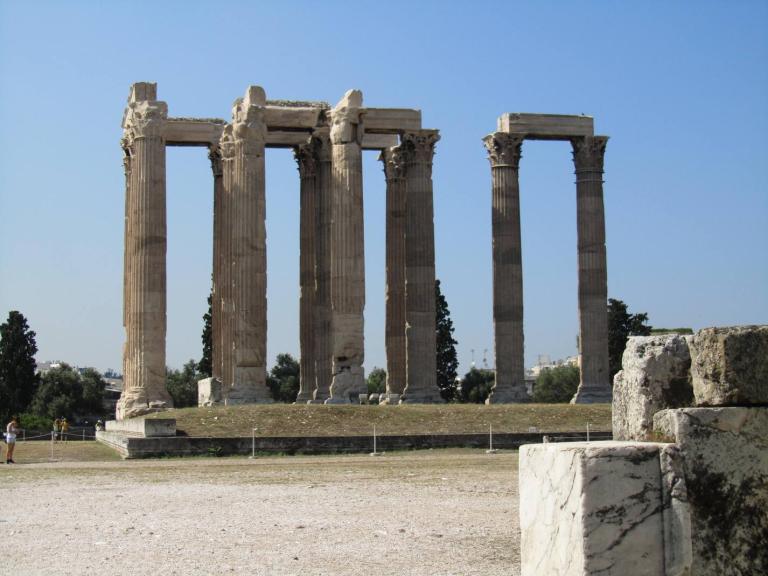
Temple of Zeus – Athens
Did your own practices change as a result of all the interviews? Anything you started doing, or stopped doing? What about your concepts of the Gods and the Universe – how did this project affect your thinking about Them?
My practices evolved during the project, this is true. But my spiritual life was really on its own other trajectory. What this project did was sharpen my understanding of what polytheism means to me, and help really grasp the meaning of devotional practice. I’d been doing it, but couldn’t elucidate exactly why I did except that I liked it and it made me feel connected to Beings who I love. Now, I can, and I am able to build on that deepened understanding.
Do you have an “elevator speech” on polytheism – a way to describe your polytheism to monotheists and non-theists that is both faithful to your experiences and brief enough to speak to those who can’t or won’t take the time for a more in-depth explanation?
Polytheism is the reification and veneration of multiple Divine Beings. It is a religious practice which is based on personal experiences of those Beings as achieved through the ritual and devotional engagement with Them. Mythology is symbolically meaningful and it informs my practice to a degree but in no way do I regard it as holy writ in the way the monotheists do their scriptures. In fact, belief is irrelevant to because my personal experiences and positive results guide the religious practice.
What does devotional polytheism need most right now to grow, both in spiritual depth and in raw numbers? Works of polytheistic theology? Physical temples? Organized priesthoods? More public events? Something else?
We need to prioritize honoring and then setting aside our differences in order to reclaim political and social solidarity with Paganism as a whole – what’s happening with the Maetreum of Cybele could happen to any of us in this monotheist culture we live in.
Rather than a unified polytheist theology that links us all, I’d like to see the different devotional polytheist religions deepen their own unique theological and ritual approaches. I’d like to see them spend as much time connecting more strongly to contemporary society as they do reconstructing ancient traditions so that these religions become powerfully vital and relevant to contemporary, multi-cultural people.
It’s also vital to increase opportunities for ritual and clerical training so that the religions can really have rock-solid ritual and devotional practices. I also think that devotional polytheist-oriented gatherings would be ideal places to host opportunities for ritual and clerical training. However, it is also vital for religious groups to foster home-based religious practice. Most ancient polytheists and many contemporary polytheistic religions were primarily home and family based, with civic sponsorship and cultii more or less being an outgrowth of that. Affording opportunities for people to learn how to build effective but also do-able religious practice at home without the presence of any grand clergy is key to the growth and development of devotional polytheism.
While more polytheist theology might help Pagans gain a foothold in religious studies and theology departments, it would be more helpful to the devotional polytheist community as a whole for the different religions to strengthen their own theological approaches / ritual practices and to build infrastructure. Dedicated real estate to house the religious activity is key, as is increasing opportunities for ritual and clerical training. More of us need to engage with public “interfaith” dialogues, and demand that non-monotheist perspectives be represented and respected in such discussions.
You had 120 respondents but you only had room for 23 in the book. Is there another project waiting to be pulled out of the rest of those responses?
This ethnographic survey was entirely self-funded and self-implemented. It took three years and a lot of personal sacrifices to bring the book into being. I would like to publish another volume of interviews, certainly, and will do so as soon as I have made enough in sales to fund the next phase. If I can clear $10,000 in sales and donations, I will launch a Kickstarter campaign to match those funds so that I can get another volume produced.
What research would you like to see follow this book?
On an academic level, I have begun to plan an article comparing Semitic orthopraxy to contemporary Western polytheist orthopraxy. I think that once the case for orthopraxy gets made in religious studies, it will be easier for Pagan scholars to get into the curriculum.
Personally, I might eventually like to do an ethnographic survey of people whose religious practice focuses on ancestors and/or land spirits. I’m also keen to trace the figure of Maman Brigitte across the Caribbean. She is a mysterious question mark and I’d like for all of us to know more about Her.
What’s your next project?
Connaissance Sankofa Media is now accepting submissions for Words of Flame, An Anthology of Devotional Fiction. This collection of short fiction goes beyond the reinvention and reuse of folklore and myth, because the authors are Pagans whose work is inspired by their own devotional relationships with the Deities and spirits about whom they write. For contributor information and publishing guidelines, contact us or send an email to [email protected].
As I mentioned before, I’m also interested in publishing independent Pagan studies research.
At the moment, my personal work is pretty secular. I’m working on an urban fantasy mystery novel, a coloring book based on the cryptids of North America, and a walking tour app for my hometown.
Anything else you’d like to tell our readers?
It is my hope that this work sparks debate in the wider community and bolsters the work of Pagans in religious studies and theology departments. I also hope it inspires readers to grow a deeper spiritual understanding of their own path and practice.
Previous Post
April 27, 2014
Dreams of Beltane
Next Post
May 1, 2014 A Pagan at the National Day of Prayer
Browse Our Archives
Select a Category Books Community CUUPS Druidry Foundations and Context Gods and Goddesses Magic Myth Nature Ritual Spiritual Practice Theology Travel Uncategorized Videos
Select a Month October 2026 September 2026 August 2026 July 2026 June 2026 May 2026 April 2026 March 2026 February 2026 January 2026 December 2025 November 2025 October 2025 September 2025 August 2025 July 2025 June 2025 May 2025 April 2025 March 2025 February 2025 January 2025 December 2024 November 2024 October 2024 September 2024 August 2024 July 2024 June 2024 May 2024 April 2024 March 2024 February 2024 January 2024 December 2023 November 2023 October 2023 September 2023 August 2023 July 2023 June 2023 May 2023 April 2023 March 2023 February 2023 January 2023 December 2022 November 2022 October 2022 September 2022 August 2022 July 2022 June 2022 May 2022 April 2022 March 2022 February 2022 January 2022 December 2021 November 2021 October 2021 September 2021 August 2021 July 2021 June 2021 May 2021 April 2021 March 2021 February 2021 January 2021 December 2020 November 2020 October 2020 September 2020 August 2020 July 2020 June 2020 May 2020 April 2020 March 2020 February 2020 January 2020 December 2019 November 2019 October 2019 September 2019 August 2019 July 2019 June 2019 May 2019 April 2019 March 2019 February 2019 January 2019 December 2018 November 2018 October 2018 September 2018 August 2018 July 2018 June 2018 May 2018 April 2018 March 2018 February 2018 January 2018 December 2017 November 2017 October 2017 September 2017 August 2017 July 2017 June 2017 May 2017 April 2017 March 2017 February 2017 January 2017 December 2016 November 2016 October 2016 September 2016 August 2016 July 2016 June 2016 May 2016 April 2016 March 2016 February 2016 January 2016 December 2015 November 2015 October 2015 September 2015 August 2015 July 2015 June 2015 May 2015 April 2015 March 2015 February 2015 January 2015 December 2014 November 2014 October 2014 September 2014 August 2014 July 2014 June 2014 May 2014 April 2014 March 2014 February 2014 January 2014 December 2013 November 2013 October 2013 September 2013 August 2013 July 2013 June 2013 May 2013 April 2013 March 2013 February 2013 January 2013 December 2012 November 2012 October 2012 September 2012 August 2012 July 2012 June 2012 May 2012 April 2012 March 2012 February 2012 January 2012 December 2011 November 2011 October 2011 September 2011 August 2011 July 2011 June 2011 May 2011 April 2011 March 2011 February 2011 January 2011 December 2010 November 2010 October 2010 September 2010 August 2010 July 2010 June 2010 May 2010 April 2010 March 2010 February 2010 January 2010 December 2009 November 2009 October 2009 September 2009 August 2009 July 2009 June 2009 May 2009 April 2009 March 2009 February 2009 January 2009 December 2008 November 2008 October 2008 September 2008 August 2008 July 2008 June 2008
Follow Us!
TAKE THE
Religious Wisdom Quiz
Which Christian tradition is most noted for the use of incense and elaborate liturgy?
Select your answer to see how you score.
Presbyterian Baptist Eastern Orthodox Methodist
Related posts from John Beckett




What We Lose When “Ask AI” Becomes A...
TRENDING AT PATHEOS Pagan

Swimfan: Forgotten Aughts Pleasures
This is a recovery effort. In 2002, My Big Fat Greek Wedding...

Top Three Anti-Catholic Lies About Catholicism
This is my initial transcript for the video, "THE 3 WORST...

Pope Leo Celebrates Mass for Nurses & Docs...
I don't have any idea how he did it, but Pope Leo...

The Sermon on the Mount, Part I: Matthew...
The Sermon on the Mount, Part I (Matthew 4:12-5:12) St. Matthew moves...

What's up from Crossway: Reviewing some of their latest A few weeks...

Janie Learns the Way of the Cross: A...
Teaching children about Jesus' Passion can be challenging. Many parents and educators...
view all Pagan blogs
Ad-Free & Subscriber Log-In Subscription Support
- About Us
- 2026 Calendar
- Videos
- Podcasts
- Library of World Religions
- Faith In Media Tracker
- Advertise With Us
- Write for Us
- Privacy Policy
- Terms of Service
- Do Not Sell My Data
- Contact Us
- Radiant Digital
- Manage Newsletter Subscriptions
- Unsubscribe From Notifications
- Sitemap
Copyright 2008-2026, Patheos. All rights reserved.
Subscription Support Ad-Free & Subscriber Log-In
Follow Patheos