
BuddhistCatholicContemplativeEvangelicalGeneral ChristianHinduJewishLatter-day SaintMuslimNew VisionsProgressive Christian
Beliefs
- Buddhist
- Catholic
- Contemplative
- Evangelical
- General Christian
- Hindu
- Jewish
- Latter-day Saint
- More Voices
- Muslim
- New Visions
- Pagan
- Progressive Christian
Topics
- Religion News
- Food and Religion
- Sports and Religion
- Religious Art
- Religious Music and Entertainment
- Religious Events
- History and Religion
- Style and Religion
- Politics and Religion
- Women in Religion
- Recreation Outdoors and Religion
- Business Finance and Religion
- Careers Workplace and Religion
- Education and Religion
- Family Parenting and Religion
- Health Fitness and Religion
- Home and Religion
- Relationships and Religion
- Technology and Religion
- Travel and Religion
Columnists
- Buddhist Columnists
- Business Finance and Religion Columnists
- Careers Workplace and Religion Columnists
- Catholic Columnists
- Contemplative Columnists
- Education and Religion Columnists
- Evangelists Columnists
- Family Parenting and Religion Columnists
- General Christian Columnists
- Health Fitness and Religion Columnists
- Hindu Columnists
- History and Religion Columnists
- Home and Religion Columnists
- Jewish Columnists
- More Voices Columnists
- Latter Day Columnists
- Muslim Columnists
- New Visions Columnists
- Nonreligious Columnists
- Pagan Columnists
- Politics and Religion Columnists
- Progressive Columnists
- Recreation Outdoors and Religion Columnists
- Relationships and Religion Columnists
- Religion News Columnists
- Religious Art Columnists
- Religious Events Columnists
- Religious Music and Entertainment Columnists
- Sports and Religion Columnists
- Style and Religion Columnists
- Technology and Religion Columnists
- Travel and Religion Columnists
- Women in Religion Columnists
Resource Library
- 2026 Calendar
- Library of World Religions
- The 100 Most Holy Places on Earth
- Patheos Answers
- Podcasts
- Videos
- Faith Leaders Database
- Anglican Episcopalian
- Bahai
- Baptist
- Buddhism
- Christianity
- Confucianism
- Eastern Orthodoxy
- Hinduism
- Holiness and Pentecostal
- ISKCON
- Islam
- Judaism
- Lutheran
- Methodist
- The Church of Jesus Christ of Latter-day Saints
- New Age
- Paganism
- Presbytarian and Reformed
- Protestantism
- Religion Behind the Scenes
- Roman Catholic
- Scientology
- Shia Islam
- Sikhism
- Sufism
- Sunni Islam
- Taoism
- Zen
- See all religions
Research Tools
 Ad-Free & Subscriber Log-In Subscription Support
Ad-Free & Subscriber Log-In Subscription Support
Follow Patheos 

- Trending:
- Forgiveness
- |
- Marriage
- |
- Consciousness
- |
- Death Penalty
- |
- Election
- |
- Halloween

- Home
- Pagan
- The Pagan World in 2064
The Pagan World in 2064
Last updated on: March 9, 2014 at 4:00 pm by John Beckett
The Pagan World in 2064 2014-03-08T11:00:26-06:00 John Beckett
Patheos Explore the world's faith through different perspectives on religion and spirituality! Patheos has the views of the prevalent religions and spiritualities of the world.
Patheos Pagan Managing Editor Christine Kraemer has thrown out a challenge for bloggers for March. She asks “As Pagans, what do we hope to build?” Here’s Christine’s full question:
Much of the current dialogue in the Pagan blogosphere is about carving out ways to explain and justify our personal experiences and beliefs in relation to other traditions, but without a clear vision of the place our own traditions and experiences might have in an ideal world. Will the Pagan movement become one tradition-heavy set of religions with several “fringes”? Will it split apart into competing factions? Or will we find a way to unite using some shared cultural language? What institutions will we build, or will we build institutions at all? What rights or recognition will we have in the larger society?
What does your Paganism look like in 50 years?
What we can build is limited only by our imaginations. But our imaginations are far more limited than we like to think. Ask a typical Pagan what he or she would like to see in 50 years and you’re likely to get one of two answers. A Pagan who dislikes institutions will speak of individual spirituality, political activism and alternatives to mainstream culture. A Pagan who likes institutions will speak of temples, clergy and Pagan schools and universities. The first looks a lot like Paganism today, only bigger and better. The second looks a lot like mainline Protestantism, only with more Gods.
Building the Pagan world of 2064 requires thinking beyond what we see in front of us today.
Vibrant, growing religions are vibrant and growing because they respond to the needs and desires of people where and when they are. So part of the problem in figuring out what to build for 2064 is figuring out what the world as a whole will look like in 2064.

My favorite kindergarten book. Things didn’t quite work out this way.
In 1964 the future was supposed to be flying cars, cities on the moon, and 20 hour work weeks. Instead, we got the internet, smart phones, and Wal-Mart. Can we do any better at predicting the future?
The driving forces in today’s world are globalization, population dynamics (falling birthrates in the West, exploding populations in the global South), climate change and peak oil. Will 2064 in the West look just like 2014, only with worse weather and higher energy prices? Or will we see dense, compact cities for the rich, decaying suburbs for the poor, and exurbs returned to farmland? Or something else only some random futurist is even contemplating?
We cannot draw a blueprint for the Pagan world of 2064. However, Paganism is well-suited to a future that is uncertain and challenging.
Nature centered Paganism gives people religious reasons for building stronger connections to the Natural world and for changing their lives in ways that will limit further environmental damage. Self centered Paganism gives people tools for dealing with difficult situations and for confronting unhelpful and unjust institutions. Community centered Paganism builds networks of mutual support which will be critical if – when – today’s structures fail. And Deity centered Paganism calls on the wisdom and power of beings far older and wiser than us.
My dream for 2064 includes exponential growth and a Pagan restoration on a scale that’s never been seen. I think that’s unlikely. So instead of my wish list, here’s what I think the Pagan world in 2064 will look like, if things go reasonably well for us.
Nature Centered Paganism. This is where we will see the largest growth and the most impact on the mainstream culture. The effects of peak oil will force ordinary people to use less, commute less and travel less. Only a few will take up rural homesteading, but we’ll see more back yard and window sill gardens. Climate change will cause most people to reconsider their relations with the natural world. Concern for other species and ecosystems – and action to support that concern – will become mainstream.
So will the celebration of the equinoxes and solstices, although I won’t guess at what the mainstream observance of them will look like. Samhain will grow, as some Halloween partiers look for deeper meaning in the holiday. Imbolc, Beltane and Lughnasadh will remain ignored by all but Wheel of the Year Pagans.
Self Centered Paganism. Magic will become the spiritual wing of the Big Tent of Paganism, and at least a few Pagan spiritual practices will become mainstream. Mystery traditions will be revived, reimagined and expanded, and one or two will become widespread. Initiations will be in demand, which will inevitably inspire a few high-dollar ego-stroking ripoffs. One or two monasteries will arise for those who wish to spend their lives in contemplation of the mysteries – and in extreme simplicity.
Community Centered Paganism. This is where I’m least confident in my predictions, where I have the greatest trouble imagining something that doesn’t exist today. Child care, elder care, and general mutual support are going to become more and more necessary as our national infrastructure (i.e. – public programs) fades. Does that mean returning to multi-generational households? A revival of fraternal organizations (Freemasons, Oddfellows, etc)? Communes have been a near-universal failure every time they’ve been tried, but individual housing centered around a common area has worked before. We don’t have to all live next door to each other, just close enough to check up on each other from time to time.
Large intentionally Pagan communities centered around a temple or community center is a 200 year dream, not a 50 year plan. I see no way we can grow enough to make something like that feasible in the lifetime of anyone reading this today.
Deity Centered Paganism. Polytheism will become the religious wing of the Big Tent of Paganism. Practice will be centered on individual traditions, and in some cases, on individual deities. But there will be extensive communication and cooperation between traditions. We’ll see the development of robust polytheistic theologies and good techniques of devotional and ecstatic ritual will be shared across traditions – the “religious tech” that works for Heathens will work for Kemetics too. Individual traditions will add their own unique observances and practices, some revived from the ancients and others which will arise in response to a need here and now.
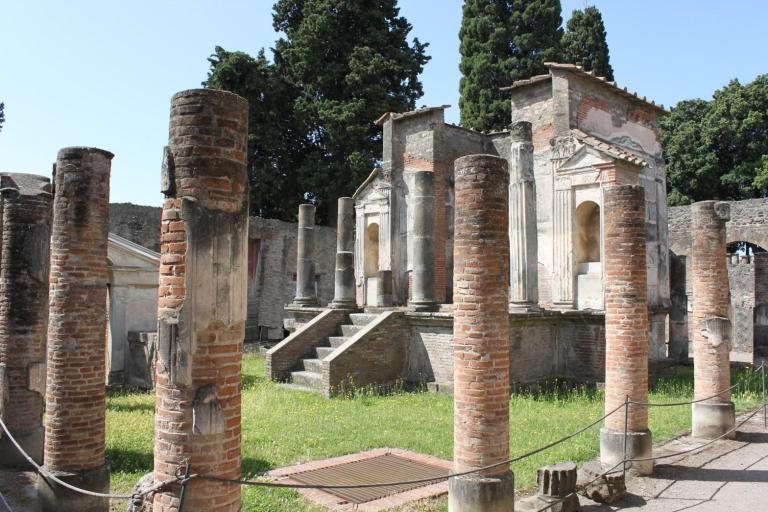
The Temple of Isis at Pompeii. A few dozen people could stand in the courtyard, but only a handful of priests would fit inside the sanctuary itself. Temples don’t have to be large.
Temples and shrines will spring up, but they’ll be built as houses of the Gods, not as churches or community centers. They’ll be smaller than churches, less costly, and they may even be portable. Priesthoods will arise around the temples – most likely, the priesthoods will come first and then the temples will follow. Each priesthood will have its own requirements for entry and training, and priests will be expected to support themselves with full-time or part-time employment. No tradition will develop the necessary combination of size, commitment, and desire required to support full-time paid clergy on a widespread basis.
This is what I expect Paganism will look like in 50 years. But religions – even minority religions – are impossible to separate from the culture in which they live and breathe. Changes in the wider world and mainstream culture that we aren’t expecting will have an effect on Paganism. We can’t design for what we can’t see coming.
What we can do is to develop the skills and build the institutions that will help us become the kind of grounded, dedicated, and resilient Pagans who can thrive under any circumstances, who can serve our human and other-than-human communities in any environment, and who can teach others to do the same.
Previous Post

March 6, 2014
Vampires Are Us
Next Post

March 11, 2014 A Pagan Watches Cosmos
Browse Our Archives
Select a Category Books Community CUUPS Druidry Foundations and Context Gods and Goddesses Magic Myth Nature Ritual Spiritual Practice Theology Travel Uncategorized Videos
Select a Month October 2026 September 2026 August 2026 July 2026 June 2026 May 2026 April 2026 March 2026 February 2026 January 2026 December 2025 November 2025 October 2025 September 2025 August 2025 July 2025 June 2025 May 2025 April 2025 March 2025 February 2025 January 2025 December 2024 November 2024 October 2024 September 2024 August 2024 July 2024 June 2024 May 2024 April 2024 March 2024 February 2024 January 2024 December 2023 November 2023 October 2023 September 2023 August 2023 July 2023 June 2023 May 2023 April 2023 March 2023 February 2023 January 2023 December 2022 November 2022 October 2022 September 2022 August 2022 July 2022 June 2022 May 2022 April 2022 March 2022 February 2022 January 2022 December 2021 November 2021 October 2021 September 2021 August 2021 July 2021 June 2021 May 2021 April 2021 March 2021 February 2021 January 2021 December 2020 November 2020 October 2020 September 2020 August 2020 July 2020 June 2020 May 2020 April 2020 March 2020 February 2020 January 2020 December 2019 November 2019 October 2019 September 2019 August 2019 July 2019 June 2019 May 2019 April 2019 March 2019 February 2019 January 2019 December 2018 November 2018 October 2018 September 2018 August 2018 July 2018 June 2018 May 2018 April 2018 March 2018 February 2018 January 2018 December 2017 November 2017 October 2017 September 2017 August 2017 July 2017 June 2017 May 2017 April 2017 March 2017 February 2017 January 2017 December 2016 November 2016 October 2016 September 2016 August 2016 July 2016 June 2016 May 2016 April 2016 March 2016 February 2016 January 2016 December 2015 November 2015 October 2015 September 2015 August 2015 July 2015 June 2015 May 2015 April 2015 March 2015 February 2015 January 2015 December 2014 November 2014 October 2014 September 2014 August 2014 July 2014 June 2014 May 2014 April 2014 March 2014 February 2014 January 2014 December 2013 November 2013 October 2013 September 2013 August 2013 July 2013 June 2013 May 2013 April 2013 March 2013 February 2013 January 2013 December 2012 November 2012 October 2012 September 2012 August 2012 July 2012 June 2012 May 2012 April 2012 March 2012 February 2012 January 2012 December 2011 November 2011 October 2011 September 2011 August 2011 July 2011 June 2011 May 2011 April 2011 March 2011 February 2011 January 2011 December 2010 November 2010 October 2010 September 2010 August 2010 July 2010 June 2010 May 2010 April 2010 March 2010 February 2010 January 2010 December 2009 November 2009 October 2009 September 2009 August 2009 July 2009 June 2009 May 2009 April 2009 March 2009 February 2009 January 2009 December 2008 November 2008 October 2008 September 2008 August 2008 July 2008 June 2008
Follow Us!
TAKE THE
Religious Wisdom Quiz
True or False: The feast of Purim commemorates the Jewish people's deliverance from Haman's plot.
Select your answer to see how you score.
TRUE FALSE
Related posts from John Beckett


The Vampire Films of Jean Rollin


Bo French Doesn’t Understand Texas
TRENDING AT PATHEOS Pagan

When Halloween Unmasks Married Hearts
Written by Dr. David K. Ewen from Eternal Truth Bible College Behind...

Aristotle. He’s been called the father of logic, the father of the...

Methodist Central Hall and Westminster Abbey
Situated on the same square is Methodist Central Hall and Westminster Abbey. ...

57th Dove Awards Honor Dolly Parton, Crown New...
On gospel music’s biggest night, the 57th annual GMA Dove Awards honored...

The First Eucharistic Controversy: Christ’s Real Presence
For Catholics, the Eucharist is the source and summit of the Christian...

What a Stop Sign Can Teach Us About...
How to Make a Decision When You Can't Hear God Main point:...
view all Pagan blogs
Ad-Free & Subscriber Log-In Subscription Support
- About Us
- 2026 Calendar
- Videos
- Podcasts
- Library of World Religions
- Faith In Media Tracker
- Advertise With Us
- Write for Us
- Privacy Policy
- Terms of Service
- Do Not Sell My Data
- Contact Us
- Radiant Digital
- Manage Newsletter Subscriptions
- Unsubscribe From Notifications
- Sitemap
Copyright 2008-2026, Patheos. All rights reserved.
Subscription Support Ad-Free & Subscriber Log-In
Follow Patheos