
BuddhistCatholicContemplativeEvangelicalGeneral ChristianHinduJewishLatter-day SaintMuslimNew VisionsProgressive Christian
Beliefs
- Buddhist
- Catholic
- Contemplative
- Evangelical
- General Christian
- Hindu
- Jewish
- Latter-day Saint
- More Voices
- Muslim
- New Visions
- Pagan
- Progressive Christian
Topics
- Religion News
- Food and Religion
- Sports and Religion
- Religious Art
- Religious Music and Entertainment
- Religious Events
- History and Religion
- Style and Religion
- Politics and Religion
- Women in Religion
- Recreation Outdoors and Religion
- Business Finance and Religion
- Careers Workplace and Religion
- Education and Religion
- Family Parenting and Religion
- Health Fitness and Religion
- Home and Religion
- Relationships and Religion
- Technology and Religion
- Travel and Religion
Columnists
- Buddhist Columnists
- Business Finance and Religion Columnists
- Careers Workplace and Religion Columnists
- Catholic Columnists
- Contemplative Columnists
- Education and Religion Columnists
- Evangelists Columnists
- Family Parenting and Religion Columnists
- General Christian Columnists
- Health Fitness and Religion Columnists
- Hindu Columnists
- History and Religion Columnists
- Home and Religion Columnists
- Jewish Columnists
- More Voices Columnists
- Latter Day Columnists
- Muslim Columnists
- New Visions Columnists
- Nonreligious Columnists
- Pagan Columnists
- Politics and Religion Columnists
- Progressive Columnists
- Recreation Outdoors and Religion Columnists
- Relationships and Religion Columnists
- Religion News Columnists
- Religious Art Columnists
- Religious Events Columnists
- Religious Music and Entertainment Columnists
- Sports and Religion Columnists
- Style and Religion Columnists
- Technology and Religion Columnists
- Travel and Religion Columnists
- Women in Religion Columnists
Resource Library
- 2026 Calendar
- Library of World Religions
- The 100 Most Holy Places on Earth
- Patheos Answers
- Podcasts
- Videos
- Faith Leaders Database
- Anglican Episcopalian
- Bahai
- Baptist
- Buddhism
- Christianity
- Confucianism
- Eastern Orthodoxy
- Hinduism
- Holiness and Pentecostal
- ISKCON
- Islam
- Judaism
- Lutheran
- Methodist
- The Church of Jesus Christ of Latter-day Saints
- New Age
- Paganism
- Presbytarian and Reformed
- Protestantism
- Religion Behind the Scenes
- Roman Catholic
- Scientology
- Shia Islam
- Sikhism
- Sufism
- Sunni Islam
- Taoism
- Zen
- See all religions
Research Tools
 Ad-Free & Subscriber Log-In Subscription Support
Ad-Free & Subscriber Log-In Subscription Support
Follow Patheos 

- Trending:
- Forgiveness
- |
- Marriage
- |
- Consciousness
- |
- Death Penalty
- |
- Election
- |
- Halloween

- Home
- Pagan
- Wrestling With The Gods
Wrestling With The Gods
Last updated on: December 17, 2013 at 6:57 pm by John Beckett
Wrestling With The Gods 2013-12-17T18:57:55-06:00 John Beckett
Patheos Explore the world's faith through different perspectives on religion and spirituality! Patheos has the views of the prevalent religions and spiritualities of the world.
There’s a t-shirt I see regularly at UU gatherings and occasionally at Pagan ones. It says “some questions are too important for answers.”
I respect the humility in that sentiment. Philosophers, theologians, and ordinary people have struggled with the Big Questions of Life for thousands of years. Many of these questions aren’t simply beyond our current knowledge, they’re beyond our capacity to know. Assuming we have certainty when we do not has been the source of countless problems, most notably fundamentalism.
In practice, though, many of the people wearing these shirts seem more interested in proclaiming our lack of certainty than in actually engaging the questions.
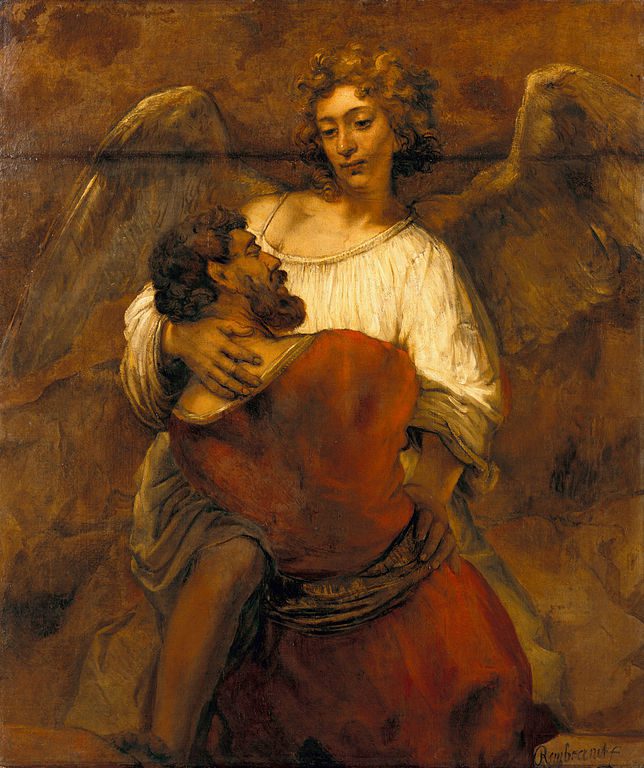
Jacob Wrestling with the Angel by Rembrandt

The Old Testament tells the story of Jacob, who wrestled with an angel all night, refusing to let go until the angel blessed him. In the end, the angel gave him his blessing but also put his hip out of joint. In the church where I grew up, it was said that while Jacob was rewarded for his persistence toward a worthy goal, the injury was his punishment for arrogance – for what some current polytheists call impiety.
Like most good stories, this one has many possible meanings. Blessings – wisdom, enlightenment, magic – do not come easily. The blessings of the really important questions do not come from simply acknowledging their presence. Their blessings come when we wrestle with them: when we propose answers, when we try them on and see how they fit. Their blessings come when we weigh the various answers for strengths, weaknesses, and meaning. Their blessings come when we read and study and meditate and contemplate, and when we discuss our findings with others.
As Jacob’s injury shows, wrestling with Big Questions is not without risk. You may have your assumptions challenged. You may lose your comfortable ignorance. You may be forced to confront parts of yourself you’d rather leave hidden. Initiations – whether in ritual or in the ordinary world – leave you changed. Those changes aren’t always pleasant and sometimes they’re painful.
There is perhaps no bigger question – and no more dangerous question – than that of the gods. What are they? Who are they? What do they offer us, and what do they want in return?
There are many possible answers. If after an appropriate amount of wrestling you’ve settled on one that is meaningful and helpful to you, then I’m happy for you. For any absolutists readers, that doesn’t mean every answer is right. It means this is a Big Question that we can’t answer with certainty. I’ll judge your theology by how it motivates you to be a good person, not by how closely it matches mine.
There are many thoughts on the gods in the Big Tent of Paganism: hard polytheism, soft polytheism, duotheism, pantheism, non-theism. As you try them on, though, remember that we live in a culture dominated by Christianity and by materialism. It is very easy to view the goddesses and gods of our ancestors as variations on the popular view of the god of Christianity: as omniscient and omnipotent and greatly concerned with our well-being. But if there are many gods they are by necessity limited in power and scope.
It’s also easy to view the gods as purely psychological phenomena and believe they exist only as products of our brains. Some forms of Paganism teach this, indirectly if not explicitly. That’s not necessarily a bad thing. I’m reminded of my favorite book subtitle of all time, from Lon Milo DuQuette’s Low Magick: “It’s All In Your Head … You Just Have No Idea How Big Your Head Is.” Even if goddesses and gods are purely psychological phenomena they are still mighty and powerful and worthy of our respect and emulation.
I’m a polytheist, but I’m not concerned with Pagans whose answers differ from mine. As with Christians and atheists and others, I’ll judge their theology by how they live their lives, not by how closely their thoughts match mine.
But I am concerned with two things. I’m concerned with Pagans who fail to wrestle with the questions and thus adopt a view of the gods that is weak and unhelpful. I want Paganism to be a robust religion (or if you prefer, religions) on its own, not just an environmentally friendly version of the mainstream. And I’m concerned with Pagans who profess to be polytheists but who tap out of the wrestling match and fail to consider the implications of multiple deities of limited power and scope.
Morpheus Ravenna – dancer, artist, and defacto high priestess of Morrigan – has an excellent blog post titled Gods with Agency: Ritual theory for polytheists. If you’re a polytheist, go read it in it’s entirety. Read the comments too. Here’s a key quote:
If your Gods are real to you, treat Them like beings with agency. Agency: the capacity of an entity to act. In magical terms, agency is something like will.
If our Gods are real, They have agency. We don’t get to order Them around. We don’t command Them; instead we invite. We don’t dismiss Them when we’re ready to move on; instead we say thank you and goodbye.
If our Gods are real, They don’t disappear outside of ritual space … If our Gods are real, and They have agency, They are making a choice whether or not to respond to our calls. They are making a choice whether or not to engage, to help us, to be present. We can’t be treating them like a tool you put back on a shelf when you don’t need it, and then expecting Them to come and wield Their agency for our benefit!
What would you do if the Gods were real to you?
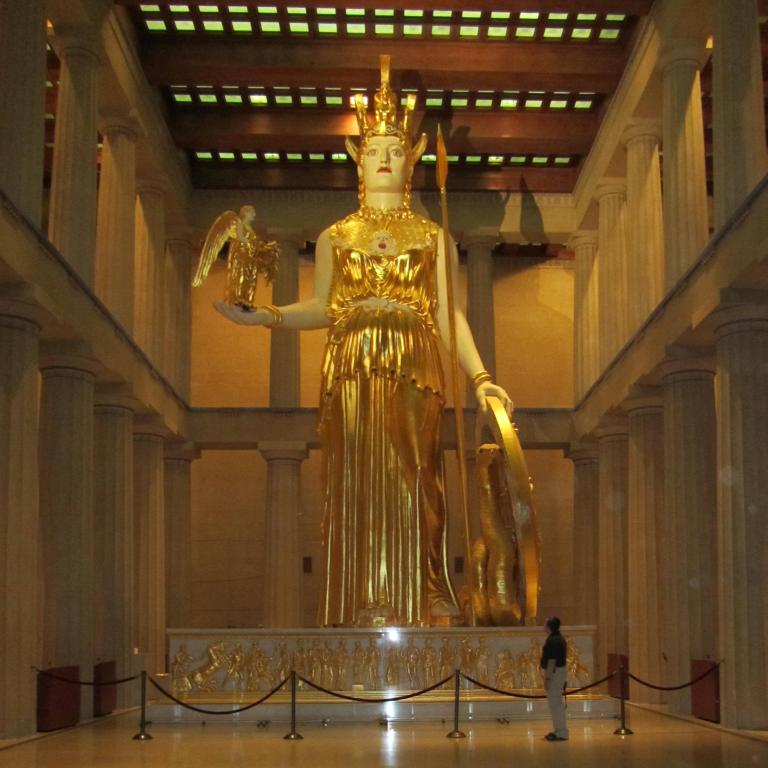
Athena Parthenos
Though my early rituals were heavily influenced by Isaac Bonewits’ work, I also mindlessly copied some other rituals that “summoned” and “dismissed” deities. But when I came to the conclusion that the different experiences I had with different deities meant it was likely they were different beings, I started being more polite in my rituals.
The first time I participated in a Drawing Down ritual, I understood in a very tangible way that the gods – or at least a certain Forest God – have their own ideas and their own priorities. My personal growth was a secondary concern, and my comfort and convenience wasn’t much of a concern at all.
I still struggle with maintaining a reciprocal relationship on a daily basis. My prayers are consistent, but my devotions and offerings aren’t. And I think it’s time for more wrestling – for more diligent work to experience the gods first-hand and to learn more about them in the process.
Like all the Big Questions of Life, the nature of the gods is ultimately uncertain. We can choose to ignore these big questions and carry on with our lives. We can give them some casual thought, then drop them when they lead us to places that are inconvenient.
Or we can wrestle with the gods, in full knowledge that we may be injured and we will be changed, and through our wrestling find answers that bring us meaning and wisdom.
Previous Post

December 15, 2013
Pagan Unity
Next Post

December 20, 2013 A Solstice Walk
Browse Our Archives
Select a Category Books Community CUUPS Druidry Foundations and Context Gods and Goddesses Magic Myth Nature Ritual Spiritual Practice Theology Travel Uncategorized Videos
Select a Month October 2026 September 2026 August 2026 July 2026 June 2026 May 2026 April 2026 March 2026 February 2026 January 2026 December 2025 November 2025 October 2025 September 2025 August 2025 July 2025 June 2025 May 2025 April 2025 March 2025 February 2025 January 2025 December 2024 November 2024 October 2024 September 2024 August 2024 July 2024 June 2024 May 2024 April 2024 March 2024 February 2024 January 2024 December 2023 November 2023 October 2023 September 2023 August 2023 July 2023 June 2023 May 2023 April 2023 March 2023 February 2023 January 2023 December 2022 November 2022 October 2022 September 2022 August 2022 July 2022 June 2022 May 2022 April 2022 March 2022 February 2022 January 2022 December 2021 November 2021 October 2021 September 2021 August 2021 July 2021 June 2021 May 2021 April 2021 March 2021 February 2021 January 2021 December 2020 November 2020 October 2020 September 2020 August 2020 July 2020 June 2020 May 2020 April 2020 March 2020 February 2020 January 2020 December 2019 November 2019 October 2019 September 2019 August 2019 July 2019 June 2019 May 2019 April 2019 March 2019 February 2019 January 2019 December 2018 November 2018 October 2018 September 2018 August 2018 July 2018 June 2018 May 2018 April 2018 March 2018 February 2018 January 2018 December 2017 November 2017 October 2017 September 2017 August 2017 July 2017 June 2017 May 2017 April 2017 March 2017 February 2017 January 2017 December 2016 November 2016 October 2016 September 2016 August 2016 July 2016 June 2016 May 2016 April 2016 March 2016 February 2016 January 2016 December 2015 November 2015 October 2015 September 2015 August 2015 July 2015 June 2015 May 2015 April 2015 March 2015 February 2015 January 2015 December 2014 November 2014 October 2014 September 2014 August 2014 July 2014 June 2014 May 2014 April 2014 March 2014 February 2014 January 2014 December 2013 November 2013 October 2013 September 2013 August 2013 July 2013 June 2013 May 2013 April 2013 March 2013 February 2013 January 2013 December 2012 November 2012 October 2012 September 2012 August 2012 July 2012 June 2012 May 2012 April 2012 March 2012 February 2012 January 2012 December 2011 November 2011 October 2011 September 2011 August 2011 July 2011 June 2011 May 2011 April 2011 March 2011 February 2011 January 2011 December 2010 November 2010 October 2010 September 2010 August 2010 July 2010 June 2010 May 2010 April 2010 March 2010 February 2010 January 2010 December 2009 November 2009 October 2009 September 2009 August 2009 July 2009 June 2009 May 2009 April 2009 March 2009 February 2009 January 2009 December 2008 November 2008 October 2008 September 2008 August 2008 July 2008 June 2008
Follow Us!
TAKE THE
Religious Wisdom Quiz
I used a tent peg and hammer to kill a fleeing enemy commander while he slept. Who am I?
Select your answer to see how you score.
Jael Deborah Delilah Ruth
Related posts from John Beckett
The Gods Are Alive And Speaking

The Call of the Morrigan in 2025

Invoking a God by Sending $1000 to a...
Good Luck To Pope Leo, But I’m A...
TRENDING AT PATHEOS Pagan

The First Eucharistic Controversy: Christ’s Real Presence
For Catholics, the Eucharist is the source and summit of the Christian...

How to Make a Decision When You Can't...
Main point: It’s much more valuable to stay close to God so...

Archdiocese Hosts Military Marriage Retreat in Germany
RASTATT, Germany — The transient military lifestyle, with its frequent deployments and...

Nearly every morning, I make the drive to Detroit with my high-school-age...

The Real AI Story Is Adoption Without Trust
Artificial intelligence has crossed a political threshold. It is no longer a...

A new article, written by Jeff Lindsay and Gale L. Pooley,...
view all Pagan blogs
Ad-Free & Subscriber Log-In Subscription Support
- About Us
- 2026 Calendar
- Videos
- Podcasts
- Library of World Religions
- Faith In Media Tracker
- Advertise With Us
- Write for Us
- Privacy Policy
- Terms of Service
- Do Not Sell My Data
- Contact Us
- Radiant Digital
- Manage Newsletter Subscriptions
- Unsubscribe From Notifications
- Sitemap
Copyright 2008-2026, Patheos. All rights reserved.
Subscription Support Ad-Free & Subscriber Log-In
Follow Patheos