
BuddhistCatholicContemplativeEvangelicalGeneral ChristianHinduJewishLatter-day SaintMuslimNew VisionsProgressive Christian
Beliefs
- Buddhist
- Catholic
- Contemplative
- Evangelical
- General Christian
- Hindu
- Jewish
- Latter-day Saint
- More Voices
- Muslim
- New Visions
- Pagan
- Progressive Christian
Topics
- Religion News
- Food and Religion
- Sports and Religion
- Religious Art
- Religious Music and Entertainment
- Religious Events
- History and Religion
- Style and Religion
- Politics and Religion
- Women in Religion
- Recreation Outdoors and Religion
- Business Finance and Religion
- Careers Workplace and Religion
- Education and Religion
- Family Parenting and Religion
- Health Fitness and Religion
- Home and Religion
- Relationships and Religion
- Technology and Religion
- Travel and Religion
Columnists
- Buddhist Columnists
- Business Finance and Religion Columnists
- Careers Workplace and Religion Columnists
- Catholic Columnists
- Contemplative Columnists
- Education and Religion Columnists
- Evangelists Columnists
- Family Parenting and Religion Columnists
- General Christian Columnists
- Health Fitness and Religion Columnists
- Hindu Columnists
- History and Religion Columnists
- Home and Religion Columnists
- Jewish Columnists
- More Voices Columnists
- Latter Day Columnists
- Muslim Columnists
- New Visions Columnists
- Nonreligious Columnists
- Pagan Columnists
- Politics and Religion Columnists
- Progressive Columnists
- Recreation Outdoors and Religion Columnists
- Relationships and Religion Columnists
- Religion News Columnists
- Religious Art Columnists
- Religious Events Columnists
- Religious Music and Entertainment Columnists
- Sports and Religion Columnists
- Style and Religion Columnists
- Technology and Religion Columnists
- Travel and Religion Columnists
- Women in Religion Columnists
Resource Library
- 2026 Calendar
- Library of World Religions
- The 100 Most Holy Places on Earth
- Patheos Answers
- Podcasts
- Videos
- Faith Leaders Database
- Anglican Episcopalian
- Bahai
- Baptist
- Buddhism
- Christianity
- Confucianism
- Eastern Orthodoxy
- Hinduism
- Holiness and Pentecostal
- ISKCON
- Islam
- Judaism
- Lutheran
- Methodist
- The Church of Jesus Christ of Latter-day Saints
- New Age
- Paganism
- Presbytarian and Reformed
- Protestantism
- Religion Behind the Scenes
- Roman Catholic
- Scientology
- Shia Islam
- Sikhism
- Sufism
- Sunni Islam
- Taoism
- Zen
- See all religions
Research Tools
 Ad-Free & Subscriber Log-In Subscription Support
Ad-Free & Subscriber Log-In Subscription Support
Follow Patheos 

- Trending:
- Forgiveness
- |
- Marriage
- |
- Consciousness
- |
- Death Penalty
- |
- Election
- |
- Halloween

- Home
- Pagan
- Five Ritualists at Dinner
Five Ritualists at Dinner
Last updated on: December 10, 2013 at 5:30 pm by John Beckett
Five Ritualists at Dinner 2013-12-09T21:20:14-06:00 John Beckett
Patheos Explore the world's faith through different perspectives on religion and spirituality! Patheos has the views of the prevalent religions and spiritualities of the world.
From the comments on my last post, both here and (appropriately enough) on social media, I’m far from the only one who has dreams of a Druid college. This isn’t surprising – formal education is prominent in our lives. From the time we’re old enough to leave our mothers for a few hours we’re in school: kindergarten, elementary school, middle school, high school. Many of us go on to college or university and some of us go back again, and again. We’re told that education is the key to a good life and we want the best education for ourselves and our children.
In the world of fiction, who among us hasn’t dreamed of becoming a student at Hogwarts, or the priestess school of The Mists of Avalon, or the Shaolin Temple of Kung Fu, or Miss Robichaux’s Academy for Exceptional Young Ladies?
When we think about Pagan learning we tend to fall back on the models with which we’re familiar. Sometimes those models are helpful and sometimes they’re not. As we consider what institutions the Pagan movement needs – whether physical or virtual – it’s helpful to consider the differences between education, certification, and learning.
[Note – I’m an engineer, not an educator. I’m sure some of you can add some nuance to these layman’s definitions. To the extent that they further the discussion of the main topic, I welcome your contributions in the comments section.]
Education “is a form of learning in which the knowledge, skills, and habits of a group of people are transferred from one generation to the next through teaching, training, or research.” We have several models of education in the Pagan world. There’s a solitary Witch training her successor. There’s a coven introducing its Book of Shadows to a class of dedicants. There’s an OBOD Bard working through his lessons and reporting back to his tutor. There’s a seeker reading Scott Cunningham and trying spells on her own.
These models are different ways of transferring knowledge from a previous generation to the next generation. All of them can work well and all of them can fail miserably: it comes down to the quality of the instructor, the quality of the student, and the compatibility of the two.
Certification “refers to the confirmation of certain characteristics of an object, person, or organization. This confirmation is often, but not always, provided by some form of external review, education, assessment, or audit.” We want a college education but we also want a college degree – certification that says we’ve completed an approved course of study. Without that degree – that certification – you won’t even be considered for many jobs you might otherwise be well-suited for.
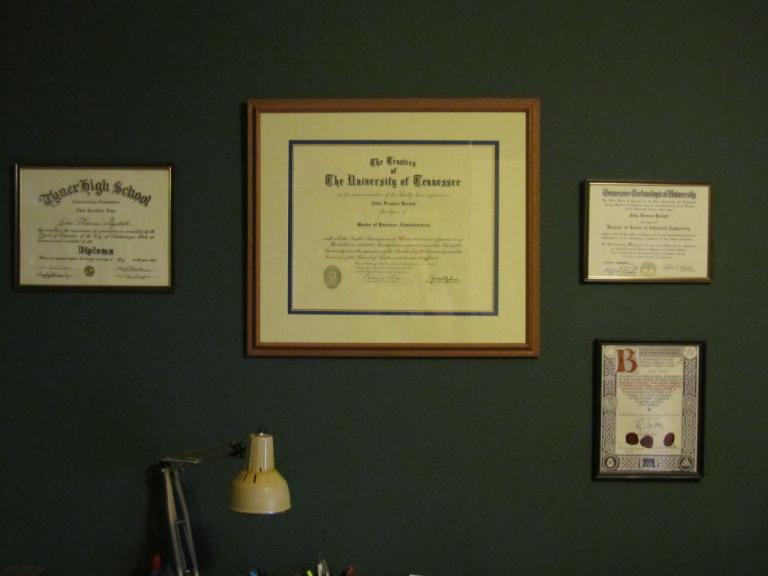 There are certifications in the Pagan world. Traditional Wicca has its lineages. Cherry Hill Seminary offers master’s degrees including the Master of Divinity, the degree awarded by most Christian seminaries for their aspiring ministers. I have a certificate proclaiming I’m “a full member in the Druid grade of the most ancient Bardic and Druid order, the Order of Bards, Ovates and Druids.” If you want to know what I think of that certification, it’s framed and hanging on the same wall with my high school diploma, my bachelor’s degree in Industrial Engineering, and my MBA.
Certifications have their value, as anyone knows who’s ever been confronted with someone who claims to be a high priestess but can’t magic her way out of a wet paper bag. And there is value in the learning that comes from doing the work that leads to a certification.
But if you’ve ever been turned down for a job solely because you didn’t have a degree (or because you didn’t have the right degree), or if you’ve ever hired someone with an impressive degree from an impressive university only to discover after the fact that he couldn’t do the job, you understand the limits of certifications.
For those who are attempting to advance the state of the art of modern Paganism, it’s not a question of certification. Neither is it a question of education. It’s a question of learning.
Learning “is acquiring new … knowledge, behaviors, skills, values, or preferences and may involve synthesizing different types of information … learning may be viewed as a process, rather than a collection of factual and procedural knowledge.” That’s an edited version of a Wikipedia definition, but it emphasizes the point I’m trying to make here. Learning is the process of acquiring new knowledge.
Want to learn to lead good rituals? You can read these posts on what to do, what not to do, what to do differently in large groups and how to add mystery to them. That’s education. Want a more in-depth education? Go read Isaac Bonewits’ Neopagan Rites. Go participate in a dozen rituals by a half dozen different groups. Lead a dozen of your own. You’ll learn. If your effort to do ritual matches your effort to learn about ritual, you’ll get better.
Eventually, though, you’re going to encounter diminishing returns working on your own. Your rituals will be very good, but could they be better still? Could they be more powerful, more meaningful, more worshipful, more magical?
Now imagine inviting five of the best ritualists in the modern Pagan world over for dinner. You discuss ritual theory over soup, logistics and presentation over salad, the symbolism of your tradition over the main course, and your relationship with your gods over dessert. By the time you’re pouring after dinner drinks, somebody’s got a script and a red pen, somebody else is digging in their bag for a book, two people are clearing the furniture out of your living room and the last one is raiding your candle stash. Who wants to cast the circle?
You think after that dinner your rituals are going to take a step up?
You think the other ritualists would learn something too? Think they might go home and tell their friends about it? Maybe write a blog post about it? Maybe a book?
This is the purpose of the Druid college. Not to provide structured education. Not to provide certifications. But to bring knowledgeable and experienced Pagan practitioners together to share what they do best and find ways to do it even better.
Some of this goes on in conventions and gatherings. Some of it goes on in social media. Some of it goes on when four bloggers write on the same topic in close succession… at least when they’re advancing the state of Pagan beliefs and practices and not ranting about how some other Pagan offended them.
Brendan Myers’ new book The Earth, The Gods and The Soul is sitting in my to-be-read pile and at the rate I’m going it will be the Twelve Days of Solstice before I get to it. But Brendan gave a preview of it in Episode 120 of The Wigglian Way podcast. He pointed out three key survivals of ancient pagan philosophy through the Christian era, but then asked if such ideas could not just survive but flourish in the absence of Pagan institutions.
I think it’s safe to conclude … that the answer is ‘no’. To help an idea flourish in a big way, institutions are really, really helpful. [Without them] we do not normally find an ongoing exchange of argument, counter-argument, criticism, counter-criticism, improvement, adaptation, correcting of mistakes, and widening of application.
I want our ideas to flourish. I want our beliefs and practices to flourish. I want the magic that happens occasionally to happen regularly. I want to re-enchant the world.
I want to invite five ritualists over for dinner.

Previous Post

December 8, 2013
Dreams of a Druid College
Next Post

December 12, 2013 Lessons From the Marathon
Browse Our Archives
Select a Category Books Community CUUPS Druidry Foundations and Context Gods and Goddesses Magic Myth Nature Ritual Spiritual Practice Theology Travel Uncategorized Videos
Select a Month October 2026 September 2026 August 2026 July 2026 June 2026 May 2026 April 2026 March 2026 February 2026 January 2026 December 2025 November 2025 October 2025 September 2025 August 2025 July 2025 June 2025 May 2025 April 2025 March 2025 February 2025 January 2025 December 2024 November 2024 October 2024 September 2024 August 2024 July 2024 June 2024 May 2024 April 2024 March 2024 February 2024 January 2024 December 2023 November 2023 October 2023 September 2023 August 2023 July 2023 June 2023 May 2023 April 2023 March 2023 February 2023 January 2023 December 2022 November 2022 October 2022 September 2022 August 2022 July 2022 June 2022 May 2022 April 2022 March 2022 February 2022 January 2022 December 2021 November 2021 October 2021 September 2021 August 2021 July 2021 June 2021 May 2021 April 2021 March 2021 February 2021 January 2021 December 2020 November 2020 October 2020 September 2020 August 2020 July 2020 June 2020 May 2020 April 2020 March 2020 February 2020 January 2020 December 2019 November 2019 October 2019 September 2019 August 2019 July 2019 June 2019 May 2019 April 2019 March 2019 February 2019 January 2019 December 2018 November 2018 October 2018 September 2018 August 2018 July 2018 June 2018 May 2018 April 2018 March 2018 February 2018 January 2018 December 2017 November 2017 October 2017 September 2017 August 2017 July 2017 June 2017 May 2017 April 2017 March 2017 February 2017 January 2017 December 2016 November 2016 October 2016 September 2016 August 2016 July 2016 June 2016 May 2016 April 2016 March 2016 February 2016 January 2016 December 2015 November 2015 October 2015 September 2015 August 2015 July 2015 June 2015 May 2015 April 2015 March 2015 February 2015 January 2015 December 2014 November 2014 October 2014 September 2014 August 2014 July 2014 June 2014 May 2014 April 2014 March 2014 February 2014 January 2014 December 2013 November 2013 October 2013 September 2013 August 2013 July 2013 June 2013 May 2013 April 2013 March 2013 February 2013 January 2013 December 2012 November 2012 October 2012 September 2012 August 2012 July 2012 June 2012 May 2012 April 2012 March 2012 February 2012 January 2012 December 2011 November 2011 October 2011 September 2011 August 2011 July 2011 June 2011 May 2011 April 2011 March 2011 February 2011 January 2011 December 2010 November 2010 October 2010 September 2010 August 2010 July 2010 June 2010 May 2010 April 2010 March 2010 February 2010 January 2010 December 2009 November 2009 October 2009 September 2009 August 2009 July 2009 June 2009 May 2009 April 2009 March 2009 February 2009 January 2009 December 2008 November 2008 October 2008 September 2008 August 2008 July 2008 June 2008
Follow Us!
TAKE THE
Religious Wisdom Quiz
What was the capacity of a bath?
Select your answer to see how you score.
10 liters 22 liters 30 liters 15 liters
Related posts from John Beckett




What We Lose When “Ask AI” Becomes A...
TRENDING AT PATHEOS Pagan

57th Dove Awards Honor Dolly Parton, Crown New...
On gospel music’s biggest night, the 57th annual GMA Dove Awards honored...

The First Eucharistic Controversy: Christ’s Real Presence
For Catholics, the Eucharist is the source and summit of the Christian...

What a Stop Sign Can Teach Us About...
How to Make a Decision When You Can't Hear God Main point:...

Archdiocese Hosts Military Marriage Retreat in Germany
RASTATT, Germany — The transient military lifestyle, with its frequent deployments and...

Nearly every morning, I make the drive to Detroit with my high-school-age...

The Real AI Story Is Adoption Without Trust
Artificial intelligence has crossed a political threshold. It is no longer a...
view all Pagan blogs
Ad-Free & Subscriber Log-In Subscription Support
- About Us
- 2026 Calendar
- Videos
- Podcasts
- Library of World Religions
- Faith In Media Tracker
- Advertise With Us
- Write for Us
- Privacy Policy
- Terms of Service
- Do Not Sell My Data
- Contact Us
- Radiant Digital
- Manage Newsletter Subscriptions
- Unsubscribe From Notifications
- Sitemap
Copyright 2008-2026, Patheos. All rights reserved.
Subscription Support Ad-Free & Subscriber Log-In
Follow Patheos